When an RSVP Deadline Triggers Commitment Anxiety: One Agreement to Try

The RSVP Tab You Keep Slamming Shut
If you got a wedding invite and immediately felt like your relationship was being graded—like you just failed a test you didn’t know you were taking—I want you to know I’ve seen that exact look in people’s eyes more times than I can count.
Taylor (name changed for privacy) came into my café in Toronto on a rainy weeknight with that “I’m fine, obviously” posture—the one where the shoulders sit a millimeter too high. I’d already turned the chairs upside down for closing, but I left one table by the window open, the streetlights turning the wet pavement into a shaky mirror.
They set their phone on the table like it was hot. Not metaphorically. Literally warm from being held and re-checked. Their laptop stayed shut, but I didn’t need to see the screen to picture it: the invite email, the RSVP deadline, the flight tabs, the draft message to their partner rewritten into oblivion.
“It’s ridiculous,” Taylor said, and their laugh landed like a fork hitting a plate. “It’s just a wedding invite. But my chest did the thing. Tight. And my stomach—like a drop.”
They tapped the edge of the espresso cup I’d put in front of them, not drinking yet. “I’m not scared of love. I’m scared of losing my options. Why does a wedding invite feel like a test I didn’t study for?”
I watched their thumb hover over their screen, that micro-flinch right before avoidance kicks in. It reminded me of an old café habit: when the espresso runs too fast, you don’t keep forcing it and pretend it’s fine—you stop, adjust, and begin again. Taylor’s energy felt like that: over-pressured, over-extracted, like their nervous system was pulling bitterness out of something that could be warm.
“A wedding invite can turn your relationship into a pop quiz your nervous system didn’t study for,” I said gently. “And you’re not alone in it. Let’s make this smaller and clearer. We’re not here to predict your whole future. We’re here for one thing: a Journey to Clarity—what old story gets activated, and what’s one step that brings you back to yourself.”

Choosing the Compass: A 4-Card Spread for Commitment Anxiety
I asked Taylor to take one slow breath—nothing mystical, just a clean handoff from spiraling to noticing. While I shuffled, the café did its quiet teamwork: the low hum of the fridge, the soft clink of a spoon against porcelain, the smell of coffee grounds lingering like a hand on your shoulder.
“Today we’ll use the Situation-Obstacle-Advice-Outcome · Context Edition spread,” I told them, placing four cards in a straight line across the table.
For you reading this: I choose this spread when someone’s stress is trigger-driven—like commitment anxiety triggered by a wedding invitation—because it’s concise but psychologically complete. It shows the present reaction, then the older conditioning underneath, then the inner antidote, then a realistic one-step experiment. It keeps the reading focused on self-awareness and actionable advice, not fortune-telling relationship outcomes.
“Card one,” I said, tapping the far left, “is your present reaction—what the RSVP deadline is doing to your body and behavior.”
I tapped the second. “Card two is the old story—the learned script that makes commitment feel like losing your freedom.”
My finger hovered over the third. “Card three is the antidote. The stance that helps you meet fear without forcing a big decision.”
And the last card: “One step this week. Something small, doable, and real.”
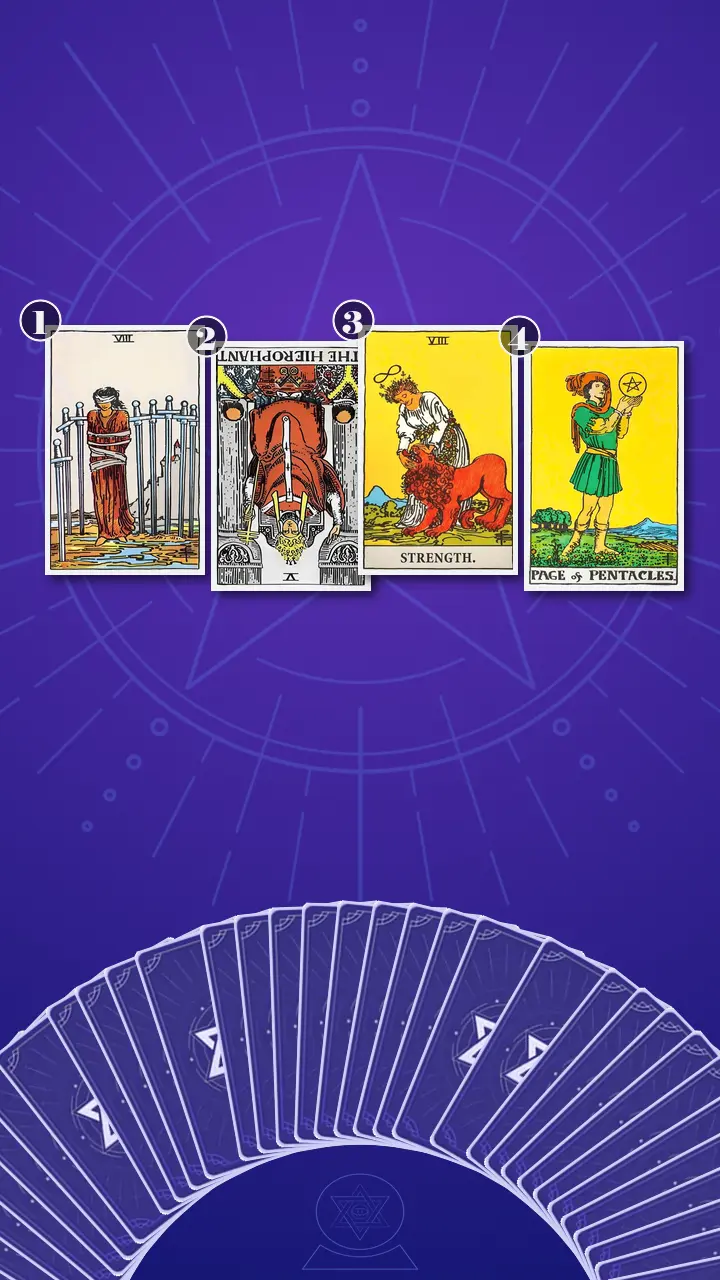
Reading the Map: From Mental Fences to Firm Ground
Position 1: Your present reaction — Eight of Swords (upright)
“Now flipping over is the card that represents Your present reaction: what the wedding invite is activating in your behavior and inner state right now.”
Eight of Swords, upright.
I nodded toward the image. “This is you on your condo couch with the overhead light too bright, the invite email open, three tabs going—flights, hotel, and a draft text to your partner you keep rewriting. Your stomach drops at the RSVP deadline like clicking ‘Accept’ erases your options. So you close the laptop, open Instagram, and start mentally auditing your relationship for flaws so you can feel in control again.”
In the Eight of Swords, the blindfold and loose bindings matter. “The fear feels absolute,” I said, “but it’s not a locked cell. It’s more like a checkout screen—like you’ve already been charged, so you panic-close the tab instead of checking what’s optional.”
Energetically, this is Air in excess: thought spinning into a fence. “Your brain is trying to protect you by narrowing your choices,” I said, “but it ends up making you feel trapped.”
Taylor let out a short, bitter laugh—unexpected, but honest. “That’s… painfully accurate,” they said. “Like, rude.”
Their fingers gripped the cup, then released. Tight. Release. Tight. The body knows the loop even when the mind calls it “research.”
Position 2: The old story — The Hierophant (reversed)
“Now flipping over is the card that represents The old story: the learned belief or conditioning that turns commitment into a threat.”
The Hierophant, reversed.
I didn’t rush. This card can hit a nerve because it’s not about your partner—it’s about the template you think you’re being forced to live inside.
“Here’s the scene,” I said. “A friend posts ‘Future Mrs.’ engagement photos. Your group chat lights up: ‘WHEN’S YOUR TURN??’ You laugh-react, make a joke, and inside something snaps: commitment equals roles, expectations, and a life that gets smaller. You’re not scared of your partner—you’re scared of the script.”
That’s the reversed Hierophant: inherited rules you never consented to. Like default settings you’re expected to keep. Like HR policy language sneaking into your love life—next steps, milestones, alignment—and suddenly it feels like performance review season.
Taylor’s throat bobbed with a quiet swallow. Their eyes flicked to the café door, then back to the card—an old reflex, scanning for exits.
“This is the belief loop,” I said, keeping it clean and non-judgmental. “Trigger: wedding invite. Belief: ‘commitment is a trap and I’ll lose myself.’ Behavior: overthink, compare, avoid future-talk. Short-term relief: no decision today. Long-term cost: intimacy stalls, tension grows, and then the belief feels proven.”
“Oof,” Taylor said softly. “That’s exactly the voice in my head.”
I slid them a napkin and a pen. “Quick micro-exercise. Two lines. No editing.”
They wrote, hand moving fast like they were afraid of being caught: Commitment does not have to mean: rigid roles. Then, after a pause: For me, commitment could mean: choosing each other while keeping our own lives.
Their shoulders dropped a fraction. Not fixed—just less self-blame. A little more curiosity.
“Fear isn’t a no—it’s a request for better boundaries,” I said. “This card says your fear is reacting to the institution-template, not to love itself.”
Position 3: The inner antidote — Strength (upright)
“Now flipping over is the card that represents The inner antidote: the most supportive mindset to meet the fear without forcing a decision.”
The café felt suddenly quieter, like even the espresso machine knew to stop hissing for a second.
Strength, upright.
“This is the moment where you stop trying to solve your relationship like a marketing campaign,” I told Taylor, “and start staying present with what’s real.”
In modern life, Strength looks like this: instead of opening another attachment-style TikTok or a Spotify podcast, you make tea, sit down, and let the discomfort exist for thirty seconds without trying to fix it. Then you send one plain sentence: ‘That wedding invite brought up a lot for me, and I don’t want to dodge it.’ No pitch deck. No conclusion.
I glanced at the crema ring on Taylor’s espresso and then at their hands. This is where my café brain becomes my tarot brain. I call it my Stress Flavor Profile: when we’re afraid, we tend to over-extract—we press harder, longer, trying to force certainty out of life. But over-extraction doesn’t give clarity. It gives bitterness.
“Your mind is over-extracting,” I said. “More tabs. More analysis. More mental rehearsals. Strength is the opposite brew method. Lower pressure. Steady contact. You don’t defeat fear. You hold it.”
You don’t need total certainty to be honest—you need steadiness that can tolerate one uncomfortable conversation.
Setup: It’s 9:18 PM, you’ve opened the invite email for the third time, your phone feels hot in your hand, and your chest tightens like someone just asked you to commit on the spot—even though they didn’t. You’re stuck between “If I speak, it becomes real” and “If I don’t speak, I’m slowly disappearing inside the silence.”
Stop trying to defeat your fear with logic alone, and start holding it gently like Strength holds the lion—firm, present, and unafraid to stay with what’s real.
Reinforcement: Taylor’s reaction came in a chain. First: a freeze—breath held, eyes fixed on the infinity symbol above Strength’s head like they’d forgotten the room existed. Second: the mind trying to fight back—brows pulling together, a flash of irritation. “But if I say it out loud,” they said, voice sharper for a second, “doesn’t that mean I’m signing up for something?” Third: the release—an exhale that sounded like steam escaping a wand, their grip unclenching around the cup. I didn’t argue them out of it. I just stayed steady.
“Saying one true sentence isn’t a contract,” I said. “It’s a temperature check. It tells you what’s alive.” I nodded at their mug. “I use something called a Cup Temperature Scan—not as magic, as a metaphor. If your energy cools the second a topic comes up, it means you’re leaking yourself trying to hold it alone. Strength says: keep warmth by bringing it into the open, gently.”
Then I asked, “Now, with this new lens—can you think of one moment last week when you felt that chest-tightening start, and an honest sentence could’ve made it softer? Not solved. Softer.”
Taylor stared at the table, eyes a little glassy. “On the TTC,” they said. “I was scrolling engagement photos and drafting a message I didn’t send. I could’ve just said… ‘Hey, I’m spiraling. Can we talk this week?’”
That was the shift I wanted for them: not from fear to no fear, but from dread-driven comparison and contracted overthinking to grounded courage—the kind that lets you name what’s real without forcing an outcome.
Position 4: One step this week — Page of Pentacles (upright)
“Now flipping over is the card that represents One step this week: a small, practical action that builds clarity and self-trust without overpromising.”
Page of Pentacles, upright.
“This card is the anti-doomscroll,” I said. “It’s the beginner builder. The one who learns commitment by doing one real, low-drama thing.”
In your life, it looks like this: you and your partner pick one tangible move that doesn’t decide your whole future—RSVP together and choose a budget cap for travel, or put a 30-minute ‘future talk’ on the calendar with one agenda question: ‘What does commitment look like for us right now?’ You write it down. You follow through.
Energetically, the Page is Earth: steady, measurable. “Instead of trying to guarantee you’ll never regret anything,” I told Taylor, “you gather data from reality. Like a tiny A/B test—small, honest feedback.”
The One-Agreement Experiment: Actionable Next Steps for Relationship Clarity
I leaned back and stitched the four cards into one story, because this is where tarot becomes a tool you can actually use.
“Here’s what the map says,” I told Taylor. “The wedding invite didn’t create your fear—it triggered it. The Eight of Swords shows how your mind builds a mental fence and calls it ‘being responsible.’ The Hierophant reversed shows the real engine underneath: an inherited relationship script where ‘serious’ means surrendering authorship. Strength says your way through isn’t more logic—it’s calm presence and one honest sentence. And the Page of Pentacles says clarity comes from one small agreement you can keep.”
“Your cognitive blind spot,” I added, “is treating talking like you’re locking yourself into a permanent verdict. But the transformation direction is different: commitment becomes a chosen container with flexible boundaries, not a point of no return.”
Then I got practical—because anxiety loves vagueness, and relief loves specificity.
- The Two-Sentence Truth (20 seconds to send)Text your partner this week with two sentences: (1) name the trigger, (2) request a small talk. Example: “That wedding invite brought up pressure for me. Can we do a 20-minute check-in this week about what commitment means for us right now?”If you feel the urge to over-explain, don’t. One feeling + one request is the whole practice.
- The Notes-App Reframe (10 minutes, messy on purpose)Open Notes and write two lines: “Commitment does not have to mean ___.” and “For me, commitment could mean ___.” Bring only the second sentence into your conversation.Don’t edit for correctness. Editing is just another way to avoid feeling.
- One Page-of-Pentacles Agreement (30 minutes max)Choose one concrete step with your partner: RSVP together + pick a budget cap for travel, or put a 30-minute “future talk” on your shared calendar with one agenda question: “What does commitment look like for us right now?”Use my “Alertness Scheduling” rule: don’t do this talk at 11:30 PM after doomscrolling. Put it in a time slot when you’re more regulated—like an espresso machine, you work better with maintenance.
Before Taylor left, I offered one last tool from my own world: “If you feel flooded before the conversation, do a 5-Minute Coffee Meditation—smell the grounds, notice your breath, let your jaw soften. You’re training your body to stay in the room. That’s Strength.”

A Week Later: Ownership, Not Certainty
A week later, Taylor messaged me a screenshot—not of a podcast playlist, not of a Reddit thread. A simple calendar invite titled ‘20-min check-in’, and below it, the text they’d sent: “That wedding invite brought up pressure for me. Can we talk this week about what commitment means for us right now?”
They added: “I hit send and felt nauseous for like… ten seconds. Then I felt weirdly calm. We didn’t decide anything ‘forever.’ We just picked a budget cap for the trip and agreed we both want independence and closeness.”
It was clear but not perfect—the kind of clear that still trembles a little. They’d taken one step and then sat alone at a café afterward, phone face-down, just breathing, letting the world stay un-dramatic for once.
That’s what I love about tarot when it’s done well: it doesn’t tell you what you “should” want. It helps you see what story is driving the panic, and it hands you a way back to your own authorship—so you can choose your next move on purpose.
You get to define the container. The container doesn’t get to define you.
When a wedding invite hits your inbox and your chest tightens, it’s not that you don’t want closeness—it’s that part of you is terrified that one honest step forward means the door locks behind you.
If commitment didn’t have to be a verdict—just one small agreement you can shape—what’s the next sentence you’d be willing to say out loud this week?