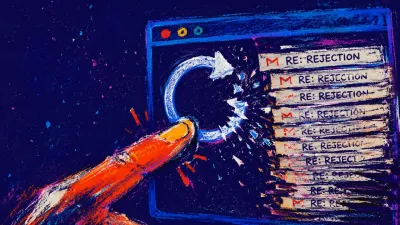
Drafting the 'something came up' text—then choosing one honest line

The Notes App Cancellation Text: Last-Minute Date Canceling in a London Flatshare
If you’re a late-20s London app-dater who’s fine all day… until one hour before the date when your chest tightens and the “I’m about to be exposed” spiral hits (hello, Sunday Scaries but make it dating), I already know the shape of the room you’re sitting in.
Taylor (name changed for privacy) slid into the chair across from me like they were trying not to take up space. Twenty-eight. Junior UX designer. Non-binary. The kind of competent that makes deadlines and stakeholder meetings look easy—until the moment becomes personal and time-bound.
They described 7:03 p.m. on a Friday in their Zone 2 flatshare: bedroom door half-closed, a flatmate’s podcast leaking through the wall, and that sharp little click of the kettle in the kitchen like punctuation. Their overhead light felt too bright. Their phone screen was warm from Google Maps. They kept toggling between the weather app and the restaurant menu, as if one more check would produce certainty.
“I’m not scared of dating,” they said, voice tight in the throat the way a hoodie string gets yanked. “I’m scared of being looked at.”
When they spoke, their hand kept finding the hollow at the base of their neck—pressing, releasing—like they were trying to negotiate with their own body. Shame sat on their chest like a cat that had decided it owned the place: heavy, unapologetic, and making it hard to breathe all the way in.
“An hour before,” Taylor went on, “I draft the cancellation in Notes. I send it right before I’d need to leave. Then I flip my phone face-down like it can’t judge me.” They swallowed, hard. “Relief hits first. Then I feel disgusting. Like… proof that I’m not normal.”
I nodded, slow. “You’re not bailing on the date—you’re bailing on being seen.”
Their eyes went glassy for a second, the way a screen does before it refreshes. I kept my voice gentle and plain. “Let’s make this practical. We’re not here to predict whether someone will like you. We’re here to find clarity about the shame story that makes you disappear—and name one small step you can take even while shame is loud.”

Choosing the Ladder: A Tarot Spread for Pre-Date Anxiety
I invited Taylor to take one slow breath—not as a ritual, not as a spell, just as a clean transition from spiralling in their head to being present in the room with me. Then I shuffled while they held the question: Breakout before a date—what shame story makes me bail, one step?
For this kind of repeating micro-moment—last-minute date canceling, soft-ghosting after canceling, that very specific “I’m about to be exposed” panic—I like a spread that maps mechanism, not destiny.
So I chose the Four-Layer Insight Ladder · Context Edition. A full Celtic Cross would be too much architecture for a single, recurring choke-point. This ladder is lean on purpose: it moves from symptom → trigger → shame root → protector tactic → inner resource → one-step practice. Enough structure to explain how tarot works in context, without pretending the cards owe anyone a romantic outcome.
I explained the layout as I placed the cards: “We’ll read it like descending a staircase. The top row shows what happens right before you bail. The middle row shows why the shame story feels so convincing and what you do to stay safe. The bottom row shows what restores choice—and the smallest next step you can try this week.”
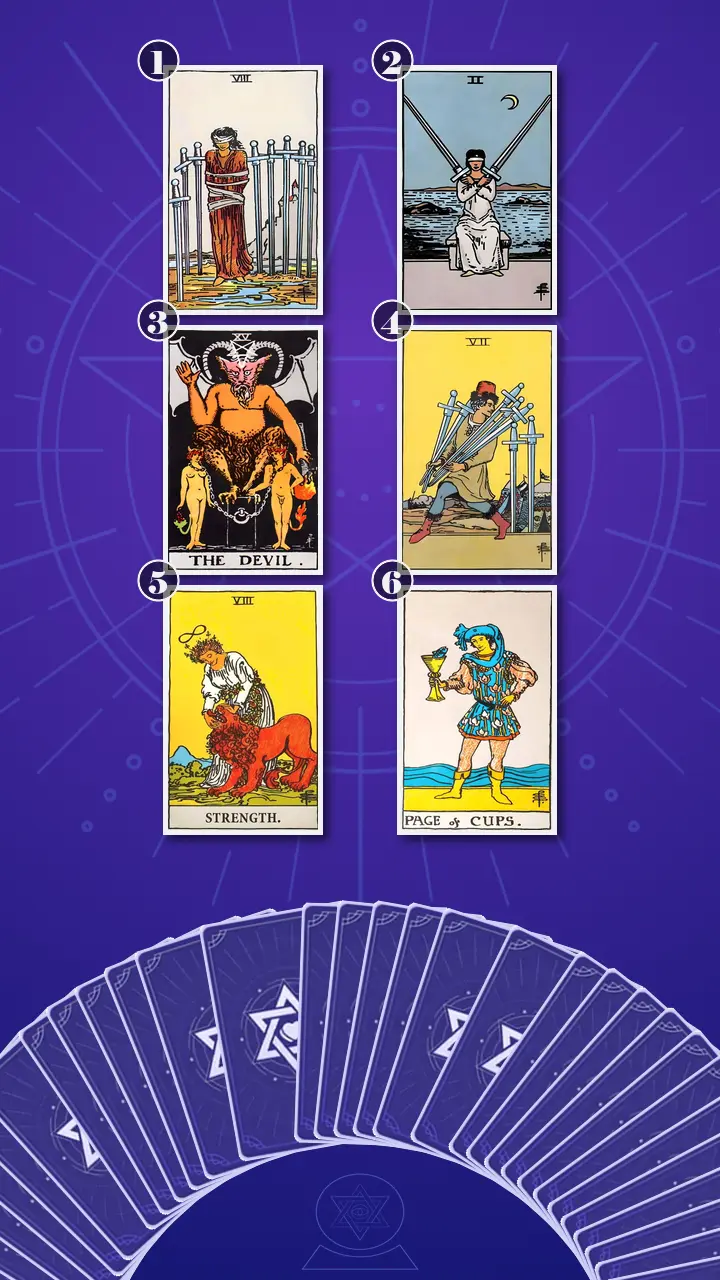
Reading the Staircase: A Map for the Hour Before You Leave
Position 1 — The Pre-Date Freeze in Your Body
“Now turning over is the card that represents your surface presenting pattern: the exact pre-date freeze/withdraw behaviour and how it feels in the body.”
Eight of Swords, upright.
Even before I spoke, Taylor let out a small, cracked laugh—more bitter than amused. “That’s… rude,” they said. “Accurate, but rude.”
I kept my tone warm. “Yeah. The Eight of Swords doesn’t do subtle.”
I described the scene the card mirrors in modern life: You’re in your bedroom in a London flatshare with your coat half on, phone in hand. You’ve checked the route, the menu, the weather—yet you feel like there’s ‘no safe move.’ Your chest tightens, you reread the last text thread like it contains the correct answer, and you freeze in the hallway as if leaving the flat will automatically equal being judged.
“This is Air energy—Swords—at its most contracted,” I said. “Your mind builds a ring of rules around you: I can’t go unless I can guarantee I’ll be liked. I can’t go unless I look perfect. I can’t go unless there’s zero chance of awkwardness. And the wild part is: the bindings in the picture are loose. The trap feels absolute in your body, but it’s being held up by assumptions and self-talk.”
Taylor’s shoulders were still lifted, almost touching their ears. Their breath was shallow and high. I watched the way their foot tapped—a fast metronome—as if the body was already halfway into retreat.
“When this card shows up for pre-date anxiety,” I added, “it’s often because the nervous system is reacting as though being seen equals being harmed. Not logically. Somatically.”
Position 2 — The Trigger That Flips the Switch
“Now turning over is the card that represents your immediate trigger: the moment, cue, or thought that flips your system into shutdown right before you leave.”
Two of Swords, upright.
“This is the exact choke-point,” I said. “The moment you go emotionally offline.”
I grounded it in the modern scenario: You sit on the bed fully dressed, staring at your phone, trying to decide whether to go or cancel based on ‘logic’—but you’ve gone numb. It feels safer to be numb than to feel excited, because excitement would mean you care. The clock forces a decision, and you call the shutdown ‘intuition.’
“Two of Swords is a blockage state,” I said. “Air again—but now it’s guarding the heart. It’s not that you don’t have feelings. It’s that your system decides feelings are too risky, so it clamps down. And then you’re trying to make a decision with zero emotional data.”
Taylor stared at the card for a beat, then looked away, as if eye contact with it might count as admitting something. “I always tell myself I’m ‘protecting my energy,’” they said. “But it’s like… I’m protecting myself from wanting it.”
“Exactly,” I said. “And I want to ask you the question this position is really asking: what’s the exact cue? Mirror? Instagram? A slightly awkward text? A venue change?”
“Instagram,” they admitted. “I check, and it’s like I can see how I’m going to disappoint them.”
“That’s helpful,” I said. “Because it means we can intervene before the cancellation text writes itself.”
Position 3 — The Shame Story Under the Surface
“Now turning over is the card that represents your core shame story: the belief about self-worth and rejection that makes bailing feel necessary.”
The Devil, upright.
The room went oddly quiet, the way it does when a flat suddenly stops making noise and you notice you’ve been listening for it. Somewhere in my mind, I saw the Highlands in late winter—the land holding its breath, not dead, just braced. That’s how shame works too: a bracing that pretends it’s wisdom.
“Shame doesn’t need proof,” I said softly. “It only needs a deadline.”
Then I gave Taylor the verdict metaphor this card demands: “The Devil turns your date into a courtroom. Your brain becomes the prosecutor. It runs an inner monologue like: If they see X, they’ll decide Y, and then it proves Z.”
I nodded toward the card. “In real life, it sounds like: If they see I’m awkward, they’ll decide I’m not worth the effort, and then it proves there’s something wrong with me.”
Taylor’s throat moved in a sharp swallow. Their eyes flicked toward their phone on the table, then away again, like they wanted to escape into a screen but didn’t want to be seen escaping.
“The Devil’s chains are always loose,” I continued. “But the story feels inevitable. You start treating attraction like a verdict. Like one evening could become permanent evidence.”
I let a London-specific detail land, because shame is louder when you feel watched: “In a shared flat, there’s always a witness. A flatmate in the hallway. The kettle clicking. A podcast laugh through the wall. It can make vulnerability feel… public.”
Taylor exhaled, long and quiet. “Yeah,” they said. “It’s like if I go, I’m handing them the power to decide my value.”
“That’s the Devil exactly,” I said. “Desire starts to feel dangerous. And performance becomes a form of bondage.”
Position 4 — The Protector Strategy (Your Signature Exit Choreography)
“Now turning over is the card that represents your protector strategy: the specific way you try to stay safe—what you do instead of going.”
Seven of Swords, upright.
Taylor gave me a guilty half-smile, like they’d been caught mid-sneak. “Oh no.”
I didn’t scold it; I named it. “This is the stealth choreography.”
I spoke the modern translation plainly: You send the vague cancellation text (‘something came up’) at the last possible second so there’s no time for a reply. Then you flip your phone face-down, turn on Do Not Disturb, and avoid opening any apps where you might see their response. Even kindness would feel like evidence you messed up, so you disappear to avoid witnessing their reaction—and your own shame.
“Seven of Swords is control disguised as clean exits,” I said. “It’s not villain energy. It’s protector energy. It’s the part of you that thinks: If I disappear fast enough, I don’t have to see their reaction.”
Taylor laughed again, this time more like recognition than pain. “I literally put on a hoodie and open Netflix. Like… comfort show, autoplay, ‘Are you still watching?’—and I’m like, yeah, I’m still avoiding.”
“That makes sense,” I said. “Tonight’s relief is real. But tomorrow’s cost is real too. Every time you do this, the nervous system learns: I can’t handle being seen. That’s how self-trust erodes.”
Taylor’s fingers hovered over their phone unconsciously, as if checking Focus mode would make the feeling go away.
Position 5 — When Strength Spoke (The Antidote)
I paused before I turned this card. The air in the room felt thicker—like the moment right before a storm decides whether it’s actually going to rain. “We’re turning over the most important card in this reading,” I said. “This is your key transformation: the inner capacity that breaks the loop and restores choice in the moment.”
Strength, upright.
And suddenly the whole spread shifted. Not in a magical way—in a physiological way. The kind of shift I’ve watched in people for decades: the moment their body realises it’s allowed to choose something other than retreat.
“Strength isn’t ‘dating confidence’ like a performance,” I said. “It’s regulated courage. It’s the ability to stay with intensity without running.”
Setup (the last hour): “It’s that last hour: you’re dressed, route checked, phone in hand—then one glance in the mirror or at their Instagram flips the switch and your body goes ‘abort mission.’ Your mind tries to win by overthinking, but your body is already in a clamp.”
Delivery (the line that changes the metric):
Stop treating the date like a trial you must win, and start treating it like a lion you can meet with steady gentleness—Strength is calm courage, not perfect performance.
I let the sentence hang there for a breath. No rushing to soften it. No trying to make it more palatable.
Reinforcement (what it looks like in the body, right now):
Taylor froze in a clean, three-beat sequence. First, a physical stop—breath caught mid-chest, fingers still, eyes fixed on the card like it had said their government name. Second, the thought landed—their gaze went slightly unfocused, as if replaying every moment they’d stood by the front door with keys in hand, already drafting the exit. Third, the release—an exhale that sounded like it came from under their ribs, and their shoulders dropped a full inch like someone had quietly removed a backpack.
“But if I don’t treat it like a trial…” Their voice wobbled with something that was almost anger. “Does that mean I’ve been wrong this whole time? Like I’ve been… sabotaging myself?”
I nodded once. Calm. “It means your protector has been doing its job. And it means you get to renegotiate the job description.”
This is where my family’s way of reading comes in—my Nature Empathy Technique, the thing my Highland elders taught me before I ever touched a tarot deck: people show you the truth through their seasons. And tonight, Taylor’s body was in winter—contracted, conserving, defending. Strength is not spring fireworks. Strength is the first sign the ground will thaw.
“I want to use my Body Signal Interpretation here,” I said. “Because your body’s telling the story before your mouth can. Tight throat and hot face? That’s Fire trying to rise—emotion, exposure, aliveness—while your Air mind tries to control the weather. Strength is Fire in balance: not a blaze, a hearth.”
I offered the practice exactly as the card asked for it, not as a motivational poster: “Set a 3-minute timer. Stand with your keys in your hand—or put your hand on the doorknob. Do one slow exhale and unclench your jaw. Then write, in Notes, one sentence: ‘If I go and feel awkward, what I’m protecting is ______.’ Don’t fix it—just name it. If your chest feels too tight, stop early and do something regulating: water, sit down, window open.”
Then I brought in the two voices, because Taylor had been living inside them for years.
“There’s a Seven of Swords voice,” I said, “that drafts: ‘Something came up, so sorry!’ clean, fast, no conversation. And there’s a Strength voice that says: ‘I don’t need to win tonight; I need to stay with myself.’ Not ‘spark.’ Not ‘be impressive.’ Self-respect.”
Taylor rubbed their jaw as if they’d just realised it was clenched. “I can feel how hard I’ve been holding my face,” they whispered.
“Now,” I asked, gently but directly, “use this new perspective and think back to last week—was there a moment, keys in hand or phone in hand, where this insight would’ve changed how it felt in your body?”
Taylor’s eyes went wet but steady. “Yes,” they said. “Right at the door. I could’ve… just breathed. Even once. Instead of treating it like proof I’m defective.”
“That’s the shift,” I said. “From shame-driven contraction and last-minute avoidance to self-respecting presence and calmer openness to connection. Not a personality makeover. A nervous system choice you can practise.”
Position 6 — The One-Step Practice (Small, Human, Doable)
“Now turning over is the card that represents your one-step practice: a small, doable action or communication move you can try this week to stay engaged—with yourself and with connection.”
Page of Cups, upright.
“This is Water,” I said, “but not dramatic ocean Water. It’s a cup. A sip. It’s emotional honesty in teaspoon doses.”
I gave the modern scenario in plain terms: Instead of engineering a perfect persona, you do one small, sincere relational act. You send a simple line that matches your real capacity—‘Not gonna lie, I’m a bit nervous, but I’m still looking forward to meeting.’ Or, if you need to reschedule, you do it honestly and warmly with a specific alternative time. It’s not a grand confession; it’s human-level truth.
Taylor stared at the Page like it was both comforting and terrifying. “That text makes me cringe,” they admitted immediately.
“Good,” I said, gently wry. “That’s how you know it’s hitting the pattern. The cringe is often just shame trying to keep you in the cage.”
“So I just… send it?”
“You send it,” I agreed. “And you don’t rewrite it twelve times like a Hinge prompt you’ll delete anyway. Version two. Then put the phone down for ten minutes. Let your body learn it can survive honesty.”
From Verdict to Participation: Actionable Advice for Your Next 48 Hours
When I looked at the whole ladder, the story was painfully coherent: Air everywhere at the top—screens, routes, mirrors, clocks, text threads—until the mind becomes a locked room. Then The Devil at the root: the worth-on-the-line narrative that says being seen equals being judged. Then Seven of Swords: the clean escape that prevents immediate discomfort but makes tomorrow heavier. And then, finally, Strength: Fire in balance—embodied self-compassion—followed by Page of Cups: a small, warm, human sentence that turns courage into contact.
The cognitive blind spot was simple and brutal: Taylor kept treating their nervous system’s contraction as evidence that they shouldn’t go. But the cards showed it as evidence that they cared—and that shame had hijacked the success metric.
The transformation direction was equally clear: shift from trying to prevent rejection by disappearing to practising one small, self-respecting act of presence, even if imperfect.
If you’re searching for a tarot spread for pre-date anxiety and last-minute dating self-sabotage, this is why the Four-Layer Insight Ladder tarot spread for pre-date anxiety and last-minute dating self-sabotage works: it doesn’t ask, “Will it go well?” It asks, “What’s the loop, and where can you put one foot on the ground?”
- Doorway Strength Reset (20 seconds)When you’re at the door with keys in hand: exhale longer than you inhale once, unclench your jaw, drop your shoulders, and take one step into the hallway. Your only goal is “move one metre while staying on my own side.”If your chest spikes, don’t argue with it. Do the reset again, then choose a “Minimum Viable Date” plan instead of canceling.
- Teaspoon Honesty Text (60–90 minutes before leaving)Send: “Not gonna lie, I’m a bit nervous, but I’m still looking forward to meeting.” Then put your phone face-down on purpose—not as avoidance, as a boundary—and do something physical for 10 minutes (make tea, wash up, pack your bag).Expect your brain to call this “cringe.” Send version 2 and stop. You’re not obligated to overshare; one honest sentence is enough.
- Minimum Viable Date (30-minute goal)Define success as showing up for 30 minutes. You can leave after that with one respectful line: “I’ve had a nice time—I’m gonna head off, but thank you for meeting.” No dramatic failure narrative required.This is your nervous system’s “MVP.” Not perfect—real enough to learn from.
And because bodies need exits that aren’t shame exits, I offered one of my simplest regulating strategies—adapted for London flat life: “If you start to spiral, do my 5-minute balcony energy awakening practice, even if it’s just a window. Open it. Feel the air on your face. Name your state like a weather report: ‘tight-throat, hot-face, fast-heart.’ No diagnosis. Just data.”
“If the panic is too high,” I added, “use my Shower water-flow meditation technique: two minutes, warm water over hands or wrists, and imagine the shame story sliding off like soap. You’re not fixing your life. You’re re-entering your body.”

A Week Later: Ownership, Not Certainty
A week later, Taylor messaged me: “I did the 30-minute thing. I was nervous the whole walk to the Victoria line. I sent the text anyway. They replied ‘same lol’ and I didn’t die.”
They added, almost as an afterthought: “I still woke up the next morning thinking, ‘what if I was weird?’ But I made coffee and I didn’t punish myself for it. That felt new.”
Clear, but still tender: they’d left the date after forty minutes, polite and steady, and celebrated by sitting alone in a café for an hour—quietly proud, quietly shaky, watching rain bead on the window like proof that soft things can still hold.
That’s what a real Journey to Clarity looks like to me. Not a sudden personality transplant—just the moment you stop treating fear as a verdict and start treating it as weather you can move through, one self-respecting step at a time.
When you’re standing there with your keys in hand and your throat tight, it’s not that you “don’t want love”—it’s that being seen feels like it could become evidence against you.
If you didn’t need tonight to prove anything, what would one small, self-respecting version of “showing up” look like for you—right now, in your actual body and schedule?