From Ringtone Freeze to Grounded Self-Trust: Choosing One Next Step

Finding Clarity in the PATH Entrance Ping
You’re 28, commuting through Toronto, and a ringtone you haven’t used in years makes your stomach drop like you just got bad news—instant nostalgia loop.
Alex said it almost word-for-word the moment she sat down across from me on Zoom, her condo window behind her washed in that pale, end-of-day light that makes everything feel a little too honest. “It’s just a ringtone,” she told me, fingers worrying the edge of a mug, “so why does it hit like that?”
She described Monday at Union Station: iced coffee sweating through the cup, fluorescent lights buzzing, the floor smelling like damp concrete. Someone’s phone cut through the noise with that exact old sound, and her body reacted before her mind could pretend it didn’t. Stomach drop. Throat tightening like she’d swallowed a pebble. A restless, automatic reach—hand already fishing for her own phone like it had a magnet in it.
“And then I lose momentum,” she said, the words coming out clipped like she was embarrassed to admit them. “I’ll be about to do something—send an email, plan my week, even just make dinner—and suddenly I’m in… a past chapter. Replaying. Doing the ‘what-if’ edits. I hate that a tiny sound can derail my whole evening.”
I watched her shoulders hover a fraction too high, as if her neck was doing extra work just to keep her composure upright. The way she described it, the ringtone wasn’t a memory. It was a remote control—and she felt like she’d lost it.
“I get it,” I said, keeping my voice grounded, close-friend gentle. “And I’m not going to treat that ringtone like destiny. We’re going to treat it like information. Today, let’s make this a Journey to Clarity: we’ll map what exactly gets activated, what chapter is replaying, and—most importantly—your next step that doesn’t require perfect closure first.”

Choosing the Compass: The Celtic Cross · Context Edition
I invited Alex to take one slow breath in through her nose and let it out like she was fogging a mirror. Not as a ritual for magic—just a clean transition, a way to tell her nervous system, we’re here now.
Then I shuffled. The sound of the cards was soft and dry, like paper sliding over itself—small, ordinary, steady.
“Today, we’ll use the Celtic Cross · Context Edition,” I told her. “It’s a classic spread, but tuned to your exact wording: the ringtone trigger, the chapter it pulls up, and the next grounded move.”
For you reading this: Celtic Cross is the best fit when a problem needs a clear chain—symptom to root to next step. It helps me trace the present pattern (the moment the ringtone hooks you), the force that keeps it sticky, what’s actually operating under the surface, and then how to turn insight into actionable advice. In this version, Position 4 is defined as the past chapter being replayed, and Position 6 is your next step, so we’re not guessing—we’re answering directly.
“Here’s the map,” I said, and I saw her exhale a little, like she’d been waiting for structure. “The first card shows what the loop looks like in real time. The crossing card shows what intensifies it. The root card shows what’s underneath. And the sixth card—the one to the right—will name the most non-dramatic next step that builds forward motion.”
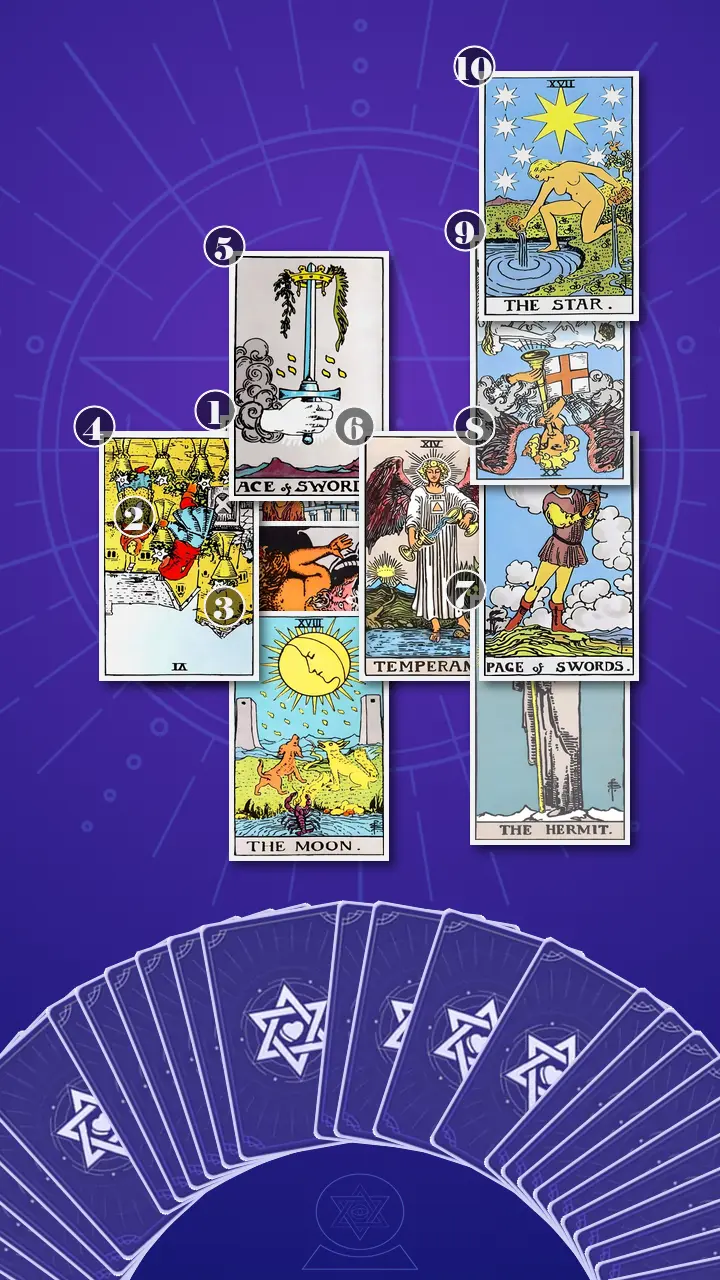
Reading the Map: How Tarot Works in a Trigger Loop
Position 1: The replay loop right now
“Now flipping over is the card that represents the replay loop right now: what the ringtone-triggered pattern looks like in real time.”
Eight of Swords, upright.
Immediately, I thought of her phrase: my hand is already reaching. The Eight of Swords is that moment when your cursor is blinking on a half-written sentence, and the old ringtone hits (from your phone, someone else’s phone, or a video). You freeze—like your attention gets funneled into one narrow hallway. The trap isn’t the ringtone. It’s the corridor your mind automatically walks into.
Energetically, this is blockage—not because you’re powerless, but because your options feel temporarily invisible. The blindfold says, “I can’t see choices right now.” The loose bindings say, “But you can still move.”
Alex gave a small, bitter laugh that surprised even her. “Okay… yeah,” she said, eyes flicking away from the camera. “That’s… kind of brutal. Like, it’s literally a sound, and I act like I have to follow it.”
“I’m going to say something I repeat a lot,” I told her, letting it land without judgment. “A trigger is a cue, not a command. The Eight of Swords is the cue. It’s the moment you forget you’re holding the remote.”
Position 2: What blocks or intensifies the replay
“Now flipping over is the card that represents what blocks or intensifies the replay: the sticky force that keeps the loop running.”
The Devil, upright.
This one is never subtle. In real life, it looks like: the ringtone doesn’t just remind you—it hooks you. Your thumb opens old chats or an old profile like it’s a reflex. It feels like research—like you’re getting clarity—but it behaves like a craving: one more scroll, one more timestamp, one more hit of familiarity.
Energetically, this is excess—too much attachment, too much “I need this to feel safe.” The Devil doesn’t usually show me evil; it shows me a bargain. And Alex’s bargain is painfully modern: familiar ache feels safer than uncertain forward motion.
I named it plainly, because naming breaks spells. “In the first five seconds after the ringtone,” I said, “what are you bargaining for—comfort, certainty, or control?”
Her jaw tightened, then released. “Control,” she admitted. “If I can decode why it still hits, then I’m not… at the mercy of it.”
I nodded. “That makes sense. And it costs you time, presence, and self-trust.” I paused and added, “Phone face down is not avoidance—it’s a choice point.”
Position 3: The deep root beneath the ringtone reaction
“Now flipping over is the card that represents the deep root beneath the ringtone reaction: what’s operating under the surface.”
The Moon, upright.
The Moon is what happens before language. Under the ringtone reaction is a foggy, half-wordless feeling—grief, longing, uncertainty—that your mind keeps trying to translate into a neat explanation. You replay scenes to feel safe in certainty, but the more you force a ‘meaning,’ the more anxious and unreal it feels, like walking a winding path at night while your brain invents shapes in the dark.
Energetically, The Moon is deficiency of clarity but not deficiency of truth. The truth exists—just not in a clean, logical sentence yet. And The Moon asks for a skill most high-achieving people were never taught: tolerance for not-knowing.
“Notice how your body goes first,” I said. “Stomach drop, tight throat, restless hands. That’s Moon-language. Your mind tries to catch up by building a story.”
Alex swallowed. I saw her fingers still, just for a second, as if she’d caught herself mid-scroll.
“And here’s the key,” I added gently. “You don’t need a perfect explanation to take a real next step. Not-knowing for sixty seconds won’t harm you. Chasing certainty for forty-five minutes will.”
Position 4: The past chapter being replayed
“Now flipping over is the card that represents the past chapter being replayed: what kind of past energy is resurfacing and how it distorts the present.”
Six of Cups, reversed.
This is the highlight reel card. The ringtone pulls up the ‘good parts’ first: the version of you (or your life) that felt simpler, sweeter, more certain. You’re not necessarily missing the whole chapter—you’re missing the feeling it gave you: ease, belonging, being known.
Energetically, Six of Cups reversed is imbalance: nostalgia is overfeeding the past and underfeeding the present. Like tasting a sample at Costco until you’re too full to cook dinner. Beautiful, but not nourishing in the way you need now.
Alex’s eyes went glossy—not tears, not exactly. More like her gaze had to travel somewhere far away for a moment. “It’s weird,” she said. “My brain plays it like… Normal People. Just the soft parts. Not the messy parts.”
“Exactly,” I said. “And that distortion makes your current life feel ‘behind’—especially when you add Instagram updates and soft launches and everyone looking like they’re constantly leveling up.”
Position 5: Your conscious aim
“Now flipping over is the card that represents your conscious aim: what you think you need (and what you’re trying to achieve by understanding the trigger).”
Ace of Swords, upright.
Alex didn’t want drama. She wanted clarity. Ace of Swords is that craving for one clean sentence that tells the truth so you can stop treating every trigger like a mystery novel. Instead of “What does this mean?” you ask “What is the pattern?” and you write it down plainly in Notes while you’re waiting for the elevator or the kettle to boil: When I hear X, I chase meaning and lose time.
Energetically, this is balance—the right kind of mental sharpness. Not more analysis. Better analysis. An edit tool, not a courtroom.
I had a quick inner flashback—years ago on a transoceanic cruise, teaching an intuition workshop to a room full of exhausted passengers who’d been doomscrolling through relationship texts at 2 a.m. The ones who did best weren’t the “most spiritual.” They were the ones who could name a pattern without prosecuting themselves for having it.
“Your mind wants to cut through the fog,” I told Alex. “That’s healthy. But we’re going to use the Ace like an editor, not like a detective who never sleeps.”
When Temperance Spoke: Two Cups, One Next Step
Position 6: Your next step
When I reached for the sixth card, the air in the room changed—not spooky, just quiet. Like when a notification finally stops buzzing and you realize how tense your body was.
“Now flipping over is the card that represents your next step: the most grounded, non-dramatic move that interrupts the replay and builds forward motion.”
Temperance, upright.
Setup: Alex was caught in the same tiny moment on repeat: mid-task, ringtone hits, hand moves toward the phone before she even decides—like the past grabbed the remote. And because she values competence, the trigger didn’t just pull memories; it pulled shame for being pullable.
Stop treating the ringtone like a siren pulling you backward; start treating it like two cups you can consciously pour together into a calmer, steadier next step.
She stiffened at first—three micro-reactions in a row. First, a physiological freeze: her breath caught, and her shoulders crept up toward her ears. Then cognition seeped in: her eyes unfocused, like she was replaying a specific moment on the subway, thumb already on the unlock screen. Then emotion arrived: her mouth tightened, and she blurted, sharper than she’d sounded all session, “But if that’s true… doesn’t it mean I’ve been doing it wrong? Like I’m still not over it?”
“No,” I said, gently but firmly. “It means you’ve been trying to buy control with perfect understanding. And your body pays for it first.” I kept my tone non-medical, energy-lens only—because we’re not diagnosing a disorder here; we’re listening to signals. “That tight throat? That shoulder lift? That’s your system bracing. Temperance is asking you to bring circulation back.”
This is where my own toolbox comes in. I’ve spent years doing what I call an Energy Flow Diagnosis—not as a medical claim, but as a pattern: when shoulders and neck lock, attention narrows; when the body softens, choice returns. “Right now,” I told her, “your energy is getting stuck in the throat and hands—swallowing words, grabbing for proof. Temperance reroutes it.”
“Let’s test it,” I said. “Three normal breaths. Feel your feet. Drop your shoulders a millimeter. And picture the two cups as two truths: ‘That chapter mattered’ and ‘I’m choosing this chapter now.’ You don’t have to erase either.”
Her shoulders lowered—not dramatically, but enough that the line of her neck lengthened. She stared at the card, then whispered, almost embarrassed, “Okay. That… feels different. Like I don’t have to win against the memory.”
I let a small pause hang. “Now,” I asked her, “with this new lens: think back to last week. Was there a moment when the ringtone hit and this would have changed what you did in the next two minutes?”
She blinked fast once. “Thursday night,” she said. “In bed. I told myself ‘one more scroll and it’ll click.’ If I’d done… the cups thing? I could’ve just… put it down. Done something tiny. Slept.”
“That’s the shift,” I said. “This isn’t about never being triggered. It’s about moving from being yanked into an old movie to trusting yourself enough to choose the next action anyway. That’s how you go from nostalgic pull to grounded self-trust.”
Position 7: Your stance in this
“Now flipping over is the card that represents your stance in this: how you’re currently relating to the trigger and to yourself.”
The Hermit, upright.
The Hermit is quiet competence—the opposite of performative closure. In modern life, it looks like 15 minutes alone, phone in another room, no input, no friends’ takes, no Reddit threads about “closure is a myth.” Just you and one honest sentence in a notebook.
Energetically, The Hermit is deficiency of noise—and that’s a compliment. You don’t need more opinions. You need your own lantern. A small circle of clarity you can actually live by.
Alex nodded slowly, like her body recognized that before her mind approved it. “I keep trying to talk it out with people,” she admitted. “And then I feel… worse. Like I’m making it a bigger thing.”
“The Hermit says: private honesty is not making it bigger,” I told her. “It’s making it cleaner.”
Position 8: Your environment cues
“Now flipping over is the card that represents your environment cues: what in your surroundings keeps activating the loop.”
Page of Swords, upright.
This is Toronto-in-2026 energy: Slack pings, group chats that never sleep, TikTok audios you didn’t consent to, podcasts autoplaying, notifications designed like tiny hooks. Even if the ringtone is rare, the Page of Swords shows your nervous system is trained to snap to signals. The wind never stops.
Energetically, this is excess mental stimulation. It’s not just “in your head.” It’s in the ecosystem. And that matters, because the best mindset in the world will still struggle in a hurricane of inputs.
“You’re allowed to change the environment,” I told her. “Focus modes aren’t rude. They’re a boundary with your own attention.”
She made a face—half amused, half guilty. “I literally feel bad turning on Do Not Disturb,” she said.
“That guilt is also a notification,” I replied. “You don’t have to tap it.”
Position 9: What you hope for and fear
“Now flipping over is the card that represents what you hope for and fear: the hidden bargain you’re making with the past replay.”
Judgement, reversed.
Judgement is the trumpet—the call. And in your story, it echoes the ringtone perfectly. But reversed, it’s not predicting a cosmic event. It’s showing a psychological pattern: part of you wants the past to stop calling without you having to answer what it meant. Another part fears that answering would require a new identity—self-forgiveness, admitting what you lost, letting go of a version of you that still feels safer.
Energetically, this is blockage through self-criticism. Replay becomes procrastination disguised as processing. And then you judge yourself for still being affected.
“What if answering the call isn’t a rebirth performance?” I asked. “What if it’s a quiet reply?”
Alex’s eyes softened. The shame in her face loosened a notch.
Position 10: Integration direction
“Now flipping over is the card that represents integration direction: what becomes possible when you relate to the trigger differently.”
The Star, upright.
The Star is the opposite of the ringtone. The ringtone is sudden, yanking, demanding. The Star is steady—something you choose to orient toward. In modern terms: a playlist that belongs only to your current chapter, a photo that represents your next step, a nightly walk that tells your body, we’re safe in the present.
Energetically, The Star is renewal through consistency. Not a breakthrough. A baseline shift. Triggers can still exist, and yet they stop defining your direction.
Alex took a fuller breath than she had at the beginning. “That sounds… possible,” she said. “Not perfect. But possible.”
The One-Week Integration Plan: Actionable Advice for the Next 48 Hours
I pulled the whole spread together for her like a story with a clear cause-and-effect, not a moral verdict.
“Here’s what I see,” I said. “In the present, you slip into a narrow corridor of thought (Eight of Swords). The loop is intensified by a compulsive bargain: familiar pain feels safer than uncertain forward motion (The Devil). Underneath, there’s Moon-fog—unprocessed feeling your mind tries to solve like a puzzle. The past chapter being replayed is a highlight reel that makes your present feel behind (Six of Cups reversed). Consciously, you’re aiming for one sharp sentence of truth (Ace of Swords). Your next step is integration, not erasure—two cups poured on purpose (Temperance). Your power stance is quiet inner guidance (Hermit), and your environment is high-input and reactive (Page of Swords). The hidden fear is that ‘answering the call’ requires a dramatic identity rewrite (Judgement reversed). But the direction is gentle healing and self-trust (The Star).”
“Your cognitive blind spot,” I added, “is believing that if a trigger still affects you, you must not be in control—or not ‘moved on.’ That’s not true. Control isn’t never being triggered. Control is choosing what you do next.”
“And the transformation direction is exactly your key shift: moving from treating the ringtone as a message you must decode to treating it as data you can acknowledge—then acting in the present anyway.”
Then I gave her a plan that matched real life: a fast-paced job, a phone always within reach, and a brain that will absolutely try to negotiate.
- The 30-Second “Data-Not-Command” ResetNext time the old ringtone hits (from anywhere), say: “This is a memory cue, not an instruction.” Then place your phone face down for 30 seconds—no unlocking, no searching.If face-down feels impossible, do the minimum version: lock the phone, hold it in your hand, and take three normal breaths before deciding. You’re delaying the investigation, not banning the feeling.
- The 10-Minute Temperance Block (Once a Day)Set a timer for 10 minutes and complete one grounded task with a clear finish line (send one email, wash one mug + wipe the counter, fold five items). No phone until the timer ends.Expect your mind to argue: “But I need to know what it means.” Treat that as part of the loop, not a new assignment. Consistency beats intensity.
- Venetian Aqua Wisdom: Restore Circulation, Restore ChoiceOnce this week, do a “two pours” ritual: pour water or tea slowly into a glass. While pouring, name two things—one lesson you’re keeping from the past chapter, and one behavior you’re not repeating. Take one sip, then do a 5-minute next-step action.This isn’t spiritual theater; it’s nervous system regulation. Like water in Venice, energy moves when it has a channel. Keep it simple, keep it repeatable.

A Week Later: The Quiet Proof
Six days later, Alex messaged me. “Union Station,” she wrote. “Someone’s phone did it—the ringtone. Stomach still dropped. But I literally said, ‘memory cue, not instruction,’ put my phone face down in my tote, and just… walked. Later I did the 10-minute timer and sent the email I’d been avoiding.”
Her follow-up came after midnight, like a small confession: she slept a full night, but in the morning her first thought was still, What if I’m not actually over it? Then, she said, she smiled a little—because this time she knew that thought wasn’t a siren. It was just weather.
That’s the Journey to Clarity I care about: not dramatic closure, but ownership. You’re not erasing the chapter—you’re editing where it lives in your day.
When a tiny sound can flip you into an old movie in your head, it’s not that you’re weak—it’s that part of you is still trying to buy control with perfect understanding, and your body pays for it first.
If you let the ringtone be a memory-cue (not a command) just once this week, what’s the smallest present-tense action you’d want to choose first—before you go looking for meaning?