From Meeting Freeze to One-Line Attribution: A Boundary Practice

Finding Clarity in the 11:02 a.m. Google Meet Glare
If you’ve ever watched someone restate your idea in a meeting, get the nods, and then you spent the next hour drafting a ‘just to recap’ Slack message like it’s damage control—welcome to workplace credit anxiety.
Taylor (name changed for privacy) took my call from a Toronto condo kitchen table, the kind that’s always half work zone, half real life. They’d pulled their laptop close like it could protect them. I could hear a kettle click off in the background, that tiny domestic punctuation that somehow makes a work meeting feel even more exposed.
“It keeps happening,” they said. “I’m not trying to be dramatic, I just want it to be accurate.”
As they described Wednesday’s 11:02 a.m. Google Meet, I could see it without seeing it: the screen glare drying your eyes out; the pen clenched so hard your fingers ache; your idea leaving your mouth like a careful, useful thing—then sliding across the table and attaching itself to someone else’s name. Two minutes later someone repeats it louder, in cleaner leadership language, and the room responds to them like they just invented oxygen.
Taylor’s body told the truth before their words did: tight jaw, throat narrowing, a hot rush up the cheeks, shoulders braced like they were about to take impact. Anxiety, but not the abstract kind—more like trying to swallow around a throat that’s turned into a straw.
“In the moment, I freeze,” they admitted. “Then after, I write this… novel of a recap. Like if I timestamp it hard enough, reality will snap back.”
They wanted fair recognition for their work. But they were terrified that claiming credit in real time would make them look petty, difficult, not a team player. The contradiction sat between us like a muted mic icon: wanting clarity, fearing the social cost of saying the one accurate sentence.
I leaned in, gentler than my radio voice but just as steady. “We can work with that,” I said. “Not by turning you into a confrontational person. By helping you find one clean boundary that your nervous system can actually execute in the room. Let’s draw a map through the fog—toward clarity.”

Choosing the Compass: The Transformation Path Grid for Meeting Credit Swaps
I always start my sessions with something practical that looks simple from the outside: a breath, a pause, a reset. Not as a mystical ritual—more like switching a song from shuffle to a deliberate track. “Before we pull cards,” I told Taylor, “take one inhale through the nose, slow. Exhale like you’re lowering your shoulders by one inch.”
While they breathed, I shuffled. The sound of the cards—papery, rhythmic—reminded me of cueing a segment live on air. You don’t get infinite takes; you get one clean entrance.
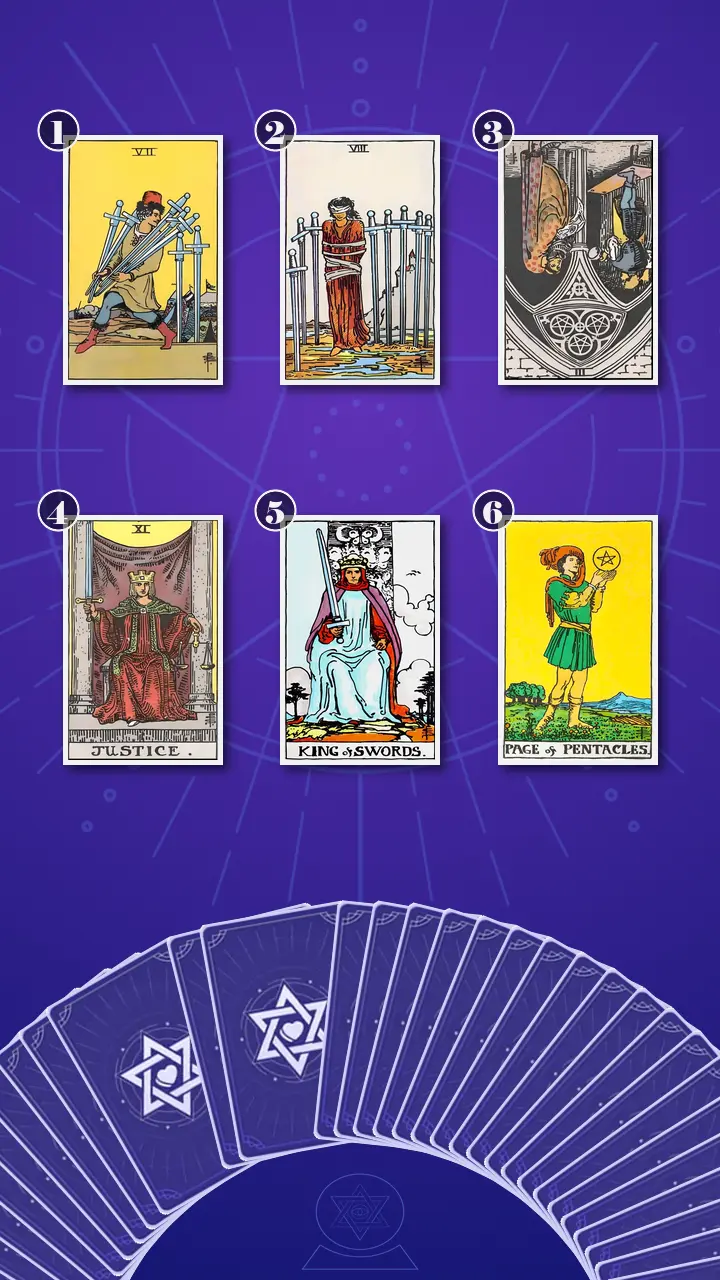
“For this,” I said, “I’m using a spread I call the Transformation Path Grid (6) · Context Edition.”
To you reading along: this is the smallest tarot spread that still gives a full work-boundary map without turning the reading into a prediction. Taylor’s question is practical—meeting credit swap, what boundary helps me speak up, what’s my next step?—but it’s also cyclical: credit gets fuzzy → they freeze → they ruminate and send a long recap. This six-card grid lets me name (1) what’s happening, (2) what blocks their voice, (3) the root pattern, then pivot into (4) the key shift, (5) the boundary strategy, and (6) the next step for integration.
The layout matters, too. Three cards on top—analysis. Three cards beneath—enactment. It’s like stepping down from overthinking into action.
“We’ll start with the surface reality,” I said, “then go straight to the body-level block. And we’ll end with something you can do this week—small, boring-on-purpose, repeatable.”
Reading the Map: Where the Story of Your Idea Gets Assigned
Position 1 — The meeting dynamic as it’s actually being played
“Now we’re turning over the card that represents the surface reality of the meeting credit swap—what’s actually happening in the room,” I said.
Seven of Swords, upright.
There’s a reason this card makes people squint. It’s not a cartoon villain card. It’s a card about strategy, plausible deniability, narrative control.
I grounded it in Taylor’s modern life without softening it: “This is exactly like what you described,” I told them. “You share a thoughtful design idea in a fast cross-functional Zoom. Someone else repeats it with cleaner ‘leadership language,’ and suddenly it becomes their idea in the room’s memory. They don’t exactly lie—they control the framing.”
Energetically, this isn’t excess emotion or a lack of talent. It’s a context where the loudest recap becomes the story. That backward glance in the card? That’s the vibe of: I can take this and still pretend it’s just ‘building on.’
Taylor let out a small laugh that had no humor in it. “That’s… painfully accurate. Like, I almost wish it were more malicious, because then I’d know what to do.”
“Yeah,” I said, keeping my tone calm. “This card explains why you feel so stuck. You’re not reacting to a clean conflict. You’re reacting to something slippery enough that calling it out feels like you’d be ‘making accusations’ instead of clarifying facts.”
Position 2 — The block that keeps your voice from showing up in real time
“Now we’re turning over the card that represents the specific block that stops you from speaking up when credit shifts,” I said.
Eight of Swords, upright.
When I see this card in a work-boundary reading, I don’t think “you can’t.” I think: your body is treating social discomfort as danger. A microphone that technically works—while your nervous system refuses to go live.
“This is the freeze you described,” I said, and I made it a micro-scene, because Taylor needed their experience mirrored back in HD: “Your cursor hovers over the unmute button. You can already predict the micro-reactions—someone’s pause, a forced laugh, the ‘okay, sure’ tone. Your jaw tightens, your throat feels smaller, and you decide it’s safer to stay quiet.”
I watched Taylor swallow. Their eyes went slightly unfocused, like their brain was replaying last week’s call.
“And then,” I continued, following the exact inner monologue structure that keeps people trapped: “If I say it now, I’ll sound insecure.If I wait, I’ll feel resentful.If I don’t say it, I’m teaching them it’s okay to erase me.”
That’s the Eight of Swords energy in blockage: a deficiency of perceived options. Not because options aren’t there—but because the blindfold is social-risk forecasting.
Taylor’s fingers tightened around their mug, then loosened. “It’s wild,” they said quietly. “I’ll spend an hour polishing a Slack message to avoid ten seconds of awkwardness.”
“And that makes perfect sense,” I replied. “Your system is trying to keep belonging intact. But it’s costing you clarity.”
Position 3 — The deeper root: the system problem disguised as a personal problem
“Now we’re turning over the card that represents the deeper root pattern—the belief or team dynamic that makes this repeat,” I said.
Three of Pentacles, reversed.
“This is the collaboration card,” I told Taylor. “And reversed, it’s not ‘teamwork is bad.’ It’s teamwork without clear standards—roles, owners, attribution norms. It’s a Jira board with tasks but no assignees. Everything belongs to everyone until it belongs to the person who speaks last.”
I tied it directly to their lived behavior: “Your team values collaboration, but there’s no consistent habit of naming who contributed what. So you start keeping receipts in a private doc because the system doesn’t reliably name craft.”
Energetically, this reversal shows a blockage in shared structure: not enough visible scaffolding for credit. In that vacuum, Taylor’s silence gets misread as consent—because the system rewards whoever controls the story.
Taylor nodded, and the embarrassment shifted into something clearer—annoyance, maybe even grief. “I keep thinking if I just do better work, it’ll fix itself,” they said.
My voice went softer. “That’s the unseen craftsperson story. And it’s exhausting.”
When Justice Spoke: Turning “Do They Like Me?” into “Is This Accurate?”
Position 4 — The key shift that changes the whole system
I held the next card a beat longer than usual. The condo kitchen hum—fridge, distant traffic—seemed to get louder, like the room was waiting for the chorus to drop.
“Now we’re turning over the card that represents the key shift—the principle that makes speaking up possible and grounded,” I said.
Justice, upright.
Justice isn’t about being harsh. It’s about being clean. Scales and sword: balanced tone, one clear truth. And in a meeting credit swap, that translates into something profoundly unsexy: accuracy as a standard.
I felt myself slip into my on-air analyst mode for a second—the part of me that can say, plainly, what a segment is actually about. “Taylor,” I said, “this isn’t a vibes conversation. It’s an accuracy conversation.”
Setup (the moment you know too well): You know that split second on a fast Zoom when you share an idea, someone repeats it louder with slightly different words, and your throat tightens as you watch the room nod—like the ownership just quietly changed hands. You get trapped trying to find a perfect sentence that won’t get you labeled difficult.
Delivery (the sentence that needs to land):
Stop waiting for permission to be ‘nice’; start using a fairness standard—like Justice’s scales and sword—to name ownership clearly and move on.
I let the line hang in the air the way I let a lyric hang right before a beat returns—long enough for the nervous system to catch up.
Reinforcement (what I saw happen in Taylor’s body): First, a physiological freeze: their breathing paused mid-inhale, like their chest forgot the next step. Second, the cognitive seep-in: their eyes dropped to the card, then drifted slightly to the side, as if they were replaying a meeting in their head but with a new script on the subtitles. Third, the emotional release: a slow exhale, shoulders lowering by a fraction, and a tiny shake of the head—half relief, half disbelief.
“But if I do that,” they said, and there it was—an unexpected flash of anger under the fear—“doesn’t it mean I should’ve been doing it all along? Like I let it happen?”
I didn’t rush to comfort them out of the feeling. I stayed with it. “It means you did what your system thought would keep you safe,” I said. “And now you’re renegotiating the safety contract.”
Then I brought in my signature lens—because Justice isn’t only mental; it’s embodied. “Can I ask you something a little weird?” I said. “What did you listen to after the last meeting where this happened?”
Taylor blinked. “Uh. I put on lo-fi. Like… ‘focus beats.’ And then I doom-scrolled LinkedIn for twenty minutes.”
“That tracks,” I said gently. “This is one of my tools—Music Pulse Diagnosis. Your recently played songs are like a stress ECG. Lo-fi ‘focus’ after a meeting often means: your brain is trying to sand down an emotional spike by going numb and productive. It’s not wrong. But it also tells me your nervous system needs a repeatable rhythm for the moment you speak.”
I tapped the Justice card lightly. “Justice isn’t asking you to become louder. It’s asking you to become consistent—so the room learns the norm.”
I looked them straight on. “Now, using this new lens, think back to last week: was there a moment where one factual line—said once—would’ve changed how you felt walking away from the call?”
Taylor didn’t answer immediately. Their mouth opened, closed. Then: “When my manager said, ‘Great idea, Jordan,’ and Jordan had just repeated what I said.” Their face flushed again, but this time it wasn’t only embarrassment. It was clarity arriving with a sting.
“Right there,” I said. “That’s the pivot from workplace credit anxiety into accuracy-based self-advocacy. Not a personality transplant. A new standard.”
The King’s Mic-Check: A Boundary You Can Say Without Apologizing
Position 5 — The boundary that helps you speak up
“Now we’re turning over the card that represents the boundary that helps you speak—how to frame it so it stays professional,” I said.
King of Swords, upright.
I love this card for modern meetings because it’s the opposite of spiraling. The King doesn’t over-explain. He doesn’t try to be liked. He isn’t performing confidence—he’s applying a standard. Like a well-written PRD: clear, specific, not emotional.
“This is your posture and tone boundary,” I told Taylor, and I made it concrete: “Shoulders down. Voice steady. Short sentence. Immediate return to agenda. Loudness isn’t authority—clarity is.”
Then I gave them the line, conflict-free and repeatable, the way you’d correct a shared doc rather than call someone out:
“Quick clarify—when we say X, that was the approach I proposed earlier. Happy to share the rationale.”
Taylor sat up straighter without meaning to—exactly the resonance I look for with this card. Their jaw unclenched, then tried to clench again, like an old reflex.
I added the rule that turns this from a nice idea into a boundary: “Say it once. Say it clean. Then move on.”
“Because,” I continued, “hinting is not a boundary. A sentence is.”
And then I brought in my other signature tool, the one that makes speaking up physically doable: “This is where I use Breath Soundtrack,” I said. “You don’t need a confidence pep talk. You need a rhythm you can follow when your throat tightens.”
I taught them a quick pattern: inhale for 4, hold for 2, exhale for 6. “Your line goes on the exhale,” I said. “Not because it’s spiritual—because your voice steadies when the exhale is longer.”
The Page’s Boring Magic: Making Owners Visible Without Making It Weird
Position 6 — The next step you can take this week
“Now we’re turning over the card that represents your integration step—what you can do this week to reinforce the boundary,” I said.
Page of Pentacles, upright.
After all that Air—strategy, freeze, language—this card is Earth. Keyboard clicks. A shared Google Doc highlight. Something tangible that makes reality harder to distort.
“This isn’t you building a courtroom case,” I said. “It’s you building a light system. Owners, decisions, next steps. Boring on purpose.”
I pictured it as I spoke: Taylor volunteering to take notes, the cursor blinking in the shared doc while the meeting is still happening, the little chime when someone comments, the faint relief of seeing names next to actions. Not secret receipts—shared alignment.
Taylor’s voice got quieter. “I can do that,” they said. “That feels… less scary than calling someone out.”
“Exactly,” I said. “Documentation is support, not a substitute for speaking. But paired with one sentence in the room? It becomes a norm.”
The One-Page “Accuracy-First” Plan: Actionable Advice for Your Next Two Meetings
I summarized what the grid had shown us in one clean storyline, because clarity isn’t a pile of insights—it’s a sequence you can follow.
“Here’s the arc,” I told Taylor. “The Seven of Swords shows a context where credit is handled strategically—whoever frames it last often ‘owns’ it. The Eight of Swords shows your body reading real-time correction as social danger, so you go quiet and try to fix it later. The Three of Pentacles reversed says the deeper issue is structural: collaboration without clear attribution norms. Justice is the turning point—switch from ‘Do they like me?’ to ‘Is this accurate?’ The King of Swords gives you the voice: one calm line, no apology tour. And the Page of Pentacles makes it stick through a lightweight system: owners visible in writing.”
“Your cognitive blind spot,” I added, “is thinking you need perfect wording or perfect proof before you’re allowed to be clear. But the transformation direction is the opposite: from hinting and post-meeting documenting to one calm, factual, real-time sentence—then a simple process.”
Then I gave Taylor the next steps, structured like meeting hygiene, not a personality overhaul:
- Save your one-sentence credit clarity scriptIn your Notes app or Slack saved items, create a snippet titled “Credit clarity line.” Pick one version: “Quick clarify—when we say X, that was the approach I proposed earlier. Happy to share the rationale.”If your chest tightens, use the smallest version: “To build on my earlier point about X…” It still counts.
- Use it within 10 seconds—then move the meeting forwardIn your next meeting, say the line once within 10 seconds of the credit swap, then immediately ask a forward-moving question: “And for next steps, should I take the first pass on X?”No-extra-explanation rule: one sentence of clarification, then back to the agenda. No apology, no backstory.
- Make owners visible in shared notes (Page of Pentacles move)Volunteer once to capture notes in the shared doc and add “Owner:” next to each decision/task in real time. Afterward, send a two-sentence recap: (1) Decision + owner. (2) Next step + owner.Keep it boring on purpose. The more neutral it is, the less it reads as keeping score.
Before we ended, I offered a sound-based support plan—not as a cure-all, but as first aid for the throat-jaw lockup.
“This is my White Noise First Aid for the night before a high-stakes meeting,” I said. “Ten minutes of steady rain or pink noise while you do the 4–2–6 breathing. Not to ‘manifest’ anything—just to teach your body that calm is available.”
Then I added a BGM Prescription—three tracks Taylor could use as anchors for different moments (pre-meeting, post-meeting, and the ‘I have to speak’ moment). I didn’t turn it into a performance. I kept it functional: one track with a steady tempo for rehearsing the one-liner out loud, one for decompression without doom-scrolling, one for sleep.
“We’re not trying to eliminate discomfort,” I said. “We’re trying to make discomfort survivable enough that you can stay accurate.”

A Week Later: The Quiet Proof
Six days later, Taylor texted me a screenshot: a shared doc with three neat lines—Decision, Owner, Next step, Owner. Underneath, one message: “I said the line. My voice shook a tiny bit, but I didn’t explain. I went straight back to the agenda. No one argued. My manager just nodded and kept going.”
They added, almost like they didn’t want to jinx it: “After, I didn’t write a novel recap. I sent two sentences and closed my laptop.”
It wasn’t a movie ending. It was better—small and real. Clear but still tender. Taylor went to a coffee shop after work and sat alone for an hour, not celebrating exactly—just letting their shoulders unbrace, noticing how strange it felt to be proud and a little sad at the same time.
In my head, I heard the studio rule I’ve lived by for years: you don’t need to fill every silence. You just need to hit your mark and trust the structure. That’s what this Journey to Clarity was, in the end—moving from workplace credit anxiety and self-silencing into calm, accuracy-based self-advocacy. Not louder. Not meaner. Simply more exact.
When your idea gets repeated back to the room with someone else’s name attached, it’s not just annoying—you can feel your throat tighten because you’re choosing between belonging and being accurate in real time.
If you treated attribution like a normal accuracy check (not a personal confrontation), what’s the smallest one-sentence clarification you’d be willing to try the next time the moment happens?