From Headphones-as-Armor to Skill-Based Safety: Tiny Reps in Public

Finding Clarity in the Low-Volume Commute
If you’re a 20-something woman in NYC who puts your headphones in the second you hit the sidewalk—then keeps the volume low so you can still listen for everything (hello, hypervigilance).
Taylor (name changed for privacy) arrived with her tote still looped around her wrist like an anchor. She was 27, an early-career product designer, the kind of person whose calendar holds more Slack huddles than lunch breaks. She sat down and immediately tucked one leg under the other, as if her body wanted fewer edges exposed.
“It’s embarrassing,” she said, not looking embarrassed exactly—more like determined to stay composed. “The AirPods go in before I even think about it. I’m listening to music, but I’m not really listening to music.”
As she spoke, I watched her jaw do what jaws do when they’ve been asked to hold a secret for too long: it clenched, released, then clenched again—like a door that never fully latches.
She described 8:46 a.m. on the downtown 4/5/6 platform: fluorescent lights buzzing; the metallic smell of the tracks mixing with somebody’s burnt coffee; the window reflections that make it easy to check who’s behind you without turning your head. AirPods in before the train arrives. Volume low. Eyes flicking, not wild—precise. Like she was doing “threat math” while wearing a neutral face.
“I want to feel relaxed and present,” she said. “But if I relax, that’s when something happens. And then it’ll be my fault for not noticing.”
That core contradiction sat between us like weather: wanting ease, fearing ease will make you lose control.
I’ve lived long enough to know that when someone says they’re “fine,” their body is often telling the truth underneath the word. In my family, we call it listening for the season beneath the sentence. Taylor’s season, right now, was late-winter vigilance—everything braced, everything ready, even when nothing is actively attacking.
“Headphones in—music on—nervous system on call,” I said gently. “I don’t hear ‘dramatic’ in what you’re describing. I hear a system that learned it has to stay online to get you through normal places.”
I let that land for a moment, then added, “Let’s make this a Journey to Clarity. Not ‘how do I force myself to relax,’ but: what is this protecting… and what’s one step you can take that doesn’t require a personality transplant?”
Choosing the Map Panel: The Transformation Path Grid (6) · Context Edition
I asked Taylor to take one slow inhale—nothing theatrical—and then an exhale that was just a little longer. Not a ritual for luck. A transition for the nervous system: a way of telling the body, we’re focusing now.
As I shuffled, I named the method out loud: “Today I want to use a spread I designed for questions exactly like this—deep inner work, practical next steps. It’s called the Transformation Path Grid (6) · Context Edition.”
For readers who wonder how tarot works in situations like hypervigilance: I’m not using these cards to predict whether the subway will be chaotic next week. I’m using them like a system diagram. The spread gives us a chain: the visible coping behavior → what locks it in place → the deeper driver underneath → the turning point → one realistic practice → how you’ll recognize integration when it’s working.
That’s why this spread fits Taylor’s question—“Headphones in—what is my hypervigilance protecting, one step?” It keeps the logic tight. It doesn’t turn into fortune-telling; it turns into a map.
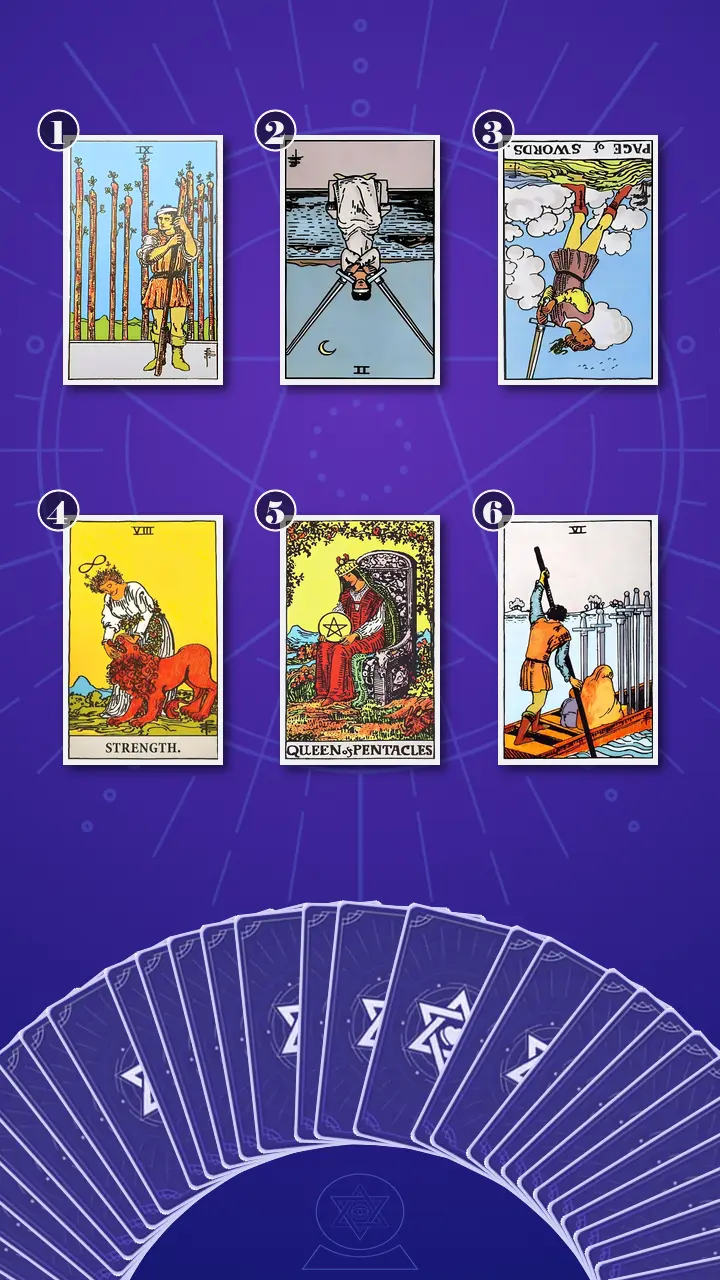
I pointed to the layout as I placed the cards in a simple 2x3 grid. “The first card names the day-to-day pattern. The second shows the main blockage—what keeps the loop running even when it’s exhausting. The fourth is the turning point, the antidote. And the fifth is your one-step practice—something small enough to try in real life, on a Tuesday, without anyone needing to know.”
The Guard Who Never Clocks Out
Position 1: Surface pattern — what the headphones-in hypervigilance looks like day-to-day
“Now flipped over,” I said, “is the card that represents your surface pattern—what this looks like in real life, and what it’s trying to manage in the next 60 seconds.”
Nine of Wands, upright.
The image is a person standing guard with a bandaged head, gripping a wand too tightly. Behind them, wands form a barrier—protective, but also isolating.
I connected it to her world using the simplest translation: “You step into the subway car with earbuds in like a uniform you put on for public life. You’re technically ‘fine’—but you’re braced: bag gripped, body angled, eyes scanning reflections. The headphones send ‘don’t approach me,’ while your nervous system stays on shift, expecting the next jolt.”
Energetically, this is Fire in a state of excess—protective heat that never cools. The Nine of Wands isn’t weakness. It’s endurance. It’s the part of you that says, I can get through this, even if it costs you.
Taylor let out a short laugh—one of those sounds that’s half humor, half salt. “That’s… painfully accurate,” she said. “Like, brutal.”
Her fingers pinched the side of her tote strap, then relaxed. I clocked the micro-movement: the smallest proof that being seen can loosen the body, even for a second.
“You’re not ‘too sensitive,’” I told her. “You’re just running a security system with no off switch. The question isn’t ‘why am I like this?’ The question is: what did your system learn it has to prevent?”
Position 2: Primary blockage — the belief or reflex that keeps the pattern locked
“Now flipped over,” I said, “is the card that represents the primary blockage—the immediate ‘nope’ that snaps you back into scanning.”
Two of Swords, reversed.
In the picture, a blindfolded figure holds two swords crossed over their chest. Even the ocean behind them looks held in place, like emotion paused mid-wave.
Here’s how it speaks in modern life: “At a crowded café or open office, you keep headphones on but you’re not choosing peace—you’re stuck in an in-between. You want ease, but you also don’t want to miss a cue. So you freeze in micro-decisions: volume up? volume down? move seats? stay? The tension leaks through as irritability and mental replay later.”
This is Air in blockage. Not clear thinking—stuck thinking. The reversed energy says the stalemate is cracking. Avoidance isn’t holding. Information leaks in anyway, so you end up with the worst of both settings: you’re not soothed, and you’re not fully present.
I used the split-screen I often use for city hypervigilance—because it’s exactly what it feels like:
Outer screen: AirPods in. Face neutral. Figma open. “I’m in focus mode.”
Inner screen: Track footsteps. Map exits. Clock the laugh that sounds too sharp. Rehearse what you’ll do if someone taps your shoulder. Toggle between transparency mode and noise canceling like an emotional metaphor—never landing on a setting that feels safe.
“It’s like you’re working a second job called don’t get caught off guard,” I said. “And it’s unpaid. It just bills your body.”
Taylor’s eyes went distant for a beat—not dramatic, just unfocused, as if she was replaying a café moment: chair scrape, flinch, then immediate face-smoothing to look normal. Then she nodded once, slow.
“Yeah,” she said quietly. “And I hate how much energy it takes to look… chill.”
Position 3: Root driver — what this hypervigilance is ‘for’ underneath the behavior
“Now flipped over,” I said, “is the card that represents the root driver—what this vigilance is protecting, underneath the headphones.”
Page of Swords, reversed.
The Page is a watcher. Upright, curious and alert. Reversed, that alertness turns jittery—information becomes compulsion.
Translated into Taylor’s life: “Walking home or riding the train, your mind becomes a live risk assessment: tracking distances, tones, sudden movements, and ‘vibe shifts.’ You’re not enjoying music or your thoughts—you’re gathering data to avoid being caught off guard. The more you monitor, the less safe you feel, because the monitoring itself keeps the alarm system running.”
This is Air in excess—too much wind. Not a breeze that clears your head, but gusts that keep slamming doors. It’s the feeling of having fifteen browser tabs open “just in case,” your brain using RAM on threats that aren’t even happening.
And here’s the protection hidden inside it: if you can collect enough data, you can avoid being surprised. If you avoid being surprised, you can avoid shame. You can keep the curated, composed image intact.
I glanced at Taylor’s shoulders again. They were lifted—not high, just permanently a few millimeters above rest, like her body didn’t trust chairs to hold it.
“Can I offer you my most practical lens?” I asked. “I call it Body Signal Interpretation. Your jaw and shoulders are doing a constant low-level startle response. That’s not a moral failing. That’s your body saying, I’m preparing for impact. Your mind is using scanning to try to justify the preparation.”
I paused. “If scanning actually worked, wouldn’t you feel better by now?”
Taylor swallowed. Her thumb rubbed the pad of her index finger—another small self-soothing motion she didn’t seem to notice. “I do feel… worse,” she admitted. “Like I can’t turn it off.”
“Right,” I said. “So the next step isn’t more surveillance. It’s building the part of you that can handle discomfort if it shows up.”
When Strength Spoke: A Different Kind of Protection
Position 4: Turning point — the inner resource that makes safety feel internal
Before I turned the fourth card, the room got noticeably quieter. Not because anything mystical happened—because Taylor stopped moving. Her hands went still on her lap, like her body knew we were about to touch the nerve at the center of the loop.
“Now flipped over,” I said, “is the card that represents your turning point—what ‘having your own back in real time’ can look like.”
Strength, upright.
On the card, a woman holds a lion—not with force, but with calm hands. The lion isn’t destroyed; it’s softened.
In Taylor’s life: “The turning point is the moment you notice the urge to scan—and instead of obeying it, you lead yourself. You soften your shoulders, lengthen your exhale, and remember: you can handle discomfort in real time. Awareness stays, but it becomes a choice rather than a compulsion.”
Strength is Fire in balance—warmth that steadies instead of scorching. Courage that doesn’t perform. A kind of inner leadership that says, I can be here, even with intensity.
Setup: You know that moment on the train when your playlist is playing but you’re not hearing it—because part of you is tracking every movement and trying to look normal at the same time? That’s the exact moment your nervous system thinks safety is something you earn by staying tight.
Stop trying to ‘out-hear’ and ‘out-see’ every risk; start strengthening your inner steadiness—like Strength holding the lion with calm hands.
There was a pause after I said it—an intentional one. I’ve watched words bounce off armored people for decades. A pause gives a sentence a place to land.
Reinforcement: Taylor’s reaction came in a chain—three small movements, like weather shifting.
First: a freeze. Her inhale stopped halfway in, her eyes widening just enough to catch the light. Her shoulders tensed as if preparing to argue with the idea.
Second: the mind trying to reroute. Her gaze slipped off the card and unfocused, as if she was scrolling through her own internal footage—platforms, elevators, gym mirrors, the exact moment her stomach drops when footsteps speed up behind her.
Third: the release, but not a neat one. Her exhale came out shaky, like air finally leaving a room that’s been over-pressurized. Her jaw softened—barely five percent, but it was visible. She pressed her lips together, then gave a small, frustrated head shake.
“But if I stop scanning,” she said, voice sharper with emotion than with logic, “doesn’t that mean I’ve been doing it wrong the whole time?”
I didn’t rush to soothe that. Her question deserved respect.
“No,” I said. “It means you did what worked when you didn’t have other tools. Hypervigilance is not stupidity. It’s intelligence pointed at the wrong job. The upgrade is this: Protection can be a skill, not a scan.”
I leaned in slightly, keeping my tone practical. “Strength doesn’t ask you to be fearless. It asks you to stay present with intensity without escalating it. And we can train that—quietly, invisibly, in real life.”
I glanced again at her body—my old Highland lens. “Your shoulders are your early-warning system. Your jaw is your boundary guard. When they tighten, that’s not a command to scan harder. That’s a message: lead me.”
Then I asked the question that turns insight into a memory: “Right now, with this new lens, can you think of one moment last week—on the subway, in the office, in an elevator—where you could have done one tiny Strength rep instead of doubling down on scanning?”
Taylor blinked fast, then nodded. “Yesterday,” she said. “In the Sweetgreen line. Someone got too close and I… I did the whole calm face thing while my brain was yelling.”
“Perfect,” I said. “Not perfect as in ‘good job,’ but perfect as in: real. That’s where this practice lives.”
This card marked the emotional shift I wanted for her: from braced vigilance and split attention to skill-based safety and calmer internal steadiness. Not a promise of a danger-free city—just a nervous system that doesn’t have to work overtime to survive Tuesday.
Earth Before Air: Making the Next Step Socially Invisible
Position 5: One-step practice — the smallest realistic experiment you can run this week
“Now flipped over,” I said, “is the card for your one-step practice—what tells your body ‘we’re supported’ before your mind starts scanning.”
Queen of Pentacles, upright.
This Queen is all Earth: grounded posture, steady hands, a sense of warmth you can touch. She’s not performing calm. She’s inhabiting it.
Her modern translation is beautifully unglamorous: “Your one-step practice looks boring in the best way: body-first safety. You slow your pace by 5%, put both feet on the floor, choose a seat that supports your back, hold something warm, and let your jaw unclench. You set boundaries from comfort, not from panic—so the need to scan drops a notch.”
This is where my Elemental Balance lens becomes useful. Taylor’s spread began with Fire (defense and endurance) and overactive Air (monitoring, stalemate, mental scanning). The Queen of Pentacles doesn’t argue with Air. She grounds it. She says: Earth first. Body first. Then thoughts become navigation, not alarms.
I watched Taylor’s shoulders lower a fraction as I spoke about feet inside shoes and the weight of keys. That’s not symbolism—that’s physiology responding to permission.
“This is my favorite kind of practice,” I told her. “Because nobody on the MTA has to know you’re doing it.”
Position 6: Integration — how you’ll recognize it’s working (a felt sense, not a prediction)
“Now flipped over,” I said, “is the card that represents integration—how it feels when this is working in the real world.”
Six of Swords, upright.
A small boat crossing water, carrying what it carries—no denial, no erasure—toward calmer shores.
In modern life: “Integration feels like commuting without a constant internal briefing. You still notice your surroundings, but your thoughts aren’t shouting. You can remember the actual song you played. You move through the city with flexible boundaries—and your nervous system gets to clock out more often.”
This is the kind of hope I trust: not fireworks, but quieter water. As I often say, especially to city women who are tired of being told to “just relax”: Calmer waters doesn’t mean zero awareness—it means less inner shouting.
The Reroute: Actionable Advice for the Headphones-as-Armor Loop
I pulled the whole story together for her, the way I’d explain it to any reader standing at a career crossroads or a nervous-system crossroads—someone who’s high-functioning, but chronically braced.
“Here’s the logic your cards told,” I said. “You’ve been living as the Nine of Wands: functioning, but on duty. The Two of Swords reversed shows the lock: you try to look calm while your system refuses to fully settle—half shut down, half monitoring. The Page of Swords reversed is the engine underneath: a live risk-assessment brain that confuses more information with more safety. Strength is the antidote: protection through calm self-leadership. And the Queen of Pentacles makes it practical—safety you can touch, in the body, so your mind doesn’t have to run constant surveillance.”
“Your cognitive blind spot,” I continued, “is thinking that preventing every possible threat is the same thing as being safe. But your key shift—the one your spread is asking for—is different: shift from trying to prevent every possible threat to practicing how you will support yourself if discomfort shows up.”
“That’s why we used the Transformation Path Grid (6) · Context Edition,” I added. “It doesn’t demand you stop having boundaries. It helps you stop paying for those boundaries with your jaw and your shoulders.”
Then I offered the next steps—small, specific, and designed to be used on subways, in open-plan offices, in elevators. Not a self-help production. A reroute.
- The 90-Second Strength Rep (before the headphones)The next time you enter a shared space (MTA platform, office door, gym lobby), pause for 90 seconds before you hit play: drop your shoulders once, unclench your jaw, and do 3 breaths where your exhale is longer than your inhale.If you feel silly or rushed, shrink it to one long exhale only. The win is noticing—not fixing.
- The Scan-to-Skill Swap (once per day)The first time you catch yourself checking reflections/exits or monitoring someone’s distance, stop scanning for 10 seconds and feel your feet inside your shoes. Then choose one deliberate action on purpose: keep walking, change cars, step aside, or put headphones in/out consciously.Use the phrase: “Swap one scan for one regulation rep.” It keeps the practice clean and fast.
- The 2-Minute “Water-Flow” Reset (after exposure)When you get home, do a micro-reset before your brain starts replaying. If you’re showering, let the water hit the back of your neck and imagine it rinsing off the “on-duty” posture. If you’re not showering, wash your hands slowly and feel the temperature change as a signal: you’re leaving guard mode.This is my go-to “Shower water-flow meditation technique.” Keep it absurdly simple. Two minutes is enough to teach your body there’s an off-ramp.
I added one last practical permission, because it matters: “This isn’t about forcing yourself into situations that feel unsafe. Headphones are allowed. Panic isn’t required. The point is choice, not proving something.”

A Week Later: The Quiet Proof of Calmer Waters
A week later, Taylor messaged me at 7:52 p.m.—right around the time the city gets sharp at the edges.
“I did the Strength rep on the platform,” she wrote. “I still wore my AirPods. But I actually heard the chorus of the song. Like… I noticed it. And my jaw didn’t hurt when I got home.”
It wasn’t a victory parade. It was something better: a small internal exhale she could measure.
Later in the message she added, “I’m not cured or whatever. I still did the one-earbud-out thing in the elevator today.” Then: “But I asked myself if it was armor or enjoyment—and I chose on purpose. That felt new.”
That’s what I consider a real Journey to Clarity: not the absence of vigilance, but the beginning of self-leadership. From braced vigilance and split attention to skill-based safety and calmer internal steadiness—one breath, one shoulder-drop, one conscious choice at a time.
We’ve all had that moment where you’re trying to look unbothered in public, but your jaw is locked and your attention is split between ‘act normal’ and ‘don’t miss anything.’
And if you want a structure for your own next step, this is exactly what the Transformation Path Grid (6) · Context Edition is for: naming the loop, finding the turning point, and turning it into something you can practice in real life.
If you didn’t have to prevent every possible moment from going sideways—what’s one tiny way you’d like to practice having your own back when discomfort shows up?