From Emergency-Contact Dread to Mutual Support: A One-Text Shift

Emergency Contact Field Anxiety, Lit Up by a Blinking Cursor
If you can run a whole sprint plan in Figma and Slack but the “Emergency contact” field makes your jaw lock and your hands freeze, you’re not being dramatic—you’re hitting a family script (hyper-independence).
Jordan (name changed for privacy) sank into the chair across from me like she’d been holding herself upright all day on pure calendar invites and iced coffee. She’s 29, a product designer downtown, the kind of person who can make a messy problem feel solvable for everyone else.
She described the exact moment that sent her spiraling: 8:47 PM on a Tuesday in her Toronto condo living room, laptop open to an onboarding PDF. The cursor blinked in the “Emergency contact” field like a tiny metronome counting down. The screen glow felt too bright. The fridge hum sounded obnoxiously loud. Her phone was warm in her hand from “just checking one thing,” and her hands hovered over the keyboard like they’d forgotten how to type.
“It’s just a form,” she said, and I watched her swallow like the words had edges. “But it makes me feel weirdly exposed.”
She told me she cycles through names like she’s ranking them in a spreadsheet—reliability, closeness, inconvenience—then freezes. Sometimes she leaves it blank and closes the tab. Sometimes she types her mom’s name just to get it done, without texting first, and then feels resentful and weirdly small afterward.
I could hear the core contradiction under every sentence: she wants a chosen, adult support system—something mutual and real—but she’s scared that needing help will disappoint people or make her look unreliable. And the dread wasn’t abstract. It was physical: a tight throat, a jaw that clamps, a small chest clench, fingers going cold over a blank line. Like her body was trying to hold a door shut while her life kept knocking.
“I’m great in a crisis for other people,” she added, almost annoyed at herself for saying it out loud. “But I don’t know who I’d call for mine.”
I nodded, letting that land without trying to fix it too fast. “Okay,” I said softly. “Let’s not treat that blank box like a test you can fail. We’ll treat it like a signal. We’re going to map what old role gets activated—and what one small, practical step would start rewriting it. A real Journey to Clarity, not a motivational speech.”
Choosing the Compass: The Transformation Path Grid (6)
I’m Alison Melody—radio host by day, tarot reader by choice, and someone who trusts nervous systems more than perfect explanations. Before we touched the cards, I asked Jordan to take one breath that was just for her. Not “deep” in an Instagram way—just slower than whatever her day had been.
I shuffled while she held the question in her mind: Emergency contact field—what old family role runs me now, one step? I keep my setup simple. The point isn’t mystique. It’s focus—like turning down the volume on the whole city so you can finally hear one instrument.
“For this,” I told her, “I’m using a spread I like for modern life admin triggers: Transformation Path Grid (6) · Context Edition.”
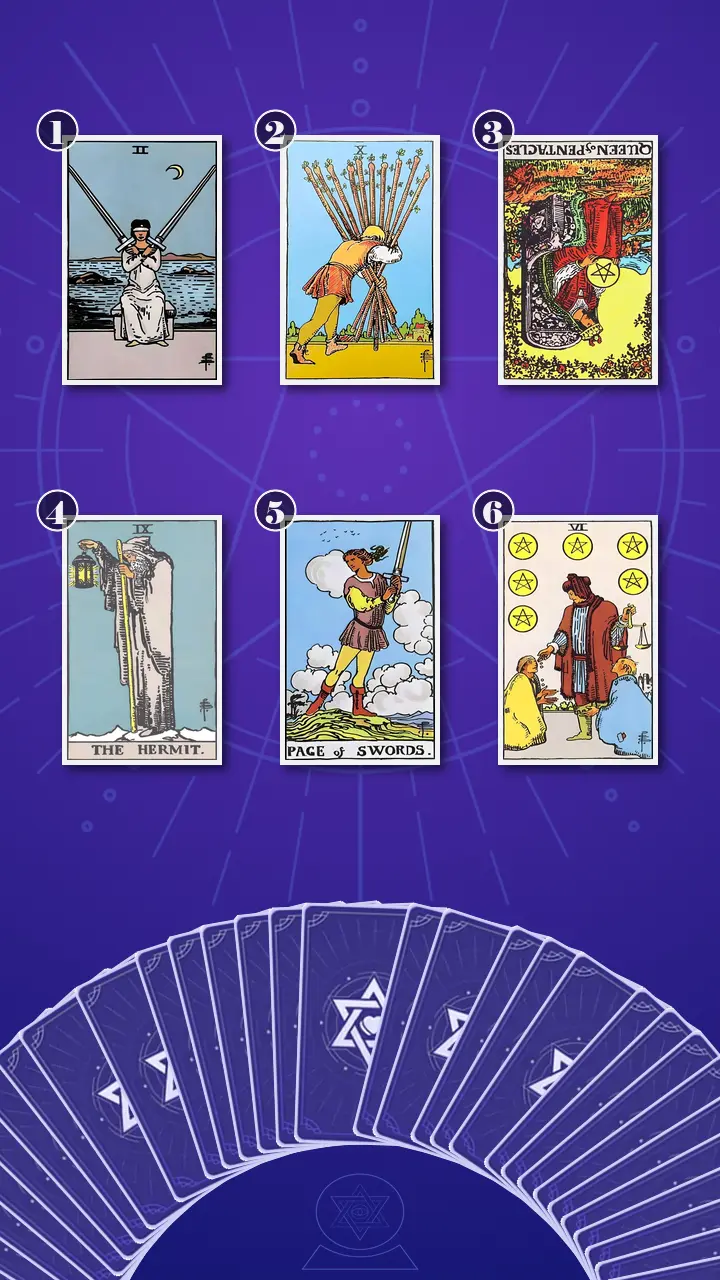
To you, reading this: the reason I choose a tight six-card spread here is because this isn’t a prediction problem. It’s a pattern problem. A bigger spread like the Celtic Cross would add noise—more cards, more angles, more opportunities to intellectualize. This grid keeps the arc clean: the surface freeze (1) → the active pressure habit (2) → the inherited family script (3) → the turning-point perspective shift (4) → one doable action (5) → what integration looks like when you practice it (6).
I pointed to the layout on the table—a 2×3 grid. “Top row is surface → pressure → root. Bottom row is catalyst → one step → integration. We read it like a practical map. No fate language. Just: here’s what happens, here’s why, and here’s what to do next.”
Reading the Map: The Freeze That Pretends to Be “Just Admin”
Position 1 — The Immediate Freeze: Two of Swords (upright)
“Now we flip the card that represents the immediate present-state reaction to the emergency-contact prompt—the observable freeze,” I said.
Two of Swords, upright.
I didn’t have to reach for metaphor; the card was already living in her week. “This is like you staring at the ‘Emergency contact’ field while your cursor blinks like a countdown,” I said, echoing what she’d told me. “You run through names, not based on closeness, but on who won’t make it awkward. And then you go numb, grab your phone, and tell yourself you’ll finish it after dinner.”
In energy terms, the Two of Swords is blockage through self-protection. Not laziness. Not a lack of friends. A protective system that says: If I don’t choose, I can’t be rejected. If I don’t ask, I can’t misread the relationship.
I tapped the blindfold in the image with my nail. “That blank line isn’t a test of your social life—it’s a test of an old role. Your mind tries to keep you dignified by not looking directly at the messy truth: you want reciprocal support, and you don’t want to be the only adult in your life who never gets to need anything.”
Jordan let out a small laugh that wasn’t humor so much as relief with teeth. “That’s… painfully accurate,” she said. “Like, rude.”
“I know,” I said, and kept my tone kind. “The Two of Swords can feel brutal because it shows how fast we turn emotion into a logistics problem.”
Position 2 — The Active Block: Ten of Wands (upright)
“Now we flip the card that represents what is actively blocking a simple choice—the habit that turns paperwork into pressure,” I said.
Ten of Wands, upright.
“This one,” I told her, “is your main choke point.”
Its modern-life translation is almost too clean: the moment Jordan considers asking a friend, her brain frames it as dumping weight on them. She feels responsible for having a perfect safety plan without involving anyone else—so she either leaves the field blank or defaults to family. It’s not that she has no one; it’s that she carries the whole concept of support like a private workload.
Ten of Wands is excess—too much duty, too much “I’ll handle it,” too much invisible labor. It’s carrying every grocery bag in one trip to prove you can, then resenting the whole walk upstairs.
I used the scene-analogy that always hits in Toronto. “It’s like you’re on the TTC with a laptop bag, a tote, and ten invisible bags of ‘I should have this handled.’ And while you’re juggling all that, you’re still texting other people, ‘You got this.’”
I paused so she could find herself in it. “Your inner monologue is: If I ask, I’m adding weight. If I don’t ask, I’m ‘fine.’ But look at the cost: being ‘fine’ keeps you un-askable. Over-functioning is a way of staying un-askable.”
Her shoulders dropped the tiniest amount, like a bag sliding off one strap. She exhaled slowly—one of those exhale-sighs that says, Oh. I thought this was just my personality.
Position 3 — The Root Script: Queen of Pentacles (reversed)
“Now we flip the card that represents the old family role or conditioning that still runs the system—the inherited script underneath the block,” I said.
Queen of Pentacles, reversed.
In a lot of readings, the Queen of Pentacles is the steady, practical nurturer. Reversed, that care can tip into a kind of self-erasure—where being useful becomes the proof of worth, and needing anything feels like breaking the rules.
I gave her the day-in-the-life montage the card practically demanded. “You’re the one with the spare charger, the snack, the calendar invite, the backup plan,” I said. “People text you when they’re spiraling because you’re calm, organized, unshakeable.”
Then I cut to the blank line. “And then there’s this emergency-contact field, and suddenly it’s like: I can be useful. I don’t get to be needy.”
Queen of Pentacles reversed is care turned into control. Not control like manipulation—control like: If I keep everything running, no one can accuse me of being a burden. It’s competence as armor.
Jordan’s throat moved—an involuntary swallow. Her jaw flexed, then unclenched. That flinch of recognition was exactly what I’d expected: admin freeze connected to identity, not logistics.
“In my family,” she said quietly, “I was the one who… kept things from getting worse.”
“That’s the card,” I said. “The Provider/Caretaker archetype, reversed. Nurturing becomes self-neglect. Competence becomes the substitute for being cared for.”
I’ve hosted enough late-night radio to know what it sounds like when someone is about to say something honest but doesn’t yet trust it. In the studio, it’s the moment right before a caller admits, I haven’t told anyone this. On my old show notes, I used to write: Wait for the quiet. Don’t fill it. So I didn’t.
When the Hermit Lifted the Lantern
Position 4 — The Catalyst: The Hermit (upright)
“We’re flipping the turning point now,” I said. “This card represents the perspective shift that interrupts the old script—where awareness and self-trust can enter.”
The room felt quieter the second the card turned, like the city outside agreed to lower its volume for a beat.
The Hermit, upright.
Its modern-life translation is simple and, honestly, merciful: instead of forcing the ‘correct’ choice, Jordan pauses. She notices the jaw tension, the shame flare, the urge to pick the safest default. Then she asks a different question: “Who do I actually trust with my real life—today?” She lets the answer be small and honest. This turns the emergency-contact field from a social-life report card into a self-trust decision.
The Hermit is balance—not isolation as punishment, but solitude as clarity. Like switching from a harsh overhead office light to a desk lamp. You don’t need to illuminate your whole life—just the next two inches.
This is where my radio-host brain and my tarot brain merge into one tool. I asked, “Before we go further—what have you been listening to lately? Not your ‘taste.’ Your stress soundtrack. What’s been on repeat when you’re doing life admin?”
Jordan blinked. “Uh… honestly? A lot of low-fi focus stuff. And then, when I’m spiraling… sad playlists. Like, atmospheric. It’s… numbing.”
“That’s your data,” I said, using my Music Pulse Diagnosis the way I’d use a heart-rate monitor. “When you’re about to make a vulnerable ask, your system reaches for music that makes you disappear a little. That’s not wrong. It’s protective. But it also keeps you in the blindfold.”
“So the Hermit isn’t ‘be alone forever,’” I continued. “It’s: choose with a lantern, not with a blindfold. A small, honest light.”
The Aha Moment (Setup)
For Jordan, the pattern was painfully consistent: she’d hit the emergency-contact box, tell herself it was “just admin,” feel her jaw tighten, and then be ten minutes deep in scrolling—anything to avoid choosing a person. She wasn’t choosing a name; she was trying to avoid the shame-story attached to needing anyone at all.
The Aha Moment (Delivery)
Not ‘I have to handle it alone,’ but ‘I can pause, hold up a lantern, and choose one person on purpose.’
I let the sentence sit between us like a clean note held long enough to vibrate through the room.
The Aha Moment (Reinforcement)
Jordan’s body reacted before her face did. First: a micro-freeze—her breath caught, fingers still, eyes fixed on the card like it had just said her name. Second: the cognition seeped in—her gaze unfocused slightly, like she was replaying every time she’d typed her mom’s name without consent, every time she’d told herself it was “fine,” every time she’d felt irritated afterward and didn’t know why. Third: the release—her shoulders lowered in a slow, unfamiliar drop, and she let out a shaky exhale that sounded like, “Oh.”
Then the complex part hit: her eyes got bright, and her mouth tightened with a flash of resistance. “But if that’s true…” she said, voice thin, “doesn’t it mean I’ve been doing it wrong? Like I’ve been… kind of lying? To myself?”
I kept my tone steady. “It means you’ve been surviving with the tools you had,” I said. “The old role kept you safe. The Hermit isn’t here to shame you. It’s here to give you a new option that doesn’t require a whole personality transplant.”
I slid a sticky note toward her. “Let’s make it practical—ten minutes. I call this Lantern Before Default.”
“Open the form,” I said. “Stop at the emergency-contact field. Put one hand on your jaw or throat—where you tense. And take three slow breaths.”
This is where I used my Breath Soundtrack skill—not as woo, as structure. “Inhale for four counts, exhale for six,” I coached, matching it to a calm tempo like a 60 BPM track. “Let your exhale be the downbeat.”
“Now,” I continued, “write two names: (A) the person you’d default to out of obligation, (B) the person you’d choose if nobody got disappointed.”
Jordan’s pen hovered, then moved. Her hand was steadier than when she’d arrived.
I asked, “Now—with this new perspective—think back to last week. Was there a moment when this insight would’ve changed how you felt? Even five percent?”
She stared at the sticky note. “Tuesday. I literally had the PDF open. And I remember thinking, ‘If I don’t have someone, I’m not a real adult.’” She swallowed. “If I’d thought, ‘I can choose one person on purpose’… I think I wouldn’t have… hated myself for it.”
“That’s the shift,” I said. “This is bigger than paperwork. It’s the move from paperwork-dread and hyper-independent freezing toward self-led clarity and consent-based, reciprocal support.”
Clarity Is Care: The Page’s Two Sentences
Position 5 — One Step This Week: Page of Swords (upright)
“Now we flip the card representing one concrete next step this week—a specific ask, boundary, or conversation,” I said.
Page of Swords, upright.
This card is the opposite of mind-reading. It’s clean words. Nervous courage. The modern scenario is basically a script: Jordan drafts a short, factual, permission-based text to one trusted person. She stops trying to optimize the relationship in her head. She presses send. Whatever the response, she now has real data instead of hours of guessing.
Page of Swords is balanced Air—thinking that serves action instead of spiraling. It’s “clear > perfect.”
I narrated the exact move, because that’s where people get stuck. “You open Messages,” I said. “You type. You delete. You type again. And then you choose the version that’s honest and boring.”
Jordan gave a tight little smile. “Boring sounds… safe.”
“Boring is underrated,” I said. “Clarity is care—especially when you’re asking.”
Position 6 — Integration: Six of Pentacles (upright)
“Now we flip the last card—what integration looks like when the new pattern is practiced,” I said.
Six of Pentacles, upright.
Its symbol is a set of scales—measured reciprocity. In real life, it’s the difference between silently assigning your mom a role and having one or two people who actually opted in. You exchange key info and boundaries. You don’t make it a debt. You make it an agreement.
Six of Pentacles is balance—giving and receiving calibrated, not earned through self-sacrifice.
“This is your new adulthood metric,” I told her. “Not ‘I never need anyone.’ Not ‘I only put family because that’s safest.’ It’s: Mutual support isn’t a debt. It’s an agreement.”
Jordan looked at the spread like she was seeing the whole arc for the first time: blindfold → burden → caretaking identity → lantern → clean ask → balanced exchange. Not a moral story. A system story.
The One-Page Agreement: Actionable Next Steps (Without Making It Weird)
I leaned back and gave her the simple summary—the kind you can actually remember after you close your laptop.
“Here’s the story your cards told,” I said. “When the emergency-contact prompt appears, you protect yourself by freezing (Two of Swords). Then your ‘I handle everything’ reflex piles pressure on top of it (Ten of Wands). Underneath is an old family role—the competent caretaker who stays safe by being useful, not needy (Queen of Pentacles reversed). The turning point is the Hermit: a lantern pause that chooses from self-trust instead of obligation. The next step is Page of Swords: one clean, consent-based ask. And the long-term integration is Six of Pentacles: reciprocal support that’s measured and mutual.”
“Your cognitive blind spot,” I added gently, “is that you keep treating this like you’re being graded on having a perfect support network. But the real issue isn’t the ‘right’ name—it’s the shame-story attached to needing anyone. Transformation direction is exactly what you asked for: shifting from proving independence by never asking to practicing one clear, consent-based request for reciprocal support.”
Then I got concrete. “Let’s make your next 48 hours stupidly doable,” I said. “And because you live in a city that never really goes quiet, I’m going to pair each action with a sound cue—so your nervous system has something to follow.”
- Lantern Before Default (90 seconds)Open the form and stop at the “Emergency contact” field. Put one hand on your jaw or throat. Do 3 slow breaths (inhale 4, exhale 6). Then write two names in iPhone Notes: (A) who you’d default to out of obligation, (B) who you’d choose if nobody got disappointed.If your body goes full “nope,” close the laptop and come back later—this is practice, not a test. For a sound anchor, play 60 BPM instrumental or even a steady metronome beat for 90 seconds.
- The Two-Sentence Consent TextPick ONE person you trust enough to be practical with (not necessarily your closest friend). Send: “Hey—quick practical question. I’m updating my emergency contact for work/doctor; would you be comfortable being listed? Totally fine to say no.”Expect the “I’m being dramatic” alarm. Treat it as the old caretaker script talking, not reality. If you freeze, draft it and save it as a note—still counts.
- The Reciprocity Swap (5 minutes)If they say yes, swap the basics in the same thread: current address + building buzzer (if relevant), any allergies/meds you’d want known, preferred hospital/clinic, and one “who to call next” name. If the form allows, consider a 3-month trial: “Can I list you for the next few months while I get settled?”Don’t let it become another open tab. Fill the form the same day you get consent. Reward your brain with something small after—walk outside, tea, one song you actually like (not a numb one).
Before she left, I offered my BGM Prescription—three tracks as tools, not miracles:
“One: a 60–70 BPM instrumental for admin tasks (steady enough to keep you from doomscrolling). Two: brown noise or soft pink noise for TTC/condo hum days—white noise first aid when your nervous system is spiky. Three: a ‘clean-lantern’ playlist: sparse piano or ambient that feels present, not dissociative. The goal isn’t to disappear. It’s to stay here.”

A Week Later: The Quiet Proof of Chosen Support
Six days later, I got a message from Jordan. It wasn’t a paragraph. It was the kind of short update that tells you someone did the hard thing and didn’t make it a performance.
“I sent the text,” she wrote. “She said yes. We swapped info. I filled the form that night.”
Then, a second message: “I still felt weird after. Like… I wanted to celebrate but also wanted to hide.”
I could picture it: she’d done the brave, practical thing—and then sat alone at a café near Queen West with a coffee she didn’t really taste, watching other people set down a second cup for a friend like it was nothing. Clear, but a little tender. Not a movie ending. A real one.
That’s what I mean when I say tarot can offer actionable advice. Not because the cards “decide” for you, but because they name the system you’re trapped in—and show you the smallest lever that changes it. Jordan didn’t fix her entire support network in a week. She practiced one consent-based ask. And her body learned something new: I can be held, on purpose.
When a single blank box on a form makes your jaw lock and your brain start ranking people by “least risky,” it’s not because you’re failing at adulthood—it’s because you learned that being the reliable one meant never needing anyone back.
If you let this be a self-trust moment instead of a shame moment, who’s one person you could ask—cleanly, with consent—just for this one practical role?