From Stomach-Drop Unease to a Clean Consent Rule: IG Tag Boundaries

The Stomach-Drop Notification: Freezing and overthinking how to ask a friend not to tag you on Instagram without sounding dramatic, controlling, or risking the friendship
If an Instagram tag notification can give you an instant stomach-drop—like the internet just put you on stage—welcome to social-media boundary friction.
Taylor (name changed for privacy) slid into the chair by my café window like she was trying not to take up space. Outside, London did its usual Thursday thing: a bus hissed to a stop, wet tyres shushed over the road, and the streetlights made the drizzle look like glitter you didn’t ask for.
“It’s so stupid,” she said, already halfway into apologising. “I got tagged in my friend’s Story. And I know there’s a ‘Remove tag’ button. I know I can just hide it. But I’m… stuck. I keep rewriting a DM in Notes like it’s a work email.”
She tapped her phone screen once, then again. The glow lit her palm, and I watched her jaw tighten the way it does when someone is bracing for impact. The unease wasn’t abstract— it was physical, like her body had turned into a clenched fist that didn’t know how to unclench until the situation was “closed.”
“I don’t want to start a thing,” she added. “I just don’t want to be tagged like that. But if I say something, I’ll look controlling. Or dramatic. And then it’s like… have I ruined the vibe? Have I ruined the friendship?”
I nodded, slow. “Nothing about that is stupid. Your nervous system is reacting to being put on display, and your brain is trying to draft a message that can’t be criticised.” I set a small glass of water down between us and let my voice stay warm and steady. “Let’s draw a map through the fog. We’re here for one thing: finding clarity—what boundary you need today, and one doable next step.”

Choosing the Compass: The Relationship Spread · Context Edition
I didn’t make this a mystical performance. I just asked Taylor to take one breath in through her nose—long enough to actually feel her ribs move—then exhale and let her shoulders drop even half an inch. While she did, I shuffled slowly, the soft slap of cardstock blending with the espresso machine’s steady hum behind the counter.
“We’ll use something I call the Relationship Spread · Context Edition,” I said. “It’s a five-card cross: you, them, the dynamic, guidance, and a practical next step.”
For readers who’ve ever wondered how tarot works in moments like this: I use a spread like this because it stops us from spiralling into mind-reading. The structure gives the question a container. It separates your immediate reaction from the other person’s style, then lands on the real tension (the shared dynamic), before it offers two things people actually need in social media conflicts with a friend: a clean boundary principle and an action you can do today.
“We’ll look at Position 1 for the exact way you’re getting stuck,” I told Taylor. “Position 3 is the centre of gravity—why this feels so high-stakes. Position 4 is the boundary to lead with. And Position 5 is the grounded move that keeps this from becoming a whole drama.”
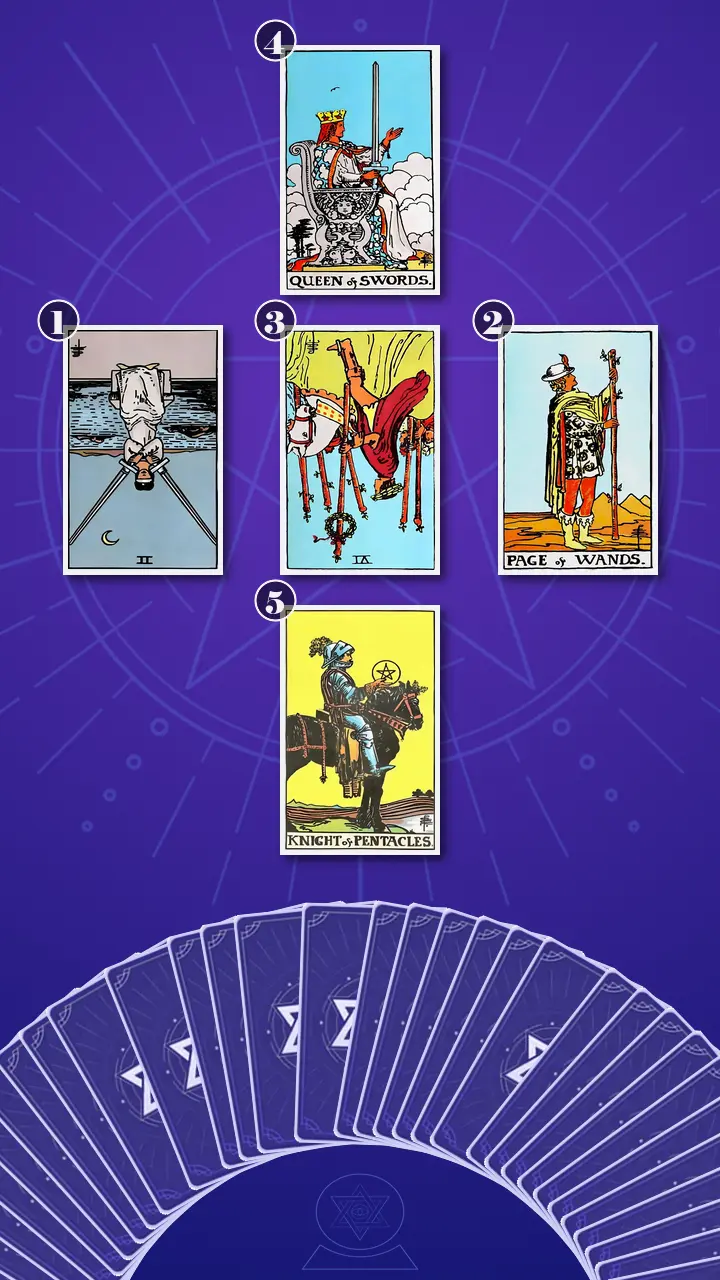
Reading the Map: Card meanings in context, not in theory
Position 1 — Your immediate internal reaction (the stuck loop)
“Now flipped over,” I said, “is the card representing your immediate internal reaction and the specific way you’re getting stuck right now.”
Two of Swords, reversed.
“This is the Notes-app DM loop,” I said, keeping it plain. “Toggling between ‘Remove tag’ and ‘Hide from profile,’ drafting a message, reopening the Story like the answer is hidden in the pixels. The blindfold in this card is you not wanting to look directly at the simplest truth—because you’re busy defending yourself against an imaginary reaction.”
Reversed, the energy isn’t calm neutrality. It’s a blockage—Air energy (thought, words, boundaries) that can’t land. Too much analysis, not enough action. “You’re trying to be unreadable,” I added, “so no one can accuse you of being ‘too much.’ But the cost is you stay stuck, and the tag stays up.”
Taylor let out a small laugh that sounded like it had a thorn in it. “That’s… honestly brutal. I literally rewrote one line eight times this morning.” Her fingers tightened around her phone, then loosened.
I mirrored her words back gently. “Staying silent isn’t the same thing as being safe. It’s just conflict avoidance with a longer hangover.”
Position 2 — Your friend’s likely energy (without assuming malice)
“Now flipped over is the card representing your friend’s likely energy or approach in this moment, without assuming malice.”
Page of Wands, upright.
“This is tagging like confetti,” I said. “Fast, playful, impulsive. More ‘I thought you’d love it!’ than ‘I considered your work life.’ It’s like being added to a group chat without being asked—meant as inclusion, but still… not consent.”
Energetically, this is Fire in balance for her—enthusiasm and momentum—while your nervous system hears the same moment as “spotlight.” I kept the split-screen clear: “She’s hyped. Your body is cautious, client-facing, and already doing a LinkedIn-meets-Instagram risk assessment.”
Taylor’s shoulders softened a fraction, not because it excused it, but because it stopped being a character trial. “Yeah,” she said quietly. “She’s not trying to mess with me. She just posts first. Always.”
Position 3 — The shared social-media dynamic (the real high-stakes trigger)
“Now flipped over is the card representing the social-media dynamic between you—what the tag activates and why it feels high-stakes today.”
Six of Wands, reversed.
“This is the parade float,” I said. “Visibility without control.” In my mind I could already see it: Taylor elevated, a crowd she didn’t invite, the algorithm pretending it’s casual while her stomach believes it’s a press conference.
“Reversed, the attention lands wrong,” I continued. “You’re not enjoying being seen. You’re managing optics: checking who viewed, imagining coworkers forming opinions, mentally drafting explanations you never asked to write.”
Her thumb flicked across her screen like she could swipe away the feeling. “It’s insane,” she said. “I know nobody cares. But my body acts like… it’s a performance review.”
“Exactly,” I replied, and I let the key contrast land. “You’re trying to manage optics when what you actually need to manage is consent.”
Her jaw worked once, like she was chewing on that sentence. Then she nodded—sharp, almost annoyed at how accurate it was.
When the Queen of Swords Spoke: The clean boundary that changes everything
Position 4 — The boundary you need to hold today (the clearest edge)
I paused before turning the next card. The café suddenly felt quieter, as if even the grinder was listening. “This,” I said, “is the guidance position—your boundary. The cleanest edge to draw.”
Queen of Swords, upright.
“This is you with your eyes open,” I told her. “Direct gaze. Clear sky. Clean information.” I kept it specific: “One consent rule. One request. No extra performance.”
And because I’m a café owner, I reached for the metaphor that lives in my hands every day. “Let me use my Stress Flavor Profile for a second,” I said. “When you pull espresso too long, you don’t get ‘more coffee.’ You get bitterness. That’s over-extraction. Your four-paragraph DM with three disclaimers? That’s emotional over-extraction. You’re trying to pull safety out of more words, but all it does is make your boundary taste like guilt.”
Taylor’s mouth twitched—half relief, half recognition. Her eyes stayed on the Queen like it was giving her permission she’d been waiting for.
Setup: I could see the exact loop she lived in: the tag appears, her stomach drops, her shoulders lock, and her brain starts auditioning for “chill”—drafting a DM that keeps getting longer because she’s trying to protect her comfort and prove she’s easygoing at the same time.
Stop auditioning for ‘chill,’ start speaking one clean truth—like the Queen of Swords, you can lift the sword of clarity without turning it into a fight.
I let the sentence sit there. No rushing. No filling the space with coaching.
Reinforcement: Taylor’s reaction came in a chain, not a single emotion. First, a tiny freeze—her breath caught, and her phone hovered mid-air like it weighed more than it should. Then her gaze went slightly unfocused, like she was replaying every Notes draft she’d ever written. Finally, her shoulders dropped on an exhale that sounded like something unclenching inside her chest.
“But if I’m that direct,” she said, and there was a quick flash of defensiveness, “won’t she think I’m—” She stopped herself, swallowed, and her voice went softer. “High-maintenance?”
I kept my tone steady and kind. “Direct doesn’t mean harsh. It means legible. And you don’t need a perfect speech to deserve basic consent.”
I slid a napkin toward her and, without making it precious, gave her the script difference she needed to see: “Essay DM tries to manage her emotions. Queen DM states your rule and your request.”
Then I asked, exactly when her body was ready to receive it: “Now, with this new lens—can you think of one moment last week when you held back because you were trying to sound chill, and this would’ve changed how you felt?”
She nodded, eyes a bit wet but not falling apart. “Yesterday. I literally sent a meme instead of saying what I needed.” She gave a tiny, embarrassed laugh. “God. I hate that I do that.”
“This,” I said, “is the shift. From stomach-drop unease and tone-policed silence to calm, direct consent language. It’s not about controlling how you’re perceived. It’s about stating one specific rule and one clear request.”
Position 5 — The practical next step (steady follow-through)
“Now flipped over is the card representing a practical, doable next step you can take today to implement the boundary without escalation.”
Knight of Pentacles, upright.
“Message + setting + repeat,” I said. “This is Earth energy: steady, practical, consistent.” It’s not the adrenaline of a big confrontation; it’s the quiet power of a policy. “Your boundary becomes believable when it’s routine—not when you can perform courage on command.”
I thought of my espresso machine maintenance schedule—unromantic, repetitive, the reason the coffee tastes right every single day. “This card is asking you to build a workflow,” I told her, “so your consent line doesn’t depend on your mood.”
Taylor’s face changed in a way I always notice: less phone-glow trance, more real-world presence. “I can do a workflow,” she said. “I can’t do… a dramatic friendship summit.”
“Perfect,” I replied. “We’re not doing a summit.”
From Optics to Consent: Actionable advice you can do today
Here’s the story your spread told, start to finish: the tag hits and your mind goes blindfold-on (Two of Swords reversed), because you’re trying to stay liked and uncriticisable. Your friend is operating on share-first Fire (Page of Wands), which isn’t malice—but it does collide with your need for privacy. The real trigger isn’t just her; it’s the imagined audience and the “mini PR crisis” your body runs (Six of Wands reversed). The antidote is clean Air—one calm consent rule stated plainly (Queen of Swords). And the way you keep it from becoming a recurring crisis is Earth: a repeatable system that makes your boundary a default (Knight of Pentacles).
Your cognitive blind spot today is thinking the right tone will protect the friendship more than the right boundary will. It won’t. Over-explaining just hands the steering wheel to other people’s reactions. The transformation direction is simple and brave: shift from trying to control how you’re perceived to stating one specific consent rule and one clear request.
I also used one of my café tools here—my Cup Temperature Scan. If a cappuccino cools fast, it tells me the room is drafty or the cup is thin. Your energy is doing the same thing: the longer you sit in the tag-and-Notes loop, the faster your calm leaks out. So we act while the boundary is still warm enough to hold.
- The Two-Sentence Consent DMOpen Notes and write: “Hey—could you ask me before tagging me? I’d like you to remove/hide this one when you get a sec.” Copy/paste it into IG and send it as-is (no disclaimers, no extra context).Set a 2-minute timer. When it ends, send whatever’s on the screen. If your brain tries to add “sorry” or “I might be overthinking,” delete one line instead of adding one.
- Remove/Hide First, Explain LaterBefore you narrate anything—or check views—choose one visibility action that gives immediate relief: tap “Remove tag” or “Hide from profile.” Do it once, then put your phone face down.If your hands feel buzzy, place one hand on your chest and take one slow breath first. Then do the setting step. You’re managing consent, not optics.
- Build the ‘Policy, Not Vibe’ TemplateSave a reusable note titled “Consent Line.” Keep your rule and request there so next time you’re not reinventing wording: “Ask before tagging.” + “Please remove/hide this one.”Treat it like espresso machine maintenance: boring on purpose. Consistency lowers drama. You’ll thank yourself the next time a tag hits on a commute.

A Week Later: The quiet proof
Six days later, Taylor sent me a message while I was wiping down the counter after the morning rush. “I did it,” she wrote. “Two sentences. No apologies. I hid the tag first, then sent the DM. She replied ‘Omg of course, didn’t even think—sorry!’ and removed it.”
Then she added: “I still felt shaky after, so I made tea and stared at my kitchen wall for two minutes. But I didn’t spiral. That’s new.”
I pictured her there—phone face down, kettle steaming—feeling that tender mix of steadiness and leftover adrenaline. Clear doesn’t always feel fearless. Sometimes it just feels… quieter.
In my world, this is what a real Journey to Clarity looks like: not a flawless outcome, but a clean decision made from self-respect. The Queen of Swords doesn’t ask you to be cold. She asks you to be unmistakable.
When a tag turns your body into a clenched jaw and your mind into a blinking-cursor debate, it’s not “dramatic”—it’s the cost of trying to stay liked while your comfort is being negotiated in public.
If you trusted that one clear sentence is enough today, what’s the simplest consent rule you’d want your friends to know—without turning it into a whole conversation?