Not Introduced at the Party, Then Invisible: Learning Self-Entry

Finding Clarity in the 9:18 p.m. Hover
If you’ve ever shown up to a party in Toronto where you only know one person, and they immediately drift into other groups—so you hover, smile, and start scrolling like your phone is your job (classic “I don’t belong” spiral).
That’s how Jordan (name changed for privacy) started our session—like they were still standing in that condo living room, two steps behind their friend, trying to look casual while their nervous system did math.
They told me it was Saturday night, 9:18 p.m., in a Toronto condo where the music was too loud and the air smelled like someone’s candle and spilled beer. Their friend had already slipped into a couch-circle—bodies angled inward like a closed triangle—mid-laugh, mid-story. Jordan stood half a step behind, phone warm in their palm, thumb scrolling just to look occupied.
“They didn’t introduce me,” Jordan said. They tried to laugh like it wasn’t a big deal, but their voice had that tight, flattened sound people get when they’re trying not to need anything. “I’m not mad. I just feel… erased.”
I watched their shoulders stay slightly lifted, like they were bracing for a door to swing open and hit them. Shame doesn’t always show up as tears—sometimes it’s the small, held-breath feeling of trying to fold yourself into the seam of the room so no one notices you don’t have an ‘in.’
“We can work with this,” I told them, steady and simple. “Not to decide whether your friend is ‘good’ or ‘bad’—but to understand what old ‘I don’t belong’ loop this moment plugged into, and how you can get your agency back. Let’s turn this into a map. A real Journey to Clarity.”

Choosing the Compass: The Four-Layer Insight Ladder
I asked Jordan to take one slow breath—not as a mystical ritual, just a nervous-system handoff from replaying the party to looking at it. While they held the question in mind, I shuffled until the cards felt settled.
“Today I’m using a spread I built for moments exactly like this,” I said. “It’s called the Four-Layer Insight Ladder · Context Edition.”
For anyone reading this who’s ever Googled friend didn’t introduce me at party felt invisible at 1 a.m.: this spread is designed for the deeper leverage point. A classic relationship spread can describe the surface dynamic, but it won’t necessarily show you why one missed introduction can land like a verdict. The Four-Layer Insight Ladder keeps the arc tight and empowering—present trigger → internal meaning → old root imprint → protection pattern → inner antidote → one actionable next step. No prediction. Just clarity and traction.
I told Jordan what each rung would do. “The first card is the trigger—what your nervous system grabbed onto. The fourth card shows the specific protection move that keeps you stuck. And the fifth card is the turning point: the inner quality that lets you self-authorize belonging without waiting for someone else to do it for you.”
Reading the Map: When a Circle Feels Like a Locked Interface
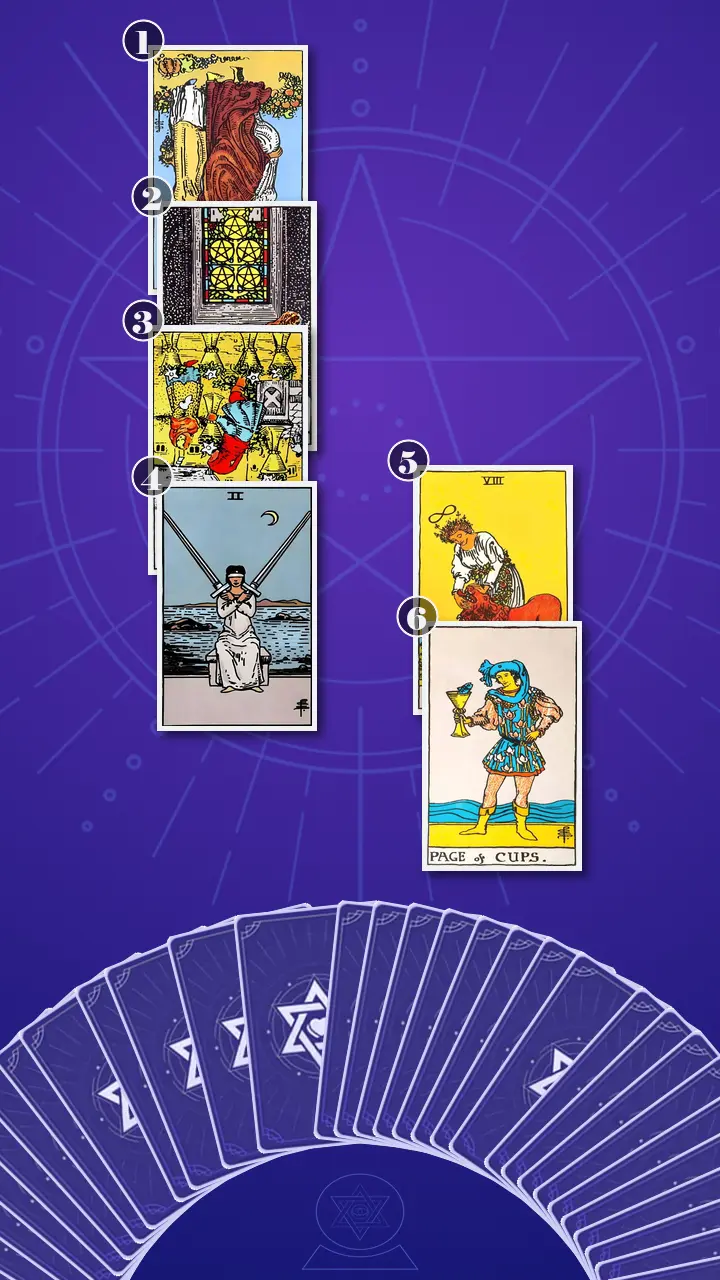
Position 1 — The surface trigger
“Now I’m turning over the card that represents the surface trigger: what about the party moment most activated the nervous system and shaped your immediate behavior.”
Three of Cups, reversed.
It immediately pulled us into that exact modern scene: you arrive at a friend-of-a-friend party where you only know one person, they get pulled into a group that’s already mid-story, bodies angled inward like a closed circle. You hover half a step behind them, laugh at the right moments, and keep your hands busy with your drink and your phone—waiting for the simple “Oh, this is Jordan” that never comes.
In reversed form, the Three of Cups is social warmth with a blockage—community energy that looks available, but feels sealed. The celebration exists… just not for you. The energy isn’t “no one likes you.” It’s “the entry point isn’t obvious, and your system reads that as danger.”
Jordan let out a quick, bitter little laugh. “That’s… honestly kind of cruel,” they said, shaking their head. “Because it’s literally the feet thing. Everyone’s feet pointed in. Like an app with no button that says ‘Join.’”
“Exactly,” I said. “It’s a user interface problem that your body interprets as identity.”
Position 2 — The meaning you assigned in the moment
“Now I’m turning over the card that represents the meaning you assigned in the moment: the internal story that turned a social gap into a personal conclusion.”
Five of Pentacles, upright.
This card has a brutal honesty to it: the missed introduction becomes a temperature shift. You’re physically in the room, but emotionally out in the cold—standing near warmth and laughter like it’s behind glass, scanning for proof that you’re not wanted. Who makes eye contact? Who doesn’t? How long is the pause before anyone ‘should’ notice you?
In the Five of Pentacles, the energy is scarcity: a deficiency state. Not a fact—an internal climate. Your brain treats one glitch like a full system outage: “They didn’t say my name” becomes “I’m not part of this.”
Jordan’s eyes flicked down toward the card and stayed there. Their shoulders rose a millimeter, like they were standing near a heat vent but still cold. The room around us was quiet except for the soft scrape of a streetcar outside—Toronto doing its steady, indifferent thing.
“A missed introduction can sting like exclusion—even when it’s just ambiguity,” I said gently. “And it makes sense that it hits hard if your system is already trained to hunt for evidence.”
Jordan nodded once, heavy. “It’s like… I’m right there, but not included.”
Position 3 — The old root
“Now I’m turning over the card that represents the old root: the earlier belonging imprint this situation is plugging into.”
Six of Cups, reversed.
The present moment didn’t just sting—it time-traveled. The card translated it perfectly: your adult brain knows it could be an oversight, but your body reacts like you’re back in a school hallway or first-week-of-university vibe, waiting to be picked into the group, trying to be ‘easy’ so you don’t give anyone a reason to exclude you.
In reversal, the Six of Cups is the past showing up in an unhelpful way: old roles, old rules. Conditional inclusion. The belief that belonging is something granted by someone else, not something you can participate in.
I asked, “If this feeling had an earlier timestamp—where does it take you?”
Jordan exhaled softly, like a lock finally clicking. “This is old,” they said. “Like… fluorescent lights. Waiting. Trying to be the easiest person to include.”
Two voices lived inside that sentence. The grown-up voice: It was one awkward moment. The younger voice: I’m not getting picked.
Position 4 — Your protection pattern
“Now I’m turning over the card that represents your protection pattern: the specific move you make to stay safe that accidentally reinforces the loop.”
Two of Swords, upright.
In real life, this card looks like being politely unavailable. Pleasant face. Drink in hand. Phone up. Eyes scanning for a ‘safe opening.’ Waiting for certainty before you speak. From the outside, it reads like you’d rather not talk. Inside, it’s a freeze: “I can’t move until I know it’s safe.”
The Two of Swords is blocked Air—controlled, held, stalled. It’s protection, not failure. But it has a cost: you’re protecting yourself from being rejected out loud… and accidentally making yourself unapproachable.
I said the line cleanly, because this card needs clean language: “You’re not ‘low-maintenance’—you’re going quiet to stay safe.”
Jordan’s jaw tightened, then they looked away and swallowed. “I thought I was being chill,” they said. “But I was disappearing.”
When Strength Spoke: Belonging as Practice, Not Permission
I slowed down before the next card. The room felt like it got a fraction quieter—not in a dramatic way, just in the way you notice when someone finally stops arguing with themselves.
Position 5 — The antidote energy
“Now I’m turning over the card that represents the antidote energy: what inner quality helps you self-authorize belonging without needing someone else to validate it first.”
Strength, upright.
The modern translation landed instantly: instead of chasing the room’s approval, you do a micro-reset. You feel the heat of shame, but you don’t obey it. Shoulders drop, breath returns, and you choose one calm line of contact anyway. Quiet courage—acting like you belong for two minutes, even while your nervous system is loud.
Setup: I could feel Jordan still stuck in that 9:18 p.m. moment—two steps behind their friend, phone pretending to be work. Their mind was trying to prove something: If I don’t get introduced, it means I’m not worth claiming. It was decision fatigue, but social: a constant scan for the “correct” move that would guarantee safety.
Delivery:
Stop treating a missed introduction as proof you’re unworthy; start choosing steady self-approval and lead with quiet courage—like Strength, you don’t force the room to accept you, you soften the fear and step in anyway.
Reinforcement: Jordan went still in a three-step wave. First: a physical freeze—breath paused, fingers hovering near their water glass. Second: cognitive seep—eyes unfocused, like a memory was replaying behind their pupils; the condo party blurred into a hallway, into a group project, into every moment they’d waited for someone else to “authorize” their entry. Third: emotional release—an exhale that sounded surprised, almost annoyed at how true it felt. Their shoulders dropped, not fully relaxed, but enough that I could see their collarbones again. Then their face tightened with a flash of resistance. “But if I have to do that,” they said, voice sharper for a second, “doesn’t it mean I wasn’t wanted?”
“It means you’re refusing to let ambiguity run your self-worth,” I said. “That’s different.”
This is where my old Wall Street brain always speaks up: a single data point is not a trend. I told Jordan, “In my work I used to call this a signal-to-noise problem. One missed intro is noisy data. Strength is you choosing not to trade your identity on noise.”
Then I brought in my own framework—because this is exactly what it’s for. “Let’s use Influence Credit Scoring for a second. Your brain is giving this one public moment a five-star weight—like it’s the only metric. But relationships have multiple data streams: private warmth, follow-through, invitations, how they speak about you when you’re not in the room. Strength is you rebalancing the score so your worth doesn’t hinge on one awkward public moment.”
I asked, “Now, with this new lens—can you think of a moment last week where you could have acted like you belonged for just two minutes?”
Jordan blinked, eyes slightly wet. “At work happy hour,” they said. “I stood by the ice bucket and did the phone thing.” A small, wobbly smile. “I could’ve just… asked someone something.”
That was the shift in real time: from shame-driven shrinking and evidence-hunting to the first flicker of steady self-respect and gentle courage in initiating connection.
Position 6 — One next step
“Now I’m turning over the card that represents one next step: a small, doable action this week that practices connection and repairs self-trust.”
Page of Cups, upright.
The Page of Cups doesn’t demand a personality transplant. It offers a clean, sincere bid. At the party: “Hey, I’m Jordan—how do you know Alex?” Or the next day: a light follow-up DM to someone you met, without over-explaining the awkwardness. Connection as a friendly experiment, not a referendum on your likability.
“Two minutes. One breath. One sentence,” I said, letting it be simple on purpose.
The Clean Opener Experiment: Actionable Next Steps for the Next 48 Hours
Here’s the story the whole ladder told, start to finish: the party trigger (Three of Cups reversed) wasn’t just a social moment—it hit an old scarcity wound (Five of Pentacles), woke up a younger part that learned to wait to be chosen (Six of Cups reversed), and activated a freeze disguised as being chill (Two of Swords). The loop’s logic is brutal but consistent: if I disappear, I can’t be rejected out loud—and then the long-term cost is that no one gets a chance to see you. Strength flips the script. It says belonging isn’t something you get granted in public. You practice it. Page of Cups makes it behavioral: one small, sincere reach.
Your cognitive blind spot in this loop is that you treat social ambiguity like a final verdict instead of a normal human gap. The transformation direction is clear: shift from needing external social proof to practicing self-authorization through one small, direct act of connection.
I gave Jordan a tight plan they could actually try—because advice that sounds good but doesn’t fit your body isn’t advice, it’s just content.
- Save a “Circle-Entry Script”In your Notes app, write one clean opener: “Hey, I’m Jordan—how do you know [Name]?” Keep it pinned so you’re not inventing language while your chest is tight.Say it out loud once at home, literally once, then stop. If your brain calls it cringe, treat that as information—not a stop sign.
- Use my Cocktail Party Algorithm (3-phase template)Phase 1 (Entry): opener question. Phase 2 (Bridge): one small self-detail (“I work downtown / I’m new-ish to this group”). Phase 3 (Exit): a clean close (“Nice meeting you—I’m going to grab a drink”).This isn’t “winning the room.” It’s giving your nervous system a script so you don’t freeze waiting for permission.
- Do a 90-second “Facts vs Story” debrief after eventsWrite 3 observable facts (what you saw/heard) and 1 story (what your mind concluded). End with: “It felt awkward, and that doesn’t mean I’m unwanted.” Then close the app on purpose.Set a timer. When it ends, you’re done—even if your brain wants more “proof.” You’re breaking the evidence-hunt loop, not erasing emotion.

A Week Later: The Quiet Proof
Six days later, Jordan messaged me. “Went to a work thing near King West,” they wrote. “Did the two-minute experiment. Shoulders down, one exhale, asked someone how they knew the host. It was awkward for like… 20 seconds. Then it wasn’t.”
They added, almost as an afterthought: “Also, I slept. Like, a full night. Woke up and still had the ‘what if I’m annoying?’ thought—but it didn’t run the whole morning.”
That’s how clarity usually arrives: not as a perfect social life, but as ownership. A missed introduction isn’t a verdict. It’s a moment you can meet with steadier self-respect—and one small, direct bid for connection.
When you’re standing right there in the room but your chest goes tight like you’re outside the glass, it’s not because you’re unworthy—it’s because your brain is treating one quiet moment as proof you don’t belong.
If you didn’t need anyone to ‘claim’ you first, what’s the one small sentence you’d be willing to say to step closer to the circle—just for two minutes?
Every reading at AceTarot is a journey to connect with inner wisdom and empower your next step. The stories shared here are psychological mirrors, not private records—crafted to reflect universal emotional loops and help you find your own clarity. Learn more about our Journey to Clarity.