From Submit-Button Dread to Self-Respect: The Version 1.0 Send

Submit-Button Paralysis at 11:17 PM
You’ve got the PDF attached, the form filled, and you’re still hovering over Submit like it’s going to decide your entire self-worth—classic submit-button paralysis.
Jordan (name changed for privacy) sat down across from me with the kind of careful posture people get when they’ve been bracing for a while. They’re 28, non-binary, Toronto-based, early-career marketing—smart, fast-moving office, lots of eyes on the work. The kind of job where your writing lives in Google Docs Suggesting mode and your nervous system learns to flinch at comments that start with, “Quick question…”
They told me about a specific night: 11:17 PM in a condo bedroom, laptop balanced on their knees. The screen’s cool glow made their hands look a little too pale, and outside the window the streetcar noise kept doing that faint electric buzz that gets under your skin when you’re already tense. They kept scrolling up and down the same cover letter, reading one sentence out loud for tone—like if they got the cadence perfect, the whole thing would finally feel safe.
But their body gave them away. Tight chest. Throat like it was holding a swallowed apology. Breath staying high in the ribs. Hands hovering over the trackpad like the click was an electric fence.
“I’m literally one click away,” they said, and their voice did that tiny crack between humor and fear. “And I still can’t do it.”
I watched their fingers make a small, unconscious rubbing motion—thumb to index finger—like they were trying to sand off an invisible flaw. The dread wasn’t a thought. It was a physical weather system: a cold front in the sternum, a chokehold at the base of the throat, a jitter in the hands that made even stillness feel loud.
“We can work with this,” I said, keeping my tone steady—more human than mystical. “Not by forcing confidence, but by getting clear on what ‘Submit’ has come to mean in your system. Let’s try to draw a map through the fog—one that ends with one doable step.”

Choosing the Compass: How This Tarot Spread Works for “Hit Send” Anxiety
I asked Jordan to take one breath in through the nose, one out through the mouth—not as a ritual, just a transition. A way to tell the brain: we’re not in the Slack thread right now; we’re in the room. Then I shuffled slowly, letting the cards make their soft paper-thrum—a sound I’ve always loved because it’s honest. No performance. Just process.
“Today,” I said, “we’ll use a spread I built for moments exactly like this: the Four-Layer Insight Ladder · Context Edition.”
For you reading along: I choose this spread when the question isn’t “Which option should I pick?” but “Why does my body treat one click like a trial?” It separates the layers cleanly—surface symptom, immediate pressure, root wound—and then it turns insight into two things people actually need: a pivot and a next step. It’s practical tarot for a career crossroads moment that looks like procrastination from the outside but feels like self-worth on the line from the inside.
I showed Jordan the structure like a staircase: we’d read down the first three cards to diagnose what was happening, then read upward through the last three to build the way through.
“Card 1 will name the exact freeze,” I said. “Card 3 will tell us what it’s protecting. And card 4 is the pivot—what unlocks movement without needing perfection first.”
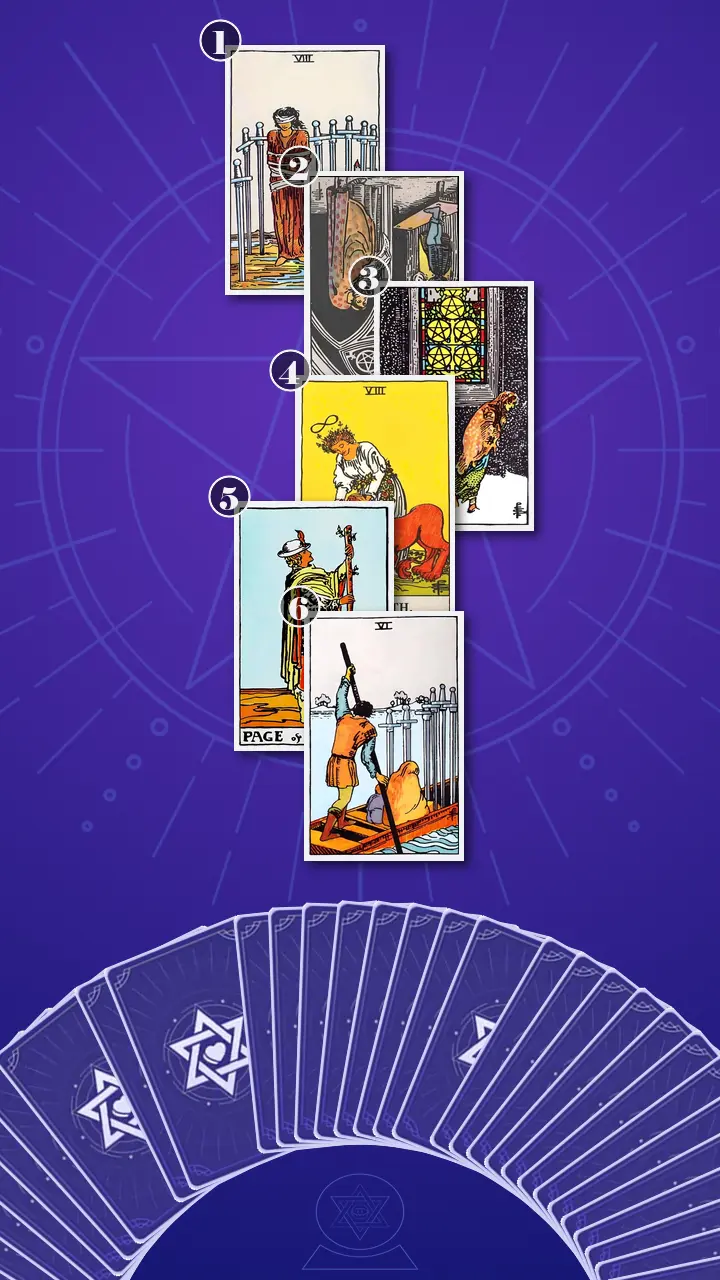
Reading the Map: Card Meanings in Context
Position 1 — Surface Symptom: The Hover That Looks Like “Being Careful”
“Now we’re opening the card that represents the surface symptom: the exact ‘Submit button freeze’ behavior and what it’s protecting in the moment,” I said, turning over the first card.
Eight of Swords, upright.
I tapped the blindfold lightly on the illustration—not as superstition, but as a visual cue. “This is the mind building a cage out of rules,” I said. “And the part people miss: the bindings are loose. It feels impossible, but it isn’t actually locked.”
Then I anchored it in their real life—because tarot only earns trust when it can meet you on the screen you’re staring at.
“It’s late, you’ve filled every field of the application portal and attached the right PDF, but you keep toggling between tabs to recheck details you already know. Your hands hover over the trackpad like it’s electrified. You’re not blocked by ability—you’re blocked by the thought: ‘If I click, they can judge me.’”
Jordan let out a short laugh—one of those laughs that has a bitter edge, like it’s trying not to cry. “Okay,” they said. “That’s…too accurate. Like, rude-accurate.”
“I’m not here to roast you,” I said, but I smiled a little so they knew I could hold the humor. “This card is describing a blockage in Air energy—thoughts tightening into restraints. The Eight of Swords isn’t laziness. It’s your nervous system treating visibility as danger, so your mind tries to keep you ‘safe’ by freezing.”
Position 2 — Immediate Pressure: The Imagined Panel on the Other Side of Send
“Now we’re opening the card that represents the immediate pressure: the evaluation/standard you feel you’re being measured against,” I said.
Three of Pentacles, reversed.
“This is the energy of craft and feedback…turned into a tribunal,” I said. “Reversed, it often shows unclear standards, fear of being assessed, and doing everything alone so no one can comment—except the imagined commenters in your head.”
I used the translation exactly as it showed up in the spread, because Jordan’s life already had the script.
“You’re about to send a deliverable at work and suddenly picture a Slack thread dissecting it. Instead of checking the actual requirement, you try to pre-empt every possible critique by polishing in isolation. The goalposts move because you’re guessing what ‘good’ means, and your confidence collapses under imaginary scrutiny.”
Jordan’s shoulders dropped a fraction—small, but real. Their gaze flicked away from the card like it was exposing them. A quiet, uncomfortable nod. The kind that says, wait…that’s exactly what I do.
“Here’s the loop,” I said, in my calm coach voice. “You tell yourself, ‘I’m being careful.’ Then, ‘I’m just polishing.’ Then the truth under it: ‘If I send, they’ll see the crack.’ Craft-in-progress becomes public judgment.”
“Yeah,” Jordan said. “And I can’t tell if I’m being responsible or just scared.”
“Both can be true,” I said. “But this card suggests the fear is driving the steering wheel more than your standards are.”
Position 3 — Self-Worth Wound: Belonging vs Impressing
“Now we’re opening the card that represents the self-worth wound: the deeper fear about belonging or value that makes submission feel unsafe,” I said, and I slowed down a little. This position tends to land in the throat.
Five of Pentacles, upright.
Before I said anything, I noticed Jordan swallow—like their body already recognized the temperature drop in this card.
“This isn’t about your competence,” I said. “This is about what rejection has come to mean.”
I gave them the two-rooms contrast, because the Five of Pentacles always speaks in weather and windows.
“Imagine it’s February in Toronto. You’re outside a lit café window, snow turning the sidewalk into that gritty gray slush. Inside, you can see warmth—people laughing, steam on the glass, a barista calling names. And you tell yourself, without anyone even saying it: ‘I’m not allowed in there.’ That’s the Five of Pentacles.”
Then I linked it to digital life, where the nervous system can interpret silence like exile.
“You interpret a potential rejection as proof you’re ‘out’—out of the room, out of the industry, out of belonging. So you try to buy entry with perfection: one more tweak, one more credential, one more line that sounds smarter. The freeze is your nervous system refusing to step into a moment that feels like exile-risk.”
Jordan’s face changed in that slow way that means the insight is slipping past the intellect and into memory. Their lips parted like they were about to say something, then didn’t. A throat-tight “oh.” Brief sadness, not dramatic—just real.
“So when I don’t hit submit,” they said quietly, “it’s not because I’m lazy. It’s because…if they don’t like it, it proves I don’t belong.”
“Exactly,” I said. “And if we can name that, we can stop treating your fear like a character flaw. It’s a protector—miscalibrated, but trying to do its job.”
When Strength Spoke: The Breath That Holds the Lion
Position 4 — Key Reframe: The Inner Capacity That Unlocks Movement
I let the room get a little quieter before turning the next card. The streetcar noise softened for a second, like the city itself was taking a breath. “We’re turning over the pivot,” I said. “This is the core medicine.”
Strength, upright.
In my work—radio, music therapy, sound research—I’ve learned something that shows up here perfectly: you can’t argue a nervous system into calm. You can’t logic your way out of a body alarm. You can only regulate it. Strength is regulation as courage.
I grounded it in the modern scenario the card was already offering.
“Right before you click, you stop negotiating with your anxiety (‘But what if…’) and treat it like a scared protector. You slow your breathing, soften your jaw, and choose a kinder internal line: ‘I can be seen and still be okay.’ You don’t submit because you’re suddenly fearless—you submit because you’re steady enough to move with fear present.”
Jordan’s breathing stalled for a beat. That tiny freeze people get when they realize they’ve been trying to win a war that was never winnable.
Setup. You know that moment: everything’s attached, every field is filled, and your cursor just…hovers. Your chest gets tight, your hands go tense on the trackpad, and suddenly it’s not “an application,” it’s “a test of whether I’m actually good enough.”
Delivery.
Stop treating ‘Submit’ like a verdict on your value; start treating it like gentle courage—hands steady on the lion, breath steady in your body.
I let the sentence hang for a second—like a sustained note you don’t rush to resolve.
Reinforcement. Jordan’s reaction came in layers, the way real change always does. First: a physical stillness, like their shoulders forgot how to hold themselves up. Their jaw unclenched in a slow, almost surprised way; I could see the tongue relax behind the teeth. Second: their eyes unfocused for a second, like they were replaying a dozen almost-sends—Sunday Scaries, TTC hover, office draft-saving—through this new lens. Third: the exhale finally arrived, shaky at first and then deeper, as if their ribs were remembering they had more room than they’d been using.
And then the unexpected part: their expression tightened with a flash of anger—brief, honest. “But if that’s true,” they said, “doesn’t it mean I’ve been…doing it wrong? Like I’ve wasted so much time.”
I nodded, because that’s the moment people need the most steadiness. “It means you were using the tools you had,” I said. “You were trying to buy safety with perfection. That’s not ‘wrong.’ It’s just expensive.”
“Okay,” Jordan whispered. Their hands, which had been clenched together, loosened and separated on the table as if space had become allowed.
I leaned in slightly. “Now—use this new perspective and look back at last week. Was there a moment when you hovered over Submit and a kinder relationship with the scared part of you would’ve changed how it felt?”
Jordan blinked hard once. “Wednesday,” they said. “I had the email ready for my manager at 3:12. I saved it as draft. I told myself I’d ‘sleep on it’ because I didn’t want them to think I sounded dumb.”
“That’s the lion,” I said softly. “Loud. Not evil. Strength isn’t hype. It’s a steady hand on the lion and a steady breath in your body.”
This was the pivot: not from anxiety to confidence overnight, but from tight dread and shame-driven perfectionism at the threshold of visibility to a first flicker of grounded self-trust. The direction was clear.
My Signature Lens Here: Music Pulse Diagnosis
“Can I ask you something that might sound random?” I said. “What have you been listening to lately—like, on repeat—especially on nights you get stuck?”
Jordan looked relieved to answer something concrete. “Honestly? A lot of sad indie. And then those ‘deep focus’ playlists on Spotify that are basically anxious lo-fi.”
I nodded. “That’s useful. I call this Music Pulse Diagnosis. Your recently played songs are like an EKG for your stress pattern. Sad indie plus anxious lo-fi often means you’re trying to regulate with music that keeps you in ‘thinking mode’—lots of texture, not much grounding. Your brain stays on the treadmill.”
“So my playlist is…making it worse?” Jordan asked.
“Not worse,” I said. “Just revealing the strategy: you’re trying to soothe dread with more mind. Strength wants a different soundtrack—one that supports breath and steadiness.”
Position 5 — One Step This Week: Version 1.0 Energy at the Threshold
“Now we’re opening the card that represents one step this week: a single, doable action that turns the reframe into behavior at the exact threshold moment,” I said.
Page of Wands, upright.
This card always feels like someone lighting a match in a dark hallway—not enough to see the whole building, but enough to take the next step.
“You pick one micro-deadline (like 12:30 PM) and treat the submission as a prototype. You click Submit as ‘Version 1.0,’ not as your final form. Instead of asking, ‘Is this impressive?’ you ask, ‘Does this meet the requirement?’ and you let the learning happen after the send.”
Jordan’s posture shifted—subtle forward tilt, like their body could imagine motion again.
“I can do v1.0,” they said. “That…actually lands.”
“Good,” I said. “Because Page of Wands is sprint energy. Ship the smallest honest thing. Learn from reality, not from imagined comment sections.”
Position 6 — Integration: The Crossing After You Click
“Now we’re opening the card that represents integration: how to metabolize the act of submitting so your nervous system learns it’s survivable and repeatable,” I said.
Six of Swords, upright.
“After you submit, you can feel your body unclench—but your mind wants to replay every word. This card looks like closing the laptop and taking a short walk anyway, letting your nervous system register: ‘We crossed.’ The thoughts may still be there, but they become direction (‘next step’) instead of punishment (‘proof I’m bad’).”
I watched Jordan’s fingers uncurl completely, the blood seeming to return to their hands as if the idea of aftercare itself was permission.
“So the goal isn’t to be instantly calm,” they said. “It’s to…move anyway and then help my body understand it lived.”
“Exactly,” I said. “Clarity comes after movement—not before.”
From Insight to Action: A Sound-Based “2-Breath Submit” Protocol
Here’s the story the spread told, end to end: your submit-button paralysis isn’t a productivity problem—it’s an exposure problem. The Eight of Swords shows the mind locking you into internal rules right at the finish line. The reversed Three of Pentacles adds the pressure of imagined evaluation and unclear criteria, so you try to pre-empt critique by polishing in isolation. Underneath, the Five of Pentacles reveals the real wound: a belonging fear—if I’m not impressive, I’m out. Strength is the bridge: regulated, self-compassionate courage. Then the Page of Wands turns that courage into behavior—Version 1.0, micro-deadline, requirement-only rubric. And the Six of Swords finishes the cycle with integration: a physical crossing so your nervous system learns, “I can be seen and survive.”
Your blind spot isn’t that you need more preparation. It’s that you’re still treating the click like a verdict on your value. The transformation direction is to treat submission as a practice of self-respect and a data point you can learn from—something repeatable, not something that needs to feel emotionally safe first.
Because I’m Alison Melody, and sound is my native language, I translated Strength into something your body can follow—no pep talk required. Think of it as a Breath Soundtrack: a rhythm your nervous system can recognize at the exact threshold moment.
- The 2-Breath Submit (under 10 minutes)Open the form/email. Put one hand on your chest or keep your palm flat on the desk as an anchor. Inhale for a slow count of 4, exhale for 6—twice. Silently name the protector: “This is the part that’s trying to keep me from being judged.” Then set a 90-second timer: you’re allowed to make only fixes that change facts (not tone). When the timer ends, click Submit—or close the laptop intentionally and schedule a specific send time as a calendar event.Expect your brain to sneer, “This is cheesy.” Treat that as proof you’re training steadiness, not chasing a mood. If anxiety spikes, shrink it to one breath and one fact-only edit.
- Version 1.0 Folder + Micro-DeadlineCreate a folder literally named “Version 1.0.” Put one real submission in it this week (job app, deliverable, or email). Choose one micro-deadline—“I click Submit by 12:30 PM”—and add it to your calendar with a 5-minute reminder. When the reminder hits, ask only: “Does this meet the requirement?” (not “Is this impressive?”). Then click.Don’t let the deadline become a new perfection contest. The deadline is for clicking, not for feeling ready. If you miss it, pick the next small window—no worth-reset required.
- Post-Submit Crossing (Six of Swords Aftercare)Within 10 minutes after you submit, do one physical transition: walk to the end of your block, make tea, take a quick shower, or eat something. If you catch yourself re-reading what you sent, say (out loud if you can): “I’m not doing a second lap right now.” Then move your body anyway.Plan for rumination like weather. If you need a container, set a 3-minute worry timer—then end it with the physical marker.
And because sound can be immediate first aid, I gave Jordan my BGM Prescription—three tracks to support the nervous system shift (not medical treatment, just practical regulation):
1) White Noise First Aid: 10 minutes of clean white noise (or brown noise if white feels sharp) while you do the 90-second fact-only edits—this helps mute the “imagined Slack thread” in your head.
2) Frequency Cleansing: a gentle 528 Hz or 432 Hz ambient track at low volume during the two breaths—something steady enough that your exhale can ride on it.
3) A “Crossing Song”: one song you play only after you click Submit—your Six of Swords marker. Same track every time. The point is conditioning: your brain learns, we crossed; it’s done for now.

A Week Later: The Quiet Proof of Finding Clarity
Six days later, Jordan texted me a screenshot at 12:31 PM: a calendar reminder labeled “Version 1.0 — click.” Under it, one line: “I did it. Two breaths. 90 seconds. Sent.”
They followed it with another message: “I still felt shaky. But I didn’t spiral. I made tea right after and walked to the corner. It was…weirdly calm.”
That’s the kind of clarity I trust—the kind that shows up as follow-through, not as perfect certainty. A nervous system learning, by repetition, that being seen doesn’t equal being exiled.
When I think back on their original posture—hands hovering like the trackpad was hot—it’s not that everything became easy. It’s that something inside them stopped confusing cruelty with motivation. Strength did what Strength always does: it replaced the prosecutor with an inner guide.
They’d clicked Submit, then celebrated by sitting alone in a café for an hour—warm cup between their hands, inbox unopened, a little tender and a little proud.
When your cursor freezes over “Submit,” it’s not laziness—it’s that tight-chest moment where being seen feels like it could decide whether you belong.
If you treated one submission this week as a small act of self-respect (not a performance), what would your Version 1.0 look like?