From 'We Need to Talk' Dread to Curiosity: A Boundaried Reply

The 11:57 p.m. Notes-App Spiral
You see “can we talk later?” and your stomach drops—then you open Notes like it’s an emergency kit, rewriting the same paragraph until 2 a.m. (classic catastrophizing + mind-reading).
Jordan said it like she was embarrassed to even be saying it out loud, as if the sentence itself was “too much.” She was 29, a product designer in New York, the kind of person who could ship a feature in a sprint and present a roadmap with clean slides—yet one vague text turned her body into a fire alarm.
We met on a video call, but I could still feel the scene she described: 11:57 p.m., a dim bedroom in Brooklyn, the A/C rattling like it was impatient, the only light that harsh phone-glow that makes everything look slightly unreal. She’d flipped the phone face-down like it was hot. Picked it up again within seconds. Opened the chat. Then Notes. Thumb hovering over Send as if the button could either save the relationship or set it on fire.
“The phrase isn’t even a breakup,” she told me. “But my body reacts like it is. It’s like… I hate feeling like I’m waiting to be evaluated.”
I watched her as she spoke. Her shoulders were lifted a fraction too high, like she was bracing for weather. Her hands kept moving—small, buzzy motions, fingers tapping the edge of her desk. That restless hand-energy is a kind of truth all on its own.
“You want honest connection,” I said gently, “and your body hears eviction.”
She let out a breath that sounded almost like a laugh, but didn’t reach her eyes. “Yeah. And then my brain goes, If I can just find the right words, maybe I can stop the damage before it starts.”
I nodded. “That’s dread with a job assignment. It convinces you that urgency is a deadline.” I paused, letting my voice steady the room. “Today, we’re not here to predict how the conversation ends. We’re here to figure out what old story flares—and what your next step is, so you can meet ‘we need to talk’ with clarity instead of panic.”
Choosing the Compass: The Celtic Cross · Context Edition
I asked Jordan to put both feet on the floor and take one slower exhale than inhale—nothing mystical, just a signal to her nervous system: we are here, not back then. While she breathed, I shuffled my worn deck the way I always do, steady and unhurried, like smoothing a sheet before you lie down.
“For this,” I told her, “I’m going to use the Celtic Cross · Context Edition.”
And for anyone reading along: the Celtic Cross is useful because it maps a whole trigger cycle—what hits first, what blocks you, what story is underneath, what memory your body is pulling from, what you’re aiming for, and what you can do next. In this version, the final card isn’t a fixed ‘outcome.’ It’s an ethical, non-fortune-telling next step—because Jordan’s question wasn’t, “Are we doomed?” It was: “After ‘we need to talk,’ what old story flares—my next step?”
I traced the structure in simple terms. “The first card is the flare-up—the first thirty seconds after the text. The crossing card is what blocks clarity. The root card is the old script underneath. And the final card at the top is the move you can make that protects your dignity while you wait.”
Jordan swallowed and nodded once, like she was agreeing to a plan. That’s what this spread is: a plan for finding clarity when your brain wants to write an ending in the dark.
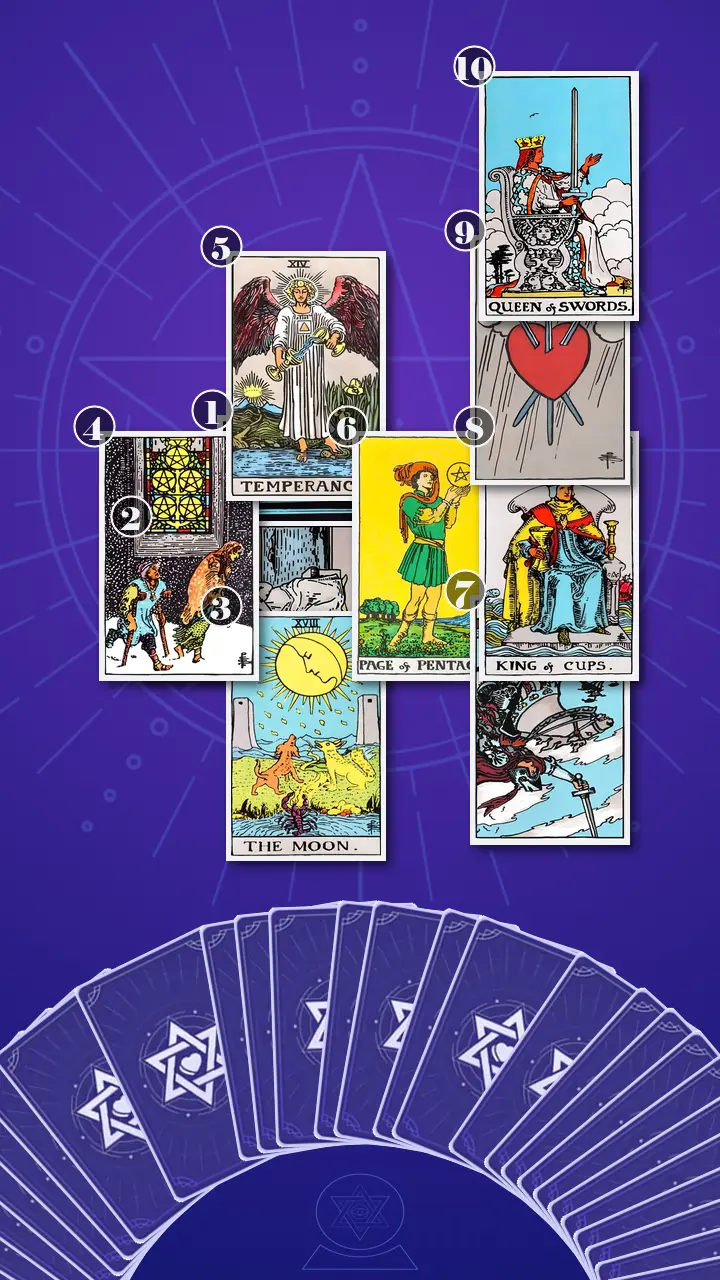
Reading the Map: Card Meanings in Context
Position 1 — The immediate flare-up: the moment “we need to talk” lands
“Now we’re looking at the card that represents the immediate flare-up—the moment the message hits and your mind-body response takes over.”
Nine of Swords, upright.
The image is someone sitting up in bed, swords lined behind them like a wall. I didn’t need to dramatize it; Jordan already lived there. “This,” I said, “is the phone-glow night where you reread the last twenty messages and try to find evidence in punctuation. It’s like refreshing a tracking page every thirty seconds—movement on the screen feels like control, but it doesn’t actually change the shipment.”
Her jaw tightened, then she gave a short, bitter laugh. “That’s… honestly kind of brutal.”
“I know,” I said, and softened my tone. “But brutal doesn’t mean hopeless. It just means your mind goes into trial mode fast. Uncertainty becomes a full mental courtroom before any facts arrive.”
In my family we call this an Air surge—thoughts accelerating faster than reality. And Jordan’s body had already testified: stomach drop, tight chest, restless hands. “Your body is sounding the alarm,” I told her, “but it doesn’t mean there’s a fire. It means your system hates not knowing.”
Position 2 — What blocks clarity right now: the reflex that turns uncertainty into compulsion or shutdown
“Now we’re looking at the card that represents what blocks clarity right now—the reflex that turns uncertainty into compulsion or shutdown.”
Two of Swords, reversed.
“In its balanced form,” I explained, “this card is a pause. A boundary. A temporary ‘not choosing’ while you gather information.” Reversed, the pause collapses. The blindfold doesn’t come off into clarity; it comes off into frantic checking.
“This is like toggling between ‘reply instantly’ and ‘delete the whole thread’—no middle gear,” I said. “Or like having twenty browser tabs open and insisting you must close them all right now to be safe.”
Jordan’s eyes flicked away from the camera, embarrassed. “I either go essay-mode or freeze-mode,” she admitted. “And both feel terrible.”
“Exactly,” I said. “Text too much, you regret it. Text nothing, you spiral harder. Speed feels like safety, but it’s just motion.”
Position 3 — The old story at the root: the subconscious script being activated
“Now we’re looking at the card that represents the old story at the root—the subconscious script that wakes up when you see that phrase.”
The Moon, upright.
In the Moon card, there’s a path between towers—real, but foggy. A dog and a wolf howl. Something crawls up from the water. “This card is not saying your intuition is wrong,” I told her. “It’s saying visibility is low. And when visibility is low, the mind fills in the gap with familiar shapes.”
“Like walking home in heavy fog and deciding every shadow is a person following you,” I continued. “Or like trying to debug a product with zero error logs—your brain starts inventing causes, and suddenly you’re fixing problems that might not exist.”
Jordan’s fingers stilled for the first time. The stillness was small, but it mattered.
“Here’s the phrase I want you to borrow,” I said. “Your brain is writing endings in the dark. The Moon is that darkness. It’s the projector, and the film it loves is an old one: ‘I’m about to get left,’ ‘I’m too much,’ ‘I’m not chosen.’”
There was a quiet beat. Outside my own window, the late-afternoon light slid behind a cloud, dimming the room by a shade—environment conspiring, as it does, when we speak about fog.
“So when you ask, ‘What old story flares?’” I said, “the answer is: the Moon-story. Not facts. A script.”
Position 4 — What the nervous system remembers: the earlier imprint that taught you to fear this moment
“Now we’re looking at the card that represents what your nervous system remembers—the imprint that taught you to fear this kind of moment.”
Five of Pentacles, upright.
Two figures outside in the snow, a warm stained-glass window just out of reach. “This is the ‘outside looking in’ feeling,” I said. “The moment your body decides, before anyone says anything, that you’re about to be shut out of belonging.”
Jordan’s throat moved as she swallowed. Her eyes glossed, not with tears yet, but with that specific shine that comes when someone recognizes themselves too clearly.
“I’ve been ghosted before,” she said quietly. “Like… it wasn’t a fight. It was just… gone. No explanation.”
“Of course ‘we need to talk’ hits like a door closing,” I said. “Your system learned a rule back then: conflict equals exclusion. The Five of Pentacles is that memory.”
Position 5 — What you’re trying to reach: the regulated, constructive way you want to handle the talk
“Now we’re looking at the card that represents what you’re trying to reach—the version of you who handles the talk in a way you’ll respect tomorrow.”
Temperance, upright.
An angel pours water between two cups—drip, not flood. One foot on land, one in water. “This,” I said, “is you wanting to stay present without performing. It’s regulation. It’s blending truth with kindness.”
I leaned in. “I want a tiny micro-scene: your fingers hovering over Send… and then you place the phone face-down. Just one moment where you don’t obey the surge.”
Jordan exhaled. Her shoulders lowered a fraction, like a backpack strap slipping off one shoulder.
“Temperance is a skill,” I said, “not a personality trait. Like a mixing board: you can turn the volume down without muting the track.”
And because my work is rooted in Nature Empathy—watching rhythms instead of forcing them—I added, “When the Moon is high, everything feels louder. Temperance is you choosing a steadier tide.”
Position 6 — The next influence to lean into: supportive direction without controlling the outcome
“Now we’re looking at the card that represents the next influence to lean into—the most supportive immediate direction.”
Page of Pentacles, upright.
A young person holds one coin, studying it. Green field, distant hills. “One coin,” I said. “One thing at a time. This is the antidote to solving the entire relationship tonight.”
“Like sending a calendar invite instead of twelve back-and-forth messages,” I said. “Structure reduces free-fall.”
Jordan gave a faint smile. “I can do structure. It’s… feelings that don’t cooperate.”
“Then we borrow Earth,” I told her. “Earth is what you control: time, place, topic scope. A container is not control—it’s care.”
Position 7 — Your default role in the pattern: how you tend to act when the trigger hits
“Now we’re looking at the card that represents your default role in the pattern—what you do when the trigger hits.”
Knight of Swords, reversed.
The Knight charges forward under storm clouds, sword raised. Reversed, that charge becomes reactive communication—words sent at adrenaline speed, then immediate regret. “This is your strength—quick thinking—turning into self-sabotage when it tries to outrun uncertainty,” I said.
“It’s like hitting ‘Reply All’ while your heart is racing,” I continued. “Or driving faster on a rainy highway because you want it to be over. The speed doesn’t make you safer. It just reduces your options.”
Jordan nodded with a wince. “I send something, and then I reopen the thread to analyze how it landed. Then I draft the follow-up to fix the first one.”
“That’s the Knight reversed,” I said. “And the fix isn’t ‘be perfect.’ The fix is a speed limit.”
Position 8 — What the situation offers: external support and tone available
“Now we’re looking at the card that represents what the situation offers—the support or tone available around you.”
King of Cups, upright.
A calm figure holds a cup while waves chop around the throne. “This is emotional steadiness existing in the room,” I said. “It could be your partner’s capacity. It could be a friend who doesn’t hype you up. It could even be the tone the situation is inviting you to set.”
“The waves still exist,” I added, “but they don’t get to vote on your worth.”
Jordan blinked slowly, like she was letting that land somewhere below her thoughts.
Position 9 — The fear underneath: what you’re bracing for, and what clarity you secretly want
“Now we’re looking at the card that represents the fear underneath—what you’re bracing for.”
Three of Swords, upright.
A heart pierced, rain behind it. Clean and stark. “This is the fear that the talk is heartbreak,” I said plainly. “That it’s confirmation you weren’t chosen.”
“But there’s also something else here,” I said. “Sometimes this card shows a hope in disguise: the hope that truth will finally be clear, even if it stings, so you can stop living in suspense.”
Jordan’s voice went small. “I don’t want reassurance. But I also can’t sit in the not-knowing.”
“That’s the human part,” I said. “Not a flaw.”
When the Queen of Swords Spoke: Finding Clarity in Daylight
When I turned the final card, the energy in the call shifted the way weather does—subtle, but unmistakable. It felt like clouds thinning.
“Now we’re looking at the card that represents your actionable next step—the most empowering move you can take now to meet the talk with clarity and boundaries.”
Queen of Swords, upright.
The Queen sits upright, sword raised, gaze clear. Air, refined—not a storm, but a clean wind that clears the room. “This is discernment,” I said. “Truth-telling. Boundaries that don’t apologize for existing.”
I watched Jordan’s body as I spoke. Her hands, still buzzing, had crept toward her phone on the desk as if they wanted to grab certainty. This is where my Body Signal Interpretation matters most: when the hands reach, it’s usually not because the person wants to text—it’s because the nervous system wants to end the unknown.
“Your hands are trying to solve a feeling,” I said softly. “The Queen doesn’t solve feelings with essays. She solves uncertainty with one clean question.”
Setup (I kept it close to the real moment, because that’s where the medicine works): You see “we need to talk,” your stomach drops, your hands get buzzy, and suddenly you’re drafting a ten-paragraph message in Notes like you’re trying to outrun a breakup that hasn’t even happened.
Delivery (I let it stand alone, the way a boundary stands alone):
Don’t let the Moon write the ending for you; let the Queen of Swords lift one clean sentence like a blade and ask for the truth you need.
There was a pause—real silence, not awkward silence. The kind where you can hear your own breath and realize it’s been shallow.
Reinforcement (this is where the shift becomes physical): Jordan froze first—her inhale caught, shoulders held high, fingers hovering in midair like they’d been interrupted mid-scroll. Then her eyes unfocused for a second, like her mind was replaying every midnight Notes draft she’d ever written, every time she’d tried to “earn” safety with the perfect paragraph. And then—quietly—she exhaled. Not a performance exhale. A release. Her shoulders dropped a fraction. Her jaw unclenched as if she’d forgotten it was clenched. She looked down at the desk and nodded once, slow.
“But if I do that,” she said, a flash of resistance passing through her voice, “isn’t it… cold? Like I’m pretending I don’t care?”
“No,” I said, steady as a shoreline. “It’s the opposite. You care enough to protect the conversation from panic. Clarity isn’t a demand for reassurance—it’s a boundary that keeps your dignity intact while you wait for the real conversation.”
I gave her a simple container—something she could do in ten minutes, not ten hours:
“Open Notes,” I instructed, “and type one blunt line: ‘The story my brain is writing is: ____.’ Then one line: ‘The facts I actually have are: ____.’ Even if it’s just, ‘One text. No context.’ Then send one logistics-and-context text: ‘I’m open to talking. Is this about something specific, and can we pick a time today?’ After that, phone on Do Not Disturb for ten minutes. Cold water on your wrists or stand by a window and name five things you can see.”
I watched her do a version of it in real time—phone face-down, eyes lifting to the window behind her. The light on her cheek was suddenly softer, less phone-blue, more human.
Then I asked, as promised, “Now, with this new lens—can you think of a moment last week where the Moon-story took over? A moment when one clean question would’ve changed your whole night?”
Her mouth trembled into something like a smile. “Tuesday,” she said. “I wrote a whole thing. I could’ve just… asked for context.”
“That’s it,” I told her. “That’s the first step from dread and urgency toward steadier self-trust. From ‘I must perform to stay’ to ‘I can ask for clarity and still belong.’”
From Insight to Action: The Talk Container Protocol
When I stepped back and looked at the whole spread, the storyline was clean.
The trigger hits and your mind goes into Nine of Swords trial mode—late-night spiraling, evidence-hunting, pre-writing the whole script. The obstacle is the Two of Swords reversed: the collapsed pause, where you can’t tolerate not knowing, so you force motion. Underneath it all, The Moon is running an old film—projection in low visibility—powered by the Five of Pentacles imprint: “I’m about to be outside again.” Your aim is Temperance, a regulated way of holding feelings without flooding. The near-term support is Page of Pentacles—Earth: one practical container. Your self-pattern is Knight of Swords reversed—speed-as-safety. The environment offers King of Cups—steadiness is available. And your fear is Three of Swords—heartbreak as a foregone conclusion. The antidote is the Queen of Swords: one clear question, with dignity.
The blind spot I wanted Jordan to name was simple: she was treating urgency as information. Her brain’s speed was masquerading as wisdom. And it was costing her self-respect.
The transformation direction was equally simple—and it matched the key shift exactly: shift from pre-writing the whole script to asking one clear grounding question and setting a container for the talk (time, topic scope, and what she needs to stay regulated).
Here are the practical next steps—the ones you can actually use the next time someone texts, “we need to talk,” and you feel that familiar stomach-drop.
- Do the “Facts vs. Story” Notes Check (2 minutes)Open Notes and write two lines: (1) “The story my brain is writing is: ____.” (2) “The facts I actually have are: ____.” Stop there—no essays, no arguments.If you feel yourself turning it into a persuasive memo, set a 2-minute timer and end it when it rings. Containment is the point.
- Send One Clean Queen-of-Swords Text (30 seconds)Copy/paste: “I’m open to talking. Is this about something specific, and can we pick a time today?” Don’t add a second message. Don’t pre-apologize. Don’t explain.If you worry it sounds cold, remind yourself: a container is kindness to both of you. One clean question beats a ten-paragraph defense.
- Set the Talk Container (1 minute)Offer a time boundary that protects your evening: “I can do 7:00–7:30. Phone or a walk?” Put it on your calendar as “Talk — topic: ____.”If they won’t share the topic, hold the line: “I can talk at 7. I’m not in a good place to guess what this is about.”
And because I’m Esmeralda—and I don’t separate mind from weather—I gave her one of my simplest regulation tools for the ten-minute waiting window: my Shower water-flow meditation. “If you’re home,” I said, “stand under warm water for sixty seconds and imagine the urge-to-text running off your hands like ink. You’re not ‘fixing’ anything. You’re letting Water contain Air.”

A Week Later: Ownership, Not Certainty
A week after our session, Jordan messaged me—not an essay, just a screenshot.
It was her sent text: “I’m open to talking. Is this about something specific, and can we pick a time today?” Under it: “7:00–7:30 works for me. Phone or a walk?”
Then one line from her: “I put my phone on Do Not Disturb for ten minutes. I hated it. Then I didn’t.”
She told me the talk wasn’t a breakup. It was something small but real: a misread tone, a need for more check-ins, a bit of stress spilling sideways. Normal relationship weather—no evictions. She still felt a flicker of fear the next morning—what if I handled it wrong?—but this time she noticed the thought and didn’t sprint after it.
That’s the journey to clarity I trust most: not certainty, but ownership. Not “I never spiral,” but “I can pause, name the old story as a story, and choose my next true sentence.”
When someone says “we need to talk,” it can feel like your body is already standing outside in the cold—trying to earn your way back in with the perfect message before anyone has even opened the door.
If you didn’t have to prove you’re “not too much” in advance, what’s the one clean question you’d ask to get real context—and give yourself room to breathe?
Every reading at AceTarot is a Journey to connect with inner wisdom and empower next step.
Learn more about our Journey to Clarity.