From We Need to Talk Dread to Context-Seeking Without Apologies
Finding Clarity in the Phone-Glow Silence
If you’re the kind of person who can run a project timeline at work, but one “we need to talk” text from a friend sends you into full-on rumination mode at 11 PM (hello, friendship anxiety spiral), I need you to know: you’re not broken. You’re under-informed.
Alex came into my café in Toronto the next afternoon with that particular tired look I’ve learned to recognize over twenty years of watching people try to be fine while their nervous systems do something else entirely. Outside, March slush was melting into the curb. Inside, my espresso machine exhaled little bursts of steam like it had opinions. The air smelled like dark roast and warm sugar.
She wrapped both hands around the ceramic cup I gave her—like her fingers needed a job—and said, almost too casually, “My friend texted me last night. Just: ‘We need to talk.’”
I watched her eyes flick down to her phone, then back up, then down again. That reflex. The tiny muscle under her jaw worked like she was chewing something she didn’t want to taste.
“I set my phone face-down to calm down,” she told me, “and then I flipped it back over every two minutes. Re-opened the same iMessage thread. I rewrote a reply in Notes like twelve times. I didn’t send anything. But my body acted like I was getting fired.”
Her dread wasn’t an abstract feeling. It was a stomach-drop like stepping off a curb you thought was there, a tight chest like someone had cinched a strap one notch too far, and a restless urge that said: do something right now—text, explain, fix, or disappear.
And underneath it, the core contradiction I hear all the time in close friendships: wanting closeness and reassurance, while bracing for rejection the second anything gets serious.
“The phrase ‘we need to talk’ feels like a breakup text but for friendship,” she said, then laughed once—quick and bitter. “I can handle feedback. I just can’t handle not knowing what I’m walking into.”
I nodded, slow. “That makes sense. Your brain is trying to turn missing context into certainty. It just… picks the worst kind.”
I slid my tarot deck onto the table between us, right beside a little dish of biscotti. “Let’s make a map. Not to predict whether the friendship survives—tarot isn’t a verdict machine—but to understand why this one line spikes you so hard, and what you can do in the first five minutes after it hits. We’re going to aim for clarity: the kind you can actually use the next time your phone lights up.”

Choosing the Compass: The Celtic Cross · Context Edition
I didn’t light candles or ask the universe to deliver a grand sign. In a café, the ritual is simpler: I asked Alex to put both feet on the floor, take one slow breath in, and exhale like she was fogging up a window.
“Just hold the exact moment in your mind,” I said. “The screen. The words. The first ten seconds in your body.”
I shuffled while the grinder clicked and the milk pitcher cooled under my palm. The point of this isn’t mystique—it’s focus. When our attention stops ricocheting, the pattern becomes visible.
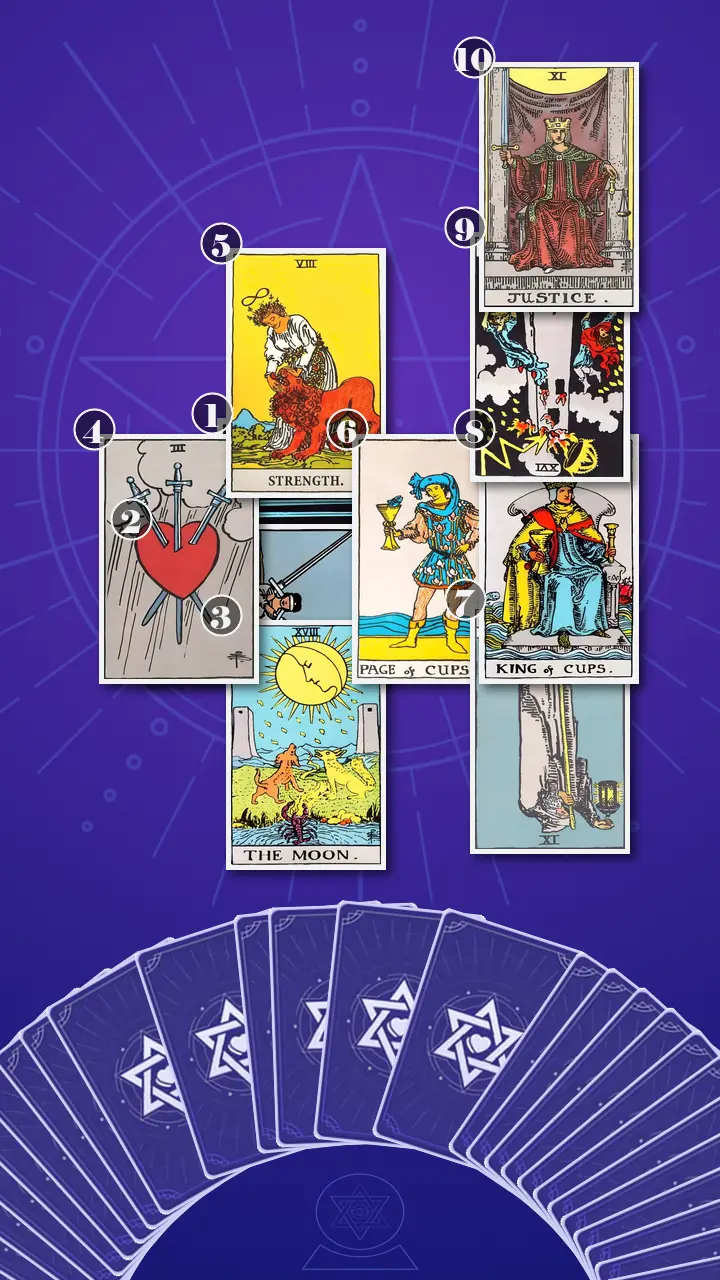
“Today we’ll use the Celtic Cross · Context Edition,” I told her, turning the deck in my hands. “It’s the classic deep-dive spread—present reaction, the block, the root cause, the memory imprint, your conscious aim, a near-term opening, your stance, the relational environment, the fear story, and then integration guidance.”
For readers who ask how tarot works, this is the practical part: the spread gives the mind a structure. Instead of spiraling in a fog of ‘what if,’ you get labeled places to put your experience: this is the reaction, this is the block, this is the old wound, this is the next move. The cards don’t create your reality; they mirror it sharply enough that you can make a different choice.
“The first card will show what happens in your mind and body right after the text,” I said. “The crossing card will show where you get stuck. And the final card—our integration—will show the healthiest way to communicate, regardless of what the talk turns out to be.”
Alex swallowed and nodded, like she was agreeing to walk into a room with the lights on.
Reading the Map: Swords, Moonlight, and the Freeze Button
Position 1: The immediate internal reaction
I turned over the first card. “Now we’re looking at the card representing the immediate internal reaction to the ‘we need to talk’ text—what’s happening in your mind/body right now.”
Nine of Swords, upright.
The image always gets people in the gut: someone sitting up in bed, head in hands, in a dark room—like the whole night has turned into a courtroom.
“This is the 2 a.m. phone glow,” I said. “Re-reading the same thread in the dark. Drafting a dozen versions of the conversation in your head. Waking up already tired from a talk that hasn’t even happened.”
In energy terms, the Nine of Swords is excess Air: thinking as overdrive. It’s your mind trying to reduce ambiguity by building worst-case narratives and scanning for hidden meaning.
Alex let out a small laugh again, but this time it shook. “That’s… rude accurate.” Her fingers tightened on the cup, then loosened. “I literally zoomed in on a period. Like it was evidence.”
“Your system is responding as if danger is confirmed,” I said gently. “Before you draft a single reply, try naming the fear in one plain sentence—no poetry, no explanation. Something like: ‘I’m afraid they’ll end the friendship.’ It’s not to shame you. It’s to stop the fear from masquerading as facts.”
Position 2: The block that keeps the spike going
I tapped the next card, laid across the first. “Now we’re looking at the card representing the specific block that keeps the reaction spiking—how you get stuck after the message.”
Two of Swords, upright.
“This is the freeze,” I said, and I pointed to the blindfold and the crossed swords. “You can’t see what the talk is about, so you lock down. Protective indecision.”
And immediately, a split-screen scene formed in my mind—because I’ve watched this exact choreography play out across café tables for years.
Left side: your thumb hovering over “Reply.” Right side: you lock your phone, then unlock it five seconds later. Left side: the typing bubble appears. Right side: it disappears. Your stomach drops again, like your body is trying to fall through the floor and hide there.
“The inner monologue here is brutal,” I said, keeping my tone plain and nonjudgmental. “‘If I ask, I’m needy. If I wait, I’m careless.’ Both options feel dangerous, so your nervous system chooses a third option: silently spiral.”
Alex gave a quiet exhale, the kind that sounds like a truth landing. She nodded once, small. “Oh. That’s exactly the stuck point.”
“And I want you to hear this,” I added. “Freeze is a protection strategy. It’s not a character flaw. But it keeps ambiguity in charge.”
Position 3: The deeper root—why ambiguity feels threatening
I turned the next card. “Now we’re looking at the card representing the deeper psychological root of why ambiguity in friendship feels threatening.”
The Moon, upright.
The Moon is not a liar card the way people think—it’s a projection card. Moonlight makes everything look like it might be something else. A path runs between two towers. A dog and a wolf howl. Something crawls out of the water like a thought you didn’t invite.
“This is your nervous system reacting to what you can’t see,” I said. “The text is a blank screen and your brain starts running old footage over it—memories, half-formed cues, imagined subtext—and it all feels equally true.”
Energetically, The Moon is blockage through uncertainty. It feeds mind-reading: “They’re upset” becomes “They’re dropping me” becomes “I’m not keepable.”
“The Moon asks for a clean distinction,” I said, and I held up my index finger like a bookmark. “What are the literal facts you have—the exact words? And what interpretations are you adding in the dark?”
Alex’s gaze went slightly unfocused, like she was replaying the moment on the TTC when the phrase kept looping in her earbuds’ silence. “I don’t even realize when I switch from facts to… vibes,” she admitted. “I just end up convinced.”
“That’s the Moon,” I said. “Conviction without context.”
Position 4: The memory imprint—why serious talks equal danger
I turned over the card to the left. “Now we’re looking at the card representing what recent experiences trained your nervous system to treat serious talks as danger.”
Three of Swords, upright.
The pierced heart against storm clouds is not subtle. It’s sharp words, disappointment, feeling misunderstood.
“Your body learned a lesson,” I said. “Not logically—somatically. Hard talks lead to hurt. So now, when someone says ‘we need to talk,’ your system braces like the rain is already coming.”
Alex’s mouth pressed into a line. She didn’t look at the card at first. Then she did, and her eyes softened with something older than last night.
“A friend ended things out of nowhere two years ago,” she said quietly. “We were fine, and then we weren’t. I didn’t see it coming. So now I try to… catch it early.”
“That makes so much sense,” I said. “But notice the hidden cost: you’re reacting to an old rupture while standing in a new room.”
Position 5: Your conscious aim—how you want to handle it
I turned the card above the center. “Now we’re looking at the card representing what you’re trying to embody instead—your conscious goal.”
Strength, upright.
Strength is not about forcing calm. It’s about gentle hands on a lion—soft power. The infinity symbol floats like a reminder that capacity can be built.
“You’re not actually trying to avoid the conversation,” I said. “You’re trying to meet it with steadiness instead of panic.”
In energy terms, Strength is balance: emotion is present, but it doesn’t run the room.
Alex’s shoulders lowered a fraction, like her body recognized permission. “I want to be the kind of friend who can just… talk. Without turning it into a referendum.”
“Exactly,” I said. “Regulate first. Respond second.”
Position 6: The near-term opening—how to respond differently
I turned the card to the right. “Now we’re looking at the card representing the next best opening for responding differently.”
Page of Cups, upright.
The Page looks into the cup like they’re surprised by the fish—like a message doesn’t have to be a threat; it can be information.
“This is your tone shift,” I said, and I watched Alex’s jaw unclench a little. “It’s swapping a twelve-line Notes draft for one warm, structured sentence. Not corporate. Not performative. Human.”
I gave her a micro-script that sounded like a real person: “I’m here. Is this about something specific?”
Alex blinked, then nodded slowly. Her fingers stopped worrying the cup. “That feels… doable,” she said, surprised by herself. “Like I’m not begging. I’m just asking.”
“Exactly,” I said. “Curiosity instead of self-prosecution.”
Position 7: Your stance—how you relate to the uncertainty
I turned the next card at the base of the staff. “Now we’re looking at the card representing your stance and coping style in this moment.”
The Hermit, reversed.
“This is the lantern turned too far inward,” I said. “Introspection becoming a closed room. You try to solve the whole situation alone: hours in Notes, no reality-checking, no asking for clarification.”
Energetically, this is blockage through isolation. The Hermit’s gift is wisdom, but reversed it becomes interrogation—your mind becomes a searchlight that never finds what it’s looking for.
“The reframe is simple but not easy,” I said. “Turn the lantern outward just one click. One context question. Then a short pause. That’s not being dramatic. That’s being in relationship.”
Alex’s eyes lifted to mine—like she was checking whether she was allowed to do that. I held steady.
Position 8: The environment—what the friendship can hold
I turned over the next card. “Now we’re looking at the card representing the relational field around you—what emotional container may be available.”
King of Cups, upright.
The King sits calmly on choppy water. The waves exist. They just don’t get to run the meeting.
“This is important,” I said. “This suggests the friendship may be capable of holding emotion without drama—especially if one of you brings steady emotional leadership.”
Energetically, this is balance through containment: feelings can be named without becoming a flood.
Alex’s expression changed—less braced, more thoughtful. “She actually is pretty direct,” she said. “Not mean. Just… adult.”
“Then this ‘we need to talk’ might be her trying to be responsible,” I said, “not her trying to be cruel.”
Position 9: Hopes and fears—the catastrophe story
I turned the next card. “Now we’re looking at the card representing the fear-story you most want to avoid—and how it shapes your texting and tone.”
The Tower, reversed.
“This is the fire alarm when it might just be a kitchen timer,” I said. “Your body hears the words and assumes collapse. Then you try to prevent it by controlling every word.”
I could almost see the behavior as she described it: writing the “covers-everything” paragraph, three paragraphs long, bullet points, pre-emptive apologies—like she was preparing for cross-examination instead of a check-in.
“Discomfort gets mislabeled as catastrophe,” I continued. “And then the stakes inflate. The talk gets heavier before it even starts.”
Alex winced—full recognition. “I do treat it like a friendship breakup text,” she said, and there was irritation in her voice now, not at her friend—at the pattern. “And I hate that about me.”
“We’re not going to hate it,” I said. “We’re going to understand it. And then we’re going to give it a smaller job.”
I leaned in slightly. “Try one tolerable outcome line: ‘They might be upset, and I can still handle hearing it.’ That’s the Tower reversed becoming a renovation instead of an explosion.”
When Justice Held the Scales Steady
Position 10: Integration guidance—how to communicate, regardless of outcome
I placed my hand over the final card for a beat. The café noise softened in my awareness—the clink of a spoon, the low hum of the fridge behind the counter—like the room was making space. “Now we’re turning over the card representing integration guidance: the healthiest way to communicate and make meaning of the talk, regardless of outcome. This is the card that changes your operating system.”
Justice, upright.
Scales in one hand. Sword in the other. A face looking straight ahead, not at shadows.
For a second, Alex didn’t move. Her eyes tracked from the scales to the sword and back again, like she was learning a new language.
Setup: I could feel exactly where she’d been living: staring at “we need to talk” with her stomach dropping, thumb hovering over the chat, already drafting an apology in Notes like she was trying to prevent an ending before she even knew the topic.
Then I let the sentence land as cleanly as a cup placed on a saucer.
Stop treating ambiguity as a conviction; choose a fair question and a clear boundary, like Justice holding the scales and sword steady.
I didn’t rush to fill the silence. In my work—tarot and coffee both—I’ve learned that extraction time matters. Pull too fast and you get sour panic. Pull too long and you get bitterness. The middle is where the flavor lives.
Reinforcement: Alex’s reaction came in layers, like a body translating insight.
First: a physiological freeze. Her breath caught. Her thumb stopped tapping the edge of her phone case mid-motion, suspended like a cursor.
Second: the cognitive shift. Her gaze went slightly unfixed, not dissociating—more like her mind was rewinding last night’s spiral and seeing, for the first time, how she’d been collecting “clues” the way you refresh a tracking page that says Delayed: checking again and again, gaining zero control, only more adrenaline.
Third: the emotional release. She exhaled, long and shaky at the end. Her shoulders dropped, not dramatically—just enough that I could tell her body believed the room was safer than it had been a moment ago.
“I’ve been treating uncertainty like evidence,” she said, voice quieter. “Like if I feel scared, it must mean something bad is true.”
“That’s Justice teaching you the difference between facts and stories,” I said. And here I brought in the framework my regulars tease me for—because of course I would use coffee to explain communication. It’s my native language.
“I call this Milk Foam Layer Analysis,” I told her. “Foam is what sits on top: tone guesses, punctuation readings, the vanished typing bubble, the vibe. Espresso is what’s real and measurable: the exact words they sent, what you actually know. Your anxiety tries to drink only foam. Justice says: sip the espresso first.”
“So… facts vs stories,” she murmured.
“Yes. And we can make it even more practical with what I call Social Espresso Extraction,” I added. “Different social contexts have different optimal extraction times. At work, speed is rewarded. In friendship, speed can become over-functioning. Justice isn’t asking you to respond instantly. Justice is asking you to respond fairly.”
I kept my voice grounded, the way I do when a customer looks overwhelmed at the pastry case. “Now, use this new lens and tell me: last week, was there a moment when a serious tone showed up and you could have asked for context instead of writing the closing argument?”
Alex blinked hard, eyes a little wet around the edges, and gave a small, incredulous smile. “Literally last night. I wrote a whole apology without knowing the headline.”
“Don’t write the closing argument before you’ve heard the headline,” I said, and she nodded like the phrase had finally found its home.
That was the shift—moving from dread and mind-reading to grounded clarity and steadier self-trust. Not perfect calm. Just a new step: context before conclusion.
The One-Page Justice Protocol: From Insight to Actionable Advice
When I looked at the whole spread together, the story was painfully coherent.
Nine of Swords showed the immediate spike: midnight rumination and self-blame. Two of Swords showed the lock: freeze, because both asking and waiting feel risky. The Moon explained why the lock is so strong: ambiguity becomes a projection screen. Three of Swords showed the imprint: your body remembers a past rupture. Strength showed your intention: steadiness. Page of Cups offered the bridge: one warm, human sentence. The Hermit reversed warned about the detour: isolating in Notes. King of Cups suggested the friendship can hold an adult conversation. Tower reversed revealed the fear engine: catastrophe story. And Justice—Justice gave you a way out that doesn’t require perfect performance.
“Here’s the cognitive blind spot,” I told Alex, keeping it simple. “You’re treating ambiguity like a silent verdict about your worth and belonging. Your body reacts like rejection has already happened. The transformation direction is the opposite: regulate first, then ask for context—so you’re responding to reality, not to midnight prosecution.”
“Okay,” she said, and then—because she’s a project coordinator and I could feel her craving something structured—she added, “What do I actually do when it happens again?”
I nodded. “We keep it small. We keep it repeatable. One clear question beats ten perfect paragraphs.”
- The 60-Second Strength ResetBefore you type anything, do five rounds of breath: 4 seconds in, 6 seconds out. Both feet on the floor. If you’re on the TTC or in the PATH, just press your heels down and let the exhale be longer than the inhale.If breath work annoys you when you’re activated, use a physical cue instead: cold water on your wrists or holding your latte cup with both hands until your chest loosens one notch.
- The Justice Reset (Facts vs Stories)Set a 9-minute timer. For 3 minutes, write two columns: Facts (their exact words) vs Stories (what your brain is adding). For 3 minutes, take slow exhales with your feet grounded. For the last 3 minutes, send one neutral context question—then put your phone face-down for 3 minutes.Expect resistance like “This feels awkward.” Keep it contained: one sentence only, no extra justification. Clarity works better than speed.
- The One-Sentence Context Text (3-Second Latte Art)Send: “Totally—what’s the topic so I can show up well?” Add a time anchor if needed: “Do you want to talk tonight or tomorrow?” If you’re in a meeting: “I’m in a meeting—can you share a quick headline so I’m not guessing?”Read it out loud before sending. If it sounds like a customer service email, shorten it. Warmth isn’t length.
I added one more tool, because friendship is a living thing, not a spreadsheet. “Use my Social Thermometer,” I said. “Different relationships have different ideal temperatures. With a close friend, it’s fair to ask for a headline. With an acquaintance, you might simply say: ‘Sure—what’s up?’ Justice is not one-size-fits-all. It’s proportional.”
Alex stared at her phone and then, for the first time since she walked in, set it down without flinching.

A Week Later: Ownership, Not Certainty
Five days later, I got a message from Alex while I was wiping down the counter after the morning rush.
“It happened again,” she wrote. “Different friend. Same phrase. I did the 60-second reset. Then I sent: ‘Totally—what’s the topic so I can show up well?’ I didn’t add a paragraph. I put my phone face-down. I hated the three minutes. But I didn’t spiral.”
Her friend’s reply had been simple: they wanted to talk about plans for a birthday weekend, because they felt weird about money and didn’t want resentment. Not rejection. Not a hidden indictment. Just logistics with feelings attached—the most human thing in the world.
Bittersweet, in under a minute: she told me she slept through the night for the first time in weeks—then admitted she still woke up with the thought, “What if I did it wrong?” But this time, she made coffee, breathed, and didn’t reach for her phone like it was a defibrillator.
This is what I mean when I say tarot can help you find clarity: not by making life frictionless, but by giving you a fairer interpretation of what’s happening—and an actionable next step that fits inside a real day.
When someone texts “we need to talk,” it can feel like your stomach drops not because you did something wrong, but because closeness is what you want most—and losing it is what your body is bracing for before you even have the facts.
If you didn’t have to earn your place in the friendship with the perfect reply, what’s one simple context question you’d feel okay sending first?