My Responsiveness Was Actually Fear: How I Reclaimed Deep Work Time
Finding Clarity in the Monday Calendar Wall
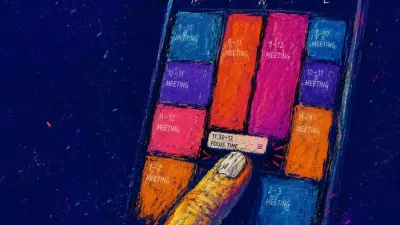
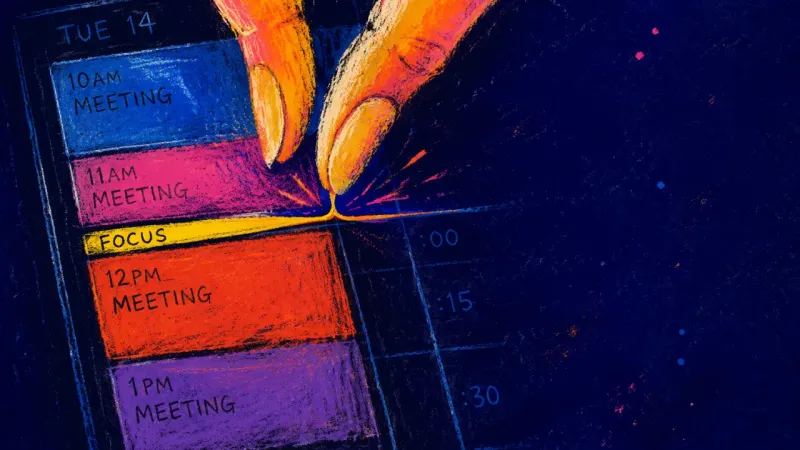
You’re a PM in a big city (Toronto, NYC, London—pick your flavor) and your Monday starts with opening your calendar, seeing wall-to-wall Zoom blocks, and feeling immediate pressure in your chest: classic calendar captivity.
Jordan showed up on my screen from a Toronto condo desk, the kind where the radiator clicks like it’s impatient with you. It was 8:41 a.m. for them—hair still damp, coffee already half-ignored—and 9:41 p.m. for me in Tokyo, in a small office behind the planetarium exhibit hall. I could hear my building’s last train of the night in the distance; Jordan could hear their laptop fan spool up, that tiny mechanical sigh that always feels like, not this again.
They shared their Google Calendar without even asking, like it was evidence. Colored blocks stacked like Tetris. No white space. The screen glare made their face look a little harsher than it probably felt from the inside.
Jordan whispered, mostly to themselves, “When am I supposed to actually think?” Their cursor hovered over Accept on yet another invite titled Alignment.
What they were asking me, underneath the scheduling question, was painfully specific: “Wall-to-wall meetings in my calendar—how do I protect deep work?”
And the contradiction was right there in their body. Their jaw held itself like a clenched hinge. Each time they glanced at the next meeting start time creeping closer, their breathing went thin, like they were trying not to take up oxygen in their own life.
“Okay,” I said, keeping my voice steady the way I do when I’m guiding a group of visitors through a meteor shower show—calm enough that their nervous system can borrow it for a minute. “We’re going to treat this like a system, not a personal failure. We’re here for a journey to clarity: not just why your calendar got like this, but what the next clean move is.”
Choosing the Compass: Celtic Cross · Context Edition
I asked Jordan to put one hand flat on their desk—just to feel something solid—and take one slow breath before we did anything else. Not mystical. Just a gear shift. When your brain is doing constant prioritization math, the first real intervention is often a pause long enough to hear your own thoughts.
I shuffled my deck the way I always do after closing time at the planetarium: methodical, unhurried, like tracking a planet’s transit. “Today,” I told them, “we’ll use the Celtic Cross · Context Edition.”
For anyone reading along who’s ever Googled how tarot works and gotten either woo-woo fog or productivity-guru bravado: this spread is useful because it doesn’t pretend your problem is just ‘time management.’ It maps a chain—habit → fear → culture → choice → integration. In Jordan’s case, that chain matters more than any single calendar tweak.
This version keeps the classic Celtic Cross structure but tunes two positions for modern work: one card will explicitly read the meeting culture around you (the external pressure), and the final card becomes an integrated workflow outcome—a sustainable rhythm, not a fortune-cookie prediction.
I previewed the parts we’d lean on most. “The first card shows your current deep-work reality. The crossing card shows what actively blocks focus time. The card on the right—near-term strategy—is where we’ll find the lever you can actually pull this week.”
Reading the Map: The Cross of Your Week
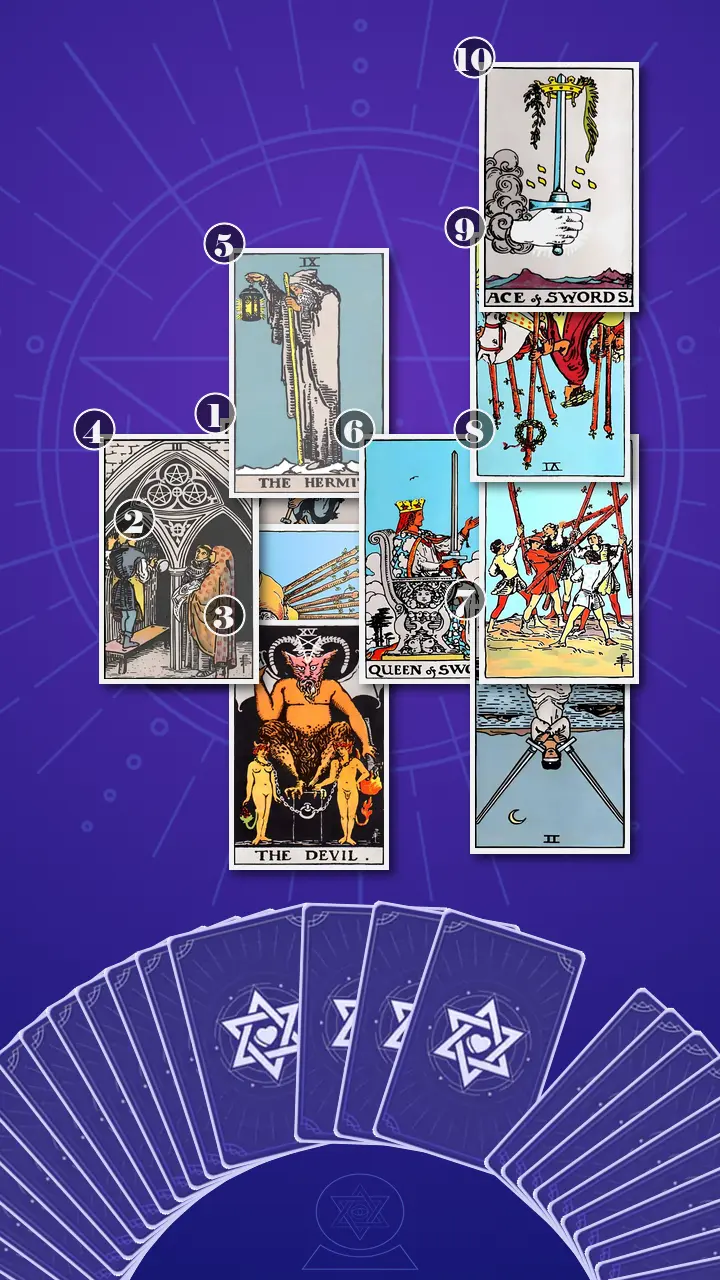
Position 1: The current deep-work reality
“Now we turn over the card representing the current deep-work reality: what your day-to-day workflow actually looks like right now.”
Eight of Pentacles, reversed.
Even through a webcam, I felt Jordan recognize it—not the medieval-looking apprentice, but the workbench energy. I translated it in the only language their nervous system had been speaking lately:
“You sit down to write a strategy doc, finally find the thread, and then—meeting reminder. You close the doc, join the call, come back, reread what you wrote, and restart. By the end of the day, you’ve ‘worked’ constantly but nothing looks finished enough to share.”
Reversed, this isn’t laziness. It’s a blockage of craft—the kind that happens when your attention is forced to reboot ten times an hour. In the upright Eight, the apprentice gets repetition. In your week, the bench keeps getting vacated.
Jordan gave a short laugh that didn’t reach their eyes. “That’s… too accurate,” they said. Then, with a little bitterness: “Kind of brutal.”
I nodded, gentle. “Being in every meeting can feel safe—until you realize it’s costing you the work that actually proves your value.”
Position 2: The main blocker
“Now we turn over the card representing the main blocker: what actively interferes with protected focus time.”
Ten of Wands, upright.
The image hit like a screenshot of their calendar: arms full, view blocked, destination technically ahead but not visible. I stayed close to the lived reality:
“Your calendar is booked like a conference schedule: standup, stakeholder sync, ad-hoc ‘alignment,’ another check-in about the thing from the last check-in. You’re carrying responsibilities that could be shortened, delegated, or turned into async—yet you keep holding them because it feels safer than dropping any.”
This is excess Fire—too much doing, too much reacting—pressing down on the reversed Eight. It’s not just that you’re busy; it’s that the busyness is heavy enough to block your line of sight. You can’t see priorities. You can only see the next Zoom link.
As I said it, I watched Jordan’s shoulders creep upward like they were bracing for impact. Their breathing stayed shallow. Their jaw tightened again. The room—both rooms, Tokyo and Toronto—felt smaller.
“And here’s the inner monologue that usually rides along with this card,” I added, because I’ve heard it a thousand times in different accents. “If I drop this, I’ll be the reason something slips.”
Jordan’s eyes flicked away from the camera, like they were checking a mental attendee list. “Yeah,” they said, quietly. “Exactly.”
Position 3: Root cause
“Now we turn over the card representing the root cause: the deeper driver underneath the meeting overload.”
The Devil, upright.
I’ve guided school groups through the planetarium long enough to know: when the lights go dark, people either relax or panic. The Devil is that panic—but in a suit and a headset.
“You join meetings you already suspect are unnecessary because declining feels socially dangerous,” I said. “The chain isn’t the meeting invite—it’s the belief that constant availability is what makes you valuable, so you keep proving you’re ‘in it’ even when it costs outcomes.”
This is a compulsion loop, not a scheduling issue. The Devil’s chains are loose in the card. In modern life, that’s the Slack green dot as a loyalty badge. An algorithm that rewards constant engagement: the more you show up, the more it shows you more.
Jordan swallowed. “I hate how true that is. Like… if I’m not in the room, I’ll look like I don’t care.”
“That sentence,” I said, “is the chain.”
Position 4: Recent past
“Now we turn over the card representing the recent past: what shaped the current meeting culture or expectations.”
Three of Pentacles, upright.
“Collaboration ramped up,” I said. “More stakeholders. More cross-functional input. More ‘we should align.’ Work started moving through group conversations instead of artifacts, so the default became scheduling time together—even for things that could be decided in writing.”
This card is balance when it’s healthy: expertise coordinating, building something real. But in a mid-size tech company, it can turn into meeting-as-proof-of-work. The blueprint in the card matters: it hints at an alternative. Collaboration can orbit a document, not a calendar invite.
Jordan’s mouth tightened again, but this time the tension looked more like grief than panic. “We have Notion pages,” they said. “They just… die unless there’s a meeting.”
“That’s not you,” I told them. “That’s a system default.”
Position 5: Conscious aim
“Now we turn over the card representing your conscious aim: what you think you need to regain deep work.”
The Hermit, upright.
The air in my Tokyo office felt quieter, as if the building itself remembered it was nighttime. The Hermit does that. It lowers the volume.
“You’re craving one protected ‘lantern’ block,” I said, “time where you don’t perform responsiveness and you can actually think. Not hiding, not disengaging: choosing quiet so you can produce something that guides everyone else’s work.”
This is intentional solitude—not deficiency, not avoidance. In workplace terms, it’s maker-schedule time. It’s Cal Newport’s Deep Work energy. It’s the part of your job that makes the meetings worth having at all.
Jordan let out a small exhale, like their body had been waiting for permission. I watched their shoulders drop a millimeter. The buzzing urgency didn’t disappear, but it softened at the edges.
When the Queen of Swords Spoke: The Clean Line
Position 6: Near-term strategy
“We’re turning over what I consider the hinge of this reading,” I said. “This card represents the near-term strategy: the most practical way your energy can shift in the coming days/weeks.”
Queen of Swords, upright.
The Queen’s sky is clear. Her sword is upright. Her other hand is open—not soft, not apologetic, just human. The first time I saw this card as a teenager, I thought it was cold. After ten years of teaching astronomy to people who are overwhelmed by the scale of the universe, I know better: clarity is a kindness. It reduces panic. It makes motion possible.
“Here’s the modern-life version,” I said, staying practical. “You start treating invites like decisions, not obligations. You decline with a crisp alternative: ‘I can’t join live, but I’ll review the doc by 3pm and leave comments.’ You stop bargaining with every request and let your calendar carry a clear standard.”
This is Air energy in balance: clean criteria, direct communication, boundaries without drama. It’s an antidote to The Devil because it breaks the availability-as-worth loop with something stronger than fear: a decision you can stand behind.
Stop negotiating with every invite and start drawing a clean line—like the Queen of Swords, let your calendar say “yes” to focus with crisp, compassionate clarity.
I let the sentence hang there for a beat, the way I pause when the planetarium projector locks onto Saturn and the room goes silent. Not because silence is mystical—because it’s where the truth lands.
Setup: This is the moment when you open your calendar on Monday and it’s a solid wall of calls—your body tightens, your brain starts sprinting, and you tell yourself you’ll ‘do the real work later.’
Reinforcement: Jordan’s reaction came in a chain—three quick beats I’ve learned to watch for.
First: a physical freeze. Their breath stopped halfway in. Their hand hovered over their trackpad like it forgot what clicking even meant.
Second: the thought landed. Their eyes lost focus, like they were replaying every time they’d typed “happy to align” while quietly panicking about the deliverable. Their jaw loosened, then tightened again—like the body didn’t trust this new option yet.
Third: the emotion surfaced. Not relief first—anger. “But if I do that,” they said, voice sharper, “doesn’t it mean I’ve been doing it wrong? Like… I’ve been training everyone to treat my time as negotiable.”
I didn’t flinch. “It means you’ve been surviving inside a culture that rewards visibility,” I said. “And now you’re upgrading the strategy.”
I leaned in a little, the way I do when I’m explaining orbital mechanics to someone who thinks they ‘should already get it.’ “In my work I use something I call Orbital Resonance—it’s a way of spotting where repeated forces lock you into a pattern. Meetings are like orbits. A recurring invite at 10 a.m. isn’t neutral; it pulls everything around it into the same gravitational loop. When you keep accepting out of fear, you create resonance: the system starts vibrating at ‘always available.’”
“The Queen of Swords is how you break resonance,” I continued. “Not by fighting people—by changing the rules of motion. One clean line. One clear alternative. That’s enough to shift the whole orbit.”
I asked the question that turns insight into memory: “Now, with that perspective—can you think of one moment last week where a clean line would’ve changed how you felt?”
Jordan looked down, then nodded slowly. “Friday. A meeting I was invited to ‘just in case.’ I wasn’t even speaking. I could’ve… just reviewed the doc.” Their voice softened. “I could’ve been useful without being there.”
That was the emotional pivot: from tight pressure to the first flicker of self-trust. From proving value through availability to proving value through protected output time and direct communication.
Climbing the Staff: Decision Fatigue, Culture Noise, Visibility Fear, and the Sword of Clarity
Position 7: Self-position
“Now we turn over the card representing how you are currently relating to boundaries, authority, and saying no.”
Two of Swords, reversed.
“You keep your focus time ‘soft’ because committing feels like choosing a side in a social tug-of-war,” I said. “You move blocks around, attend ‘just in case,’ and end up with half-boundaries that teach people your time is always negotiable.”
Reversed, this is decision fatigue spilling into the calendar. It’s blockage again—but not because you can’t choose. Because choosing would require tolerating a few minutes of discomfort.
Jordan grimaced. “I literally time-block, then… un-time-block.”
“That’s the blindfold,” I said. “Not wanting to look at the social friction.”
Position 8: Environment and meeting culture
“Now we turn over the card representing your environment and meeting culture: how colleagues, stakeholders, and norms reinforce or challenge boundaries.”
Five of Wands, upright.
“Your org has competing agendas and no single ‘meeting hygiene’ owner,” I said. “So every uncertainty spawns another call. Meetings become the arena where priorities fight for airtime, and your calendar becomes collateral damage.”
This is excess Fire again: motion, friction, noise. Many wands, no leader. It’s not that everyone is malicious; it’s that ambiguity is uncomfortable, and meetings are the fastest way to soothe it—temporarily.
I saw Jordan’s eyes sharpen with recognition. “It’s always ‘alignment,’” they said. “Like… alignment with what?”
“Exactly,” I said. “Sometimes ‘alignment’ is just anxiety management—yours and everyone else’s.”
Position 9: Hopes and fears
“Now we turn over the card representing your hopes and fears: what you hope deep work will give you, and what you fear could happen if you protect it.”
Six of Wands, reversed.
“You worry that if you’re not visibly present, someone else will make the decision, get credit, and you’ll look irrelevant,” I said. “So you stay in the room even when your actual contribution would be stronger as a written decision or a shipped doc.”
This is the workplace visibility economy—and it can be brutal when performance expectations feel fuzzy. I used one of my favorite truths, because it cuts cleanly without blaming them: “Visibility is a strategy. It’s not the same thing as value.”
Jordan nodded once, hard. Like they’d been waiting for someone to say that out loud.
Position 10: Integration outcome
“Now we turn over the card representing the integration outcome: what a sustainable deep-work rhythm looks like when the lesson is applied.”
Ace of Swords, upright.
“This is like implementing one simple team agreement—no-meeting focus blocks, agenda required, decisions documented—so deep work becomes normal rather than an exception,” I said. “One clear rule that cuts through sprawl.”
The Ace is Air in pure form: clarity, truth, decisive communication. And here’s the part that matters for anyone who’s stuck at a career crossroads or just feeling stuck in a manager-schedule that’s eating their maker work: this is not about being tougher. It’s about being clearer.
I added, quietly, “You don’t get deep work by finding gaps—you get it by making decisions that create gaps.”
From Insight to Action: The Small Rules That Reclaim Two Hours
I looked back over the spread and stitched it into one story Jordan could actually carry into a Tuesday morning.
“Here’s the chain,” I said. “Your present reality is fragmented craft (Eight of Pentacles reversed). Overload is actively crushing the conditions your work needs (Ten of Wands). Under that is an attachment loop—availability as safety (The Devil). The culture around you is loud and agenda-less (Five of Wands), and your own stance has been half-boundaries (Two of Swords reversed) because choosing feels risky. Your conscious aim is legitimate solitude that produces guidance (The Hermit). And the way out is Air: Queen of Swords decisions now, Ace of Swords rules that hold.”
“The cognitive blind spot,” I continued, “is thinking this is a time problem you can solve privately. It’s not. It’s a boundary leadership problem. Your calendar has no authority because you’ve been trying to protect focus time by hoping for gaps rather than by communicating criteria.”
“The transformation direction is very specific,” I said. “From proving value through availability to proving value through deliberately protected output time and clear, direct communication.”
Jordan’s eyes flicked to their calendar again. “But I can’t overhaul the whole culture,” they said. “And I can’t find two hours. I barely get five minutes without a ping.”
I nodded. “Then we don’t start with an overhaul. We start with a micro-orbit shift.”
I offered them actionable advice—next steps that were small enough to actually do, and strong enough to create proof.
- The Single-Tool SprintPick one 45-minute block this week. Put it on your calendar as “PRD Draft (Do Not Book)”. Turn on Do Not Disturb and close Slack for the full block. One doc only—no Jira, no Figma, no tab-hopping.If 45 minutes feels impossible, do the 25-minute version and set a status like: “In focus time—back at 2:15.” Expect the itchy guilt; it’s just the old loop protesting.
- The Queen of Swords Draft (Two Sentences)Write one decline message for a meeting where you’re a low-impact attendee. Keep it to two sentences: limit + async alternative. Example: “Can’t make it—deep work block. If you drop the question + desired decision in the doc/thread by 2pm, I’ll respond by 3pm.”Save it as a draft first if your anxiety spikes. The win is practicing clarity, not forcing confrontation. Remember: Clean no, clear yes: ‘I can’t join live, but I will deliver X by Y.’
- One Rule for Two WeeksAdopt one meeting hygiene rule for 14 days: “No agenda, no meeting.” If an invite has no agenda/decision, ask for it or propose async. For one recurring meeting, ask: “What decision are we making, and what would make this meeting unnecessary next time?”Use the Solar Sail Principle: don’t fight the culture head-on—use the existing ‘we need alignment’ momentum to require structure. It’s easier to get agreement on an agenda than on a philosophical shift.
I also gave Jordan one of my planetarium-grounded tools for the moment right before they click Accept: my Earth-rotation perspective. “Before you respond to the next invite,” I said, “take one slow breath and imagine the day as a rotating globe. This meeting is one longitude—not the whole planet. Your deep work is not ‘later.’ It’s a continent that needs daylight.”
They smiled—small, real. “That’s… nerdy,” they said.
“It’s my brand,” I replied, and it made them laugh again, this time without the bitterness.
A Week Later: The Quiet Proof
Six days later, Jordan messaged me from a lunch break. Just a screenshot and one line: “Did the 45-minute sprint. Shipped a one-page decision doc. Declined one ‘FYI’ meeting with the script. No one died.”
In the screenshot, their Google Calendar still wasn’t empty—real life doesn’t become a monastery—but there was one clean white rectangle labeled PRD Draft (Do Not Book), sitting there like a small, defiant moon holding its orbit.
They added, “I slept a full night. This morning my first thought was still, ‘What if I missed something?’—but then I remembered: I posted the update. They can read it. I’m not invisible.”
That’s the kind of clarity I trust: not perfect certainty, but a loosening. A steadying. A body that can breathe again because the system has a rule.
When your day is wall-to-wall meetings, it can feel like you’re always one ‘missed call’ away from being seen as unnecessary—so you stay available, even as your real work keeps getting pushed to the edge of your life.
If you let your value be measured by one clear outcome this week—rather than how many rooms you’re in—what would you want your calendar to protect first?
Every reading at AceTarot is a Journey to connect with inner wisdom and empower next step.
Learn more about our Journey to Clarity.