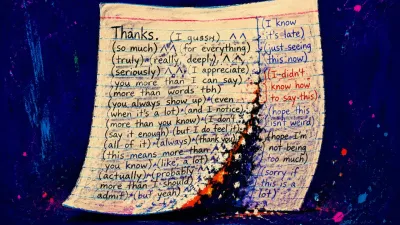
When Work Feedback Feels Like a Verdict: Turn Notes Into Next Steps
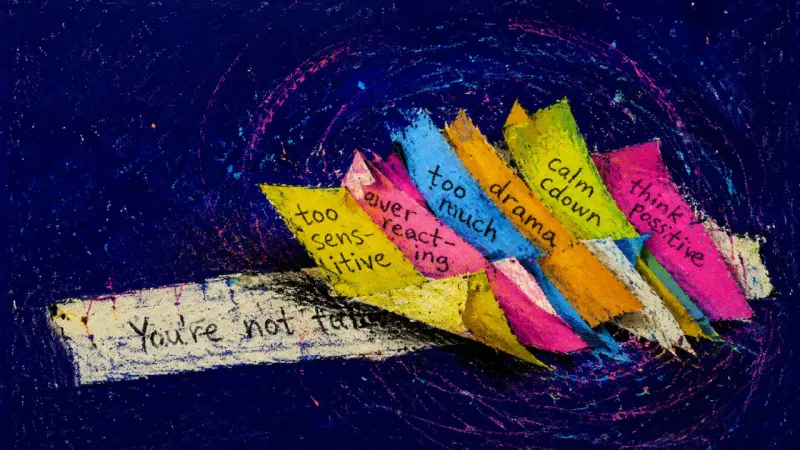
The 8:47 p.m. Slack Ping
You’re a 20-something in a hybrid corporate job in Toronto, and one Slack message from your manager after 6 p.m. can flip your whole body into Fight-or-Flight—classic feedback-triggered imposter spiral.
Taylor said it like she was confessing something embarrassing, even though her face looked perfectly “together” on camera. I watched her eyes keep flicking to the top corner of her screen, as if Slack might ping again just to prove her point.
She described Wednesday at 8:47 p.m. on her couch in a Toronto condo, the CN Tower barely there through the window haze. The fridge did that low, steady hum; her laptop fan made a tiny, irritated whine. She opened Slack, saw her manager’s name, and her stomach dropped so fast she actually pressed her palm to her ribs like she could hold it in place. She reread one sentence three times. Her chest tightened. And then—like a reflex—she started editing the deck like she was trying to erase a mistake before anyone could see it.
“I can handle feedback,” she told me, voice flat with effort. “But I can’t handle what it implies.”
That’s the contradiction right there: you genuinely want to use feedback to improve—and at the same time your nervous system hears critique as, this means I’m not good enough, which turns a normal note into a global verdict. Shame doesn’t announce itself like a headline. It feels more like trying to breathe through a too-tight scarf—quiet, hot, and constant.
I leaned in a little. “We’re not going to argue with your brain tonight. We’re going to map it. We’ll use tarot like a mirror—not to predict your career, but to help you find clarity: what old story gets activated, and what your next step is when feedback lands.”

Choosing the Compass: The Celtic Cross for Workplace Feedback
I asked Taylor to take one slow breath and put both feet on the floor—not as a mystical ritual, just a nervous-system handoff from “everything is urgent” into “we can look at this.” I shuffled slowly, the way I do when I’m listening for the part of someone that’s beneath the words.
“For this,” I said, “I’m going to use the Celtic Cross.”
And for you reading along: the Celtic Cross works especially well for feedback spirals because it separates what’s happening right now (the immediate reaction and the main challenge) from what’s been running underneath for a long time (the root belief). Then it forces the conversation forward into structure: near-future steps, your stance, what support exists in the environment, what you hope and fear, and what integration looks like. In other words, it’s designed to stop you from rereading the same Slack sentence until midnight and instead give you actionable advice and next steps.
“The first card,” I told Taylor, “will show how the feedback lands in your mind and body. The crossing card will show what makes it hard to metabolize without overcorrecting. And the ‘what’s next’ card—near future—will be our bridge out of rumination.”
Reading the Map: How the Spiral Builds
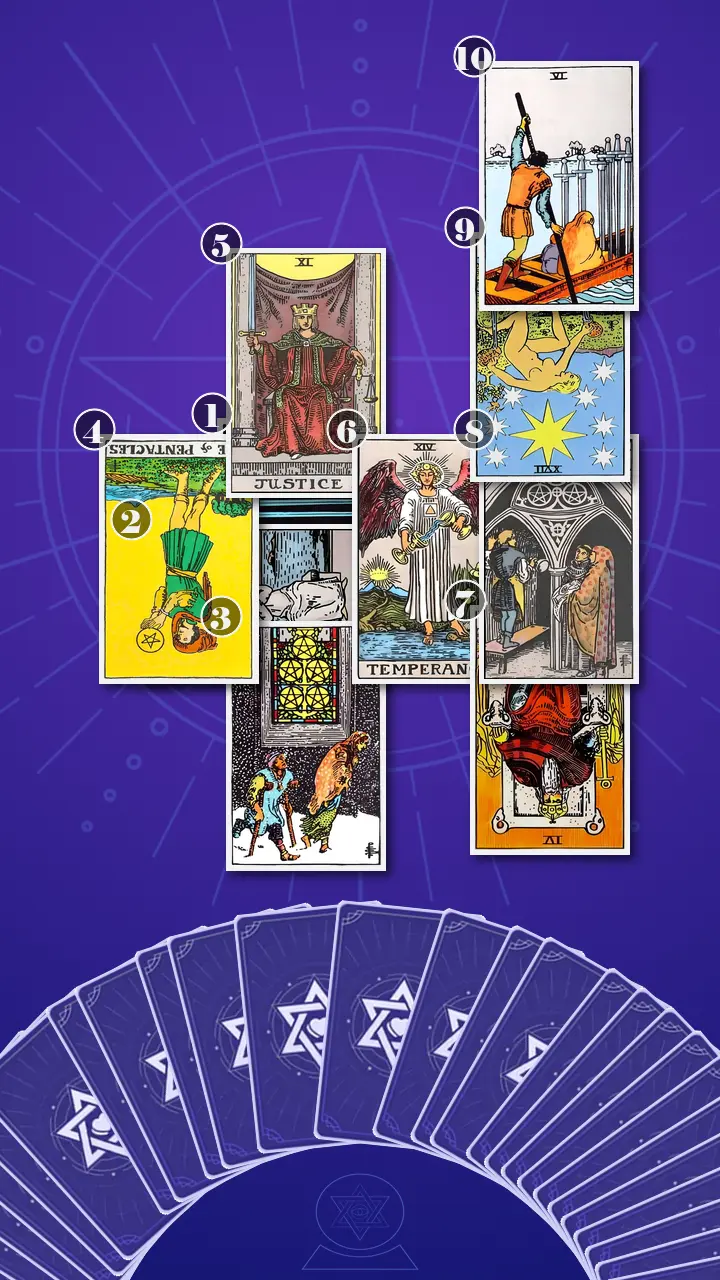
Position 1: The immediate reaction—what the spiral looks like in real time
“Now we turn over the card representing the immediate reaction: how the feedback lands in your mind/body,” I said.
Nine of Swords, upright.
I didn’t even need to dramatize it. The image does that on its own: a person upright in bed, face in hands, thoughts hung up like weapons on a wall.
“This is the 1:00 a.m. laptop moment,” I said, and I used the language that matches real life, not mythology. “You reread the same feedback line like it’s a verdict. You’re mentally screenshotting every ‘mistake’ and pinning it to an invisible wall, then calling it analysis. You’re not revising—you’re trying to control the feeling of being judged.”
In my practice, I lean on what I call Body Signal Interpretation: the body is often the first card we flip, even when we haven’t touched the deck yet. “When you said ‘tight chest’ and ‘buzzing restlessness,’ that’s your system bracing for danger,” I told her. “Not the work being imperfect—you being unsafe.”
Taylor let out a small laugh that sounded like it had edges. “That’s… kind of cruelly accurate.” Her shoulders stayed up near her ears, but her mouth softened—recognition before relief.
“Your brain isn’t ‘dramatic’—it’s trying to manufacture certainty out of missing clarity,” I said. “And the Nine of Swords shows how convincing those thoughts can look when they’re lined up neatly on the wall.”
Position 2: The main challenge—why this feedback is hard to metabolize
“Now we turn over the card representing the main challenge: what makes this feedback hard to metabolize without overcorrecting,” I said.
Two of Swords, reversed.
“This is decision paralysis disguised as being thorough,” I told her. “You toggle between two interpretations—‘they’re helping’ versus ‘they’re disappointed’—and because you can’t choose, you either write an overlong message, change too many things at once, or you wait.”
I pictured what she’d described: Line 1 tunnel lights flashing on her phone screen, Notes app opening and closing, ten possible changes typed and deleted. “The blindfold is the refusal to ask for clarity. The crossed swords are self-protection: ‘If I don’t choose, I can’t be wrong yet.’ Reversed, that protection turns into overload.”
I watched her throat move as she swallowed. Her fingers worried the edge of her sleeve, then stopped—like her body had been caught mid-pattern.
“So when you don’t get a clear priority,” I said, “your mind fills the gap with fear-based certainty. That’s the loop.”
Position 3: The old story at the root—what your nervous system treats as “true”
“Now we turn over the card representing the old story at the root,” I said.
Five of Pentacles, upright.
“This one is the belonging wound,” I said gently, because there’s no point being blunt with a bruise. “The feedback hits and your nervous system hears: ‘You’re outside. You don’t belong.’ So you act like you have to earn your way back in through flawless performance—even when support is right there: mentors, examples, standards, a quick clarifying chat. You just can’t let yourself step toward it yet.”
In the old stories from my family in the Highlands, winter wasn’t a moral failure; it was simply a season with different rules. “This card is like standing outside a warm café in winter because your brain insists you haven’t earned the right to go in,” I said. “But the door is unlocked.”
Taylor’s gaze went slightly unfocused—memory replay. Her breathing paused for half a beat, then restarted lower in her chest. “That’s… the feeling,” she said quietly. “Like everyone else has the membership and I’m borrowing a badge.”
Position 4: The recent backdrop—what’s been sensitizing you to critique
“Now we turn over the card representing the recent backdrop: what’s been building pressure,” I said.
Page of Pentacles, reversed.
“You’ve been in ‘level up’ mode,” I said, “collecting tips, templates, best practices—Notion blocks, saved threads, maybe a few ‘career growth’ videos queued up. But when feedback lands, the learning energy scatters: half-edited drafts, too many notes, no finished iteration.”
Reversed, the Page isn’t lazy. It’s afraid of being seen as a beginner. “The discomfort isn’t incompetence,” I told her. “It’s the fear of being witnessed mid-learning. So you try to skip the messy middle by over-preparing—or by redoing everything.”
She nodded once, tight. “I hate being new,” she admitted, then immediately looked like she wanted to take it back.
“Most high performers do,” I said. “That doesn’t make you broken. It makes you human.”
Position 5: Your conscious goal—what standard you think you should meet
“Now we turn over the card representing your conscious goal: what you think you should do with feedback,” I said.
Justice, upright.
“You want a clean rubric,” I said. “What changes, what stays, what counts as done. When you’re regulated, this is discernment: facts versus assumptions. When you’re spiraling, the scales turn into self-trial.”
I tapped the table lightly near the card. “Justice asks you to weigh evidence before you sentence yourself. Scales before sword. Evaluate proportionally first, then make one precise cut—rather than swinging at yourself.”
Taylor gave me a look that was half relief, half grief. “I want it to be fair,” she said. “I just… don’t know how to be fair to myself when someone else is evaluating me.”
When Temperance Poured Between Two Cups
When I reached for the next card, the room went noticeably quieter. Even through a screen, I can feel when someone stops multitasking internally. It’s like the air stops rattling.
Position 6: What’s next—the most stabilizing, realistic move that converts feedback into action
“Now we turn over the card representing what’s next,” I said. “The most stabilizing, realistic next move.”
Temperance, upright.
Temperance is an angel with one foot in water and one on land, pouring steadily between two cups. No drama. No urgency. Just measured transfer.
Setup: Taylor was right back in that couch moment—Slack ping after hours, chest tightening, rewriting everything like if she moved fast enough she could outrun what the feedback meant.
Delivery:
Stop treating one comment like a fire alarm; start blending what’s useful at your own pace, like Temperance calmly pouring cup to cup.
I let it sit there for a second, the way you let a sentence echo in a stairwell.
Reinforcement: Taylor’s reaction came in layers. First, her breath froze—an almost invisible pause, like her body had been waiting for permission to stop sprinting. Then her eyes widened a fraction and went watery, not in a dramatic way, but in that oh, that’s what I’ve been doing way. Her shoulders dropped, slowly, like someone lowering a heavy backpack they forgot they were carrying. And then she exhaled—long, shaky, from somewhere deep in the ribs.
“But… if I’m not treating it like an emergency,” she said, a flash of irritation rising fast, “doesn’t that mean I’ve been overreacting this whole time?”
There it was: the unexpected edge. Not relief—anger at the cost.
“It means you’ve been surviving it,” I said. “Temperance isn’t telling you you were wrong. It’s offering you a different container.”
This is where my Elemental Balance lens always clicks in: earlier we had Air (Swords) whipping itself into a storm—thoughts as blades, tabs as escape hatches. Temperance brings Water and Earth back into the system: feeling without drowning, action without panic. “Feedback isn’t a verdict. It’s a revision brief you can translate,” I said. “And the ‘magic’ is boring on purpose: one clarifying question, one priority change, one checkpoint. That’s how you build self-trust—through pacing, not perfection.”
I made it concrete, right then. “Right now—under ten minutes—write two lines,” I told her. “(1) ‘What they said (fact): ____.’ (2) ‘My next action (one step): ____.’ If you want, draft a two-sentence clarification and save it as a template. And if this brings up intensity, you can stop and come back later—your pace is part of the practice.”
Then I asked the question that turns insight into memory: “Now, with this new lens—when was the last time you reread feedback for the fifth time, and what single question would have given you a map instead?”
She stared slightly off-screen, like she was replaying last week. Her jaw unclenched. “I could’ve just asked, ‘Which change matters most for this round?’” she said, almost surprised by how simple it sounded. “Instead I rewrote three sections and made it impossible to review.”
That moment—small, exact—is the shift from the starting state (spotlight shame, catastrophizing, overwork) toward the desired state: cautious confidence built through one completed iteration. It’s not about being tougher. It’s about being steadier.
From Courtroom to Workshop, Then to Calmer Water
Position 7: Your stance—how you’re holding power, control, and self-trust
“Now we turn over the card representing your stance: how you’re holding power and self-trust right now,” I said.
The Emperor, reversed.
“This is the ‘control-or-collapse’ swing,” I told her. “You feel like you have to look unshakeable, so questions feel dangerous. Feedback lands like it removes your right to lead your own work. Then you either over-control—redo everything—or you collapse—wait for more direction.”
In my mind I saw the scene she’d described: cursor blinking like a judge, slide formatted for the third time, shoulders locked. That’s the courtroom aesthetic—cold light, rigid posture, Exhibit A: one sentence.
“Your inner Emperor is wearing armor under the robe,” I said. “That makes sense. But reversed, the armor keeps you from learning in public—where learning actually becomes credibility.”
Taylor’s lips pressed together, then released. “I hate how much I care,” she said. “It feels humiliating.”
“It’s not humiliating,” I said, steady. “It’s information. Caring is not the problem. The problem is the story that says caring means you must be perfect.”
Position 8: Your environment—how the workplace context is actually functioning
“Now we turn over the card representing your environment: what support or team dynamics are actually present,” I said.
Three of Pentacles, upright.
“This is the workshop card,” I said, and I felt my own shoulders relax. “It’s collaboration, craftsmanship, shared standards.”
I gave her a modern image: a shared doc open in suggestion mode, comments labeled Must/Should/Nice, someone saying, “Let’s align on the spec,” instead of you guessing alone with 18 browser tabs open. Warm light instead of interrogation light. Open posture instead of clenched jaw.
“Move it from courtroom to workshop: standards on the table, not in your nervous system,” I said.
Taylor blinked, like she hadn’t let herself consider that this could be true. “My manager actually does say ‘let’s jam on it’ sometimes,” she admitted. “I just… never take them up on it. I go private instead.”
“That’s the Five of Pentacles talking,” I said. “Walking past the warm window.”
Position 9: Hopes and fears—what you want feedback to confirm, and what you fear it confirms
“Now we turn over the card representing hopes and fears,” I said.
The Star, reversed.
“You want steady confidence,” I said, “but your brain treats optimism as unsafe. So you only trust urgency and self-pressure. Even when feedback includes positives, you discount it—like the good parts don’t count.”
It’s a brutal pattern because it keeps you hungry. “The Star reversed fears that if you relax, you’ll get exposed,” I said. “And it hopes someone will finally say the exact sentence that makes you feel you belong.”
Taylor’s voice got small. “I want them to say I’m doing well,” she said. “But when they do, I assume they’re being nice.”
“That’s not a personality flaw,” I said. “That’s a nervous system that learned praise isn’t reliable, but pressure is.”
Position 10: Integration trajectory—what becomes possible when you don’t make it about your worth
“Now we turn over the card representing integration: what becomes possible when you work with feedback without making it about your worth,” I said.
Six of Swords, upright.
“This is a transition plan,” I said. “Not a personality makeover.”
I described the image in plain language: a boat crossing to calmer water. The swords come along, but they’re upright and carried—thoughts transported, not used as weapons. “It’s like switching from doomscrolling to GPS,” I told her. “You don’t need certainty. You need directions.”
And it echoed what Temperance promised: a paced process that moves you forward even when you don’t feel confident yet. Iteration, not overhaul.
The One-Page Temperance Translation: Actionable Next Steps
I pulled the whole spread together for her, like threading beads onto one string.
“Here’s the story your cards told,” I said. “Feedback lands (Nine of Swords) and your mind turns it into a night trial. The challenge is that you freeze in ambiguity (Two of Swords reversed), so you try to regain control by rewriting and over-explaining. Underneath, there’s an old belonging fear (Five of Pentacles): ‘If I’m not excellent, I’m out.’ Recently, you’ve been pressuring yourself to level up fast (Page of Pentacles reversed), so critique hits an extra-tender place. Consciously, you’re craving fairness and a clean standard (Justice)—but your inner system turns fairness into punishment. Temperance is the bridge: translate feedback into a measured process. The Emperor reversed shows the shaky self-authority that makes critique feel like a legitimacy threat. The Three of Pentacles says your environment is more workshop than courtroom. The Star reversed names the hope-block: you can’t feel progress. And Six of Swords is the outcome: calmer water through a simple plan.”
“Your cognitive blind spot,” I added, “is that you think your only options are: be un-criticizable or be exposed. That’s a false binary. The transformation direction is the key shift: from ‘feedback equals judgment’ to ‘feedback equals a collaborative revision brief I can translate into next actions.’”
Then I gave her a small, specific system—because shame hates vagueness, and nervous systems love maps.
- The Temperance Translation Note (2 minutes)Open a sticky note or a Notion block and write: (1) What’s the feedback (fact)? (copy the sentence verbatim) (2) What’s my story (interpretation)? (one line) (3) What’s the next action? (one change only).If you catch yourself writing a paragraph, stop. Facts are short; stories sprawl.
- The Two-Sentence Clarifier (within 48 hours)Send: “Just to confirm, you’re asking for X. For this round, should I prioritize X or Y?” Then stop—no defense brief, no extra context.One clear question beats a perfect paragraph. If you start adding justification, delete every sentence that begins with “Just,” “I thought,” or “I wanted to explain.”
- The 25-Minute Single-Section Revision SprintSet a phone timer for 25 minutes. Revise only the section the feedback points to. Save/export at the end of the timer even if it isn’t perfect.Iteration builds credibility faster than overhaul. Your goal is a clean next version, not a flawless final.
And because her body was part of the pattern—not an afterthought—I offered one of my simplest grounding tools as an optional add-on: my 5-minute balcony energy awakening practice. “When the chest-tight buzz hits,” I said, “step onto a balcony or outside the building entrance. Feel the actual air temperature for ten breaths. Name what’s happening: ‘shame spike.’ Then choose the smallest next action: ‘highlight the section.’ Not the whole solution.”
If she didn’t have a balcony, I gave her my other favorite: the shower water-flow meditation. “Let the water hit the back of your neck for 30 seconds,” I said. “Not to ‘wash away’ the problem—just to tell your nervous system it’s not in immediate danger.” Toronto weather, Highland wisdom: the body believes what it can feel.

A Week Later: Ownership, Not Certainty
A week later, Taylor emailed me a screenshot—cropped tight, like she didn’t want to jinx it. Two sentences to her manager. No apology. No eight-line explanation. Just the restatement and the priority question.
“I hit send,” she wrote. “My chest still did the thing. But I didn’t rewrite the whole deck. I did one 25-minute sprint, saved the version, and went to bed.”
It wasn’t a movie-ending transformation. It was better than that: it was real. Clear but still a little tender. She slept a full night, then woke up and her first thought was, What if I’m wrong?—and this time she exhaled and opened the file anyway.
When I think about her Journey to Clarity, I don’t remember a dramatic breakthrough. I remember Temperance: the steady pour. Feedback as data about the work, not a verdict about the self.
And if you’re reading this with that familiar chest-tightening spotlight feeling—when one comment lands and your chest tightens like you’re back under a spotlight, it’s not the feedback that hurts most—it’s the old fear that this is proof you don’t belong.
If you treated the next piece of feedback as a revision brief—not a verdict—what’s one small clarification you’d feel willing to ask, just to give yourself a map?
Every reading at AceTarot is a Journey to connect with inner wisdom and empower next step.
Learn more about our Journey to Clarity.