From Burnout-Driven Instant Replies to Clear Terms With an Ex-Boss

The 8:47 p.m. Ping That Steals Your Couch
You’re a late-20s project manager in Toronto who can feel your stomach drop the second your old boss’s name pops up on Slack—classic Sunday Scaries, just in notification form.
Jordan said that to me like she was confessing something slightly embarrassing, even though her body had already told the truth. It was 8:47 p.m. on a Thursday in her condo, TV running in the background like a screensaver. Her phone lay face-up on the coffee table. Slack lit up. The glow looked harsh against the dim room, and right on cue the fridge compressor clicked on—suddenly loud, like the apartment itself had noticed the message.
“My shoulders snap tight,” she told me, rubbing the place where neck becomes shoulder, like she could knead the reaction out. “And I’m typing before I even decide to. I write, ‘Totally!’ with, like, three exclamation points. I don’t even feel ‘totally.’”
A Slack ping can hijack your nervous system faster than your logic can catch up.
She exhaled, the kind of breath that sounds like you’ve been holding a shopping bag that’s cutting into your fingers. “I keep Slack installed. Notifications on. I answer outside work hours. It starts as a ‘quick’ thing and then it’s real labour. And then I replay the whole exchange afterward and I’m too drained to do my actual life.”
As she spoke, I watched her jaw do that tiny clench-release-clench loop, and I knew this wasn’t just a boundary question. It was decision fatigue dressed up as professionalism: an always-on accessibility disguised as reliability.
“I want rest,” she said, staring at her own hands, “but I don’t want to burn bridges. I don’t want to look ungrateful. Or… difficult.”
To me, it sounded like living with an always-unlocked door—anyone can knock and walk in, even when you’re trying to sleep. Her exhaustion had a texture to it: like swimming through grey syrup while someone keeps tapping the glass, asking, Quick question?
“Okay,” I said gently. “Let’s not debate this in your head for another week. We’ll give the fog a shape. We’ll look at what the ping activates, what keeps it running, and what boundary actually heals the burnout—something you can do without turning into a different person overnight. This is a journey to clarity, not a personality transplant.”

Choosing the Compass: The Celtic Cross · Context Edition
I asked Jordan to take one slow breath in through her nose and let it out longer than it came in. Not as a ritual to impress the universe—just a clean on-ramp from “reacting” into “observing.” Then I shuffled, steady and unshowy, the way I used to teach on ships crossing the Atlantic: not about magic, about attention. When attention steadies, choices appear.
“Today,” I said, “we’re using the Celtic Cross · Context Edition.”
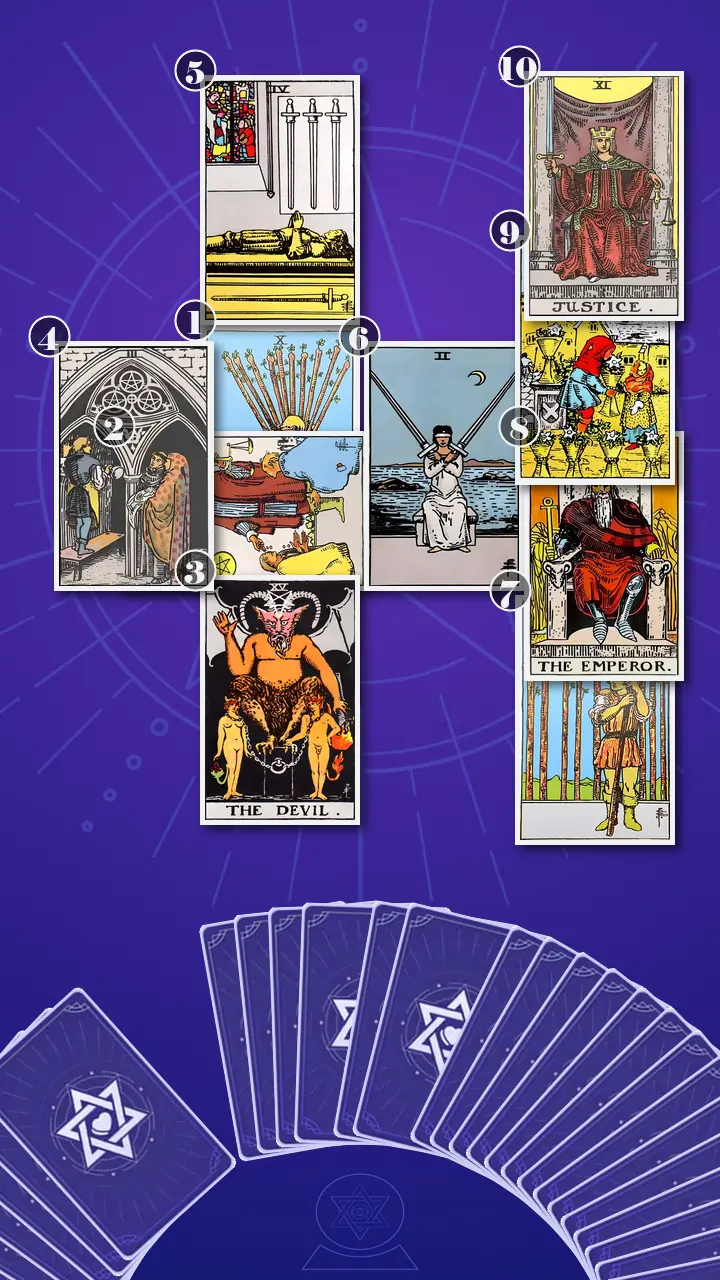
For anyone reading along and wondering how tarot works in a situation like this: I’m not using the cards to predict whether her old boss will become a villain, or whether Jordan will get punished for having boundaries. This spread is built to map a chain—present behavior → immediate obstacle → deeper fear → conditioning → conscious aim → next decision point—then it climbs into the external pressure, the emotional knot, and finally the most restorative boundary. It’s a practical map for a career crossroads where your nervous system is voting louder than your calendar.
This version of the Celtic Cross is especially good for a dynamic like “old boss + Slack” because the problem isn’t just workload; it’s power, access, and worth. Position 8 is tuned to the digital always-on environment. Position 10 is tuned to the healing boundary—what restores energy through clear terms, not wishful thinking.
“The first card,” I told Jordan, “shows what the ping activates in you right now—the visible burnout pattern. The second shows what makes a clean boundary hard in the moment. And the last card points toward the boundary that actually repairs your recovery—your next steps, not a vague vibe.”
Reading the Map: The First Cards in Context
Position 1: What the Slack ping activates right now
“Now opening,” I said, “is the card that represents what the Slack ping activates right now: the most visible burnout pattern in your behavior and attention.”
Ten of Wands, upright.
This is the card meanings in context moment where everything gets painfully literal. Ten of Wands is the “just one more thing” card—carrying, carrying, carrying until you’re bent around the load. And your modern-life version is exactly it: you’re ‘off’ for the night, but the second your old boss pings on Slack you pick up the whole invisible workload again—replying fast, offering extra help, and then feeling that heavy energy drop like you just carried work home in your arms.
Energetically, this is excess: too much responsibility flowing into one narrow channel. The bundle of wands blocks the figure’s view, and that’s what Slack does to you—one notification narrows your world until rest and choice disappear.
Jordan gave a small laugh that had no humor in it. “That’s… brutal,” she said. “Like, yes. It’s ‘one message,’ and suddenly I’m doing unpaid overtime in disguise.”
I nodded. “Your brain is running 28 browser tabs, and Slack is the one that auto-plays audio whenever it wants.”
She blinked hard, like she was trying not to be dramatic about how accurate that felt.
Position 2: The immediate challenge
“Now opening,” I said, “is the card that represents the immediate challenge: what makes it hard to hold a clean boundary in the moment.”
Six of Pentacles, reversed.
The hard part isn’t saying yes or no—it’s that the request arrives with implied authority but zero explicit terms. You end up donating time, attention, and emotional labour (tone management) because the channel (Slack) quietly sets expectations.
Reversed, this card is a blockage in fair exchange. Think of it as doing subscription-level support on a free trial. The “favour” has no scope doc, so it quietly becomes a project. You’re paying with nervous system bandwidth instead of getting a clear agreement.
As I spoke, I slipped into the echo that always lands here—a split-screen:
Screen A: “It’s just a favour.”
Screen B: “Why do I feel like I owe them?”
And right in the middle of that split-screen is the missing thing: terms. Not “nice tone.” Not extra context. Not three exclamation points. Terms.
“Don’t pay with burnout when you can ask for a scope and a channel,” I said, keeping my voice clean.
Jordan’s face did that slow shift from defending herself to recognizing herself. A slow nod. A quiet, almost embarrassed, “Oh… yeah.” Her fingers worried the edge of her sleeve like she was holding back the urge to explain herself to me, too.
Position 3: The root driver underneath it all
“Now opening,” I said, “is the card that represents the root driver: the deeper fear or attachment that keeps the pattern running.”
The Devil, upright.
You know you could mute Slack, but it feels like you can’t—because some part of you equates instant responsiveness with safety, stability, and future opportunity. The compulsion isn’t about the message; it’s about relief from the fear spike.
Energetically, this is a blockage that masquerades as control. The Devil doesn’t usually show up as “I’m trapped.” It shows up as “I’m being smart.” “I’m networking.” “I’m staying professional.” But the chains in this card are loose—meaning the door isn’t locked. Your nervous system just believes it is.
Jordan swallowed. “If I don’t reply fast, I’m scared… it proves I’m not safe. Like I’ll lose goodwill. Opportunities. Like it’ll confirm I’m not stable.”
“That’s the real sentence,” I said. “Not the Slack message.”
Position 4: The recent setup—what trained you
“Now opening,” I said, “is the card that represents the recent setup: what you’ve been trained or conditioned to do in work relationships that shaped this dynamic.”
Three of Pentacles, upright.
You learned to be ‘valuable’ by being evaluated well—fast replies, helpfulness, competence on display. So when your old boss messages, you slip back into being the person who’s trying to earn approval in real time, even though that job is over.
Energetically, this is balance in skill—but with an old hook: your body still behaves like it’s under review. Jordan’s shoulders lifted a fraction as I said it, like her posture remembered the performance before her mind did.
“Yeah,” she admitted. “Every message feels like a mini-review.”
Position 5: Your conscious aim
“Now opening,” I said, “is the card that represents your conscious aim: what you think you ‘should’ do to feel better or regain control.”
Four of Swords, upright.
You’re craving a real recovery container: an evening where your phone isn’t part of your body and your brain can actually come down. Not a more efficient way to keep engaging—an actual protected pause.
This is balance trying to return. The card shows a quiet, enclosed sanctuary. In plain language: rest doesn’t land when it’s merely desired. It lands when it’s protected.
Jordan’s eyes softened for the first time. “That’s… exactly it. I keep trying to ‘earn’ rest by finishing everything. But it never ends.”
Position 6: The next decision point
“Now opening,” I said, “is the card that represents the next decision point: the boundary moment that’s approaching and how your nervous system wants to respond.”
Two of Swords, upright.
A boundary moment is coming where you’ll feel frozen between being helpful and protecting yourself. You’ll want to write the perfect, painless reply—when what you actually need is one clean decision (like switching channels) delivered calmly.
Energetically, this is containment, not aggression. Crossed swords are a firm stop. The blindfold is the warning: don’t decide from imagined judgement alone.
I let the language go short here, on purpose—matching the freeze moment.
“Lock screen.”
“Thumb hovering.”
“Breath held.”
Jordan’s shoulders rose like she’d just watched herself do it.
“If it feels weird to set the boundary, that doesn’t mean it’s wrong—it means it’s new,” I reminded her.
She let out the tiniest exhale, almost a whistle. The kind of breath that says, Maybe I can do one small thing.
Position 7: Your stance—how you’re showing up internally
“Now opening,” I said, “is the card that represents your stance: how you’re showing up internally while trying not to burn out.”
Nine of Wands, upright.
You’re resilient, but you’re also bracing—functioning while half-expecting the next demand. You can hold the line, yet relying on willpower every night keeps you in guarded mode instead of true recovery.
This is excess in vigilance. The fence-like wands in the background are your clue: what you need is a built boundary—settings and scripts—so you don’t have to white-knuckle your evenings.
Jordan gave me a look that was half relief, half accusation. “So I’m not weak,” she said, “I’m just… constantly on guard.”
“Exactly,” I said. “And guards get tired.”
Position 8: External boundary pressure—the channel and power dynamic
“Now opening,” I said, “is the card that represents external boundary pressure: the channel, power dynamic, and implied expectations coming from the old boss and the always-on context.”
The Emperor, upright.
The ping feels ‘official’ because of who it’s from and the channel it’s in. Even casual wording lands like an order. This isn’t just personal anxiety—it’s a power-and-structure dynamic that calls for structural limits (rules, not vibes).
Energetically, this is structure—but it’s currently sitting outside you. The Emperor is the rule-setter. Right now, Slack is acting like his throne: same channel, same old hierarchy, same body response.
I watched Jordan’s jaw tighten again. “Even when it’s like, ‘Hey! Quick thing,’” she said, “my body hears, ‘Do it now.’”
“Yes,” I said. “Your body stored the org chart.”
Position 9: Hope and fear—the emotional knot
“Now opening,” I said, “is the card that represents hope and fear: the emotional knot that makes the boundary feel risky.”
Six of Cups, upright.
You want to keep the relationship warm and uncomplicated, because the past story matters: they helped you, you don’t want to seem ungrateful. But nostalgia can blur the present reality—your capacity changed, and the container needs updating.
Energetically, this is tenderness—and that’s not a flaw. The trouble is when tenderness replaces terms. A gift can be sincere and still need boundaries to stay healthy.
Jordan’s eyes went shiny, just for a second. “I don’t want them to think I’m… different now.”
“You are different now,” I said softly. “You’re more honest about your capacity.”
When Justice Spoke: Replacing Access with Fair Terms
I paused before turning the next card. The room felt quieter—like even the city had lowered its volume. Outside my window, I could hear a distant streetcar bell, and it reminded me of Venice: how a single clear sound can cut through water and fog. Some moments need that kind of clarity.
“Now opening,” I said, “is the card that represents the most healing boundary to restore burnout recovery: what ‘fair terms’ look like when you act with self-respect.”
Justice, upright.
And before I said anything else, I anchored it in the simplest professional truth in the room: Professionalism isn’t instant access; it’s clear terms.
Setup: It’s 8:47 PM, you’re finally off the clock, and then Slack lights up with your old boss’s name. Before you even read the message, your jaw tightens—like your body thinks you’re about to be evaluated. You’re trapped between “be helpful” and “be okay,” and your brain starts drafting the perfect reply to avoid imagined fallout.
Delivery:
Not “I have to stay instantly reachable,” but “I can be fair and clear,” like Justice’s scales that balance your energy with your obligations.
Reinforcement: Jordan’s reaction came in a chain—fast, physical, honest.
First: a freeze. Her breath stopped mid-inhale. Her hands went still in her lap, fingers slightly curled, like she’d been caught holding something too heavy.
Second: the thought landed. Her eyes unfocused for a heartbeat, as if her brain replayed a dozen Slack threads at once—the ones where she sounded bright and agreeable while her shoulders climbed toward her ears.
Third: the release. Her shoulders dropped a fraction. Her jaw unclenched. She let out a shaky breath that sounded like grief and relief mixed together. “But if I’m ‘fair and clear,’” she said, voice sharper than before, “doesn’t that mean I’ve been… wrong? Like I’ve been doing this to myself?”
There it was—the brief anger that sometimes shows up right when clarity arrives, because clarity implies choice.
“It doesn’t mean you were wrong,” I said. “It means you were coping. Your nervous system was trying to buy safety with speed.”
This is where my own work—Jungian psychology and the body’s language—always steps in. I use what I call an Energy Flow Diagnosis: not medical, not a diagnosis in that sense—just noticing where the psyche and the body hold the story. “When you talk about replying,” I said, “your shoulders creep up, and your jaw locks. That’s a classic ‘responsibility overload’ signal. Your body is acting like the canal gates are jammed—everything rushes into one narrow place and it backs up.”
She blinked. “A canal?”
“I’m Venetian,” I said with a small smile. “In Venice, water needs circulation. If you don’t set gates and routes, it stagnates—or it floods. Your evenings are flooding because access has no gates. Justice is a gate. A structure. A clean agreement.”
I leaned in, voice calm and very specific. “Where is your energy in the equation? Justice asks you to put it on the scales, not hide it as the invisible cost of being ‘nice.’”
Then I asked the question that makes this card practical instead of poetic. “Right now,” I said, “how much of your reply is actual work—and how much is tone-policing to avoid being judged?”
Jordan’s mouth opened, then closed. She stared at the card. “It’s… mostly tone,” she whispered. “I write paragraphs so they can’t misunderstand me.”
“And Justice holds a sword,” I said. “That sword is the short sentence. Not punishment. Precision.”
I let the silence sit for a beat, and then I invited her into the new lens. “Now, with this perspective, think back to last week. Was there a moment—one ping—where ‘fair and clear’ would’ve changed how you felt in your body?”
She nodded slowly. “Saturday,” she said. “Queen West. I had a latte. It was supposed to be a calm morning. And I just… volunteered. Again.”
Her shoulders dropped again, as if her body understood the alternative before her mind fully trusted it. That’s the shift: from hyper-alert obligation toward the first edge of steadier self-respect. Not certainty. But a container.
The One-Page Justice Policy: Actionable Advice and Next Steps
When I stepped back and looked at the whole spread, the story was coherent—and honestly, kind to Jordan.
The Ten of Wands showed the visible burnout loop: you pick up “just one more thing” until your evenings become unpaid overtime in disguise. The Six of Pentacles reversed explained why it keeps happening: the exchange is unclear, so you pay with energy instead of getting fair agreement. The Devil named the engine underneath: “access = safety,” a compulsion loop disguised as networking. The Three of Pentacles and Emperor showed the conditioning and power dynamic—your body still thinks you’re being evaluated. And the Four of Swords told the truth: you’re not craving a better system for being available; you’re craving a protected place to recover.
The cognitive blind spot here is subtle but relentless: believing that responsiveness is your value. The transformation direction is equally clear: shift from proving reliability through instant access to demonstrating professionalism through clear terms—channel, hours, scope. In other words: move from vibes-based work to terms-based work.
I told Jordan, “We’re going to make your boundary operational. Not inspirational.”
Then I offered next steps designed for real life—low friction, copy-paste-able, and gentle on a tired nervous system.
- The 3-minute Fair Terms DraftOpen Notes and write one reusable boundary sentence that sets channel + response window: “Hey—happy to help when I can. I’m not on Slack outside work; email me and I’ll reply during business hours.” Save it as “Justice Line.” Don’t send it yet.If your brain starts over-writing, stop at one sentence. One clean sentence beats ten perfect paragraphs.
- Build the fence (settings, not willpower)Tonight, set Slack to mute notifications from 6:30 PM to 8:30 AM (or use iPhone Focus / Android Focus). If full mute feels too big, turn off badges and banners first—reduce the “always-on” cue.Expect guilt. Treat it like weather, not a command. Start with a tiny container (evenings) rather than a forever rule.
- The one-line scope gateOn the next ping, reply with one clarifying line before doing any labor: “What’s the deadline and what exactly do you need from me?” Then stop. No bonus solutions. No extra context.If your chest tightens mid-reply, set a 60-second timer, exhale longer than inhale, and come back only to send that one line.
Because Jordan’s body was already carrying the story in her shoulders and jaw, I added a tiny nervous-system bridge—one of my Quick Recovery Techniques that can be done between meetings or on the TTC: “Drop your shoulders on an exhale. Unclench your teeth. Press your feet into the floor for five seconds. Then soften your gaze. It’s a three-minute reset, but it tells your body, ‘We’re not in trouble.’”
And I used my Venetian Aqua Wisdom frame to make it stick: “You’re not cutting someone off. You’re redirecting flow. Slack is a canal that floods your house. Email is a canal with banks. Business hours are gates. Justice is you deciding where the water is allowed to go.”
Finally, because she works at a desk all day, I offered one modern, non-mystical support: “When you draft your boundary, sit back in your chair, drop your shoulders, and let your jaw be loose. It’s a desk posture correction moment. Your body learns the policy along with your words.”

A Week Later: The Quiet Proof
Six days later, Jordan messaged me: “I did the Focus schedule. And I sent the redirect once. I didn’t explain. I didn’t apologize. I just… did it.”
She told me she’d done it on a Tuesday, alone in a coffee shop after work—no big victory lap. She hit send, stared at her empty inbox for three minutes, and felt a flicker of fear. Then, unexpectedly, her shoulders dropped. She drank her latte while it was still hot.
That’s what I mean by a journey to clarity. Not a perfect nervous system. Not a magically chill relationship with work. Just the first evidence that your rest can stop being negotiable.
When their name lights up your phone and your shoulders tense before you’ve even read the message, it can feel like you have to choose between being “good” and being okay.
If you didn’t have to prove your reliability through instant access, what’s one small ‘term’ you’d want your evenings to live by—channel, hours, or scope?
Every reading at AceTarot is a Journey to connect with inner wisdom and empower next step.
Learn more about our Journey to Clarity.