Congrats Text, LinkedIn Tabs, and the Sentence That Loosened the Loop

Finding Clarity in the 8:47 PM Scroll
When Maya (name changed for privacy) came onto my screen from Toronto, she asked me a question I hear in different forms from a lot of late-20s professionals: “Why can’t I just be happy for my friend who got the job I wanted?” Whenever I hear that exact blend of guilt, envy, and embarrassment, I do not hear pettiness. I hear career grief. I hear LinkedIn comparison fatigue. I hear a comparison-triggered self-worth crash that has not been named yet.
She told me about 8:47 p.m. on a Tuesday, on the TTC heading north after work. The train brakes were shrieking into the station, fluorescent lights buzzing overhead, and her phone felt warm in her hand as she toggled between a drafted “So happy for you!!” text, the saved job posting, and her friend’s new LinkedIn title. She said, “I did mean the congratulations. That’s the worst part.” Her chest tightened anyway. Her face went hot anyway. Her stomach dropped anyway. The contradiction was brutal: she cared about her friend, and her body still reacted like she had just gotten rejected all over again.
As she spoke, I could feel the real shape of the pain. It was not clean jealousy. It was the kind of feeling that smiles politely in the group chat while dragging a suitcase full of wet cement through your ribs. Or, more simply, like having twenty-seven tabs open and still only being able to see the three that went wrong. In my work, I call that an attention lock. In ordinary life, it feels like shame with a Wi-Fi connection.
“I know she deserves it,” Maya told me, rubbing the side of her thumb against the edge of her mug. “And I still hate that it wasn’t me. I sent the congrats text, and then I immediately felt worse.”
I nodded. “That makes sense to me,” I said. “Envy can be grief before it learns how to speak. We are not here to make you into a nicer version of yourself on command. We’re here to figure out what actually got hurt, and then let’s draw a map through that fog.”

Why I Chose the Shadow Spread for Career Grief
I asked Maya to put both feet on the floor, take one slow breath, and hold the question without polishing it. Then I shuffled slowly on camera. I do not treat that moment as theater. It is simply a way to help the nervous system cross a threshold—from reacting to observing.
For her reading, I chose a five-card spread I use often in cases like this: The Shadow Spread · Context Edition. This is how tarot works best for me in moments of job envy and self-worth repair: not as a fortune machine, and not as a verdict, but as a clean pattern map. Maya was not trying to decide between two offers or asking me to predict her future. She was trying to understand why her friend’s success felt so personal, and why one rejection had started acting like proof that she was less valuable.
The Shadow Spread is useful because it separates things that usually get tangled together. The first card shows the visible symptom—the behavior you can actually catch yourself doing in the ten minutes after the trigger. The middle of the spread reveals the defensive story and the deeper wound underneath it. Then the fourth card gives the medicine, the inner quality that can hold the feeling without collapsing into shame, and the fifth card brings us back down to earth with one grounded next step.
I laid the cards in a straight line from left to right. I always like that layout for this kind of question. It reads like walking through a narrow tunnel and out onto open ground.
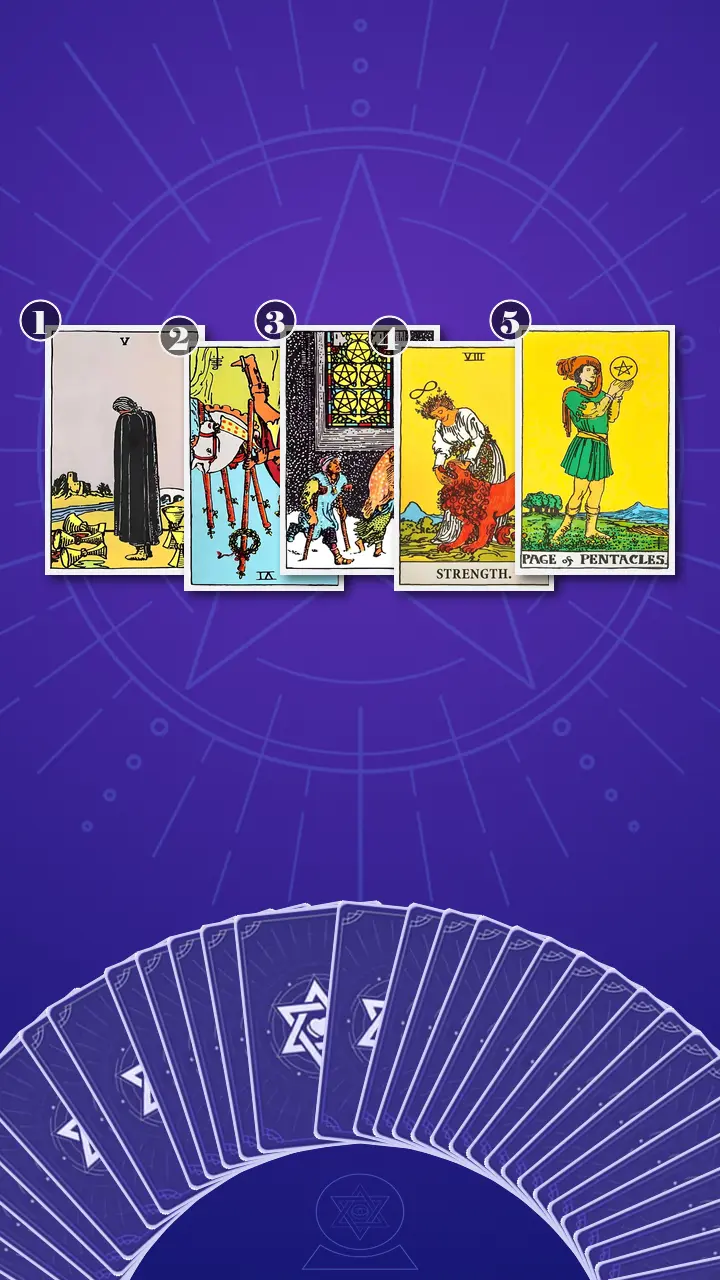
The Cups, the Crowd, and the Cold Street
Position 1: The Commute Loop That Called Itself Strategy
Now I turned the card that represents the concrete comparison behavior and grief response activated by losing the role to a friend. It was the Five of Cups, upright.
“This card is your TTC ride,” I told her. “This is you sending the warm congratulations text and then immediately reopening the saved job description, the rejection email, and your friend’s profile until the whole commute turns into a loop around what you didn’t get.”
The Five of Cups is grief in visible form. In energetic terms, it is water that has gone from healthy feeling into fixation. Not because the feeling is wrong, but because the attention has narrowed so hard that only loss stays lit. On the card, the figure faces the three spilled cups and misses the two still standing behind them. In Maya’s life, those three spilled cups were almost literal: the tabs she kept reopening, the interview answers she kept rescoring, the alternate versions of herself she kept cross-examining.
I asked her, “What are you actually mourning besides the title?”
She looked down almost immediately. “Creative ownership,” she said. “Momentum. The feeling of finally being chosen for the kind of work I actually want.”
That was the card doing its job. The Five of Cups was not accusing her of being dramatic. It was asking her to stop calling grief ‘just data.’
Maya let out a quick laugh, the kind with no real amusement in it. “Okay,” she said, “that’s almost rude.” Her shoulders lifted toward her ears and then dropped. The laugh told me her defenses were loosening. The exhale told me the recognition had landed.
Position 2: When LinkedIn Became a Leaderboard
The next card was the one revealing the self-judging storyline that turns one hiring outcome into a status ranking. It was the Six of Wands, reversed.
“This,” I said, “is the moment disappointment turns public in your head. Your friend posts the new title. The reactions stack up. Mutuals comment. Maybe someone says she’s crushing it. And suddenly you’re not reading a job update—you’re reading a scoreboard.”
The Six of Wands normally carries recognition, visibility, and earned success. Reversed, that fire distorts. It becomes validation hunger, performance panic, and the habit of treating visibility like value. Maya was not only upset about not getting the role. She was upset because the role had become a public ranking event. Very Black Mirror, very social-score, very modern white-collar brain.
“Your friend’s offer is not your performance review,” I told her. “Visibility is not value.”
I saw the sentence hit. She gave me a tight nod and a small wince at the same time, which I have learned is often the body’s way of saying, unfortunately, yes. Then she admitted the sentence that flashed through her mind every time she saw her friend’s update: “Everyone can probably tell who was chosen and who wasn’t.”
That was the defensive story right there. In energetic language, her fire was not absent. It was over-aimed outward. Ambition had been hijacked by optics. Instead of asking, “What do I want to build next?” she had been asking, “What does this make me in comparison?”
Position 3: The Keycard Story Beneath the Comparison
The third card sits at the center of this spread for a reason. It uncovers the underlying worth wound and fear of being the one not chosen. I turned it over and found the Five of Pentacles, upright.
I felt myself slow down. “This is no longer just about LinkedIn,” I said. “This is the part that gets triggered late at night, when the apartment is quiet, rent is humming in the back of your mind, and one rejection stops feeling like one outcome. It starts feeling like everybody else has a keycard to the next room and you somehow don’t.”
The Five of Pentacles is earth under scarcity pressure. It is not just disappointment; it is exclusion. The story becomes: maybe I am the one who gets left outside. On the card, the figures pass a lit window without being able to take in its warmth. In Maya’s life, that lit window was still there too—mentors, skills, friendships, existing work experience, transferable talent—but her pain was louder than her access to any of it.
At the planetarium, I spend a lot of time explaining that the darkest patch of sky is not necessarily empty space. Often, it is structure your eyes have not adjusted enough to see. Looking at this card, I had the same thought. Shame narrows the aperture. It makes support feel further away than it is.
“Not chosen is not the same as not worthy,” I said quietly.
Maya did not answer right away. Her eyes went wet, but not dramatically; just that quick brightening that happens when somebody has been carrying a sentence for a long time and finally hears its opposite. She folded one arm across her stomach and took a long, uneven breath. The defensiveness was gone now. What remained was sadness, which was progress.
When Strength Put a Hand on the Lion
Position 4: The Medicine That Did Not Ask Her to Be Nicer
When I turned the fourth card, the atmosphere changed. Even through a screen, I felt it. Behind Maya, the hum of the fridge clicked off, and the sudden quiet in her kitchen seemed to lean toward us. This was the position that names the inner quality able to hold disappointment without collapsing into shame, resentment, or fake niceness. The card was Strength, upright.
“Good,” I said before I could stop myself. “This is the antidote.”
Strength is not forced positivity. It is regulated fire. It is emotional steadiness. It is the part of you that can say, “I am hurt, and I care about her,” without trying to make one of those truths cancel the other. The woman on the card does not beat the lion into obedience and she does not let it run the road. She meets it. She holds it. I often explain this card with a city image: like walking a strong dog through a busy intersection—not yanking it, not letting it drag you into traffic, just keeping contact.
Then I gave Maya the astronomy version, because it was the clearest thing in my mind. “In my own shorthand,” I told her, “this is a Binary Star System problem. Your attention has become tidally locked to your friend’s win. One face of you keeps turning toward the same bright event, over and over, until it starts to seem like her orbit is the only thing defining the sky. Strength breaks that tidal lock. It gives you your own gravity back.”
The sentence that changed the room
Envy is sometimes grief with nowhere honest to go. The moment you stop turning it into a verdict on your worth, it stops running the whole story.
Stop treating the lion of disappointment like proof that something is wrong with you; hold it gently, and it becomes strength that carries you back to your own path.
For a second, Maya went completely still. First came the physical freeze: her fingers stopped halfway around the mug, and even her blinking slowed. Then I watched the thought move through her. Her eyes slid past me and unfocused, as if she were back on that subway platform replaying the same interview answers again, but from slightly outside herself this time. Then the resistance showed up. “But if that’s true,” she said, and there was heat in her voice now, “doesn’t that mean I’ve been doing this to myself?”
“No,” I said. “It means you’ve been trying to turn pain into data because data felt safer than grief.”
That landed differently. Her jaw loosened. One hand came up to her chest almost automatically, like her body had reached the insight before her mind finished catching up. She let out a shaky breath that broke into half a laugh, half a near-tear sound, and her shoulders dropped in a way that made her look briefly lighter and also a little unsteady—the way people do when they set down a heavy bag and realize how much effort it took to carry it. I asked her, “If you had held it this way last Tuesday, on the train, what might have changed?” She looked at the card and whispered, “I think I would’ve said I was hurt instead of opening LinkedIn again.”
That was the hinge of the whole reading: not from jealousy to sainthood, but from guilt-soaked envy and comparison loops to honest grief and grounded self-trust. A small shift in language, yes. A huge shift in orbit.
Back to Your Own Lane
Position 5: One Clean Tab, One Real Step
The final card points to one grounded career-facing action that rebuilds self-trust without forcing fake positivity. It was the Page of Pentacles, upright.
“Perfect,” I said. “Because this reading does not end with a personality improvement project. It ends with one real move.”
The Page of Pentacles is grounded earth. Focused earth. Apprentice energy. This is Maya closing the comparison tabs and spending one focused block of time updating a portfolio case study, rewriting one résumé bullet, booking one coffee chat, or honestly reviewing one skill the role required. Not six panic applications. Not a dramatic reinvention by Friday. Just one clean checklist. One tab. One step.
I told her, “This card brings you back to your lane. The question now is not whether you can win the entire race by tomorrow. It’s whether you can give steady attention to one small thing that is actually yours.”
Maya finally looked relieved. “I can do thirty minutes,” she said. “Forty-five sounds like I’m pretending to be a better person than I am this week.”
I smiled. “Then thirty minutes it is. No spiritual bonus points for suffering. The smallest version still counts.”
That is the Page of Pentacles exactly: ambition made usable again. The emotional weather had shifted enough for practical effort to come back online.
From Insight to Action: The One-Lane Rebuild
When I stitched the spread together for Maya, the pattern was clean. First came the real loss: the Five of Cups showed grief so fresh it kept disguising itself as analysis. Then the Six of Wands reversed turned that grief into a public ranking system, where LinkedIn reactions and career optics started acting like evidence in a case about her worth. The Five of Pentacles revealed why it cut so deep: this was not only about a job. It landed on an older wound around belonging, being chosen, and fearing that other people had already entered a room she was still trying to prove she deserved. Strength interrupted the whole chain by teaching her to hold the feeling without handing it the steering wheel. And the Page of Pentacles translated that emotional repair into something lived.
I told her the blind spot was not that she felt too much. It was that she had mistaken comparison for clarity. She kept treating one hiring outcome as if it were objective proof of her status, when it was actually a painful event she had not let herself grieve. The transformation direction was simple, though not easy: name the loss directly, separate rejection from worth, and take one self-chosen next step.
Then I gave her the practical framework.
- Three-Line Worth ResetOn your next commute or walk home after a trigger, open your Notes app and set a 10-minute timer. Write exactly three lines: ‘What I lost,’ ‘What this does not prove about me,’ and ‘What hurts most right now.’ If typing feels too exposed, make it a 90-second voice memo instead.Start tiny. If the full three lines feel like too much, write only one sentence: ‘I am disappointed, and that is not the same as being less valuable.’ Name the loss before you open the tabs.
- 72-Hour Social Star MapI asked her to use my Social Star Map for the next three days: send one clean, boundaried congratulations message, mute the friend’s LinkedIn or stories for 72 hours, and direct social energy toward one safe person instead—a mentor, sibling, coworker, or friend who can hold nuance without turning it into gossip.A temporary mute can be care, not cruelty. Keep the boundary private and clean; it is for nervous-system regulation, not punishment.
- One-Lane Career HourBook one 25- to 45-minute block this week with the most boring tools possible: calendar invite, timer, laptop open, one tab only. Use it for exactly one task that belongs to your actual path—update one portfolio case study, rewrite one résumé bullet, or send one coffee-chat request.Lower the bar on purpose. If you freeze, the minimum version is opening the document and renaming it with today’s date. One lane is enough.

A Week Later, the Quiet Proof
A week later, Maya sent me a screenshot of her calendar. In the middle of an otherwise ordinary Thursday was a 30-minute block titled mine. She had muted LinkedIn for three days, written the three-line note on her commute, rewritten one portfolio case study, and sent one coffee-chat email she had been avoiding for months.
She also added, “I still had the stomach-drop thing when her name came up in the group chat. But I didn’t open her profile after. I just noticed it and kept chopping vegetables.”
That may sound small to somebody who has never been caught in this kind of loop. To me, it was the whole reading made visible. Clear but still tender. Better, but not magically unhuman. She slept through one full night, woke with the brief old thought—what if I’m behind?—and then laughed softly and opened her laptop anyway.
That is the kind of clarity I trust. Not certainty. Not instant virtue. Just enough space between feeling and verdict for choice to re-enter. That is what this Shadow Spread gave her: symptom, story, wound, medicine, and one step back into her own orbit.
If you are reading this and your chest tightened because some part of the story felt uncomfortably familiar, I want to say this clearly: there is a very specific ache in watching someone you love walk through a door you were reaching for, then feeling your mind try to turn that moment into evidence that you were never enough. I never read that ache as proof of bad character. I read it as pain asking not to be sentenced.
If the next notification lights up your screen before you’ve had time to process, which quiet anchor will you choose first—the hand on the lion, the bridge behind the spilled cups, or one small next move that belongs only to your own orbit?
Every reading at AceTarot is a Journey to connect with inner wisdom and empower next step.
Learn more about our Journey to Clarity.