Caught in the Being-Chosen Spiral—and How to Test for Real Fit

Finding Clarity in the 12:38 Offer Email Spiral
If you’re a late-20s marketing person in Toronto rereading a job offer on your lunch break and feeling more activated by the title than the actual responsibilities, I know that spiral the moment I hear it. It isn’t generic indecision. It’s job offer anxiety after the yes—the very specific kind of career decision paralysis that happens when being chosen starts drowning out actual day-to-day role fit.
When Taylor (name changed for privacy) came to me, she didn’t begin with a polished career story. She began with a timestamp: 12:38 p.m. in the PATH food court, fluorescent lights buzzing overhead, a half-finished salad at one elbow, an iced coffee gone watery at the other, laptop open to the offer PDF beside Glassdoor and three LinkedIn profiles with the same title. She could feel the heat of the screen against her fingers. Cutlery kept striking ceramic. The espresso wand hissed. Her shoulders climbed higher each time her eyes landed on compensation instead of responsibilities.
“I keep thinking, if I just think harder, I’ll know,” she told me. Then she looked down and added, “What if I only want the title, not the job?”
I could hear the real weight underneath it. Her distress wasn’t abstract. It sounded like someone trying to breathe through a coat zipped too high, while her stomach dropped in quick elevator jolts every time she reopened the email that said, “We’d love to have you.” A job can be a win on paper and still be a no in your body.
I answered her the way I answer so many people caught in the being chosen vs choosing loop: “The rush is real. The relief is real. Wanting to be chosen is human. We’re not here to shame that. We’re here to separate what this offer proves from what this work would ask of your actual weekdays, and to draw a map through the fog so you can find real clarity.”

Choosing the Compass: Decision Cross · Context Edition
I asked her to put both feet on the floor and take one slow breath before touching the inbox again. Then I shuffled. I always keep the opening ritual simple. After years of guiding people through darkened planetarium domes, I’ve learned that focus is not created by spectacle; it’s created by reducing noise. Tarot works the same way. The cards do not replace judgment. They help me hear it more cleanly.
For this session, I used the Decision Cross · Context Edition, a tarot spread to decide whether to accept a job offer when the confusion is not really about two different jobs, but two different motives inside one flattering offer. It’s the smallest spread that can hold the full issue without turning into one more overbuilt Notion template: a present knot, two competing pulls, one hidden factor, and one integrating guidance card.
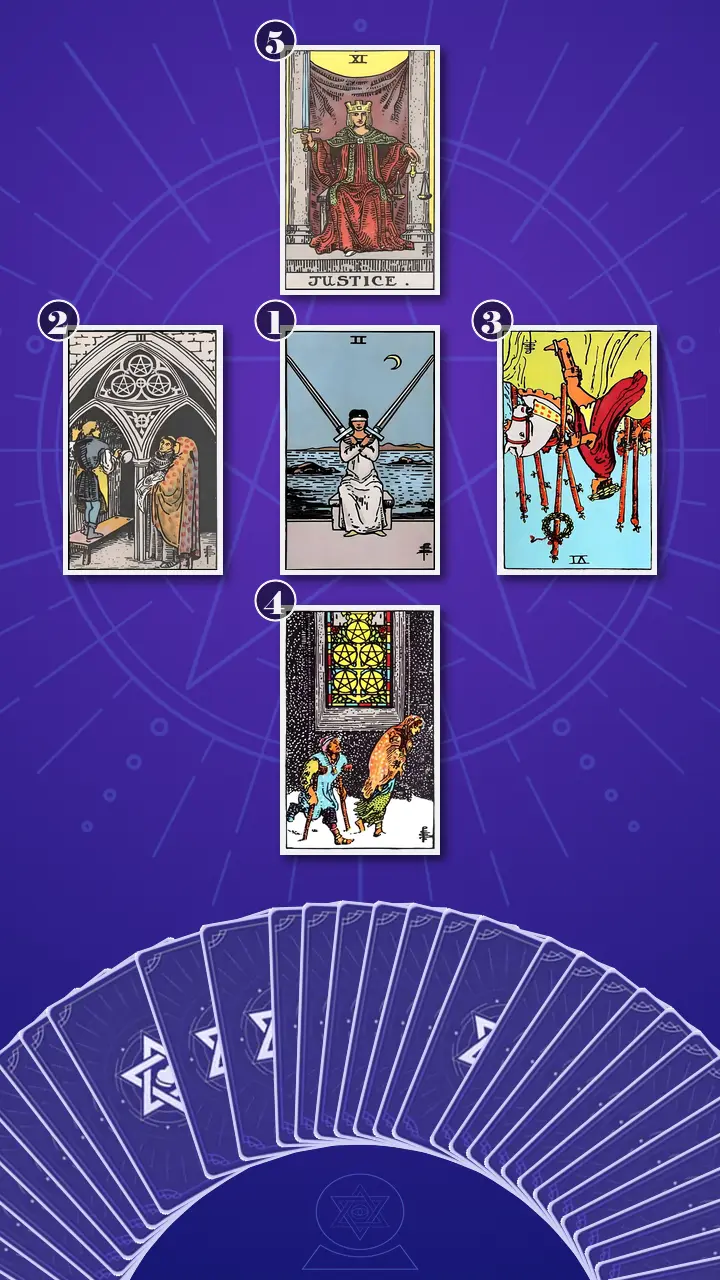
I showed her the structure as I placed the cards in a cross. The center position would reveal the immediate knot at the heart of the decision. The left side would show what she might genuinely want from the role itself—craft, growth, team, rhythm. The right side would isolate the competing pull of status, praise, or social proof. The card beneath would uncover the underlying fear keeping those two motives fused together. And the card above would show the clearest way to separate validation from fit and make a self-trusting next move.
Reading the Map: Where the Weight Really Sits
The Blindfold in the Inbox
I turned the first card. “Now we’re looking at the position that presents the immediate knot: the offer email has triggered both genuine curiosity and self-worth confusion.” The card was the Two of Swords, upright.
I told her this was the classic freeze of having fifteen tabs open and still avoiding the only tab that matters: her own honest reaction. In modern life, it looks exactly like keeping the offer email starred, the draft reply half-written, Glassdoor open, LinkedIn open, Notes open—while the one question that could actually move the decision stays minimized: when I picture doing this work every day, do I open up or tighten down? The energy here is blocked Air. Too much analysis, not enough truth. The blindfold is her muted body signal. The crossed swords are the dueling arguments in list form. The still water behind the figure is the quieter answer waiting underneath the noise.
I said, “This is why more data hasn’t given you more clarity. You’re not lacking intelligence. You’re using intelligence to postpone what your nervous system already knows.”
She let out one short breath that sounded almost like a laugh. “Damn,” she said. “Yes. That’s the freeze.” Her fingers hovered over the mug by her keyboard, then retreated, like even that tiny movement needed a committee review.
The Part of Her That Actually Wanted to Build
I turned the second card. “This position isolates what you may truly want from the role itself—what belongs to the work, not the applause around the work.” The card was the Three of Pentacles, upright.
This card grounded the reading immediately. I explained that in her world, it translated to the part of her that wanted substance: stronger campaign planning, better collaboration, sharper feedback loops, a manager she could actually learn from, the satisfaction of making competent work with real people. This is balanced Earth energy. It cares about craft, process, and the daily build of a role. Not the screenshot of the offer. The Tuesday of it.
I asked her, “If nobody could congratulate you for taking this job, which parts of the actual work would still pull you in?”
She looked away from the screen and thought for a full few seconds. It was the first time in the session her face didn’t rush to answer. “I do want more stretch,” she said. “And I like the idea of learning from a stronger brand lead. That part feels real.” I watched her shoulders drop half an inch. The card had done its job. It reminded her that there was, in fact, a genuine desire in the spread. It just wasn’t the whole story.
The Laurel Wreath and the Imagined LinkedIn Post
I turned the third card. “This position reveals the competing pull of being chosen, admired, or socially validated, separate from the work itself.” The card was the Six of Wands, reversed.
This is the card that so often makes people laugh and wince at the same time. I translated it plainly: drafting the group-chat screenshot and deleting it, mentally writing the LinkedIn update before you’ve figured out whether you’d even like the meetings, rehearsing the new title out loud because the announcement feels clearer than the job. Reversed, the fire here is not clean confidence. It’s recognition energy distorted into a worth test. The offer becomes social proof. If this company wants me, maybe that means I am finally enough.
I added, “Wanting to be chosen is human. Letting it choose for you is the part worth slowing down for.” Then I asked, “If this exact same work came with a more ordinary title and zero announcement value, how much of your excitement would still be there?”
She covered her mouth and gave me the kind of bitter little laugh I hear when a card lands a little too accurately. “Okay,” she said, shaking her head. “That’s rude. But accurate. Why does the announcement feel clearer than the job?”
“Because applause is fast,” I said. “Fit is slower. Applause spikes. Fit has to be lived.”
The Hidden Winter Under the Offer
I turned the fourth card. “This position uncovers the underlying fear or belonging wound that keeps the genuine pull and the validation pull fused together.” The card was the Five of Pentacles, upright.
The emotional temperature of the reading changed the moment I saw it. In the planetarium, I spend a great deal of time explaining that you do not discover invisible gravity by staring only at the brightest planet. You discover it by tracing what every visible object is bending around. That instinct is what I call my Galactic Gravity Analysis. In Taylor’s spread, the Three of Pentacles and Six of Wands reversed were the visible weights on the scale. Five of Pentacles was the hidden mass beneath them—the gravity making validation feel like survival.
I described what I saw in modern life terms she instantly understood: 11:46 p.m. in a condo kitchen, bare feet on cold tile, fridge humming, phone lighting up the counter, rereading the compensation line as if it might warm the room. This card is not just about money. It is about emotional winter. The fear that saying no to one offer means stepping back into uncertainty while everyone else keeps moving forward. The fear that hesitation is proof you are difficult, spoiled, or somehow falling out of the game. Like standing outside a warm restaurant in February and telling yourself you may never get another table if you walk away.
I asked her the question this position always asks: “If you said no and nothing better appeared right away, what story about yourself would feel hardest to sit with?”
Her reaction came in three small waves. First her breath stopped. Then her eyes unfocused, as if some late-night memory had started replaying behind them. Then her jaw loosened, and I heard the exhale come out of her before she spoke. “That I’m behind,” she said quietly. After a moment, she added, “That I turned down proof that I was wanted.”
There it was. Not the salary line. Not the title. Not even the role itself. The colder fear underneath all of it.
When Justice Lifted the Sword
The Card That Turned the Offer Back Into Information
By the time I reached the final card, the whole session had gone still. The hum of her kitchen seemed louder because she had stopped filling the silence with over-explanations, and on my desk in Tokyo, morning light had narrowed into one bright stripe across the table like the edge of a blade. This was the key card—the antidote.
“Now we’re looking at the position that shows the clearest way to separate validation from fit and make a self-trusting next move.” I turned it over. Justice, upright.
She was exactly where this card meets people: offer email open, shoulders high, more time spent on salary tabs and title comparisons than on picturing a normal Wednesday in the role. Her mind wanted certainty. Her body wanted honesty.
The Sentence That Changed the Reading
Stop letting the laurel wreath tell you who you are; let Justice's scales weigh the real fit and let the sword cut approval away from desire.
I let the sentence sit in the air for a beat.
Her first reaction was not relief. First she froze so fully that even the hand she had lifted toward her hair stopped midair. Then her gaze drifted off the screen—not evasive, more like someone replaying a familiar clip: the PATH lunch break, the starred email, the nearly sent message to the group chat. When she looked back at me, there was heat in her expression. “But doesn’t that mean I’ve been giving this offer way too much power?” she asked. There was a flash of anger in it, and embarrassment, and underneath both, the ache of recognition.
I answered her gently. “It means the loud part of this decision has been trying to protect a more vulnerable part. That’s different. And it means you can stop mistaking the protection strategy for the truth.”
I watched the shift happen in order. The tension left her mouth first. Then her shoulders lowered. Then the breath came out of her in one long, shaky exhale that sounded almost like surprise. That’s the moment I know a reading has crossed from explanation into contact. There was also that brief, exposed dizziness clarity can bring—the strange emptiness that appears when the fog lifts and now you are responsible for what you can see.
I gave her the clearest version of the message. “Being chosen is information, not instruction. An offer can confirm that the market wants you. It cannot decide whether this work belongs in your actual life.”
Then I asked, “Now, with this new lens, can you think of a moment last week when this would have changed how you felt?”
She nodded slowly. “Thursday night,” she said. “I kept rereading the compensation line like it was going to answer a different question. If I had asked what the role wanted from my time and energy instead, I think I would’ve realized I wasn’t excited. I was bracing.”
That was the real threshold of the reading: from validation rush and tightening doubt into grounded clarity and self-trust. Justice is balanced Air. It is discernment, self-respect, and evidence-based self-trust. In career language, it is less LinkedIn optics, more product-fit review. Less hype cycle, more standards before opinions. It does not ask someone to become cold. It asks them to become fair to themselves.
From Hype Cycle to Fit Check
Once all five cards were on the table, the whole story was suddenly simple. The Two of Swords showed why she felt stuck: she had been collecting more input while muting the only data stream that mattered, her actual reaction. The Three of Pentacles showed the part of her that did want something real—better collaboration, sharper work, more meaningful growth. The Six of Wands reversed showed how fast a flattering offer can turn into social proof. The Five of Pentacles revealed why that social proof felt so emotionally loaded: underneath the career question sat an older fear of exclusion, scarcity, and being left outside. And Justice showed the way through: not by killing ambition, but by separating fit from validation.
I told her her biggest blind spot was not that she cared about compensation, momentum, or title. It was that she had been treating the offer as a mirror for her worth instead of a map of her weekdays. She was asking, “What does this offer say about me?” when the wiser question was, “What will this work ask of me every day, and do I want to give that?”
Because this kind of inner conflict is often made worse by social glare, I gave her one of my own decision tools, a three-step framework I call Solar Eclipse Mediation. In the sky, an eclipse temporarily reduces overwhelming light so shape becomes visible. In a career crossroads moment, I use the same logic: dim the noise, trace the real outline, then decide in daylight.
She frowned a little and asked, “What if I do all that and still want to text three friends first?”
I smiled. “Then you wait ten minutes before you do. We are not building a case for an imaginary jury. We are building contact with reality.”
- Justice Scorecard Open a blank note titled ‘Justice Scorecard’ before work or on your lunch break. Make four columns: daily tasks, team and collaboration, compensation and security, and energy after a normal workday. Give each column two or three plain-language non-negotiables, then score the offer from 1–5 before you text anyone else for input. End with one sentence: ‘This offer proves I am hirable; it does not automatically prove I want this job.’ Keep it to ten minutes for the first pass. If the full version feels heavy, answer only two questions: What will this role ask of me every day, and do I want to give that?
- Normal Tuesday Test Set a seven-minute timer and write out the most likely 9 a.m., 1 p.m., and 4 p.m. version of a midweek day in this role. Do it at your kitchen counter, on the TTC, or wherever you usually spiral—same setting, new question. If the picture stays vague, send the recruiter one concrete message asking what a fairly normal midweek day looks like for someone in the role. You do not need perfect information to notice your reaction. Circle the parts that create genuine interest and underline the parts that make your body contract or go flat.
- No-Applause Test For one evening, describe the role to yourself without using the company name, salary, title, benefits, or anyone else’s reaction. If it helps, send yourself a voice note answering one question: Would I still lean toward this if nobody could congratulate me for it? This is not about shaming ambition. It is about lowering the volume of image-management long enough to hear whether desire is still there when the applause disappears.
These were her next steps, not because tarot should replace practical decision-making, but because good tarot returns people to practical decision-making with less distortion. If the title is loud but the Tuesday is blurry, slow down.

A Week Later, the Quiet Proof
Five days later, she sent me a screenshot of a note titled ‘Justice Scorecard.’ Beneath it she’d written, “I asked the recruiter what a normal midweek day looks like. The answer made the Tuesday real, and weirdly that was the first time I could hear myself.” She had stopped polling the group chat. She had stopped trying to use the offer as proof of worth. She had turned the role back into a real piece of life.
After the recruiter replied, she realized the workday felt flat in her body. She declined the role the next morning—clear, polite, no apology spiral.
That night she slept through. At sunrise the first thought was still, What if I’m wrong? This time she laughed softly, made coffee, and let the question pass without handing it the steering wheel.
That is what a real Journey to Clarity usually looks like when I witness it: not a cinematic certainty, but ownership. Not perfect calm, but steadier self-trust. From needing proof to choosing by fit. From comparison-fueled doubt to grounded discernment.
This is why I trust the Decision Cross · Context Edition as a job offer tarot spread for being chosen vs actually choosing. It does not tell you what answer would look smartest online. It helps you separate validation from alignment so your next step can belong to your real life.
Sometimes the tight chest isn’t about the job at all—it’s the fear that saying no to being chosen might leave you alone with the old question of whether you’re enough. If that’s where you are tonight, noticing that split already means you are no longer at the very beginning.
So when the laurel wreath gets quiet and only your actual Tuesday remains on the scale, what small part of your answer already feels honest?