The Tube Ride I Kept Refreshing Spotify—Then Sent a Calm Check-In

Finding Clarity in the 8:17 a.m. Scroll
You keep toggling between the group chat and the playlist on your London commute, screenshotting tiny “evidence” you swear you’re being chill about, while your jaw is basically locked.
That was the first thing I said out loud when Maya (name changed for privacy) sat down across from me—because she didn’t even have to explain the vibe for me to feel it. Her phone was face-down on the table like it was hot. Her shoulders were lifted in that subtle, defensive way people hold themselves when they’ve been bracing for a week.
She told me it started on the Victoria line—8:17 a.m., grey Wednesday, the train screeching into tunnels. Shoulder-to-shoulder commuters. One hand on the pole, the other holding a phone that had gone warm from being unlocked too long. She’d flicked from Spotify to WhatsApp and back again, like the next refresh might finally give her a straight answer.
“It’s literally just a playlist,” she said, and I watched her mouth try to smile while her stomach clearly did that drop you get when you miss your stop. “But it doesn’t feel like just a playlist.”
She described the moment she noticed it: a track she’d added—gone. Not buried. Not skipped. Removed. And then the group chat: a couple of reaction emojis on someone else’s song, a meme that could’ve been harmless, a joke that landed like shade because the air was already thin.
“I keep rewriting the message like it’s a work email,” she admitted. “I’ll type ‘lol random but—’ and then it turns into a stakeholder memo. I don’t want to make it weird, but it’s already weird. And if I bring it up, I’ll look dramatic.”
What she called “dramatic,” I could see in her body as a quiet surveillance system: restless tension living in the shoulders and jaw, a background buzz in the stomach that spiked every time she opened an app. It was like her nervous system had turned into a browser tab that refused to close—refreshing, indexing, cross-referencing, trying to predict rejection before it happened.
I leaned in a little, not to intensify anything—just to meet her where she was. “We can treat this like a real problem without treating you like the problem,” I said. “Let’s make a map. Not to win the room. To find clarity about what you need, what you’ll ask for, and what you’ll do next—no matter how they respond.”

Choosing the Compass: The Energy Diagnostic Map (7) for Group Chat Drama
I’ve learned—both on a trading floor and at a tarot table—that the moment before action is where most people burn their energy. Not in the decision itself, but in the endless rehearsal of the decision. So I kept the “ritual” simple: a breath that actually reaches the belly, and hands on the deck long enough to let the question become one sentence.
“Shared playlist drama,” I repeated back to her. “What’s my next step in our friend group?”
I shuffled slowly, not for mystery, but for focus—the way you’d clear your desktop before a hard conversation. Then I told her what I was using: the Energy Diagnostic Map (7) · Context Edition.
If you’ve ever wondered how tarot works in modern life, this is the part people miss: a good spread is a structure for thinking. Maya’s situation wasn’t a one-on-one relationship issue. A collaborative playlist is a shared digital container—like a shared kitchen, a shared Notion board, a shared group chat. The “drama” usually isn’t one villain. It’s a system: subtext, reactions, unclear norms, and everyone quietly testing what they can do without anyone calling it out.
This spread is built for that. It’s tight and diagnostic: surface vibe, inner tug-of-war, external pressure, the core knot, your usable resource, the key transformation, and then a grounded next step. No fortune-telling about who’s “bad.” Just a clean path from “what’s happening” to “what do I do.”
“A few positions to watch,” I added, both for her and for anyone reading along. “Card 4 will show the pattern keeping you stuck. Card 5 will show the communication tool you already have. And Card 6—the turning point—will show the approach that changes the system from subtext to repair.”
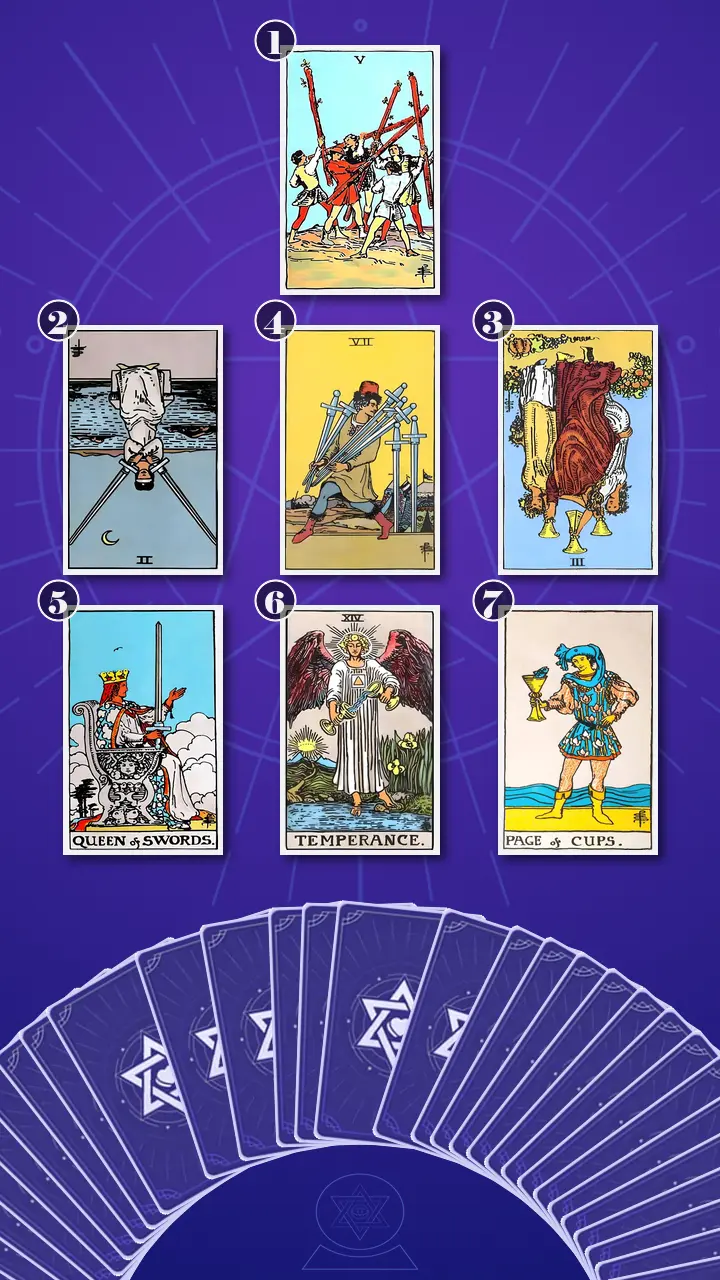
Reading the Map: From Playful Chaos to Social Forensics
Position 1: The Visible Social Stage
“Now we turn over the card that represents the surface energy of the playlist drama: the visible vibe in the group and what’s happening on the social stage,” I said.
Five of Wands, upright.
In the image, five figures swing wands in a tangle—no clear leader, no referee, no agreed rules. And in Maya’s life translation, it landed instantly: the playlist as a crowded room where everyone keeps grabbing the aux cord. One friend adds five tracks in a row, someone else deletes a couple “as a joke,” and the WhatsApp chat fills with quick-fire reaction emojis.
“This is messy-group energy,” I told her. “Not necessarily malicious. But chaotic. The energy here is excess—too many hands in the same container, everyone reaching at once, and because nobody’s named norms, every tiny move feels like a bid for influence.”
I used the analogy that always makes people sit back: “It’s like a shared kitchen with no house rules. If someone keeps moving your food, it’s not ‘just food’ anymore—it’s the system.”
Maya gave a short laugh that sounded like it came with a bruise. “Okay,” she said, exhaling through her nose. “So it’s not just in my head. That’s… almost annoying.”
“Yeah,” I said gently. “It can be both true: it’s a small digital thing, and it’s a real social signal. The card is saying the vibe is crowded and competitive. But it’s also saying: you don’t need to find a villain to find structure.”
Position 2: The Draft-Delete Spiral
“Now we turn over the card that represents your inner tug-of-war: the indecision, self-protection, and tone-policing happening internally,” I said.
Two of Swords, reversed.
The blindfold. The crossed swords over the chest. The water behind her—feelings waiting in the background while the mind tries to hold a perfect, neutral line.
In modern terms: the Tube ride where you flip between WhatsApp and Spotify, telling yourself you’ll “wait and see.” The Notes app draft that starts with a joke, then adds context, then apologizes for existing—because you’re trying to find wording that can’t be used against you. You don’t send it. You call it peacekeeping, but it’s mental gridlock with a constant hum of anxiety.
“This reversal is the stalemate cracking,” I said. “Not into action—into overload. The energy here is blocked. You’re trying to protect yourself by not choosing a conversation, but the pressure leaks anyway. And it turns into: ‘If I say X, they’ll hear Y.’”
I watched her thumb hover over an imaginary send button. Her jaw clenched, then unclenched, like she’d been doing that all week without noticing. “Yeah,” she said quietly. “Because if I say ‘it hurt,’ they’ll hear ‘I’m needy.’ And if I say ‘lol it’s fine,’ they’ll hear ‘keep doing it.’”
“Exactly,” I said. “You’re stuck between honesty and safety—except the safety is short-term. Long-term, it keeps you monitoring.”
Position 3: The Closed Circle Pressure
“Now we turn over the card that represents external pressure: group dynamics like gossip, cliques, or unspoken rules shaping the atmosphere,” I said.
Three of Cups, reversed.
Three cups raised in celebration—but reversed, the circle becomes tight. Warmth that doesn’t include everyone equally. The card translated into that side-thread feeling: inside jokes land, people reference “the playlist” like a shared secret, and you’re not sure if you’re part of the joke or the punchline.
“This isn’t saying your friends are monsters,” I said. “It’s saying the environment is skewed. The energy here is a deficiency of straightforward warmth. When a group gets a little cliquey, people bond through commentary instead of clarity. And if you already have belonging anxiety, it turns digital spaces into a scoreboard.”
Maya’s eyes unfocused for a second like she was replaying a pub scene: laughter in a corner, someone referencing something she missed, her face doing that practiced smile half a beat late. “It’s like… did I miss a memo,” she said, “or am I being edited out?”
“That sentence,” I told her, “is the pressure.”
Position 4: The Core Knot That Keeps It Looping
“Now we turn over the card that represents the core blockage: the main pattern keeping the drama looping instead of resolving through clarity,” I said.
Seven of Swords, upright.
A figure sneaks away carrying swords, looking back over their shoulder—half-truth energy, indirect communication, doing something sideways and then scanning for reactions.
And the modern-life scenario landed with almost painful accuracy: instead of asking directly, you start considering strategy moves. Quietly removing your own tracks. Adding a pointed song title that “says what you can’t.” Dropping a vague meme in the chat to test the temperature. Watching to see if anyone notices. It protects you from immediate rejection, but it traps the whole situation in subtext.
“This is self-protection,” I said, keeping my voice warm. “Not villainy. The energy is strategic but costly—a kind of cleverness that keeps you alone with your fear.”
Then I mirrored it in split-screen, because that’s where the truth usually breaks through:
What you want to ask: “Did you remove my songs? Are we okay?”
What you do instead: “Let me hint. Let me monitor. Let me gather receipts so I can be un-criticizable.”
She swallowed. Her throat moved like she was trying to push down a lump of embarrassment. “I hate that,” she said. “I hate that I’m doing… social espionage.”
My Wall Street brain flashed for a second—those old mornings where someone would pretend not to care about a position while watching the ticker like it was a heart monitor. Monitoring feels like control, until you realize it’s just anxiety with better branding.
“Monitoring isn’t clarity—it’s just stress in a loop,” I said, and I watched her blink hard like the phrase hit somewhere tender.
Position 5: The Tool You Already Own
“Now we turn over the card that represents your usable resource: the most effective communication strength or boundary tool you have in this situation,” I said.
Queen of Swords, upright.
Single upright sword. Steady gaze. An open hand that says, “Respond,” not “Get wrecked.”
“This is your clean voice,” I said. “Not your nicest voice. Not your funniest voice. Your clear voice.”
I gave her the London-workday version of the script—direct but not aggressive, like you’re clarifying a spec, not launching an attack: “Hey—noticed a couple of my songs were removed from the playlist. Was that intentional? It landed a bit off for me and I’d rather clear it up.”
“The Queen’s energy is balanced,” I explained. “It’s truth with structure. And here’s the line I want you to keep: Clarity isn’t aggression. It’s care with a spine.”
Maya’s chest lifted—small, but visible. Like her body recognized a tool that didn’t require performance. “I could actually say it like that,” she said.
“And notice,” I added, “it doesn’t come with a paragraph of disclaimers. If you can’t say it out loud without apologizing mid-sentence, it’s not clear yet.”
When Temperance Turned the Courtroom Into a Shared Container
When I reached for the next card, the room got quieter—not in a spooky way. In a human way. Like when you lower your voice because you’re about to say the thing you’ve been circling all week.
Position 6: The Turning Point
“Now we turn over the card that represents the key transformation: the mindset that shifts the system from subtext to repair and shared norms,” I said.
Temperance, upright.
The angel pours between two cups—measured mixing. One foot on land, one in water. A path leading toward a distant sun, like there’s a future where you don’t have to live in reaction mode.
Setup (what you’re caught in): You know that moment on the Tube when you reopen the playlist for the fifth time, stomach dropping, then you open Notes to draft a “casual” text that somehow turns into a full-on work email. You’re trying to choose between disappearing and exploding—because those feel like the only options that keep you safe.
Delivery (the sentence that changes the system):
Stop treating the playlist like a courtroom and start treating it like a shared container—Temperance says mix truth with tact the way the angel pours between two cups.
For a beat, I let the words sit. Outside, a car hissed through wet pavement. The kettle in my tiny office kitchen clicked as it cooled. Ordinary sounds that suddenly felt like punctuation.
Reinforcement (what it did to her body): Maya froze first—breath held high in the chest, fingers still, like a paused video. Then her eyes softened and went slightly distant, as if her brain replayed every screenshot, every midnight refresh, every moment she’d tried to build an airtight case for why she was allowed to feel hurt. And then something released: a long exhale, shoulders dropping a fraction, her jaw unclenching like it had been gripping a secret.
“But…,” she started, and her voice sharpened with a flash of anger that surprised even her. “If I stop treating it like a courtroom… doesn’t that mean I was overreacting? Like I made it bigger than it is?”
I nodded. “That’s the trap,” I said. “Temperance doesn’t say you were wrong to care. It says the format you’ve been using—trial, evidence, verdict—is keeping you stuck. A shared container isn’t a trial. It’s an agreement. You’re not proving you belong; you’re checking what kind of belonging this is.”
This is where my signature framework clicks in—Negotiation Alchemy. Not the aggressive kind. The adult kind. “Think of it like a negotiation where your goal isn’t winning,” I told her. “It’s setting terms you can live with. Your BATNA—your best alternative to a negotiated agreement—might be stepping back from the playlist for a while. Not as punishment. As self-respect. When you know your BATNA, you can speak calmly, because you’re not pleading for a verdict.”
“Now,” I continued, “with this Temperance lens, I want you to try a 9-minute practice. I call it the Two-Cups Draft. It’s short on purpose—because clarity works best when it’s short enough to say out loud without bracing.”
Two-Cups Draft (9 minutes total):
1) Set a timer for 3 minutes. Write ONE sentence under TRUTH: the concrete observation (no motives). Example: “I noticed a few of my songs were removed from the playlist.”
2) Set a timer for 3 minutes. Write ONE sentence under IMPACT: how it landed in your body/feelings (no debate language). Example: “It made me feel weirdly excluded and I’ve been overthinking it.”
3) Set a timer for 3 minutes. Write ONE sentence under ASK: a clean question. Example: “Was that intentional, and can we agree on how we handle the playlist going forward?”
“Boundary tip,” I added, because I’d seen this pattern a thousand times: “If you catch yourself adding receipts, timestamps, or a paragraph of disclaimers, that’s your cue to pause.”
Then I asked her the question that turns insight into reality: “With this new perspective, can you think of a moment last week where this would’ve changed how you felt?”
She stared at the Temperance card, then nodded once. “Sunday night,” she said. “10:58 p.m. Screenshots. Notes app. I was basically building a case against… everyone. And against myself. If I’d thought ‘shared container,’ I would’ve asked one clean question instead of trying to be un-criticizable.”
“That’s the shift,” I said. “This isn’t just about a playlist. It’s the move from anxious uncertainty and spiky self-doubt—monitoring for clues—to calm self-respect and clarity: one specific ask, clean boundaries, and then lighter connection… or peaceful distance.”
Position 7: The Next Grounded Move
“Now we turn over the card that represents your next step: the most grounded action that aligns with self-respect and relational clarity,” I said.
Page of Cups, upright.
The Page holds out a cup, and there’s a fish popping up—an unexpected little truth. The card’s message is simple and, for people like Maya, strangely brave: a small, sincere emotional bid. Not a group callout. Not a dramatic manifesto. A human check-in in a private channel.
“The energy here is open,” I told her. “Not overproduced. Not armored in sarcasm. This Page says: ‘I felt something. I’m going to name it simply.’”
I gave her the version that fits her voice: “Hey, quick check-in—seeing my songs removed felt weird and I’ve been overthinking it. Was something up? I’d rather clear it than overthink it.”
She flinched a little at the softness—like softness was risky. Then she nodded. “That’s… doable,” she said. “It’s not begging. It’s just… real.”
The Shared-Container Reset: Actionable Advice You Can Actually Use
When I looked at the full map, the story was clean: the group container is crowded and ruleless (Five of Wands). Inside, you’re stuck in draft-delete paralysis because you’re trying to be honest and guaranteed-to-be-liked at the same time (Two of Swords reversed). Outside, the group’s warmth has a cliquey, side-thread flavor that amplifies comparison fatigue (Three of Cups reversed). The core knot is indirectness—hinting, monitoring, strategy moves that keep everything in subtext (Seven of Swords). Your pivot is a clear, boundaried voice that makes room for response (Queen of Swords). The transformation is Temperance: right-size the conflict, blend truth with tact, and treat it like a shared container with norms. Then take one sincere, private, Page-of-Cups step.
The cognitive blind spot here is brutal but common: you’ve been acting like you need a verdict to justify your feelings. Like if you can build a perfect case, you’ll be safe from being dismissed as “too much.” But friendship isn’t court. And trying to be un-criticizable is a fast track to silence.
The transformation direction is exactly what you came in asking for: move from decoding hints to stay safe, to one calm, specific message that names impact and asks for clarity.
Here are the next steps I gave Maya—small enough to start, concrete enough to work. If you’re dealing with shared playlist drama or group chat anxiety, you can steal these exactly.
- The Two-Cups Message (9 minutes)Set three 3-minute timers and write one sentence each under TRUTH (observation), IMPACT (how it landed), and ASK (a clean question). Stop at three sentences—no backstory.If you feel your chest tighten or you start adding receipts, pause. The goal is a message you can say out loud without bracing.
- Private-Channel First (pick one person)Choose ONE friend and send a 2-sentence check-in in a 1:1 chat during a calm moment (not midnight scrolling): “Hey—noticed X. Was that intentional?”If you’re unsure who to pick, use my Network ROI Analytics lens: choose the person who historically responds with clarity, not performance. High-yield = consistent, kind, direct.
- 48-Hour No-Monitoring BreakFor two days, stop checking playlist history and reaction emojis. Hide the app in a folder if you need to. Let your nervous system come down before you interpret anything.Expect your brain to protest: “This is embarrassing, it’s literally a playlist.” That’s normal. You’re not reacting to music metadata—you’re reacting to belonging stakes.
One extra tool, because Maya asked for it and it fits my style: I offered my Cocktail party algorithm as a three-phase conversation template for when the 1:1 reply comes back.
Phase 1 (Open): “Quick check-in—can I ask about the playlist?”
Phase 2 (Clarify): “I noticed my songs were removed. It landed weird and I’ve been overthinking.”
Phase 3 (Container): “Can we agree on a norm—like not removing each other’s songs without a heads-up?”
It’s not robotic. It’s just a structure that prevents you from spiraling into apology paragraphs.

A Week Later: The Quiet Proof
A week later, she emailed me a screenshot—one message, no comedy intro, no legal brief. Just: “Hey—quick check. I noticed a few of my songs were removed from the playlist. Was that intentional? It landed off for me and I’d rather clear it than overthink it.”
Her friend replied within an hour: they’d been “cleaning it up” thinking it was funny, and it hadn’t clicked that it would feel like editing someone out. Not a perfect apology. Not a perfect ending. But real contact—no more guessing games.
She told me the weirdest part was what happened next: she didn’t feel euphoric. She felt… steady.
She slept through the night for the first time in days, then woke up with the old thought—What if I was dramatic?—still there. Only this time she noticed it, exhaled, and didn’t pick up her phone to check the playlist. The thought passed like a bus she didn’t have to chase.
That’s what I mean when I talk about a Journey to Clarity. Not certainty. Ownership. The shift from “I need to decode their hints so I don’t get rejected” to “I can ask one clean question and decide what I’ll do with the answer.”
When you want to name what hurt but you’re terrified that having feelings will be the thing that disqualifies you from the group, your whole body turns into a quiet surveillance system—watching, rehearsing, and bracing.
If you didn’t have to prove you belong—just ask for clarity—what would your calmest one-sentence check-in sound like?