From Guilt-Booked Brunches to Reciprocal Plans: A Slow NYC Shift

The 4:37 p.m. Group Chat Jolt
If you live in NYC and keep sending the “brunch?” text first—then immediately do Calendar Tetris for everyone—this might not be “being social” so much as managing group chat anxiety.
Jordan said that to me like they were confessing something small. Like it was just a quirky habit. But their body didn’t treat it like a quirk.
They described Friday, 4:37 p.m., Midtown open office: Slack popping off, inbox stacked like a Jenga tower, three iMessage threads open under the desk. Fluorescent lights buzzing overhead in that way that makes your shoulders climb without permission. Their phone warm from constant checking. Thumb hovering over Send while Google Calendar sat open like a second heartbeat.
“I’m already offering two brunch slots,” they said, “and I haven’t even asked myself if I want to be out of my apartment Sunday morning.”
I watched their hand drift toward their chest, not dramatic—more like a reflex. The tight, buzzy brace was already there, waiting. The sensation had a texture to it: like a vibrating phone you can’t find, except it’s inside your ribs.
“I don’t even like brunch that much,” Jordan added, a little laugh that didn’t land as funny. “I just like knowing I’m still invited.”
This was the contradiction underneath the mimosas: wanting connection and belonging—warm, human, real—while fearing that saying no will make you seem difficult, disposable, easy to replace. And guilt is such an efficient fuel. It gets things booked. It keeps things smooth. It also keeps your weekends from ever feeling like yours.
“We’re not here to shame you into ‘just saying no,’” I told them. “We’re here to figure out what the brunch is doing for you—and how to get that need met without paying for it with your nervous system. Let’s try to draw a map through the fog. Let’s aim for clarity.”
Choosing the Compass: Celtic Cross · Context Edition
I had Jordan take one slow breath—nothing mystical, just a clean reset. The kind you do when you’re about to hit send on something that could change the temperature of a relationship. I shuffled while they held the question in mind: “I keep booking brunch—what’s my people-pleasing pattern here?”
“Today I’m using a spread called the Celtic Cross · Context Edition,” I said. “It’s a classic diagnostic layout, but I frame it to make loops—especially people-pleasing loops—really visible.”
For anyone reading this who’s curious about how tarot works in a practical way: I don’t treat cards as a verdict. I treat them as a structured conversation tool—like a decision framework that pulls your attention to what’s driving your behavior, what’s reinforcing it, and what would actually interrupt it. This particular spread is good when you don’t just need a yes/no—you need the whole chain: the visible habit, the pressure point, the root fear, and the integration principle that replaces the old rule-set.
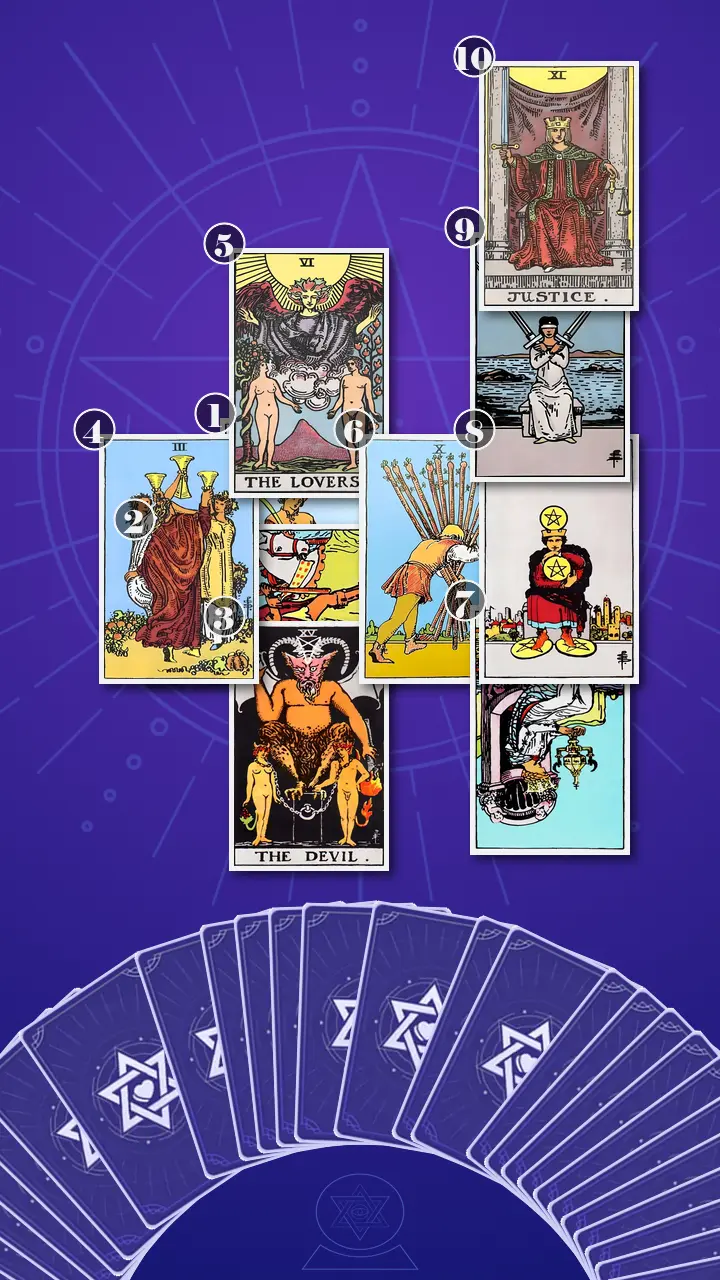
“Card 1 will show the observable pattern—what you’re doing on the surface,” I told Jordan. “Card 2 will show what crosses it—the pressure that keeps it running. Card 3 goes underneath, to the root driver. And near the end, we’ll climb a ‘staff’ of cards that shows self stance, environment, hopes/fears… and finally the integration direction: the clearest boundary principle that dissolves the loop.”
Jordan nodded—small, tight. Like they wanted the map, but also feared what it would confirm.
Reading the Map: The Brunch Certainty Habit in Context
Position 1: The observable present pattern — Two of Pentacles, upright
“Now we turn over the card that represents the observable present pattern: what you’re doing when you keep booking brunch,” I said.
Two of Pentacles, upright.
In the image, a figure keeps two coins in motion, looping them through an infinity-shaped ribbon. Behind them, ships rise and fall on choppy water—life not actually calm, just managed.
“This is you with two brunch threads open while checking your calendar,” I said, staying close to the lived reality. “Upbeat, flexible, doing the coordination dance… while your weekend already feels choppy underneath.”
Energy-wise, the Two of Pentacles is balance-through-motion. Not real rest—just continuous adjustment. It’s not inherently bad; it’s a skill. But when it turns into a reflex, it becomes a trap: you keep adding plans to stabilize social uncertainty, even as your time and energy get squeezed.
I used the split-screen contrast I’ve learned is the most honest mirror for people-pleasing:
Left: “I’m just being friendly.”
Right: “I’m managing the room.”
“Thumb hovering over Send,” I continued, “refreshing reactions, scanning who’s seen the message. And the thought that shows up is basically: If I lock it in, I can breathe… for like, 20 minutes.”
Jordan let out a short laugh—bitter around the edges. Then they pressed their lips together, like they were trying not to admit how accurate it was.
“That’s… kind of brutal,” they said. “But yeah.”
“Brutal is okay,” I replied. “Brutal means we’re looking at the right thing.”
Position 2: The people-pleasing pressure point — Six of Wands, reversed
“Now we turn over the card that represents the people-pleasing pressure point: what complicates the pattern and keeps it running,” I said.
Six of Wands, reversed.
Upright, it’s the victory parade—recognition, being seen, being celebrated. Reversed, it’s the same stage… but the applause feels uncertain. Like you’re scanning the crowd for proof you still matter.
“This is the part of you that ties self-worth to being the likable, easy, socially successful one,” I said. “Brunch isn’t just a plan here—it’s a way to secure approval and avoid the discomfort of not being clearly chosen.”
I asked, gently but precisely: “When you hit send on ‘brunch?,’ whose approval are you hoping to secure—one specific person, the whole group, or the imagined version of you that looks effortless?”
Jordan’s eyes flicked to the side. “The group,” they said. Then, quieter: “And… the version of me that doesn’t care.”
That’s the reversal. The win doesn’t feel like a win unless everyone reacts the right way. Like iMessage reactions are doing emotional heavy lifting they were never designed for.
“There’s an overcorrection risk here,” I added. “To make sure nobody’s disappointed, you over-promise with enthusiasm—then you show up depleted and irritated. Connection starts to feel forced instead of mutual.”
Jordan nodded once, like they’d been waiting for someone to name the math.
Position 3: The underlying driver — The Devil, upright
“Now we turn over the card that represents the underlying driver: the deeper attachment or fear fueling over-availability,” I said.
The Devil, upright.
I’ve seen a lot of people flinch at this card, because they think it means they’re doing something “bad.” In my experience, The Devil is rarely about being bad. It’s about being bound—to a coping strategy that worked once, and now costs you more than it gives you.
“This is attachment,” I told Jordan. “A sticky loop where short-term reassurance keeps you chained to a pattern that drains you.”
I translated the chains into the modern scene that matched their nervous system: “The plan becomes a receipt for belonging. If it’s scheduled, it’s real. If it’s not on the calendar, your brain starts acting like you might not exist to them.”
And then I named the felt sense, because that’s where the truth lives: “Tight chest. Restless checking. The compulsion to secure a time slot.”
Jordan’s shoulders rose—just a few millimeters—and then they swallowed. A small exhale slipped out like they’d been holding it in without noticing.
“An open weekend feels free,” they said, almost surprised by their own sentence. “And somehow unsafe.”
“Exactly,” I said. “Freedom vs safety. And your current system is trying to buy safety with availability.”
I added one line I’ve learned to say to New Yorkers, because it’s true: “Silence in the chat isn’t an emergency—your nervous system just thinks it is.”
Position 4: The recent social trigger — Three of Cups, upright
“Now we turn over the card that represents the recent social trigger: what tends to spark the next brunch booking loop,” I said.
Three of Cups, upright.
This card is the warm part. The part Jordan genuinely wants. A circle of connection. The little “cheers” moment that makes a city feel less sharp.
“This is the group chat ‘we should all catch up!’ energy,” I said. “The raised cups. The rush of belonging cues.”
But the same warmth can become pressure when you’re afraid of drifting. “This can make it hard to tell where celebration ends and obligation starts,” I continued. “You commit quickly—before you check capacity—because the vibe feels like a door you have to walk through right now or it closes.”
Jordan gave me a small, rueful smile. “Sundays fill up fast,” they quoted, in the tone of half-joke, half-rule-of-NYC.
“Yes,” I said. “And that rule is real. The question is: do you have to pay for it with your body?”
Position 5: The conscious desire — The Lovers, upright
“Now we turn over the card that represents the conscious desire: what you think you’re trying to create through these plans,” I said.
The Lovers, upright.
People misread The Lovers as only romance. In practice, it’s about values-based choice. The kind where you stop defaulting and start selecting—because your life is yours.
“You don’t actually want ‘more plans,’” I said, letting it land. “You want closeness that feels chosen, honest, aligned with your values. You want to know you’re securely in the circle without having to audition.”
I pointed out the angel overhead in the card. “That’s your values compass. The part of you that knows you’re allowed to choose based on alignment, not just acceptance.”
Jordan’s posture softened a notch. “I want closeness,” they said. “Not obligations with mimosas.”
“That sentence is The Lovers,” I told them. “That’s the actual target.”
Position 6: The immediate consequence — Ten of Wands, upright
“Now we turn over the card that represents the immediate consequence if nothing changes: how this impacts your energy and time next,” I said.
Ten of Wands, upright.
This card always looks like a Sunday afternoon in the city: carrying too much, trying to get home, vision blocked by what you’ve agreed to.
“Cinematic accumulation,” I said, and Jordan already knew what I meant. “One brunch becomes two plans becomes ‘quick coffee’ becomes errands in between. Subway heat. Phone battery low. That sticky feeling of being ‘on’ all day.”
“And the worst part,” I added, “is that you can’t see what you want because you’re carrying everyone’s comfort.”
Jordan laughed—this time tired, not bitter. “That’s my Sundays.”
I nodded. “And I’m going to give you a line you can keep: A resentful yes is still a boundary violation—just delayed.”
Their eyes lifted, like the sentence had weight. They didn’t argue with it. They just sat with it.
Position 7: Jordan’s stance — Queen of Cups, reversed
“Now we turn over the card that represents your stance: how you show up emotionally and the specific self-pattern you contribute,” I said.
Queen of Cups, reversed.
“This is over-absorbing other people’s feelings,” I said, careful with my tone. “Prioritizing harmony over self-honesty. Managing other people’s disappointment before it even exists.”
I translated it into the exact behavior Jordan described: “Replaying someone’s tone in a voice note and deciding you need to book brunch to keep them from being upset with you.”
“I do that,” Jordan admitted, and their voice was smaller now. “I draft these long declines. Like I’m negotiating a contract.”
That hit a memory in me—an internal flashback I didn’t fight. I’d spent years on a trading floor where people disguised fear as politeness and called it strategy. My Oxford professors would’ve called it “risk management.” But the truth is: over-explaining is rarely clarity. It’s anxiety wearing a blazer.
“A clear boundary isn’t a courtroom defense,” I said. “It’s more like a clean contract: short, specific, not constantly renegotiated because someone might feel a feeling.”
Position 8: External reinforcement — Four of Pentacles, upright
“Now we turn over the card that represents external reinforcement: what friends, city culture, and scheduling norms reward or pressure,” I said.
Four of Pentacles, upright.
“This is the NYC scarcity mindset around time,” I said. “Holding tight to the calendar for control. ‘Sundays fill up fast,’ plans booked like appointments. Being ‘reliable’ becomes social currency.”
In the card, the figure clutches what they have—one pentacle to the chest, one under each foot, one balanced on the crown. “It’s not generosity,” I said. “It’s guarding.”
“And here’s the trap,” I added. “You might be clinging to the role of ‘the planner’ because it feels like social safety. If you’re the one who makes it happen, you can’t be the one who gets forgotten.”
Jordan’s jaw flexed once. Not angry—more like recognition with a little grief in it.
Position 9: The inner knot — Two of Swords, upright
“Now we turn over the card that represents the inner knot: what you hope will happen socially, and what you fear will happen if you say no,” I said.
Two of Swords, upright.
The blindfold. The crossed swords. Calm water that’s not actually open—just contained.
“This is your ‘I’m flexible’ habit,” I said. “You use it to avoid the discomfort of a clear preference. It’s not kindness; sometimes it’s avoidance that looks like kindness.”
I gave them a one-line contrast, because tiny scripts change lives:
“I’m easy.” vs “I have a preference.”
Jordan made a soft sound—almost an “oh.” Like they’d just spotted the exact hinge in a door.
“Offer one truthful preference instead of three time slots,” I said. “That’s the pivot. That’s the opening.”
When Justice Looked Back: Capacity Math for Belonging
Position 10: Integration direction — Justice, upright
When I turned the final card, the room got quiet in a different way—like the city noise outside our window had lowered its volume to listen.
“Now we turn over the card that represents integration direction: the clearest mindset and boundary principle that dissolves the people-pleasing loop,” I said.
Justice, upright.
Scales in one hand. Sword in the other. A direct gaze that doesn’t apologize for existing.
Here’s the setup, because Jordan lived it: Friday afternoon, three group chats open, Google Calendar in the other hand, already typing “Brunch this weekend?” before checking whether their body wanted to leave the apartment on Sunday. Trapped in the belief that the right move is the one that keeps everything smooth.
Not ‘be the easy one’—be the fair one, and let the scales of Justice measure your real capacity before you book another table.
I let the sentence sit there. No extra adjectives. No pep talk. Just the clean edge of it.
Jordan’s reaction came in a three-step chain I’ve seen a hundred times—and still respect every time:
First: a physical freeze. Their breath paused mid-inhale, like their body had been caught doing something it didn’t know it was doing.
Second: cognitive seep. Their eyes unfocused for a second, like they were replaying every “Sure!” they’d texted while their chest buzzed and their jaw stayed tight.
Third: the release. A slow exhale, shoulders dropping by inches, not millimeters this time. Their hands—previously clenched around their water cup—opened. Then, unexpectedly, their face tightened with a flash of anger.
“But if I’m ‘the fair one,’” they said, voice sharper, “does that mean I’ve been… unfair? Like I’ve been doing friendship wrong?”
I didn’t rush to soothe them. Anger can be a boundary trying to form.
“No,” I said. “It means you’ve been overpaying. Not because you’re broken—because your nervous system learned that availability equals safety. Justice isn’t punishment. It’s accuracy. It’s adult reciprocity.”
My Wall Street brain kicked in—not as a flex, as a tool. “I have a framework I call Influence Credit Scoring,” I told them. “Five tiers, not to rank people like assets—honestly, that’s gross—but to stop you from being the only one getting graded. Justice asks: what’s the fair exchange here? Who shows up without you doing all the logistics? Who responds with warmth when you’re specific?”
Then I brought it back to the heart of it, plain language: “If your ‘yes’ is trying to buy belonging, it will always feel slightly expensive—choose by reciprocity, not by fear.”
Jordan blinked fast. Their eyes were a little wet, but they didn’t cry. It was more like their nervous system had finally put down something heavy.
“Now,” I said softly, “use this new lens and look back at last week. Was there a moment where you felt that buzzy urgency—where this insight could’ve changed the way you responded?”
Jordan didn’t hesitate. “Thursday night,” they said. “Someone said ‘we should do something soon,’ and I immediately started offering options. I could’ve just said what I actually wanted.”
“That’s the shift,” I said. “Not from social to antisocial. From guilt-driven urgency to discomfort while holding a small boundary… to surprise that relationships survive the boundary… to clearer self-trust.”
Justice wasn’t telling Jordan to be colder. It was offering them a new identity: not the easy one, the fair one.
The One-Page Justice Check: Actionable Advice for Boundaries
I pulled the whole spread together for them like a story you can actually use.
“Here’s the chain,” I said. “You start in Two of Pentacles—juggling, moving fast, acting fine. Six of Wands reversed crosses it—needing the social ‘win’ of being seen as easy and liked. Underneath is The Devil—certainty-as-safety: plans as proof. Three of Cups triggers it with genuine warmth, and The Lovers shows what you truly want: chosen closeness. But if nothing changes, Ten of Wands is the cost: friendship as labor. Queen of Cups reversed is you over-holding everyone’s feelings, Four of Pentacles is the city reinforcing tight scheduling, and Two of Swords is the moment you hide behind ‘I’m flexible’ to avoid preference. Justice is the replacement rule-set: fairness to your capacity, clean decisions, reciprocal choosing.”
“Your cognitive blind spot,” I added, “is thinking that being ‘easy’ is the same thing as being a good friend. In this spread, ‘easy’ is often you avoiding the micro-discomfort of honesty. The transformation direction is clear: shift from using availability to earn closeness to using reciprocity and values to choose your yes.”
Jordan leaned forward. “Okay,” they said. “But… what do I do this week?”
“Small steps,” I replied. “No personality transplant. Just a few experiments.”
I used my own communication tool here—what I call the Cocktail Party Algorithm. Three phases: Warmth → Boundary → Bridge. It’s how you stay kind without bargaining against yourself.
- The One-Sentence Decline (Warmth → Boundary → Bridge)The next time you don’t want brunch, send: “I can’t make it Sunday, but I’d love to see you next week.” That’s it—no apology paragraph, no explanation stack. If you want, add one warm emoji reaction after you send, not a justification before.Expect your brain to label short replies as “cold.” That’s a people-pleasing alarm, not a moral fact. If panic spikes, draft it and wait 20 minutes before sending.
- The Two of Swords Pause (10 minutes of not fixing)When you feel the urge to lock plans in, wait 10 minutes before replying. Put both palms flat on your desk or table and notice shoulders/chest/jaw—this is simple palmar biofeedback. Then write one line in Notes: “Do I want to be out of my apartment Sunday morning?” Answer only yes/no.If you catch yourself drafting apologies during the pause, take hands off the keyboard for 30 seconds. You’re training your nervous system that silence is survivable.
- The Justice Check (7-day capacity scan)Open your calendar for the next 7 days. Pick one social plan (or even one invite you’re about to accept). Set a 3-minute timer and write: (1) What does this cost me in recovery/time? (2) What do I actually get back—warmth, ease, real connection? (3) If I removed the fear of being left out, would I still choose it?You’re allowed to stop the exercise at any point; the goal is clarity, not forcing a “no.” If you feel chest-tightness, treat it as data: Justice scales are measuring capacity, not character.
Jordan looked at the list like it was permission they could print.
Then they did the most honest thing: they named the obstacle. “But what if the chat goes quiet,” they asked, “and I can’t handle it? Like—I genuinely feel it in my body.”
“Then we don’t jump to ‘be fearless,’” I said. “We negotiate with reality.” My other signature tool—Negotiation Alchemy—is basically BATNA meets self-respect. “Your BATNA to brunch isn’t social death,” I told them. “It’s: I rest. I reset. I show up next week with actual desire. That’s not a loss. That’s maintaining the asset you keep spending: you.”
A Week Later: Proof That Silence Isn’t an Emergency
Six days later, I got a message from Jordan. No long explanation. Just a screenshot of an iMessage thread and two lines of text.
They’d been invited to Sunday brunch. Their old self had already started drafting a mini-essay. Instead, they sent: “I can’t make it Sunday, but I’d love to see you next week.”
The friend replied, “Totally—next week works.” And that was it. No interrogation. No social exile. Just normal.
Jordan wrote: “My chest still tightened when the chat went quiet after I sent it… and then it passed.”
In the same message, they admitted the bittersweet part: “Sunday morning felt weirdly quiet. I went to a café alone with a book. It was peaceful, but I kept thinking, ‘What if I’m drifting?’ Then I remembered: fair, not easy.”
That’s the journey to clarity in real life. Not certainty. Ownership. The quiet proof that a boundary doesn’t end a relationship—it often reveals whether the relationship was real enough to hold one.
When the group chat goes quiet and your chest tightens, it can feel like your only safe move is to offer your time—because ‘not available’ starts to sound like ‘not wanted.’
If you didn’t have to prove you belong this weekend, what would a single, honest preference sound like—just one sentence you could say and still feel like yourself?
Every reading at AceTarot is a Journey to connect with inner wisdom and empower next step.
Learn more about our Journey to Clarity.