Warm in DMs, Cold in the Group Chat: From Screenshots to One Question

The 6:18 Streetcar and the Friend Who Was Warm in DMs but Cold in the Group Chat
When Jordan (name changed for privacy) sat across from me in my Toronto reading room, I had one immediate thought: if you’re a twenty-something city worker who can spot tone shifts in campaign copy for a living but still spend your TTC ride home decoding one dry group-chat reaction, this is probably mixed-signal friendship anxiety. She had booked the session with a question I hear constantly now from digitally connected twenty-somethings: why is my friend warm in DMs but cold in the group chat? She kept her phone face-down in her palm like it might light up and accuse her at any second.
She told me about Tuesday at 6:18 p.m. on the westbound 504 streetcar: TTC doors hissing open, wet coats steaming, somebody’s umbrella dripping by her boots, her thumb still cold from the metal pole. She opened a sweet DM from her friend — “miss u, we need a catch-up soon” — then flipped into the group chat and saw the same friend firing off laughing emojis at someone else’s joke while her own message sat there untouched. Before she’d even reached her stop, her stomach had tightened and something in her chest had dropped like an elevator missing a floor.
“I know it sounds small,” she said, giving me the apologetic half-smile I hear right before someone names the thing that has actually been eating their whole week. “But the difference feels too obvious to ignore. If you’re warm with me in private, why do I feel weirdly invisible when other people are around?”
I told her I didn’t think it was small at all. A dry group-chat reply can hit harder than silence when the DM was warm five minutes ago. The confusion had the texture of trying to use tone as a GPS while the signal kept bouncing between two towers: private warmth on one side, public chill on the other, and her nervous system trying to decide which one counted as truth. “Let’s not make your Notes app do all the emotional labor,” I said. “Let’s make a map and see where the fog is actually coming from.”

Choosing the Map: A Five-Card Relationship Spread for Mixed-Signal Friendship Anxiety
I asked Jordan to take one slow breath with both feet on the floor and hold the question in the plainest possible language: why does this friendship feel warm in DMs and cold in the group chat? Then I shuffled slowly, not as theater, but as a way of helping the mind stop sprinting long enough to notice what is true.
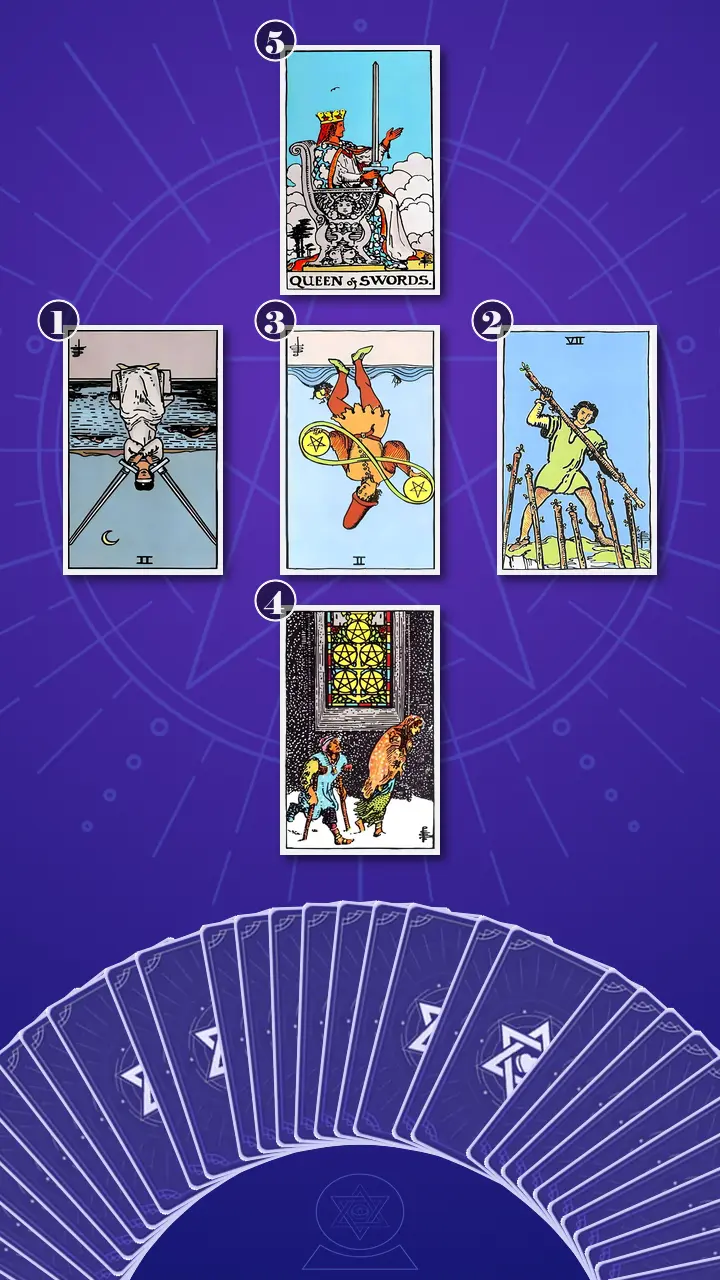
I told her I was using the Relationship Spread · Context Edition, a five-card layout I reach for when someone wants clarity around a friend who acts different in private than in public. This is how tarot works best for social ambiguity: not by pretending to read someone else’s hidden motives, but by separating what is observable, what dynamic is being created, what wound is being triggered, and what healthy next step becomes possible. It is clean, practical, and especially useful for group chat anxiety because it moves from symptom to root trigger without turning guesswork into certainty.
On the table, the spread formed a cross. Card one would show me what the mixed signal was doing inside Jordan in real time. Card three at the center would name the actual DM-versus-group-chat pattern. Card four underneath would tell me why this landed so hard in her body, and card five above the center would point toward finding clarity without self-abandonment. In other words: self, social context, dynamic, blind spot, next steps.
Reading the Split Screen
When I read friendship mixed signals, I want card meanings in context, not abstract tarot poetry. So I moved through the spread exactly the way the layout asked: left, center, right, beneath, then up.
Position 1: The Tabs That Never Close
Now turning over the card representing Jordan’s immediate experience of the mixed signal, I got the Two of Swords, reversed.
This card looked almost embarrassingly literal in her case. It looked like opening the warm DM and the cold-feeling group thread side by side at midnight, drafting three different replies, deleting all of them, and telling yourself you just need a little more evidence before you can decide whether anything is actually wrong. The energy here was blocked Air tipping into excess: too much interpretation, not enough grounded information. The crossed swords became two conflicting explanations she kept holding at once, the blindfold became context she did not actually have, and the dark water behind the figure was the hurt she was trying to out-think.
Jordan let out one short laugh with a bruise inside it. “That’s… rude,” she said. “Accurate, but rude.” Her thumb rubbed the edge of her water glass the way people do when a card has just said the quiet part out loud.
I nodded. “This is the screenshot-folder stage of anxiety,” I told her. “It’s like having eighteen tabs open and thinking one more refresh will finally make the answer obvious. The problem isn’t that you have zero data. It’s that you’re trying to force one stable answer out of two tones that keep canceling each other out.”
Position 2: Main-Feed Energy, Close-Friends Warmth
Now turning over the card representing what was visibly different about her friend’s behavior in public, I found the Seven of Wands, upright.
Here the imagery mattered: one figure on higher ground, staff raised, managing pressure. In real life, this looked like the friend who feels relaxed and easy one-on-one, then turns clipped or socially armored the moment the whole thread is active, like public visibility makes them manage optics instead of intimacy. It was not proof of hidden cruelty. It was defensive Fire: energy that braces before it softens.
“Think main-feed versus Close Friends energy,” I said. “Same person, different level of guard. Public tone is data, not a verdict.”
Jordan’s eyes lifted from the table for the first time in a way that looked less hunted. “She does get weird in groups,” she said quietly. “Like she’s trying to keep up with everyone’s vibe at once.” I stayed with the observable, because this spread was never about reading her friend’s mind. It was about reading the pressure field around the friendship.
Position 3: The Two-Channel Reality Check
At the center of the spread — the pattern created by the split itself — I turned over the Two of Pentacles, reversed.
This is the unstable rhythm of treating DMs and the group chat like they should deliver the same emotional temperature, then feeling thrown every time one room runs warmer than the other. The figure in the card keeps juggling, the infinity loop keeps moving, the ships in the background keep lifting and dropping in rough water. In Jordan’s life, it was constant app-switching: comparing emojis, timing, sentence length, who got the warmer reply, and telling herself the mismatch had to mean something final. The energy was strained Earth, not settled Earth. Instead of grounding her, it made the whole friendship feel like a balance problem she could never quite solve.
A very old part of my Wall Street brain flickered on there. When I used to sit with market dashboards open, two charts could look completely different because they were measuring different things. That did not always mean one of them was lying. Sometimes it meant the observer was committing a category error. “Jordan,” I said, “you’ve been trying to merge two app dashboards that track different pressures and calling the mismatch a verdict. Screenshots can preserve evidence; they cannot create clarity.”
She went still for a second, then gave the smallest nod. I could almost see the sentence forming behind her eyes: I’ve been forcing one story out of two formats. The room loosened by a degree.
Position 4: Outside the Emotional Room
Then I turned over the card beneath the center, the one uncovering the belonging wound underneath all of this. It was the Five of Pentacles, upright.
This is the moment a short or absent public reply stops feeling merely confusing and starts hitting like exclusion. Not dramatic, not cinematic — just sharp in that specific modern way, like standing outside a warm apartment party, seeing the light through the window, and wondering whether you were actually invited emotionally. The lit window in the card sat close but unreachable. The cold outside was the body-sense she already knew too well: tight stomach, chest drop, shoulders inching upward because one flat group-chat moment had suddenly become a referendum on whether she belonged.
Jordan looked away from me and toward the rain-blurred window beside the table. Her breathing paused, her jaw set, and then she let out a long breath that seemed to come from lower than her lungs. “It wasn’t even that dramatic,” she said. “But my body heard it as being left out.”
“Exactly,” I said. “The pain is bigger than the message. The real shift in the story is the second you stop asking, ‘What does this text mean?’ and start hearing the more painful sentence underneath it: ‘Maybe I matter less here than I thought.’”
No Cups had appeared anywhere in the spread so far, and I noticed that too. The feelings were absolutely present, but they were buried under analysis, guard, social pressure, and self-protection. It was a relationship reading with the heart hidden under systems.
When the Queen of Swords Cut Through the Theories
Position 5: The Sentence That Could Actually Change the Friendship
When I reached for the final card, the room felt noticeably quieter. The rain outside had thinned to a fine silver mist, and a band of clearer light moved across the window just as I turned over the Queen of Swords, upright. I have learned not to force meaning onto weather, but sometimes the environment conspires with a symbol so neatly that even I smile.
This position points to the cleanest way out of the spiral, and Jordan’s card could not have been clearer. The Queen of Swords is the part of her that closes the screenshot folder, names the exact pattern without dramatizing it, and says, “Hey, I’ve noticed you feel different in the group chat than you do in DMs sometimes. Am I reading that right?” The energy here was balanced Air at last: discernment instead of over-analysis, direct speech instead of private detective work, self-respect instead of self-erasure.
You know that moment on the ride home when one sweet DM briefly relaxes your body, then one flat group-chat beat makes your chest sink all over again? That swing feels personal because your brain is trying to turn contrast into certainty. Jordan was still caught in the fear that if she asked directly, she would sound intense — like being easygoing had quietly become the rule that kept her silent.
You do not have to keep swallowing the coldness and decoding it alone; let the Queen of Swords raise her clear blade and replace mind-reading with one honest question.
She froze first. Her fingers stopped halfway around the glass, and her breath stalled so lightly I only noticed because I spend my life watching for the body to speak before the mouth does. Then came the cognitive part: her gaze slipped off the card and unfocused, as if she were replaying a half-dozen commute rides, a half-dozen deleted drafts, the whole Fleabag-style inner monologue that had been working overtime while the actual friendship stayed mostly silent. Then came the feeling. Her shoulders dropped. The line between her brows softened. And right at the edge of that release, she gave me a look that carried both relief and resistance. “But if I ask,” she said, voice thin with the old fear, “doesn’t that mean I’ve made it a whole thing?”
“No,” I told her. “It means you’re finally letting reality participate. Mixed signals are not a puzzle you have to solve silently; if the pattern keeps hurting, it deserves one clear question more than ten more re-reads.” I paused, and an old professional reflex rose in me — not the trading floor itself, but the discipline it drilled into me. I call it Negotiation Alchemy: in any conversation that matters, I look for three things — the observable fact, the clean ask, and the self-respecting boundary if the answer stays foggy. In business that framework protects capital; in friendship it protects dignity. So I asked her, “Using that lens, what is the fact? What do you actually want to know? And if the answer stays vague, what boundary helps you stop auditioning for closeness in the group chat?”
She swallowed, nodded once, and looked back down. “The fact is that she’s warmer in private than in the thread. What I want to know is whether I’m reading distance that’s actually there. And if it stays vague… I think I stop letting the group chat decide how close we are.”
That was the moment the reading changed. Not into certainty, not into a perfect answer, but into grounded curiosity. I asked her to think back over the last week with this new lens. She gave a soft, embarrassed laugh and told me about a Monday morning in the office when she had typed a genuinely warm reply in the group chat and edited it down to a dry little “lol” so she wouldn’t look more invested if her friend didn’t match it. Seeing that mattered. This was the first real move from tone-scanning confusion and belonging anxiety toward self-trust and clearer friendship boundaries.
From Screenshots to Conversation
Once all five cards were on the table, I gathered the story they were telling. First came the split mind: Jordan compared warm DMs and cold public replies until the contrast became its own self-feeding loop. Then came the friend’s visible public guardedness, which may be real without automatically being rejection. At the center sat the unstable two-channel dynamic itself: two different digital rooms, two different pressures, one nervous system trying to turn them into a single verdict. Underneath all of it was the actual wound — the fear that a cooler public tone meant she mattered less and belonged less. And above it all stood the Queen, asking her to stop solving the friendship through screenshots and let conversation do what screenshots never can.
I sometimes summarize a reading the way I used to summarize a risk memo, because clarity likes structure. In Jordan’s relational SWOT, the strength was real private warmth. The weakness was her habit of treating ambiguity like proof. The opportunity was a grounded check-in. The threat was letting a belonging wound write the whole story before any honest conversation had happened. Her cognitive blind spot was not caring too much; it was assuming that public coolness had the authority to define the friendship. The transformation direction was simple and difficult at the same time: from decoding to directness, from public tone as verdict to public tone as data.
So I gave her actionable advice that was deliberately small. Not a grand confrontation. Not a twelve-paragraph message. Just practical next steps.
- The Three-Line NoteOpen your Notes app within the next 10 minutes and write only these headers: “What happened,” “What I made it mean,” and “What I want to ask.” Keep it brutally short. One concrete behavior, one story your mind added, one question you actually want answered.If your body is buzzing, draft only. Both feet on the floor, slower breath, no sending yet. Clarity does not require instant vulnerability.
- The One-Clean-Question Check-InThis week, send one grounded text — or ask on a walk, in a voice note, or over a low-pressure coffee — using my Cocktail Party Algorithm: one warm opener, one observation, one question. For example: “Hey, I’ve noticed our vibe feels different in the group chat than in DMs sometimes. Am I reading that right?”No evidence deck. No accusation. No apology for having noticed. Keep it short on purpose; one clean question beats ten private theories.
- The Two-Channel Reality CheckFor the next seven days, pick two windows only to look at the group chat — especially not on the streetcar home and not in bed. When something stings, write down the observable behavior before you ask a trusted friend to review screenshots.This is data hygiene, not denial. Different channels carry different audience pressure. If two windows feels impossible, start with a 20-minute delay before reopening the thread.
Jordan grimaced at the second step and gave me the most honest objection of the session. “But I can barely send a normal meme right now,” she said. “A message like that feels huge.”
“Then don’t start with text,” I said. “Use the same sentence on a walk. Or send a voice note so your tone can carry the care. The Queen of Swords isn’t asking for drama. She’s asking for clean language.”

A Week Later, the Proof Was Quiet
A week later, Jordan sent me a message that was blessedly short. She had asked her friend for coffee after work instead of dropping a paragraph into the middle of a Wednesday afternoon. She used the one-question version. Her friend told her the group chat makes her terse with everyone when it gets busy, and that she had not realized Jordan was feeling the difference so strongly. It did not solve friendship forever. But it gave the situation a real shape instead of the haunted one Jordan’s late-night theories had built.
My favorite part was the image that came after. Jordan wrote that she left the café, sat alone by the window with an oat latte, and stared out at Queen Street for ten quiet minutes. Clear, but still a little shaky. The next morning her first thought was still, “What if I read that wrong?” — only this time she caught herself, smiled, and did not reopen the chat before getting out of bed.
This is why I still trust tarot as a decision-making tool: not because it hands me certainty on a silver tray, but because it helps me separate noise from pattern and pattern from truth. In a Five-card Relationship Spread · Context Edition for warm DMs and cold group chat dynamics, the real magic is often very practical: from tone-scanning confusion and belonging anxiety to grounded curiosity, self-trust, and clearer friendship boundaries.
When one warm DM can calm you for an hour and one flat group-chat moment makes your stomach drop again, the ache is rarely just about tone; it’s about how quickly belonging can start to feel conditional.
If you stopped asking your screenshot folder to act like a courtroom, what one honest question might help you feel a little more solid in your own skin this week?