My “Being Chill” Was People-Pleasing: How I Tested Trio Reciprocity

Finding Clarity in the 8:47 p.m. WhatsApp Scroll
I met Jordan (name changed for privacy) on a rainy London evening over a video call—her face lit by the same blue-white glow I’ve seen a thousand times in the planetarium: the light that makes you look awake while your body is clearly running on fumes.
I told her, gently, the way I’d say it to someone stepping into my dome show right before the lights go out: “If you’re 26, commuting home on the Tube, rereading a WhatsApp group chat like it’s evidence, and trying to act ‘chill’ about being the third wheel… yeah, that’s a real kind of tired (third wheel friend).”
She blinked fast, like I’d named something she’d been trying not to name. Then she described it in a London-specific snapshot: 8:47 PM on the Central line heading east, carriage rattling, fluorescent lights flickering. Her phone screen felt warm against her palm. She watched the other two in the trio volley messages back and forth—quick, easy, inside-rhythm. Her thumb hovered over a draft: Can we do something one-on-one? Her throat tightened like she was swallowing a sentence whole.
“I don’t want to be dramatic,” she said, and her smile didn’t reach her eyes, “but I also don’t want to keep feeling like furniture.”
I could hear the core contradiction underneath, as clear as a constellation line drawn between two stars: she wanted to belong in the trio, but she feared that asking for space or clarity would prove she wasn’t truly wanted.
Awkwardness, in her case, wasn’t a vague mood. It lived in her body as a tight throat and a slightly tense smile—like she was bracing to not take up too much space, the way you hold your shoulders small when you’re trying not to bump anyone on a crowded platform.
“We’re not here to make you ‘care less,’” I said. “We’re here to find clarity—what’s actually happening, what you’re doing to survive it, and what your next step is that keeps your self-respect intact.”

Choosing the Compass: The Energy Diagnostic Map (7) for a Friendship Trio Imbalance
I asked Jordan to take one slow breath—not as a mystical ritual, just a nervous system handrail. Then I shuffled slowly, the way I do before a planetarium show when I’m syncing the projector’s timing to the night sky: steady, deliberate, focused.
“Today, we’ll use something I call the Energy Diagnostic Map (7) · Context Edition,” I said.
And for anyone reading along, here’s why that matters: a classic two-person relationship spread doesn’t fully capture a trio’s strange two-against-one gravity, and a big spread like the Celtic Cross can turn a social pattern into a maze. This map keeps it minimal while still separating: the visible vibe, your inner hesitation, the duo’s pull, the core blockage, your usable resource, the key transformation, and one concrete next step you can take this week.
“Card 1 will name the observable vibe you’re reacting to,” I told her. “Card 4 is the core blockage—what turns a normal awkward moment into a repeating identity story. And card 7 is where we land: actionable advice you can try this week, not a ‘someday’ idea.”
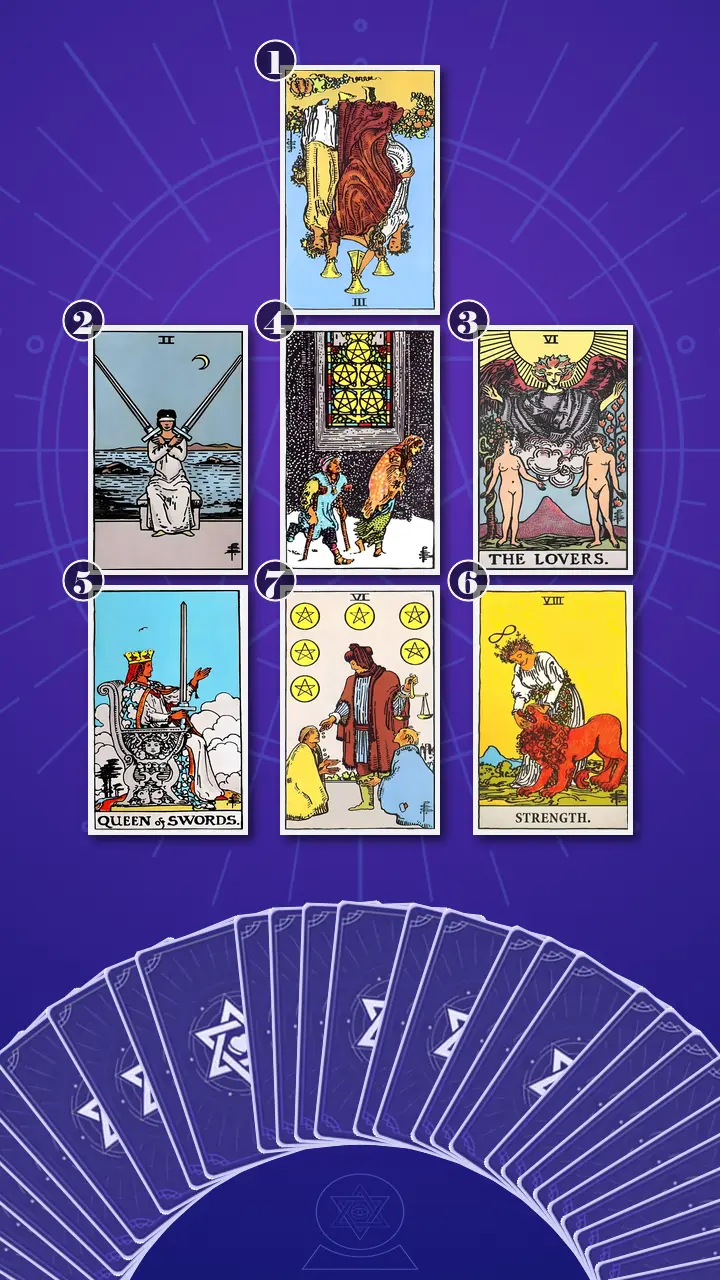
Reading the Map: How Tarot Works When You Feel Like the Extra Friend
Position 1: What the trio dynamic looks like on the surface right now
“Now turning over the card that represents what the trio dynamic looks like on the surface right now—the observable vibe you’re reacting to.”
Three of Cups, reversed.
I didn’t have to reach for anything abstract. This card, in this position, is painfully literal in modern life: a Friday-after-work hangout where you’re technically invited, but the vibe is a closed loop. They’re sharing inside jokes, swapping glances, and you become the person who laughs a beat late. So you compensate by being the “fun” one—ordering rounds, taking photos, keeping conversation moving—so no one notices you feel like an audience member in your own friend group.
Reversed, the Three of Cups reads like belonging that doesn’t quite let you in. It’s not “no friends.” It’s “friends, but the circle stays tight.” The energy here is blocked: joy exists, connection exists, but it isn’t flowing toward you consistently.
Jordan let out a small laugh that had a sharp edge to it. The reaction came in a quick chain: her breath paused (freeze), her eyes flicked down and to the side like she was replaying a specific booth moment (cognition), and then her shoulders dropped with a quiet, embarrassed exhale (release). “That’s… brutal,” she said. “It’s accurate. But brutal.”
“Feeling like the extra friend isn’t a personality flaw—it’s a pattern you can measure and respond to,” I said, because I wanted the shame to loosen early, before it could harden into a story.
Position 2: Your inner conflict in the trio
“Now turning over the card that represents your inner conflict in the trio—what you’re not saying or deciding in the moment.”
Two of Swords, upright.
This is the stalemate card, and it shows up exactly like her Tube commute: you hover over the honest message—“Can we do something just us two?”—then panic-scroll for a safer option and send a meme instead. In person, you keep your face neutral and your wants unspoken, because it feels safer to be “easy” than to risk being told no.
The energy here is self-protective balance that’s become a blockage. Not looking doesn’t mean there’s nothing to see. It means you’re choosing not to look directly at what you need and what the trio is currently offering.
I asked her, “What’s the exact sentence you keep not saying, because you’re scared it’ll make you look needy or difficult?”
Jordan’s jaw flexed once. “I want one-on-one time,” she said, like admitting it made the room colder. “And I want… I want to not always be the one adapting.”
Position 3: The relational pressure you’re responding to
“Now turning over the card that represents the relational pressure you’re responding to—the duo bond’s pull, without blaming anyone.”
The Lovers, upright.
In a trio, The Lovers isn’t automatically romance. It’s alignment—two people with a clean feedback loop. It’s the “we” energy: quick consensus, shared taste, shared momentum. And you can feel the pressure to adapt fast so you don’t get left behind, even when the plan isn’t what you’d choose.
The energy here is strong and organizing. A dyad inside a trio has weight. That doesn’t make you unwanted. It makes the structure real.
“This card asks a values question,” I said. “Do you participate from alignment—what actually nourishes you—or from fear, like approval-chasing dressed up as being chill?”
Jordan nodded, but the nod was tense, like she didn’t want to agree too loudly. “Sometimes I say yes and I’m already upset,” she admitted. “And then I hate myself for being upset.”
Position 4: The core blockage
“Now turning over the card that represents the core blockage—the deepest fear or belief that turns awkwardness into a repeating pattern.”
Five of Pentacles, upright.
The Five of Pentacles is the exclusion story. It’s shame plus scarcity lens. After the hangout, you go home and spiral: every delayed reply becomes evidence you’re optional, every photo becomes proof you’re outside the warm room. You feel embarrassed for caring, so you minimise it out loud—then punish yourself in private with replay loops and self-blame.
And the echo between Positions 2 and 4 is brutal in its simplicity: the Two of Swords keeps you silent in the moment, and the Five of Pentacles fills the silence with a verdict. The energy becomes a loop: Trigger belief (“If I make this a thing, I’ll be the problem”) → coping (stay quiet, over-accommodate, wait to be chosen) → short-term relief (no awkward conversation) → long-term cost (your needs stay invisible, duo bond strengthens) → reinforced belief (“See, I’m not essential here”).
I said it the way I’d explain a celestial illusion to a school group—no judgment, just mechanics: “This isn’t you being ‘too sensitive.’ It’s your nervous system trying to prevent rejection by avoiding clarity.”
Jordan swallowed, throat moving like she was trying to get past a lump that wasn’t food. “Sunday nights are the worst,” she said. “I see them tagged somewhere and my brain turns into… like a solicitor building a case.”
“Yes,” I said softly. “And that’s the Five of Pentacles talking. It makes belonging feel like a warm room you can see—but you don’t feel entitled to knock.”
Position 5: Your usable resource
“Now turning over the card that represents your usable resource—a boundary, skill, or mindset you can access without needing them to change first.”
Queen of Swords, upright.
This is my favourite kind of resource card because it’s not about becoming colder. It’s about becoming clearer. The Queen holds a sword and extends an open hand: directness plus invitation, clarity without accusation.
In modern life, she sounds like this—two or three sentences, no apology-padding:
“Hey — I’ve been missing one-on-one time with you. Are you up for a quick coffee after work next week, just us?”
I watched Jordan’s hands as she listened. They were slightly shaky at first, fingers worrying the edge of her sleeve—then, as if her body liked the simplicity, her breath steadied.
“Your brain will want to write a paragraph,” I warned. “It’ll try to pre-empt rejection by explaining your whole backstory. The Queen of Swords says: shorter is kinder. Shorter is clearer.”
Jordan gave a small, surprised smile. “That actually feels… doable,” she said—like she’d just found a door that wasn’t locked, only untried.
When Strength Spoke: The Lion, the Booth, and the Turning Point
Position 6: Key transformation
When I reached for the sixth card, the room seemed to quiet even through the screen. Outside Jordan’s window, headlights smeared across wet pavement; inside my own space, the hum of my laptop fan suddenly felt loud. This was the turning point card—the bridge.
“Now turning over the card that represents key transformation—the courage shift that changes how you participate or step back.”
Strength, upright.
Strength isn’t a confrontation. It’s regulated courage: calm hands, loud inner feelings. It’s the moment you feel the sting of being sidelined and still keep your dignity—steady breath, relaxed shoulders, calm voice. Instead of disappearing or performing, you say the true thing in one sentence… then you tolerate the awkward pause without scrambling to fix it.
As an astrologer-researcher, I couldn’t ignore how perfectly this mapped to something I call my Binary Star System lens. “In trios,” I told her, “a tight duo can behave like a binary star system—two bodies orbiting each other so closely they become tidally locked. They’re not doing it to punish the third star. It’s just physics: their rhythm becomes automatic.”
“And here’s the part people miss,” I continued. “Your job isn’t to fling yourself harder at their gravity until you’re exhausted. Your job is to hold your own orbit with gentle firmness—so the system either makes room for you, or you stop burning fuel trying to force a place that isn’t being offered.”
Setup: I could feel Jordan right in that familiar moment: the honest text drafted, deleted, re-drafted; the refresh of Instagram Stories like the answer lived there; the tight-throat fear that if she asked directly, she’d finally get the one thing she dreaded—confirmation she didn’t belong.
Stop shrinking yourself to fit the vibe; practice calm strength and let the lion’s truth show you where you’re genuinely welcome.
Reinforcement: Jordan’s face changed in layers. First, she went still—eyes widening just a fraction, like the moment the planetarium stars appear and your brain stops fighting the dark. Her shoulders rose (a reflex), then she noticed it and let them drop with one slow breath. Her lips pressed together, then parted as if she was about to argue and realised she didn’t actually want to. For a second, irritation flashed. “But if I do that,” she said, voice tight, “doesn’t it mean I’ve been doing it wrong? Like… I’ve been the problem?”
I didn’t rush to soothe. I kept my tone steady, Strength-style. “No,” I said. “It means you’ve been surviving. The shrink-and-smile strategy kept you included in the short term. But it also trained the dynamic that your needs don’t exist.”
She blinked again, fast. Her gaze unfocused—like she was replaying a specific hangout: the two-seat booth, her coat in her arms like a prop, the bright laugh that arrived half a second late. Then her breath came out shakier, warmer. “I can feel it,” she whispered, touching her throat with her fingertips. “Like I swallow everything.”
“Exactly,” I said. “Strength is you staying in your body long enough to say one clean sentence, instead of disappearing into overthinking.”
I asked her the question that locks the insight into real time: “Now, with this new perspective—can you think of a moment last week when you started shrinking? And what would you have said if you could hold your dignity for ten seconds of awkwardness?”
Jordan exhaled, slower now. “When they decided plans outside Oxford Circus and I just went along,” she said. “I would’ve said… ‘I’m up for drinks, but I’d really love a proper catch-up somewhere we can actually sit—can we do dinner instead?’”
In that moment, I could feel the emotional transformation click into place: not from certainty to certainty, but from the starting state of contracted, hyper-vigilant scanning toward the desired state—self-respect that can tolerate a little discomfort to get real information. This wasn’t about winning the trio. It was about strengthening self-trust.
Position 7: Next step you can take this week
“Now turning over the card that represents your next step this week—a concrete move that tests reciprocity and restores self-respect.”
Six of Pentacles, upright.
The Six of Pentacles is the scales. It’s the antidote to mind-reading. It says: stop turning your feelings into a debate about whether you’re “too sensitive.” Make it observable. Who initiates? Who follows up? Who makes space—literally and emotionally?
I said the line I’ve learned people need when they’re stuck in group chat ignored spirals: “Stop debating your feelings. Start watching behaviour.”
The energy here is grounded balance. Not punishment. Not revenge. Data. A one-week reciprocity test that tells the truth without you having to perform convenience.
The One-Page Star Map: Actionable Advice for Your Next 7 Days
I pulled the whole spread together for her in one simple narrative, the way I’d summarise a night sky for a first-time visitor: “On the surface, the trio looks like celebration with a closed loop (Three of Cups reversed). Inside you, you freeze to avoid being ‘a problem’ (Two of Swords). Externally, the other two have a strong dyad rhythm (The Lovers), which pressures you to adapt. Underneath, the real engine is the exclusion story—shame that says you’re outside the warm room unless you earn your way in (Five of Pentacles). Your resource is clarity with kindness (Queen of Swords). Your turning point is regulated courage—one clean sentence said with steady hands (Strength). And your next step is the scales: reciprocity you can measure (Six of Pentacles).”
“Here’s the cognitive blind spot,” I added. “You’ve been treating asking as proof you don’t belong. But asking is actually how you test belonging. The transformation direction is: from trying to earn a place by being convenient to testing reciprocity through clear asks and clean boundaries.”
To make it practical, I offered Jordan a simple version of my Social Star Map strategy—something I use when people’s social lives feel like chaotic meteor showers. “For one week,” I said, “we’re going to stop letting the loudest plan win. We’re going to choose where your energy goes on purpose, like plotting three bright points instead of chasing every flicker.”
- The 3-Sentence Ask (Queen of Swords)Send one text (max 3 sentences) to one person in the trio: “Hey — I’ve been missing one-on-one time with you. Are you up for a quick coffee after work next week, just us?”If your chest tightens after you hit send, put your phone on Do Not Disturb for 30 minutes and do something sensory (walk, shower, tea) so you don’t spiral-refresh for reassurance.
- The “Three Seats” Preference (Six of Pentacles in real life)For the next hangout, make one measurable ask: “Can we choose a place with three proper seats?” or “Can we book a table instead of standing at the bar?”Lower-the-bar version: if saying it out loud feels like too much, text it in advance as a simple preference—no apology, no long explanation.
- The 24-Hour No-Logistics ExperimentFor one plan this week, don’t book, coordinate, order, or follow up. Let the trio’s effort show itself. Notice who fills the gap—if anyone does.Keep it factual, not interpretive. The purpose is finding clarity, not building a court case.
“Reciprocity is the antidote to ‘maybe I’m the problem,’” I said. “And you don’t have to fight for a seat—you’re allowed to ask for one and let the answer be information.”

A Week Later: The Quiet Proof
Six days later, Jordan messaged me. No essay—just a screenshot and one line: “I sent the 3-sentence ask. My hands were shaking, but I didn’t add a paragraph.”
The reply she got back wasn’t cinematic. It was normal, which was the point: “Yes—coffee Tuesday? I’ve missed you.”
She told me something else, too, in the kind of understated update that signals real change: she’d skipped a last-minute standing-room drinks plan and went for that coffee instead. She didn’t punish herself afterward. She didn’t refresh Instagram Stories like a live scoreboard of her worth. She still felt a flicker of that old sting—what if they’re together without me?—but this time she noticed her throat tighten, took one slow breath, and let the question be what it was: a feeling, not a verdict.
That’s the journey to clarity I care about. Not a perfect trio. Not instant certainty. Just the small loosening that happens when you stop shrinking to fit a vibe—and start choosing connections that meet you halfway.
When you’re smiling in the booth-light while your throat tightens, it’s not that you’re “too sensitive”—it’s that you’re trying to belong without risking the one thing that would confirm you matter: asking for space, clarity, or effort.
If you didn’t have to earn your spot by being convenient, what’s one clear, low-drama ask you’d be willing to try this week—just to see what reciprocity actually looks like?