Downplay First, Feel Later—and How to Name What Kindness Touched

Why Being Remembered Hits So Hard at 8:11 a.m.
When Taylor (name changed for privacy), a 27-year-old content coordinator from Toronto, sat down across from me at the little marble table in the back of my café, she gave me the exact smile I have learned to recognize over twenty years of pouring espresso and reading cards: competent on the surface, slightly wrecked underneath. It is the smile of someone who can handle hybrid work, commute delays, Slack pings, and rent math—but nearly cries because a friend remembered her extra-hot oat flat white.
She told me about 8:11 on a Wednesday in a coffee shop off Queen West. The espresso machine hissed. Wet coats steamed by the door. Her friend answered the barista with Taylor's usual order before she could open her mouth. Taylor laughed too quickly, said, 'Wow, okay, stalker energy,' stared at the pastry case, and took the paper cup with a hand that suddenly felt too aware of its own shaking. Then her throat tightened. Her chest went warm. Her whole body went strangely still, as if one tiny thoughtful detail had pressed pause on the rest of the morning.
'It was just coffee,' she said. 'So why did I feel like I was about to cry?' By the streetcar ride home, she told me, she was halfway to Googling things like 'why kindness makes me cry' and 'why being remembered hits so hard' instead of simply letting the moment be what it was.
I know that feeling well when I see it. It looks like trying to swallow sunlight with a closed throat. 'Because it probably was not just coffee,' I said. 'Sometimes the smallest kindness hits hardest because it lands where care used to be inconsistent.' As she spoke, I already knew I wanted to use a Situation-Obstacle-Advice-Outcome tarot spread for understanding why a remembered coffee order hit so hard. 'Let me help you draw a map,' I told her. 'We are not here to shame the feeling. We are here to see what it is pointing to.'

Choosing the Bridge: A Four-Card Spread for a Present Trigger and Past Wound
I asked Taylor to wrap both hands around her cup, take one slow breath, and hold the question exactly as it lived in her body: My friend remembered my coffee order—what past makes it hit so hard? Then I shuffled. In my space, that pause is not theatre. It is a handoff from spiraling to noticing.
For this reading, I chose the Situation-Obstacle-Advice-Outcome spread. When somebody is asking why a small act of care feels too big, this is one of the clearest ways I can show how tarot works in real life. The spread moves in a straight line: first the present trigger, then the older pattern underneath it, then the healing reframe, then the next lived expression. More cards would have added noise. Fewer cards would have blurred the difference between what happened at the café and what that moment awakened from much earlier.
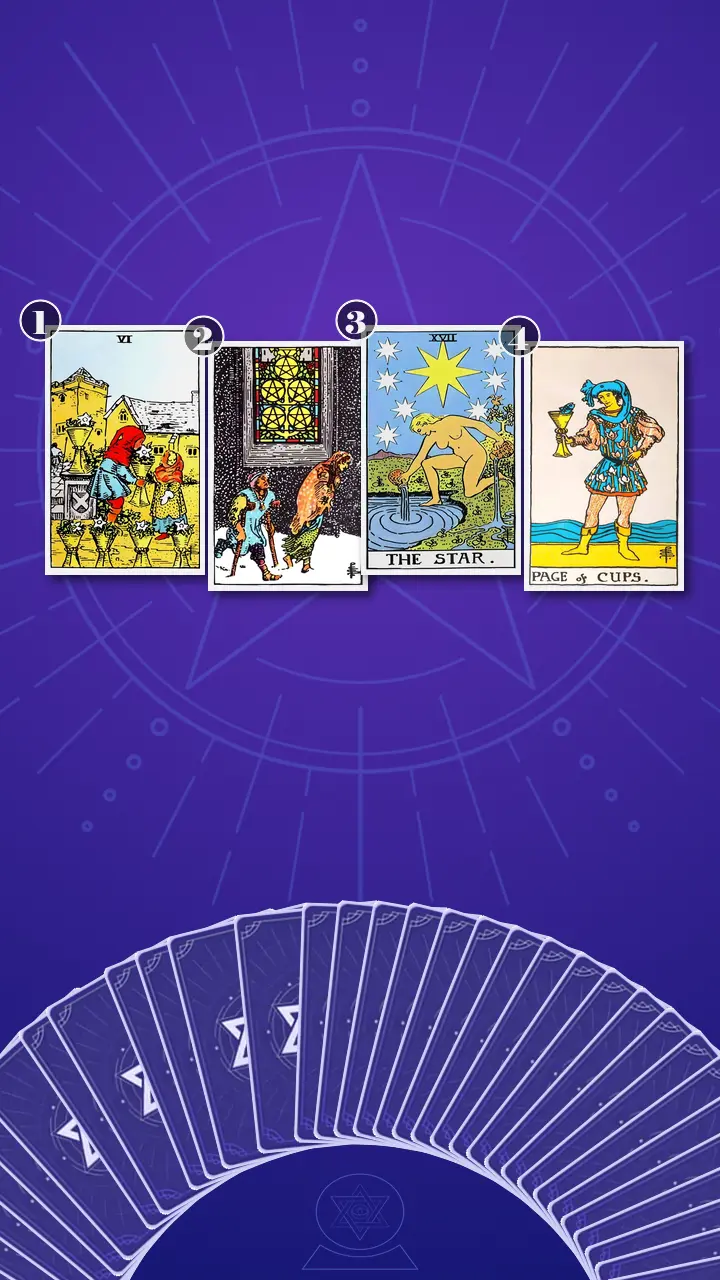
I laid the cards left to right like a short bridge. The first position would show the visible moment: what happened when the order landed, and what Taylor did in the next ten seconds. The second would reveal the older scarcity or exclusion pattern that made the gesture feel almost destabilizing. The third—usually the hinge in a reading like this—would point to the reframing that could soften shame around receiving care. The fourth would show the small relational response that becomes possible once tenderness is allowed to mean something.
Reading the Map, One Cup at a Time
The Offered Cup in a Queen West Line
I turned over the card that represents the present relational trigger and the visible behavior in the moment the remembered coffee order lands. It was the Six of Cups, upright.
In real life, this is exactly that neighborhood café moment before work: your friend answers the barista with your exact order without checking, and in the two seconds after, you laugh, look down, and feel your throat tighten because being known that specifically feels sweet, disorienting, and much bigger than the moment should be on paper. The Six of Cups carries memory, innocence, and small gestures of care offered without calculation. Its energy here is balanced on the surface, but emotionally catalytic underneath. Nothing dramatic happened—yet something old woke up immediately.
I pointed to the image of one figure offering a cup to another. 'This is care without performance,' I said. 'No grand speech. No heavy emotional setup. Just accuracy.' Then I used one of the frameworks I rely on in the café, what I call Milk Foam Layer Analysis. 'Your joke was the foam,' I told her. 'Light, quick, social. But the espresso underneath was much stronger: gratitude, longing, and the shock of not having to repeat yourself to be remembered.' It had that quiet, devastating quality of a tiny gesture in Normal People—nothing flashy, just precise enough to go straight past the intellect.
Taylor let out a short laugh that sounded almost offended by how seen she felt. 'Okay,' she said, shaking her head, 'that is rude levels of accurate.' Her fingers curled around the cup again, and I could feel recognition beginning to replace embarrassment.
The Cold Outside the Lit Window
Next came the card representing the older imprint of emotional scarcity or exclusion that makes small acts of care feel disproportionately intense. It was the Five of Pentacles, upright.
This is the aftershock card. It is the eastbound TTC ride home, the phone still warm from rereading the moment, the stop announcements crackling overhead while your mind starts scanning old scenes—family, school, friendships, dating—for a reason this felt so loaded. The Five of Pentacles says the reaction is not random. It is the body recognizing contrast. Warmth has arrived, but part of you still relates to warmth as something visible-yet-unreliable, like passing lit condo windows on a freezing night and not quite believing any of them are for you.
The energy here is blocked and contracted. Not because you are incapable of receiving care, but because some older part of your system expects consideration to be occasional rather than steady. When that is the baseline, a simple remembered coffee order can feel emotionally expensive. The problem is not that the gesture was small. The problem is that your system learned small care was not guaranteed. That is the whole loop: downplay first, feel later.
As I said it, I glanced toward the front windows of my café. Outside, the street was damp and iron-grey. Inside, the brass lamps threw soft gold across the tables. I have closed this place on enough winter nights to know the difference between seeing warmth and feeling welcome inside it. When I see the lit window in the Five of Pentacles, that is what flashes through me every time.
Taylor's reaction moved through me before she even spoke. First her breath caught. Then her eyes drifted past the cards, unfocused, as though memory had opened a door without asking permission. Finally she exhaled and said very quietly, 'I hate how accurate this is.' That was not resistance. That was the moment the old cold baseline finally had a name.
When The Star Poured Water Where Shame Used to Live
Then I turned over the third card, the one pointing to the key reframing that softens fear around belonging and receiving care. The room changed when it appeared. The grinder in front had gone silent. Even the kitchen hiss seemed to fall away for a beat, as if the café itself knew we had reached the hinge of the reading. The card was The Star, upright.
The Star appears when the question is ready to change. Not 'Why am I like this?' but 'What need just became visible?' In modern life, it looks like sitting on your bed later that night with the city glow at the window, resisting the urge to turn one thoughtful moment into a full private case study. The figure on the card pours water onto land and pool at once, and that matters here: Taylor's task is not only to receive care from someone else, but also to let herself validate the need that care touched when she gets home alone.
I leaned in a little. 'Before I say the deepest part,' I told her, 'picture the ride home after the café: your phone still warm from rereading the moment, your shoulders up around your ears, city lights sliding across the TTC window while you keep telling yourself it was only a coffee order.'
This is not proof that you are overly sensitive; it is The Star showing you where emotional drought has been, so you can stop shaming your thirst and start receiving the water.
I let the sentence rest between us.
Then I brought in another one of my café frameworks, the one I call Social Espresso Extraction. 'In coffee,' I said, 'extraction tells me what the water pulls out under pressure. In relationships, I watch for what a precise moment pulls out of someone when it finally lands cleanly enough. Some social moments over-extract into bitterness. Some under-extract into vagueness. This one was exact. Your friend's remembered order did not invent a need out of nowhere. It revealed a note that was already there: the need to be considered steadily, not accidentally. Tenderness is information, not an indictment.'
Her reaction came in three waves. First, the physical freeze: her hand stopped halfway to her cup, her mouth parted, and her breath stalled high in her chest. Then came the cognitive seep-through: her eyes lost focus in that very specific way people do when several old scenes start replaying at once and the present room has to share space with them. I could almost feel the montage moving through her—school lunch tables, family rooms, office kitchens, the small places where being thoughtfully considered had never felt safe enough to become normal. Then came the release. Her shoulders dropped. Her jaw unclenched. Her eyes glossed over. She gave a shaky laugh that carried a thread of anger inside it. 'But if that is true,' she said, 'then I have been calling myself too much for wanting something completely normal.'
'Yes,' I told her softly. 'And that does not mean you were wrong before. It means you finally have the right language now.'
I asked her, 'Using this lens, can you think of a moment last week when this insight would have changed how you understood your reaction?' She nodded almost immediately. 'A coworker left my favorite tea by my laptop before this brutal afternoon of edits,' she said. 'I nearly cried in the office kitchen and then acted chill about it. I thought I was being ridiculous. I was not. I just felt seen.'
That was the crossing point in the whole reading: from self-accusation to self-recognition, from treating tenderness as proof of deprivation to treating it as clear information about a need that deserves acknowledgment.
The Draft That Finally Gets Sent
The last card represented the inner integration and small relational expression that become possible when the guidance is practiced. It was the Page of Cups, upright.
I love this card because it does not demand a personality transplant. It asks for beginner-level emotional honesty. In real life, it is the text that usually sits in Apple Notes drafts finally getting sent at normal volume: 'That was really thoughtful yesterday. You remembering that meant a lot.' Nothing turns into a scene. Nothing becomes a whole dissertation on your past. It is simply one true line.
The energy here is open, but not flooded. The fish rising from the cup is that surprising feeling that pops up mid-moment and does not need to be shoved back underwater. The Page of Cups says the next step is not more analysis. It is small expression. You do not need a speech. One honest sentence is enough.
Taylor pressed her lips together, then smiled in that half-braced, half-relieved way I know so well. 'So the goal is not to become someone who receives care perfectly,' she said. 'It is just to stop outrunning it with a joke.' I smiled back. 'Exactly. We are cracking a window here, not kicking down a wall.'
From Private Spiral to Steadier Warmth
Once all four cards were on the table, the story was clean. The Six of Cups showed the catalyst: a small, accurate act of care that reopened an old emotional file. The Five of Pentacles showed the older wound beneath it: warmth may have existed around Taylor, but it did not feel reliably reachable enough to become her baseline. The Star changed everything by naming the blind spot—that she had been interrogating the intensity instead of asking what need the intensity revealed. And the Page of Cups grounded the healing in lived behavior: receive, name, answer, briefly.
Her cognitive blind spot was not that she was too sensitive. It was that she kept treating sensitivity as evidence that something was wrong with her. The transformation direction was much kinder: let the feeling become data. Let it say, clearly and without a courtroom, what kind of care matters to you.
- Warm Cup Check-InAfter the next small-care moment, open Notes before you get home—on one TTC stop, one song, or two minutes max—and write three quick lines: what happened / what your body did / what this might mean you need more of.If full sentences feel too exposed, use one word only: remembered, considered, safe, or easeful. When the timer ends, stop. Small clarity counts.
- The 24-Hour Honest ReplyWithin a day, send one low-pressure message to a safe friend: 'That was really thoughtful, by the way. You remembering that meant a lot.' I use my 3-Second Latte Art rule here—the opener should be simple, clean, and brief enough to say before anxiety turns it into a production.Use the Social Thermometer first: choose a relationship that feels warm, not boiling and not iced out. You are sharing one honest line, not offering your full backstory.
- A Tiny Care Evidence ArchiveStart a private note with three columns: date / gesture / body reaction. Add one line only each time somebody remembers something specific about you—a drink, a check-in, your favorite tea, the kind of place you actually like to meet.Keep each entry under a minute. The point is not to prove people are good or force trust. The point is to gently update your baseline around what steady care looks like.
'You can let the moment matter without putting your whole past on trial,' I told her. That line seemed to land almost as deeply as the reading itself.

A Week Later, the Quiet Proof
A week later, while I was opening the café and the first smell of orange peel and espresso was lifting into the room, Taylor messaged me. 'I did the Notes thing on the streetcar,' she wrote. 'Then I sent: That was really thoughtful. You remembering that made my day. She just replied with a heart and Of course.'
I smiled at the screen because that was exactly the kind of proof I had hoped for. Not a solved past. Not a perfectly healed nervous system. Just one honest response where there used to be a private spiral.
She told me she still felt a little wobbly after sending it. She took her lunch alone in a café afterward, watched the steam lift from her cup, and sat with the strange new mix of relief and exposure for twenty quiet minutes. That is often what finding clarity looks like in real life: not certainty, but warmth you can finally stay with.
This is why I keep returning to a Situation-Obstacle-Advice-Outcome tarot spread for moments like this. It helps me walk the bridge from present trigger, to past wound, to healing reframe, to the next small act of honesty that makes belonging feel more livable.
And if you are reading this because you have been asking your own version of why a thoughtful gesture stayed with you all day, I want to leave you with the gentlest truth I know: sometimes what catches in your throat is not the coffee at all, but the shock of being considered so accurately that your body remembers every place where that kind of care never felt safely yours.
If you let that tenderness be information instead of an accusation, what is the smallest true sentence you might want to say—or even just admit to yourself—about what you needed there?