From iPhone Memories Spirals to Slow-Burn Dating: Finding Your Pace

Finding Clarity in the 12:14 a.m. iPhone Memories Scroll
“If your iPhone Memories notification hits at 12:03 a.m. and suddenly you’re rewriting your entire dating life around a 9-second clip—welcome to the chemistry vs safety spiral.”
Jordan (name changed for privacy) said that line back to me like she’d been caught on camera. She was 29, a product designer in Toronto, and she had the particular tiredness of someone whose day was all pixels—Figma, Slack, tabs inside tabs—until night turned her phone into both comfort and trap.
She described Wednesday, 12:14 a.m., condo-bedroom quiet so complete you can hear the streetcar hiss three blocks away. No lamp. Just screen glow and streetlight stripes on the wall. A Memories notification pops up: her ex smiling, warm-toned like a movie. She replays a seven-second clip twice. Her thumb hovers over the old chat thread. The phone feels hot in her hand, and her chest tightens while her other hand picks at her cuticle like it’s trying to sand down a feeling.
“I don’t even want him back,” she told me. “But those photos make it look like we were perfect, and I hate that I still believe it.”
Underneath the words was the real tug-of-war: wanting undeniable chemistry that makes you feel instantly alive, versus the fear that choosing safety will feel like settling—and prove you can’t sustain real love without chaos.
I watched her hands do what she’d just described: reach, stop, reach again—like her nervous system was voting faster than she was. “We’re not here to shame the longing,” I said. “We’re here to get specific. To turn the fog into a map. Let’s find clarity without needing a midnight spike to decide your whole story.”

Choosing the Compass: The Decision Cross Spread
I asked her to take one slow breath—not as a mystic ritual, just a nervous-system handbrake—then to hold the exact question in mind: “When iPhone Memories pulls me into my ex’s highlight reel, am I choosing chemistry over safety again?”
As I shuffled, I kept the tone practical. Tarot works best, in my experience, when we treat it like a structured reflection tool: it makes the invisible visible—patterns, biases, and what we’re actually optimizing for when we think we’re “just following our gut.”
“Today we’ll use the Decision Cross,” I told her, laying the cards in a clean cross. “It’s built for two-pole dilemmas like chemistry versus safety, but it also includes the hidden driver—what keeps the loop repeating—so we don’t end up with a superficial pros-and-cons list.”
For you reading this: that’s the point of the spread’s shape. Card 1 names the present trigger and stuck behavior. Cards 2 and 3 make the tug-of-war visible—chemistry pull versus safety pull. Card 4 goes underneath like a root: the pattern you keep feeding. Card 5 sits above as guidance—how to integrate, in real life, right now.
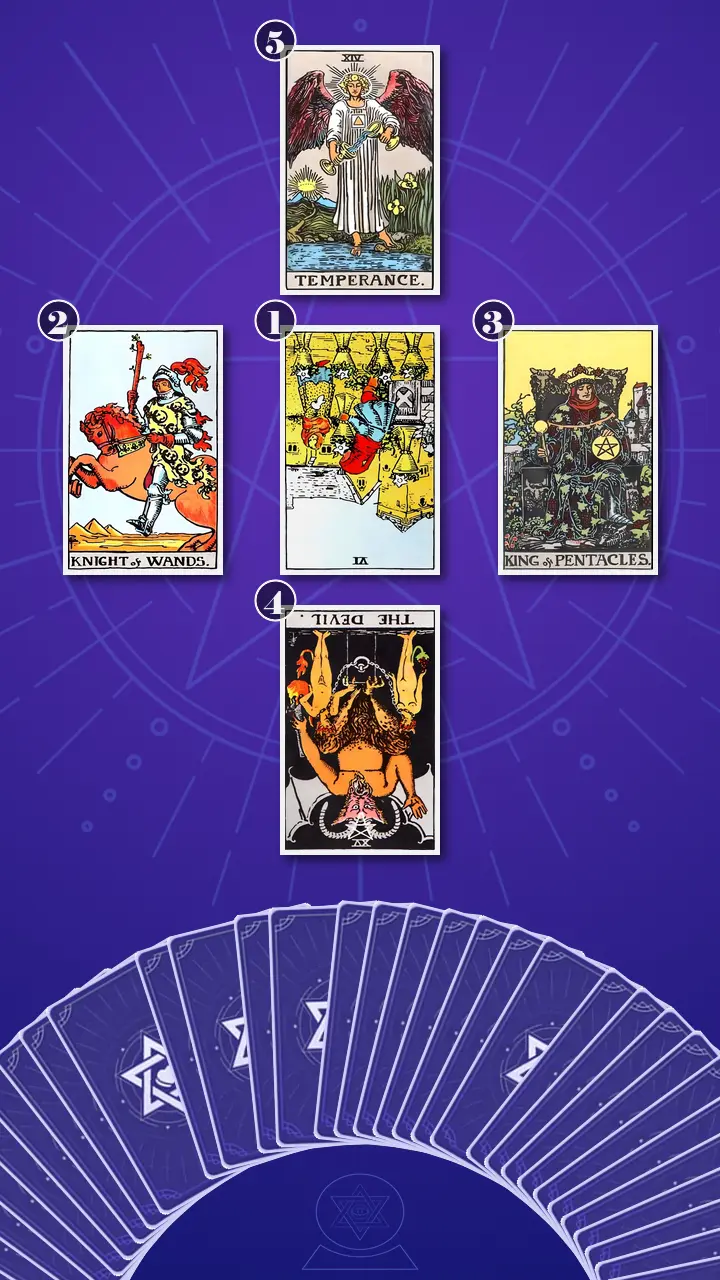
The Highlight Reel and the Match That Burns Too Fast
Position 1: The present trigger and the specific stuck behavior pattern
“Now we’re turning over the card that represents the present trigger and the specific stuck behavior pattern—how the iPhone Memories loop is shaping your choices.”
Six of Cups, reversed.
I nodded at the picture like it was a familiar app icon. “It’s not that you’re delusional—it’s that your phone is serving you a curated edit. A Memories pop-up lands when you’re most alone, and suddenly you’re measuring today’s dating life against the most photogenic parts of a relationship that also included uncertainty, inconsistency, and waiting. The problem isn’t missing them; it’s treating the highlight reel as evidence that the whole thing was safe.”
Reversed, the energy here is distortion—not a lack of love, but a warped lens. The Six of Cups is memory as a gift; upside down, it becomes memory as a filter that crops out whatever didn’t photograph well.
I used a split-screen in my voice, because that’s how it lives in the body. “On one side: warm lighting, the dim bar, the laugh, the arm around your shoulder—your brain’s ‘best-of trailer.’ On the other side: the nights you waited for a reply, the stomach drop when you saw ‘Seen,’ the quiet dread you’d never post on Instagram. This feels like proof… but proof of what, exactly?”
Jordan let out a small, bitter laugh—too quick to be humor, too honest to be a defense. “That’s… brutal. Like, yes. I watch the cute clip and forget the whole week I cried in my bathroom because he disappeared.” Her shoulders rose, then dropped in a tiny exhale, like she’d finally named what was missing from the frame.
“A highlight reel can’t tell you whether something was safe—only that it photographed well,” I said, gently, and watched her eyes flick down to the card like she was re-learning what counts as evidence.
Position 2: What ‘chemistry’ is actually doing for you
“Now we’re turning over the card that represents what ‘chemistry’ is actually doing for you—the pull, payoff, and the kind of attraction you’re chasing.”
Knight of Wands, upright.
“Chemistry shows up like a rush that makes everything feel immediate: the fast banter, the flirty texts, the vibe that turns your brain into a yes. You want to chase it because it feels like being chosen. But it can also be attraction moving faster than consistency—like falling for the first draft of someone, before you’ve seen whether they follow through when it’s not exciting.”
The energy here is excess—fire with no container. I tapped the Knight’s forward lean. “Momentum starts to feel like meaning. The nervous system goes, ‘This is alive, this is real,’ and your brain tries to crown it as The Answer.”
Jordan’s fingers made a small flicking motion, like swiping on a dating app. “It’s like… the second someone matches my pace, my brain’s like, ‘Finally. There it is.’”
“And that makes sense,” I said. “But here’s the skill we’re building: chemistry isn’t compatibility—sometimes it’s just speed with good lighting.”
Position 3: What ‘safety’ is actually asking of you
“Now we’re turning over the card that represents what ‘safety’ is actually asking of you—the benefits, fears, and the kind of stability you’re learning to trust.”
King of Pentacles, upright.
“Safety looks like someone who texts when they say they will, makes a plan, respects your time, and doesn’t make you guess. It can feel almost ‘too quiet’ at first—because your body isn’t bracing. This card asks you to notice that exhale as data: calm isn’t a lack of chemistry; it might be the first sign you’re not being emotionally auditioned.”
The energy is balance—earth doing what earth does: steady, repeatable, boring in the way reliable Wi‑Fi is boring. Not thrilling, but your whole life works better with it.
I leaned in slightly. “Knight energy is last-minute plans, fast compliments, big vibe. King energy is a reservation, a clear time, and a follow-up text that matches the promise.”
Jordan’s expression shifted—skeptical at first, then curious. “I’ve definitely had that text,” she admitted. “And I remember thinking… why am I irritated? Nothing is wrong.”
“Because your nervous system is used to alarms,” I said. “Calm isn’t ‘nothing.’ Calm is your system not bracing for impact.”
Position 4: The underlying pattern that keeps the cycle repeating
“Now we’re turning over the card that represents the underlying pattern or fear—the thing underneath the chemistry-versus-safety debate.”
The Devil, reversed.
“This isn’t about your ex being your soulmate,” I said, keeping my voice steady. “It’s about a hook: the way longing plus uncertainty can feel like love because it’s familiar. You feel pulled to replay, check, swipe, or reach out—not because it’s aligned, but because the loop promises quick relief from ambiguity. Reversed, The Devil is the split-second you catch yourself and think, ‘Oh. This is a pattern I’m feeding.’”
The energy here is blockage loosening. Not free yet—but not helpless. The chains aren’t gone; they’re slack.
I described the chain moment exactly the way she’d lived it: turning the brightness down, rewatching the same clip twice, thumb hovering over the chat thread, telling yourself it’s “just curiosity.” Then the contrast: “I miss them” versus “I miss the feeling of being pulled.”
Jordan went still in a three-beat sequence I’ve learned to respect: first the tiny breath-hold, then the faraway eyes like a memory replay, then the swallow that brings her back to the room. “It’s not romance,” she said quietly. “It’s compulsion wearing romance’s outfit.”
“Exactly,” I answered. “The urge isn’t a prophecy. It’s a pattern asking to be fed—or not.”
When Temperance Poured Between Two Cups
Position 5: How to integrate chemistry and safety into an actionable next step
I touched the last card before turning it. “This is the one that represents how to integrate chemistry and safety into an actionable next step you can practice now.”
The room felt quieter—not mystical, just focused, like the moment before a decision in a meeting when everyone finally stops pretending they don’t care.
Temperance, upright.
“Your next step isn’t choosing chemistry or safety like you’re picking one permanent flavor,” I said. “It’s choosing a pace. Temperance is you letting attraction develop inside consistency: fewer late-night spirals, more daytime clarity; fewer spike-based decisions, more observation of follow-through. You’re still allowed to want heat—you’re just not letting heat be the only thing driving the car.”
Setup: Jordan was still stuck in that midnight logic: a Memory hits, her body spikes, and her mind tries to force an immediate verdict—text him, delete everything, ghost the calm guy, download Hinge again—anything but sit in the quiet middle where nothing “proves” itself instantly.
Stop letting the highlight reel dictate the verdict; start mixing desire with discernment like Temperance pouring cup to cup.
Reinforcement: The sentence landed the way a clean truth does—first as a sting, then as relief. Jordan froze for half a second, her fingers hovering mid-air like they were about to tap a notification. Then her gaze softened and unfocused, as if she were watching herself in bed with that warm-toned clip and realizing she’d been letting a nine-second video run the whole investment committee. Finally, her shoulders sank—one notch, then another—and she exhaled through her nose like her body had been waiting for permission to stop sprinting.
She blinked fast, like she was annoyed at her own eyes. “But if I pace it,” she said, a flash of resistance sharpening her voice, “what if I end up with someone steady and I still feel… nothing? Doesn’t that mean I chose wrong again?”
I didn’t rush to soothe it. “That fear is real,” I said. “But pacing isn’t a trap—it’s data. It’s you refusing to let volatility decide the whole story.”
This is where my old life always flashes in. On the trading floor, we didn’t make big calls in the most volatile minute of the day. We pre-committed. We used scenario forecasts because feelings spike hardest right before the expensive mistakes. Temperance is that same move, translated into love.
“Let’s do a 10-minute ‘Temperance Pour’ check—once, then stop,” I told her. “Two minutes, feet on the floor, notice your chest, jaw, hands. Then in Notes: two columns—Spike and Steady. Two bullets in each about the last ex-memory or the last date. Then circle one observable behavior you can ask for or watch for this week—like ‘set a date by Wednesday.’ If you start spiraling, you close Notes early. This is information-gathering, not self-punishment.”
I held her gaze. “Now—using this new lens—think back to last week. Was there a moment when the Memory hit and your hand moved before your choice did? If you’d remembered ‘pace is the integration,’ how would you have moved differently in the next ten minutes?”
Jordan’s eyes dropped, then she nodded once. “I would’ve turned the phone face down,” she said. “And I probably would’ve gone to sleep instead of… trying to feel alive on demand.”
That was the shift right there: from memory-triggered longing and spike-chasing to paced, body-based clarity grounded in consistency and calm.
The Temperance Pacing Protocol: Next Steps You Can Actually Do
I laid the whole story back to her in one line, the way I would in a boardroom when a team is drowning in noise: the highlight reel (Six of Cups reversed) triggers a craving for speed (Knight of Wands), which makes steadiness feel suspicious (King of Pentacles). Underneath, it isn’t a soulmate signal—it’s a compulsion loop (Devil reversed). And the way out isn’t choosing an extreme; it’s integration through pacing (Temperance).
Her cognitive blind spot wasn’t “you want chemistry.” It was this: she treated intensity as proof, and calm as a verdict. The transformation direction was equally simple, and not easy: shift from using the spike as the benchmark to using consistency, respect, and your felt sense of calm as compatibility data.
Then I gave her what she’d actually come for: actionable advice that would still work at 12:14 a.m.
- No Highlight Reel After 9 (7 days)Tonight, set a Focus mode for 9 p.m.–morning that hides Photos, Instagram, and your ex’s chat thread (or turn off iPhone Memories notifications). You’re not deleting anything forever—you’re creating one week where midnight doesn’t get to run your dating decisions.Expect the thought “this is dramatic, it’s just photos.” That’s the point: small trigger, big loop. If you slip, don’t restart with shame—just resume tomorrow.
- Two-Sentence Reality Check (miss + not-safe)If a Memory hits earlier in the day, open Notes and write exactly two sentences: (1) one genuinely good thing you miss, (2) one concrete way the relationship wasn’t safe or consistent. Then close the app.Keep it concrete—“went silent for 48 hours” beats “was toxic.” Two sentences is the container; don’t turn it into a memoir.
- Slow Burn Standard + 2-hour post-date checkFor your next two dates: keep it 90–120 minutes, no late-night emotional deep dives, and aim for clear plans plus consistent contact. Set a reminder for two hours after you get home and write: “Body: tight/soft. Mind: spinning/quiet. Urge: chase/avoid/neutral.”Don’t label it “no spark” until after you’ve eaten and slept. You’re collecting real data, not chasing a verdict.
Because I can’t help being who I am, I also offered her my simplest “boardroom-style decision ledger”: if she found herself comparing someone new to the ex, she could score one thing only—follow-through. Not charm. Not butterflies. Follow-through. Weighted heavily. The King of Pentacles doesn’t win by being exciting; he wins by showing up.

A Week Later: The Quiet Proof
Eight days later, Jordan messaged me: “I did the Focus mode. Night one was awful. Night three was… weirdly easier. Also, I went on a second date with the ‘calm’ guy. I didn’t feel fireworks. But two hours after, my body felt soft. Like—no alarm.”
Then she added something smaller, and to me, more important: “I drafted the text to my ex in Notes. I didn’t send it. I went to bed.”
That’s what a Journey to Clarity usually looks like in real life—not a cinematic breakthrough, but a quiet reclaiming of choice. You don’t stop wanting chemistry. You stop outsourcing your decisions to the loudest feeling in the room.
And if tonight you also know that vulnerable hour—when the highlight reel hits and it feels like you have to choose between being wildly alive or safely loved, like calm is a verdict on you and not just a different nervous-system tempo—please hear me: noticing the pattern is already movement.
If you gave connection one notch more time than your craving wants—what would you be curious to notice in your body when it’s not performing for a spike?