That 'FYI' Group Chat Update—and the DM I Sent to Draw a Line

The 9:18 p.m. “FYI” That Felt Like a Leak
If you’ve ever opened a group chat and seen your personal news posted like a casual “FYI” update—then felt your jaw lock while you tried to act unbothered—this will feel familiar.
Jordan met me on a video call from their downtown Toronto kitchen, the kind of place where the light is aggressively bright at night and the microwave hum sounds louder than it should. They kept their phone in-frame like it was evidence. The screen was warm against their palm, and every few seconds their thumb drifted toward the chat thread the way your tongue goes to a sore tooth—checking if it still hurts, making it hurt again.
“I’m not trying to start drama,” they said, and the sentence came out pre-worn, like a hoodie they’ve slept in too many times. “I just want my stuff to stay my stuff.”
I watched their hands: restless, tapping, hovering, then pulling back. Their chest lifted with a tight, shallow inhale that didn’t quite land. Betrayal doesn’t always arrive as tears; sometimes it arrives as a clenched jaw and the quiet humiliation of being perceived by people you didn’t choose.
“It’s like… they changed a Google Doc from ‘View Only’ to ‘Anyone with the link can edit,’” Jordan added, voice half-laughing, half-wincing. “And now I’m trying to fix it by being… nicer?”
I nodded. “That metaphor is painfully accurate. And I want to name the contradiction you’re stuck in, because it’s real: you want to protect your privacy and self-respect, but you’re also afraid of social fallout—of being labeled ‘too sensitive’ in a group space where vibes feel like currency.”
I’m Laila Hoshino. Most nights I guide people through a Tokyo planetarium, showing them how the sky moves with ruthless honesty—no negotiation, no people-pleasing, just orbits and timing. But I’ve also spent years studying how humans move through each other’s gravity fields: the ways closeness, attention, and information pull on us. “Let’s do what I do under a dome of stars,” I told Jordan softly. “Let’s give this fog a map. We’re not here to write the perfect message. We’re here to find clarity—clear enough to take one next step.”

Choosing the Compass: The Celtic Cross · Context Edition
I asked Jordan to take one slow breath in, then exhale like they were trying to fog up a cold window. Not as a ritual for mysticism—just a nervous-system handrail. While they breathed, I shuffled my well-worn deck on my desk. Off-screen, the faint whir of my apartment air purifier blended with the distant Tokyo traffic; two cities, one thread of tension.
“Today we’ll use the Celtic Cross · Context Edition,” I said. “It’s a classic spread, but I read the final position as integration—what healthiest direction you can create through your choices—so we stay grounded and non-predictive.”
To you reading: this spread fits a group-chat boundary issue because it forces a full chain, not just a single ‘what do I text?’ answer. It starts with the emotional rupture (what actually hurt), crosses it with the obstacle (why it’s hard to address), drops into the hidden root (the unspoken privacy rule), and then pivots into communication risks and your strongest stance—especially important when you’re stuck between overthinking and reactivity.
“A few key positions to track,” I told Jordan. “The first card will name the exact moment your privacy got punctured. The root card will show what got left unspoken. And the ‘self’ position—card seven—will show the version of you who can set a boundary without turning it into a courtroom scene.”
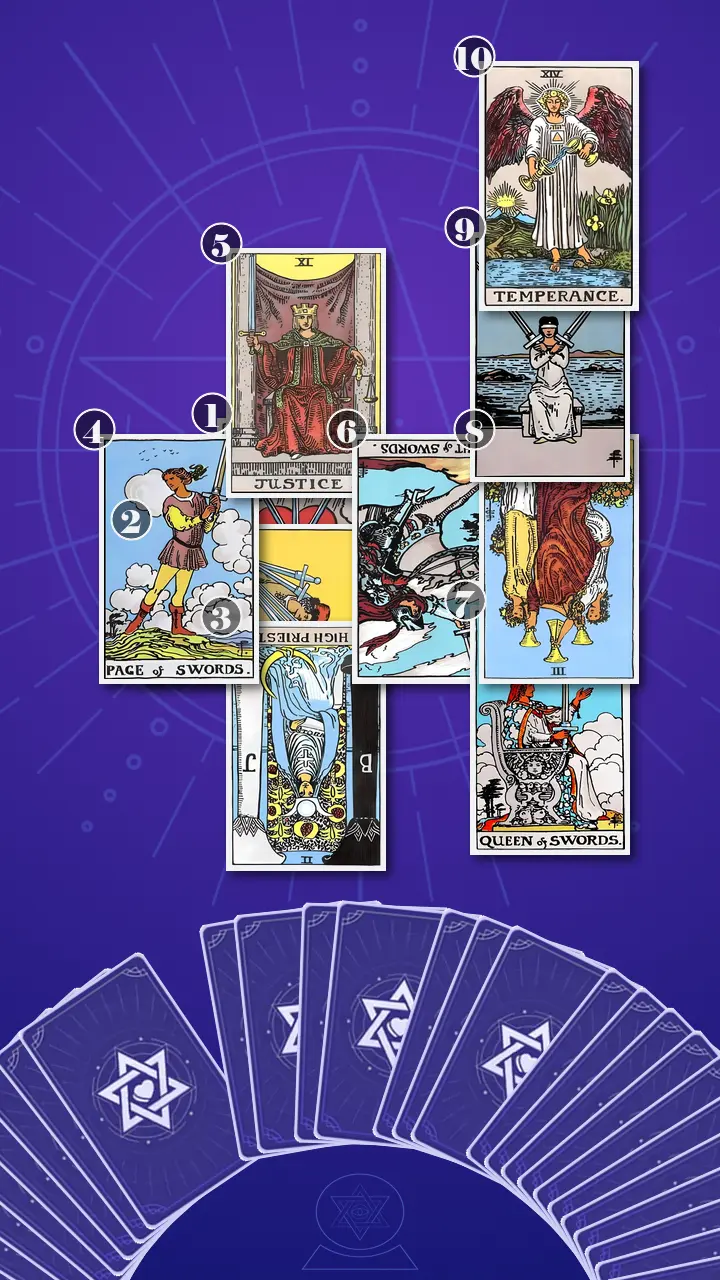
Reading the Map: Card Meanings in a Group Chat World
Position 1: The Immediate Rupture
“Now flipped over,” I said, “is the card representing the immediate emotional impact and the specific moment of rupture when your news was shared.”
Three of Swords, upright.
I didn’t soften it. The image is a heart pierced cleanly—no ambiguity, no ‘maybe it wasn’t that bad.’ “This is the screenshot-able moment,” I said. “Your private update sitting in the group thread like communal information. And your body clocking it before your mind can justify it.”
I anchored it in their reality: “Microwave humming. Overhead light too bright. Your phone warm from being in your hand. You see the ‘FYI’ tone, and it lands like a pin through a balloon.”
“Here’s the precision this card asks for,” I continued. “Not ‘I’m upset,’ but: what hurt most? Was it the exposure, the dismissal, or the loss of control of your story?”
Jordan let out a small laugh that sounded like it had edges. “That’s… brutal,” they said, eyes flicking away from the camera. “But accurate.” Their shoulders lifted, then dropped, like their body was admitting something their mouth had been negotiating.
“Try this sentence template,” I offered. “What hurt wasn’t the group chat itself; it was that my personal information got treated like public content. That’s the wound. A boundary that doesn’t name the wound will come out vague.”
Position 2: The Core Obstacle
“Now we’re looking at the card representing the core obstacle: the boundary violation pattern and why it feels hard to address directly.”
Seven of Swords, upright.
“This is information moving without consent,” I said. “Not necessarily villainy—sometimes it’s carelessness—but it’s still a consent gap. Someone took something that wasn’t theirs to redistribute.”
In modern terms: “It’s that thought you had—Did they know this wasn’t theirs to share?—paired with the other thought that keeps you stuck: If I bring it up, I’ll look petty. This card often shows up when people treat boundaries as ‘vibes’ instead of permissions.”
Jordan’s fingers pinched the edge of their sleeve. “It might be a pattern,” they admitted. “They share everyone’s business like… it’s a hobby.”
“That matters,” I said. “Because if it’s a default setting for them, you won’t fix it with hints. You fix it with a clear toggle: ‘ask before sharing anything I tell you.’”
Position 3: The Hidden Root Under the Surface
“Now flipped over is the card representing the hidden root: the unspoken rule about privacy and the intuition you didn’t act on.”
The High Priestess, reversed.
In my planetarium work, the High Priestess always feels like the velvet curtain before a show—the veil that says: there are things we don’t put on display. Reversed, that veil is there… but you don’t use it.
“This tells me your gut knew,” I said. “You had the instant ‘no’ in your body. But you overrode it to stay easygoing, to keep the social air smooth. And because the rules stayed unspoken, someone else’s assumptions filled the gap.”
Jordan swallowed. Their eyes went glossy for a second, then focused hard, as if tightening a camera lens. “I keep thinking, ‘I should’ve known better than to tell them in the first place.’”
“That’s the reversed High Priestess shadow,” I said gently. “Self-blame replaces structure. But the reframe is simple and powerful: structure beats isolation. You don’t have to tell no one anything ever again. You just need clear categories for yourself—what’s private, what’s shareable with permission, and what’s okay for group.”
Position 4: What Set the Stage
“Now we’re looking at what set the stage: the communication culture and norms that made oversharing more likely.”
Page of Swords, upright.
“This is the vibe of the space,” I said. “Fast takes. Fast replies. Low context. A little Slack/Teams energy bleeding into friendship—like the group chat rewards immediacy more than discretion.”
I could almost hear Jordan’s chat: iMessage reactions stacking, emojis piling on, people chiming in before thinking. “The Page isn’t malicious,” I added. “They’re alert, curious, quick. But in a windy environment, words travel.”
Jordan exhaled through their nose. “It really is like that. Everyone’s always ‘in the loop.’”
“Right,” I said. “So part of finding clarity is responding to reality, not the ideal version of the group where everyone intuitively knows your boundaries.”
Position 5: The Guiding Principle You’re Reaching For
“Now we’re at the card representing what you want at the highest level: the principle you’re trying to live by when you set this boundary.”
Justice, upright.
I felt the room settle. Justice has that effect—like a spine straightening. “This isn’t about punishing your friend,” I said. “It’s about fairness and accountability. Scales plus sword.”
Then I translated it into something Jordan could actually use: “Think of it as a bug report: what happened, why it matters, what needs to change. No character assassination required.”
Jordan’s posture shifted, almost imperceptibly—less collapsed forward, more upright. “So it’s not… me trying to prove I’m right.”
“Exactly,” I said. “You’re not asking for mind-reading—you’re naming the rule. Here’s the Justice self-check: if roles were reversed, would your request still be reasonable? If yes, you can stand by it without apologizing.”
I let a line land, because it’s one I wish everyone had before they enter a group-chat spiral: “Clarity isn’t drama. It’s the update your relationships need.”
Position 6: The Near-Term Friction Point
“Now flipped over is the card representing the near-term friction point: the communication risk in how you might respond next.”
Knight of Swords, reversed.
“This is the adrenaline trap,” I said. “Speed without precision. The part of you that wants to ‘correct the situation’ immediately in text form—because at least that feels like control.”
Jordan’s mouth twisted. “I… wrote something at 12:43 a.m. last night. It was sharp.”
“That’s this,” I said, and I used the echo technique like a mirrored split of time.
“Micro-scene A: 12:43 a.m., dark mode on, thumbs flying, almost hitting send. Your nervous system is in ‘post’ mode. Micro-scene B: next morning, chat muted, stomach still tight, and you’re somehow still checking it anyway.”
Then I gave them a sentence frame that doesn’t shame the loop—it names it: “When I feel exposed, I either charge… or I freeze.”
Jordan made an uncomfortable sound that was half laughter, half a wince. “I do both. I literally do both.”
“You’re not broken,” I said. “You’re trying to protect belonging and self-respect at the same time, and your brain keeps swinging between them.”
Position 7: When the Queen of Swords Picks Up the Mic (Key Card)
“Now,” I said, and even my own voice went a touch quieter, “we’re turning over the card representing your best internal stance: the version of you that can speak clearly and hold the line. This is the core of the reading.”
Queen of Swords, upright.
The air in my room felt still for a beat, the way it does in a planetarium right before the stars appear—when the audience stops shifting in their seats and just waits.
“She’s not cruel,” I said. “She’s concise. Upright sword, open hand. Truth with dignity.”
I brought in the split-screen exactly as promised, because Jordan’s whole nervous system lived in that contrast.
“Left side: your Notes app with a 200-word paragraph that’s basically ‘please don’t hate me.’ Right side: one clean DM line. And here’s the inner monologue flip: ‘If I’m clear, they’ll think I’m cold’ becomes ‘If I’m vague, I’m teaching people to guess.’ Kind versus unclear. Firm versus cruel.”
Then I reached for one of my own diagnostic lenses—something I use when people are afraid that honesty will create distance.
“In astronomy, we track something called redshift,” I said. “Light stretches as objects move away. In relationships, I call it Cosmic Redshift Communication: the early signs that two people are drifting aren’t always huge fights. Sometimes it’s you going silent in the group chat, pulling back, leaking resentment instead of stating a boundary. Distance grows quietly.”
Jordan blinked, slowly. I saw the recognition before they spoke.
“So me not saying anything… is also a kind of distance,” they said.
“Yes,” I replied. “And the Queen of Swords is how you stop that drift without detonating the whole solar system.”
Jordan’s expression tightened for a second—an unexpected flare of resistance. “But if I’m that direct,” they said, voice sharper, “doesn’t it mean I should’ve said something earlier? Like… I messed up by letting it happen?”
I held their gaze through the camera. “No. It means you’re updating the system now. Boundaries aren’t retroactive punishments. They’re future-facing permissions.”
Then I moved us into the aha moment structure—the place where clarity becomes usable.
Setup: You open the group chat and there it is—your news, typed like a casual “FYI.” Your jaw tightens, your hands keep tapping the screen, and you start drafting the message that won’t make you look “dramatic”… until it turns into five versions and none of them feel safe.
You don’t need the perfect tone. You need one clear sentence that tells people what you expect around your private information.
Jordan froze in a three-step chain I’ve seen a hundred times—because it’s human, not because it’s dramatic. First: their breath paused, like their lungs were waiting for permission. Second: their eyes went slightly unfocused, as if replaying last night’s drafts on an invisible screen. Third: a long exhale slid out, and their shoulders dropped a few millimeters—the quiet physical proof of relief.
“Okay,” they whispered, and their voice trembled in a way that wasn’t sadness exactly—it was the vulnerability of finally seeing the simplest option after hours of overthinking. Their jaw unclenched, then clenched again, like their body was testing whether it was safe to relax.
“Here’s how we make that sentence real,” I said. “Set a 10-minute timer. In your Notes app, write only three sentences: (1) what happened (fact), (2) impact (how it landed), (3) request (what you want next time). Read it once out loud. If your chest tightens, pause and take two slow breaths—then decide: send as-is, or save it for tomorrow daytime. No extra paragraphs, no screenshots, no disclaimers. You’re allowed to stop if you feel too activated; clarity works best when you’re not in adrenaline.”
I let that sink in, then asked the question that turns insight into a lived memory: “Now, with this new perspective, think back to last week—was there a moment when this would have changed how you felt? Even by five percent?”
Jordan nodded once. “When I started typing ‘Heyyy lol,’” they said. “That was me auditioning. Not communicating.”
“That’s the shift,” I affirmed. “This isn’t just about one friend. It’s from over-editing yourself for approval to trusting yourself to be clear.”
Position 8: The Social Container You’re In
“Now we’re looking at the social container: the group dynamics and external context you need to account for.”
Three of Cups, reversed.
“A group chat is a public room, even when it feels like friends on a couch,” I said. “This card is the ‘party vibe’ distortion: closeness without discernment. People are celebrating, teasing, piling on, ‘keeping everyone in the loop’—and privacy gets trampled accidentally.”
I used the room metaphor and made it concrete: “Imagine a crowded bar table. You can say something personal there, but it will echo. Not because everyone is evil—because the acoustics are wrong for confessions.”
Jordan’s eyes flicked to the side, toward their phone. “So I’m… treating it like a safe one-on-one, and it’s not.”
“Exactly,” I said. “This isn’t isolation. It’s discernment.”
Position 9: The Hope/Fear Stalemate
“Now we’re looking at your inner push-pull: what you’re hoping will happen and what you fear will happen if you speak up.”
Two of Swords, upright.
“This is ‘Drafts Forever,’” I said, plain and kind. “The blindfold is you trying not to see the conflict. The crossed swords are you holding yourself in place so nothing spills. It feels calm, but it’s tense.”
I said the line Jordan needed, the one that cuts through the performance: “Don’t negotiate your boundary in your head and call it ‘keeping the peace.’”
Jordan’s throat bobbed with a swallow. “I want an apology,” they said. “Not an argument.”
“Then we aim for a request that invites repair,” I replied, “and we keep it out of the group thread so it doesn’t become theatre.”
Position 10: Temperance and the Pace of Repair
“Last card,” I said. “This represents the integration direction—the healthiest outcome you can create through regulated, clear boundary-setting.”
Temperance, upright.
In the image, one foot is on land and one is in water: emotion and reality, together. “Temperance is not the ‘perfect message,’” I told Jordan. “It’s a process. Truth plus care, poured steadily, not dumped.”
“It’s also timing,” I added, letting my astronomy brain have a word. “Some conversations are like looking for a planet: you don’t force it at 2 a.m. and then blame yourself for not seeing it. You choose a window where your system is stable—daylight, after you’ve eaten, when you’re not running on fumes. Same truth. Better conditions.”
Jordan’s face softened. “So… I can be honest and not blow it up.”
“Yes,” I said. “Justice is the door: facts plus request. Temperance is the hallway: pacing, follow-through, and letting the friendship show whether it can meet a reasonable boundary.”
From Insight to Action: The Permission Settings Reset
I leaned back and stitched the spread into one coherent story, because that’s where tarot becomes practical.
“Here’s the arc I see,” I said. “A sharp rupture happened fast (Three of Swords) inside a high-speed communication culture (Page of Swords). Information moved without consent (Seven of Swords), and the hidden root is that your privacy rules were assumed, not stated (High Priestess reversed). Your nervous system swings between charging in too sharp and disappearing into silence (Knight of Swords reversed + Two of Swords). The way through is principled clarity (Justice) delivered by your clearest self (Queen of Swords), inside a group container that isn’t built for confidentiality (Three of Cups reversed), with pacing and repair (Temperance).”
“Your cognitive blind spot,” I added, “is that you’ve been trying to manage everyone’s perception of you—trying to be un-criticizable—instead of stating what isn’t okay. That’s why you keep drafting and deleting. The transformation direction is the opposite: one calm, specific request. Not a performance. A permission setting.”
I offered Jordan a small, workable plan—things you can do even when you’re tired, even when you don’t feel like the Main Character of Conflict.
- The Three-Sentence Boundary ScriptIn your Notes app, write three sentences: fact (“When you shared [X] in the group chat…”), impact (“…I felt exposed.”), request (“In the future, please check with me before sharing anything I tell you.”). Read it once out loud.Set a 10-minute timer. When it ends, stop editing. If your chest spikes, take two slow breaths and save it for daytime—no midnight boundary texts.
- DM First, Not the Group ThreadSend it as a private message to the friend (or ask for a 5-minute call). Keep the goal singular: a clear ask, not a verdict on their character.If you catch yourself adding disclaimers (“no worries,” “maybe I’m overthinking”), delete them. One clean sentence does more than five perfectly polite paragraphs.
- Do Not Disturb for 20 Minutes After You SendAfter you hit send, put your phone on Do Not Disturb and do something physical for 20 minutes (dishes, a quick walk, folding laundry). Give your nervous system a landing strip.You’re not avoiding the response—you’re preventing the refresh spiral. Clarity lands better when you’re not monitoring every notification like a scoreboard.
Before we ended, I layered in one of my own strategies—the kind I use to keep social energy from spilling everywhere.
“If you want a simple follow-up practice, try my Social Star Map,” I said. “For one week, choose one trusted person for sensitive updates. Keep the group chat for low-stakes stuff. It’s not punishment. It’s choosing the right ‘orbit’ for the right kind of information.”

A Week Later, the Chat Still Pings—But It Doesn’t Own You
Six days later, Jordan messaged me. Not a paragraph—just a screenshot of three sentences in a DM, timestamped 1:12 p.m., and then: “They apologized. Like, actually apologized. No debate.”
They added another line: “I still felt shaky after I sent it, so I did the DND thing and walked to grab coffee. I didn’t die. The group chat didn’t exile me. It was… fine.”
The bittersweet part came in the next message, almost as an afterthought: “I slept the whole night. But when I woke up, my first thought was still, ‘What if I was too much?’ And then—this is new—I kind of smiled and thought, ‘No. I was clear.’”
In the planetarium, people think clarity means the stars stop moving. It doesn’t. The sky stays dynamic. Clarity just means you can track what’s happening without panicking—your own orbit included. Jordan didn’t become fearless. They became steadier. That was the journey.
When your private news becomes group-chat content, it’s not just awkward—it’s that tight-chest feeling of wanting to protect yourself while still fearing you’ll lose your place in the room if you speak up.
If you didn’t have to earn permission to have privacy, what’s the one calm sentence you’d want to say—just to let people know how to treat your information next time?