From Fixing the Silence to Fair Planning: The Justice Text Experiment

The 8:56 p.m. Group Chat Silence
If the second a group trip gets mentioned, you’re already opening Notes, building a mini itinerary, and feeling your shoulders creep up—while everyone else goes “down for whatever” in the chat, you might be stuck in default trip planner mode.
Taylor (name changed for privacy) showed up to our session in Toronto with that specific kind of tired that looks functional from the outside and feels like carrying a sandbag on the inside. She dropped her tote by my chair, then set her phone on the table face-up—like it might buzz at any second with one more “Whatever works!” that would somehow become her problem.
She described a scene I’ve heard in a hundred modern versions: 8:56 p.m. on a Wednesday, perched at a tiny condo kitchen counter, under-cabinet lights humming like a low electrical whine. WhatsApp open. Google Flights open. Airbnb saved list open. The phone warm in her palm. Jaw clenched. Shoulders up by her ears. The chat is full of hype until she asks, “Okay, dates?” and then it goes quiet in that way that feels louder than a reply.
“I don’t even care where we go,” she said, voice tight around the words. “I just can’t do another trip where I’m chasing everyone. I want to be invited, not appointed.”
Under the resentment was something more tender: a fear that if she stops carrying the planning, the whole thing—and maybe her place in the group—will wobble. The feeling sat in her chest like a heavy paperback book left open for days, pages slowly curling.
I nodded, letting the silence be gentle instead of urgent. “We’re going to treat this like a system, not a personality flaw,” I told her. “We’re here for a Journey to Clarity—so you can still have shared fun and connection without automatically becoming the unpaid project manager of your social life.”

Choosing the Compass: Relationship Spread · Context Edition
I invited Taylor to take one slow breath in through her nose and out through her mouth—not as a mystical ritual, just as a clean transition from spiraling in the chat to actually seeing what’s happening. While she exhaled, I shuffled, the cards making that soft, papery whisper that always reminds me of blotter strips in my perfume training: the same materials, different kind of truth.
“For this,” I said, “I’m using a spread called the Relationship Spread · Context Edition.”
To you, the reader: this isn’t a romance spread in disguise. It’s a practical way to map a relationship system—in this case, Taylor versus the friend-group dynamic. The structure works because the issue isn’t choosing between Montreal or PEC; it’s a loop: her overfunctioning meets the group’s underfunctioning, and an unspoken agreement locks it in. The last two positions specifically target what keeps repeating: the avoided boundary conversation and the most empowering next step to rebalance responsibility without losing connection.
I laid the cards in a simple 2-column by 3-row grid: left lane is “You,” right lane is “Group/System.” We’d read across each row first, like two parallel lanes on a shared itinerary—either stuck in the same pattern, or re-aligned with clear owners.
“A few positions to watch,” I added. “The first card shows the role you keep stepping into automatically. The fifth is the core blockage—the sentence you keep drafting and not sending. And the last card is the antidote: the fairest, most doable rebalance move.”
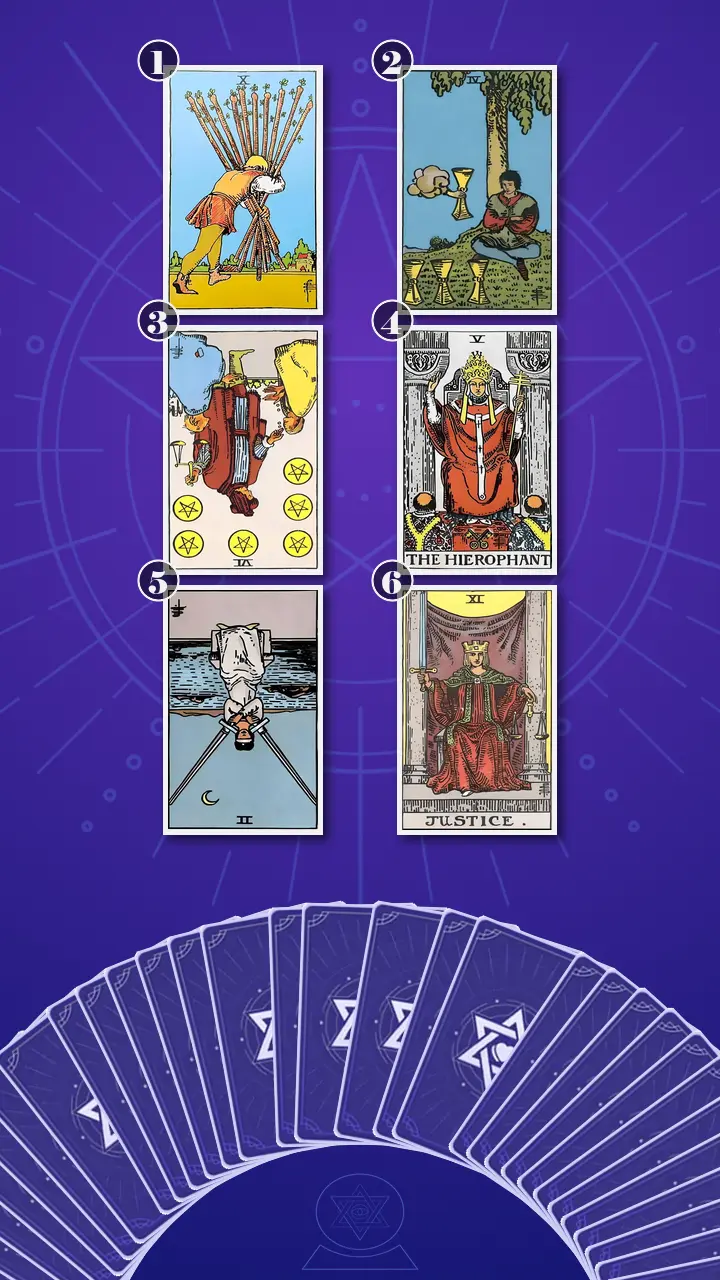
Reading the Two Lanes of the Itinerary
Position 1: Your current role in the friend-group travel dynamic
“Now flipped over,” I said, “is the card representing your current role in the friend-group travel dynamic—the observable pattern you keep stepping into.”
Ten of Wands, upright.
It hit the table with the blunt honesty of a suitcase dropped in a hallway. In the image, someone carries a bundle so big it blocks their view. And I watched Taylor’s face do that tiny, automatic recognition—like when you see your own writing on a whiteboard and realize you’ve been louder than you meant to be.
“This is the moment someone says, ‘We should do a weekend away,’” I said, using the exact modern scene this card points to, “and you immediately open Notes and outline a full itinerary. Within an hour you’ve got multiple tabs open—Airbnb, Google Flights, restaurant lists—and you’re screenshotting options while trying to sound casual in your follow-ups.”
Energetically, Ten of Wands is excess: too much output, too much responsibility, too much carrying. Not because you’re controlling—because you’re trying to keep the plan from dying in the awkward pause. But the more you carry, the less you can even see the fun you were supposedly planning for.
Taylor let out a short laugh that had a bitter edge to it. “That’s… brutal. Like, yeah. I literally start planning the same night.” Her fingers rubbed her jaw as if she could soften it by touch.
“It’s not a moral failing,” I said. “It’s a role. And roles can be renegotiated.”
Position 2: The group’s stance and participation pattern
“Now we’re looking at the group’s current stance and participation pattern—how the system responds when planning gets real.”
Four of Cups, upright.
“You send three solid options—two date ranges and a budget-friendly plan,” I said, “and the replies are emojis, ‘down for whatever,’ and silence. Nobody rejects anything, but nobody chooses.”
Four of Cups is deficiency: not enough engagement, not enough emotional ownership, not enough willingness to tolerate the minor discomfort of picking something that might not be perfect for everyone. It can look like indifference, but in friend groups it’s often decision fatigue plus conflict-avoidance: nobody wants to be the one who ‘makes it hard.’
Across the row—Ten of Wands ↔ Four of Cups—the mirror is sharp: your output rises as their participation drops. Your Google Sheet updates. Their “whatever works.” Your phone warming in your hand from refresh-refresh-refresh. Their quiet.
I watched Taylor’s shoulders lift a fraction like she was bracing for impact. “And then I’m like, okay, I’ll just decide,” she said. “Because I can’t stand it.”
“That makes sense,” I replied, “and here’s the key: your nervous system is treating group silence like a buffering wheel. You start opening more tabs to make it load faster, even though the Wi‑Fi problem isn’t you.”
Position 3: What you are giving or taking on that others are not
“Now flipped,” I said, “is the card representing what you are giving or taking on that others are not—the hidden cost of being the planner.”
Six of Pentacles, reversed.
Reversed, this card is the invisible invoice. The bill isn’t money first—it’s attention, decision-making, follow-up energy, and the low-grade stress of watching prices jump while no one commits.
“This is you giving coordination,” I said, tying it to her real-life behavior: “comparing prices, tracking who’s in, checking cancellation policies, nudging people to respond. Everyone else receives the benefit—a trip that exists—with minimal effort.”
Energetically, reversed Six of Pentacles is blockage in reciprocity. The scales are there, but they’re not being used. And when scales aren’t named, you start measuring silently—time spent, messages sent, deposits fronted—while telling yourself you don’t want to keep score.
“I don’t want to keep score…” Taylor said, and then she swallowed, “…but I also don’t want to keep paying.”
That was the sting of it: the social cost disguised as a compliment. “You’re so good at planning.” Translation: please keep doing the labor so we can keep the vibe.
Position 4: The unspoken agreement or norm that makes you the default
“Now,” I said, “we’re looking at the unspoken agreement or norm that makes you the default—the group’s script.”
The Hierophant, upright.
“This one always makes me think of workplace dynamics,” I said, letting it stay modern and plain. “The ‘meeting notes person’ phenomenon. Once someone does it well a few times, it quietly becomes their job.”
The Hierophant here is structure, but inherited structure—tradition-as-default. It’s not that your friends gathered and appointed you Supreme Travel Coordinator. It’s that the system values comfort and familiarity. ‘Taylor plans’ became a ritual because it works—until it costs you.
This is where I pulled in my own lens—my Social Pattern Analysis, the way I’ve learned to diagnose hidden interaction barriers. “In groups,” I said, “people don’t usually step up because someone ‘deserves help.’ They step up when the system makes it normal and safe to claim ownership. Right now, the norm rewards underfunctioning: if they stay vague, you’ll pick up the slack. Not because they’re evil—because the script has trained everyone.”
Taylor’s eyes shifted off the cards and toward the window. “So it’s… not that they don’t care,” she said slowly. “It’s that we’ve been running the same configuration.”
“Exactly,” I said. “A tradition is just an agreement nobody revisited.”
Position 5: The core blockage—the conversation or boundary being avoided
“Now flipped over,” I said, “is the card representing the core blockage: the conversation, boundary, or decision being avoided that keeps the pattern repeating.”
Two of Swords, reversed.
“This is the unsent draft sitting in your Notes app,” I said, and I watched Taylor’s lips press together because it was too accurate. “You type: ‘Could someone else handle lodging?’ and then delete it. You rehearse a boundary, then post another poll instead. You keep the tone light to protect the vibe, but inside you’re bracing.”
Two of Swords reversed is overflow in the mind: the decision you postpone becomes a decision anyway, just made by your actions. And the body tells the truth—jaw tight, shoulders up, chest heavy—while the chat stays ‘chill.’
I used the inner-monologue pattern the card was begging for, the blindfold logic in modern language: “I’ll ask for help after I send these options… I’ll set a boundary after we pick dates… I’ll bring it up later.”
Taylor stared at the card as if it might move. Her breath paused, then released in a quiet exhale. A beat of stillness, then she said, “Wow. Yes. It’s not that they’re lazy. It’s that I never send the one sentence. I keep hovering over it.”
“Group silence isn’t a task you have to complete,” I said softly. “But you’ve been treating it like one.”
When Justice Held the Scales: Finding Clarity Without Losing the Vibe
Position 6: The most empowering next step
I let my hands rest on the table for a moment before turning the final card. The room felt quieter, like the city outside had lowered its volume just a notch.
“This is the card representing the most empowering next step—how to re-balance responsibility without losing connection,” I said. “The boundary move you can actually try.”
Justice, upright.
Justice brings balance—Air and Earth together: clear words, concrete terms. And as a perfumer, I can’t help but think in structures. In Paris, we learned that an accord isn’t a vibe. It’s proportions. Too much of one note and the whole thing turns sharp. Friendship logistics are similar: if one person carries all the base notes—planning, deposits, follow-ups—the blend gets heavy, even if the top notes are fun.
I leaned in slightly. “Justice is roles, deadlines, receipts, split tabs. It’s the opposite of ‘hoping it will feel fair.’ It’s making fair visible.”
Taylor’s immediate reaction surprised her—she blinked hard, then her mouth twisted as if she was about to argue with herself. “But if I do that,” she said, a flash of defensiveness lighting up her tone, “won’t I sound… intense? Like I’m making it a contract?”
“That’s the old script talking,” I said. “Your personal brand in this group has become ‘easygoing, capable, will handle it.’” I let my Personal Brand Management lens come forward, not as marketing jargon, but as a social truth. “And here’s the catch: you’ve been proving you’re easygoing by doing everything. Justice is you choosing a consistent presentation that protects your self-respect: calm, direct, fair.”
The Aha Moment
Setup: She was caught in that exact moment she’d described—thumbs already moving when the chat went dead, mind sprinting to prevent the trip from falling apart, terrified that if she doesn’t rescue it, the silence will turn into proof that she’s only valued when she’s useful.
Stop proving you’re ‘easygoing’ by doing everything; start choosing clear, fair agreements—like Justice holding the scales steady.
I let the sentence sit between us for a heartbeat, like a clean line of ink on white paper.
Reinforcement: Taylor’s body reacted before her thoughts could polish it. First, a tiny freeze—her fingers stopped fidgeting, hovering above her phone like she’d paused mid-scroll. Then the cognitive shift: her gaze went unfocused for a second, like she was replaying a recent chat thread in her head—emoji reactions, the dead air after “dates?”, the way she filled it with links and options. Finally, the emotion arrived: her shoulders dropped a fraction, not all the way, but enough that the line of tension in her neck visibly softened. Her eyes went a little glassy, the way they do when someone realizes they’ve been doing something to protect belonging and it’s been costing them more than they admitted.
She exhaled again, longer this time. “I’m realizing,” she said quietly, “I keep trying to secure the friendship by securing the itinerary.”
“Yes,” I said. “And Justice is the permission to stop.”
I asked her the question I always ask when clarity lands. “Now, with this new perspective—clear, fair agreements—can you think of a moment from last week when this would’ve changed how you felt?”
Taylor didn’t answer right away. She rubbed her sternum once, like she was checking whether the heaviness was still there. “Thursday,” she said. “Hotel availability was dropping. Someone wrote ‘whatever works.’ I felt my jaw lock, and I started typing this long, too-nice follow-up. If I’d had this… I could’ve just said, ‘I’m in, but I’m not leading.’”
That was the step of transformation right there: from resentment-driven overfunctioning and “fixing the silence” to self-respectful clarity and shared accountability. Not a personality change. A system change.
The One “Justice Text” and the 24-Hour No-Spreadsheet Rule
I gathered the thread of the whole spread into one simple story—because this is how tarot works at its most useful: it turns a foggy situation into a map with cause-and-effect.
“Here’s what I see,” I said. “You start in Ten of Wands—carrying the load before anyone asks—because group silence spikes your internal pressure. The group shows up as Four of Cups: lots of hype, low commitment, ‘down for whatever,’ which reads as indifference when you’re the one watching prices rise. Reversed Six of Pentacles is the invisible invoice: you’re paying with time and mental load, and the ‘scales’ aren’t named. The Hierophant is the norm—‘Taylor plans’—a tradition nobody revisited. And the core blockage is Two of Swords reversed: the unsent boundary message. Justice is the fix, but not a dramatic one: it’s a calm, explicit agreement that redistributes responsibility.”
“Your cognitive blind spot,” I added gently, “is thinking you can negotiate fairness through over-giving and hoping people notice. You can’t. Fairness doesn’t happen automatically in friendships—you have to name the terms, or the default terms will keep naming you.”
Then I moved us into action—small, specific, doable. “Let’s make this practical,” I said. “Not a personality overhaul. A 48-hour experiment.”
I also offered one of my scent-based tools as a support, not a gimmick. “If you want,” I said, “we can use a grounding woody accord—cedar or vetiver—before you send any boundary text. It’s a ‘professional presence’ cue for your body. Think of it as sillage control: we’re keeping your message clean and short, and we’re keeping your nervous system steady while the chat goes quiet.” Taylor nodded. “I can do that,” she said. “That’s… weirdly perfect.”
- Draft the 10-minute “Justice Text” (don’t send yet)Open the group chat and type 3–4 sentences: “I’m excited to go, but I’m not coordinating this one. If we want it to happen, can two people own (1) lodging options and (2) transit options by Tuesday 6pm? If no one has bandwidth, I’m down for a simple day trip instead.”Keep it short—no over-explaining. If your chest tightens, pause. This is a draft, not a test of your worth.
- Use the 24-hour no-spreadsheet ruleFor the next trip thread, do not open Google Sheets/Notion/Notes for 24 hours after the idea is mentioned. If your hand reaches for the spreadsheet, write one line instead: “Waiting to see who volunteers.”Silence is data, not an emergency. Set a timer and do something physical (stretch shoulders, unload the dishwasher, walk to the end of your block) so you don’t spiral-refresh.
- Answer “you choose” with a single-choice promptWhen someone replies “whatever works,” send: “I can do Option A or Option B—pick one by tonight. If not, I’m out for this trip and down for a day hang instead.”Clarity beats quizzes. You’re not testing them—you’re giving the system a fair container.
“Boundaries aren’t drama,” I reminded her. “They’re structure.”

A Week Later, a Lighter Backpack
Six days after our session, Taylor texted me a screenshot. It was her draft—sent. Three sentences. No apology. Two roles. One deadline. One contingency.
Under it, two friends had replied with actual ownership. One wrote, “I can do lodging—send me the budget range.” Another: “I’ll do transit, I’ll look tonight.”
Taylor’s message under the screenshot was small and almost disbelieving: “I didn’t open a spreadsheet. I literally sat on my hands for an hour. It was uncomfortable. And then… it happened.”
She added a second message a minute later: “Also I slept. Like, a real sleep. Woke up and my first thought was still ‘what if this makes me annoying?’ But then I laughed. Because I’m allowed to be a person on the trip.”
That’s what clarity looks like most of the time: not fireworks, but a quiet shift from proving to choosing. From carrying the whole backpack to setting it down, even if your muscles still remember the weight.
When the chat goes quiet and your shoulders jump into that familiar tight brace, it can feel like you have to carry the whole trip—or risk finding out you’re only loved when you’re useful.
If you let one trip be a little less curated this time, what’s the smallest fair “term” you’d want to name—just so you can show up as a friend, not the operations lead?