Stuck in a 'Fake Friends' Vague-Post Loop? Pick One Clean Move

Finding Clarity in the 9:06 p.m. Scroll
You said no to one favor and now you’re being “fake friends” vague-posted like it’s 2014 Tumblr—but it’s 2026 Instagram Stories and your nervous system is treating it like a crisis.
Jordan (name changed for privacy) told me that sentence with a small, sharp laugh—the kind that’s trying to be casual but lands like a bruise.
They painted the scene so clearly I could practically see it through the steam from my espresso machine: 9:06 p.m. on a Tuesday in a downtown Toronto shoebox apartment. Takeout going cold on the coffee table. The TV still on but muted. Blue light from their phone reflecting back off the window like a second screen. They tap through Instagram Stories, see “fake friends,” and their stomach tightens—because it’s not naming them, but it is absolutely about them.
And the thought that won’t let go: I want to protect my boundary… but I also want to protect my place in the group.
The unease wasn’t abstract. It sat in Jordan like carbonated water in a closed bottle—tight stomach, buzzy hands, a restless urge to check the views list again, like one more refresh would finally turn ambiguity into a verdict.
I leaned forward over the small table in the corner of my café—warm lights, clinking cups, the street outside already dark—and kept my voice simple. “We’re not here to write a PR statement for your boundary. We’re here to find clarity: one clean choice you can live with tomorrow morning, without chasing proof or permission.”

Choosing the Compass: The Decision Cross Tarot Spread
I invited Jordan to take one slow breath—nothing mystical, just a nervous system handbrake. I shuffled while they held the question in their mind: Do I address the vague-post, or do I go?
“For this,” I said, “I’m going to use a simple five-position spread called the Decision Cross.”
When people search things like ‘best tarot spread for friendship conflict and social media drama’ or ‘tarot spread for deciding whether to confront someone or disengage’, they usually want two things at once: reassurance and a plan. The Decision Cross is perfect because it doesn’t pretend it can control what the other person does. It maps what’s happening, compares two paths, names the hidden driver that’s making you feel stuck, and gives one grounded next step—actionable advice, not a prediction.
I tapped the table lightly as I laid the positions out in a cross.
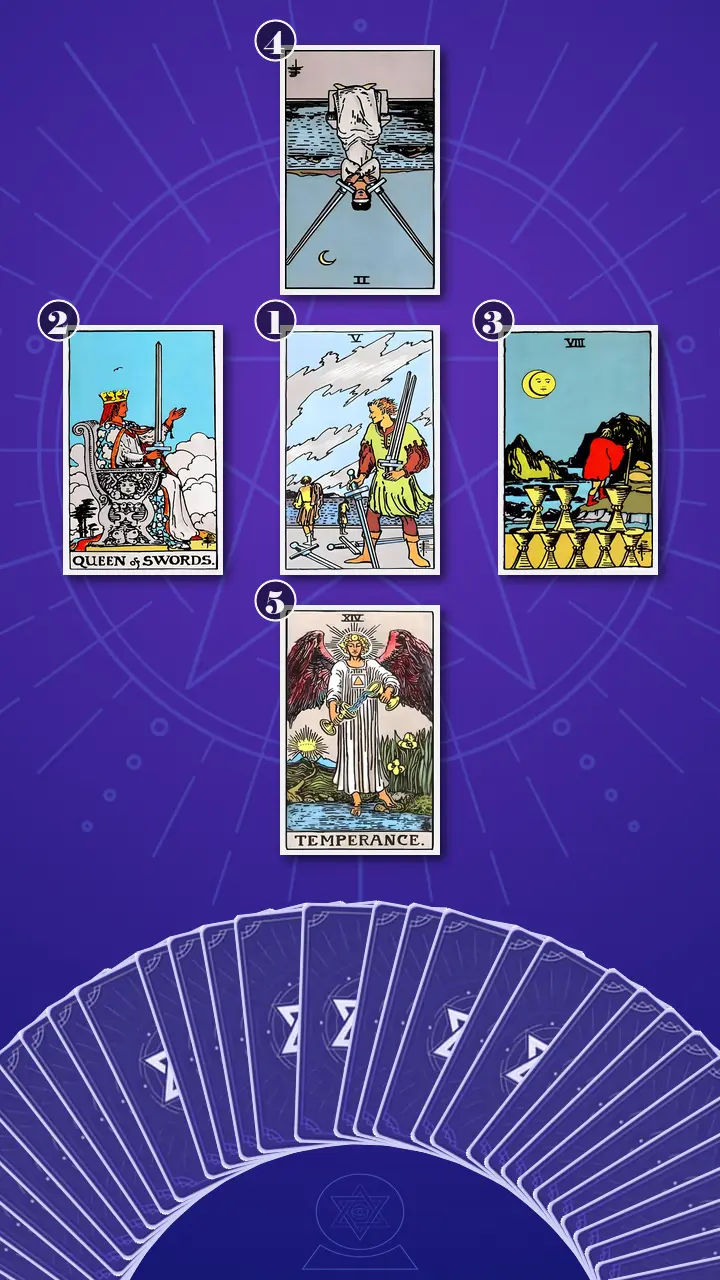
“Card 1 is the present dynamic—the day-to-day tension, the scrolling and drafting.”
“Card 2 is the address it path—what it looks like to speak directly with self-respect.”
“Card 3 is the go path—what it looks like to disengage and protect your attention.”
“Card 4 is the hidden influence—the internal blockage that makes either option feel like a social-risk emergency.”
“And card 5 is guidance—how to respond in a way that keeps you steady.”
The Tiny Courtroom and the Windy Shoreline
Position 1: The current relational dynamic and the specific ‘vague-post after I said no’ tension as it is showing up day-to-day.
“Now we turn over the card representing the current relational dynamic and the specific ‘vague-post after I said no’ tension as it is showing up day-to-day,” I said, and flipped it.
Five of Swords, upright.
“You’re in your kitchen under harsh overhead light, screenshotting an Instagram story that says ‘fake friends’ and zooming in on who liked it. You can feel your brain trying to ‘win’ by crafting the perfect clapback—even though you already know winning online would still feel gross and lonely afterward.”
I watched Jordan’s mouth press into a line that wasn’t quite a smile. “That’s… uncomfortably accurate,” they said, then—unexpectedly—let out a soft, bitter chuckle. “It’s like… mean-funny. Like, why am I acting like I’m building a case?”
“Because this card is courtroom energy,” I replied. “Not literal court—social court. The Five of Swords is the part of you that thinks: If I can just control the narrative, I’ll be safe. It’s Air energy in excess—sharp, fast, argumentative—even if you never send anything.”
I kept it concrete. “The ‘win’ here is hollow. You can win a comment thread and still feel sick after. You can prove a point and still lose peace.”
Jordan’s fingers worried the edge of a napkin. Their eyes kept flicking down toward their phone, face-up on the table like a witness waiting to be called.
“If it’s making you refresh for ‘evidence,’ it’s already costing you,” I said quietly. “Not morally. Biologically.”
Position 4: The underlying trigger and inner blockage that is making the choice feel risky or impossible.
“Now we turn over the card representing the underlying trigger and inner blockage that is making the choice feel risky or impossible.”
Two of Swords, reversed.
“You keep telling yourself you’re being ‘mature’ by staying quiet, but you’re actually stuck in a loop: reopening the post, checking who viewed it, drafting a message, closing the app. You’re trying to avoid two risks at once—looking dramatic and looking guilty—so you choose limbo and call it peace.”
Jordan didn’t nod. They froze first.
Their breath paused. Their jaw set hard enough I could see the muscle jump near their cheek. Their thumb hovered in midair like it wanted to scroll without permission.
“Silence that looks calm,” I said, “versus silence that costs you hours of rumination.”
They stared at the card’s blindfold for a long second, then looked away toward the café window, where the streetlight made pale stripes across the glass. “I keep telling myself I’m taking the high road,” they admitted, voice lower. “But it’s not a road. It’s… a treadmill.”
“Exactly,” I said. “Reversed, the Two of Swords is a blocked decision. It’s the ‘no-third-option’ stalemate: Either I confront and risk looking dramatic, or I stay quiet and risk looking guilty. Your brain tries to solve an impossible equation by opening more tabs.”
I slid a coaster between us like it was a tiny split-screen.
Left side: the Notes-app essay. ‘Hey, I saw your post… here’s context… I just want to be clear… I’m not mad… I’m sorry if—’
Right side: two lines. Clean. Boring. Un-twistable.
“This is the first loosening,” I told them. “We stop asking, ‘What’s the perfect move?’ and start asking, ‘What’s one clean move?’ And we give it a time container—like a 24-hour decision window—so you’re not living in limbo.”
Two Doors, Two Price Tags
Position 2: What happens if you address it directly, with attention to tone, boundaries, and self-respect (not ‘winning’).
“Now we turn over the card representing what happens if you address it directly, with attention to tone, boundaries, and self-respect.”
Queen of Swords, upright.
“You send one short text in daylight hours that names what you saw and sets the rule for how you’ll handle it: direct conversation only. No apologetic essay, no receipts folder, no trying to sound ‘perfectly mature’—just clarity and a boundary, then you stop explaining.”
I pointed gently to the Queen’s raised sword. “This is ‘one Slack message’ energy. Direct, brief, not a whole thread. The Queen’s strength isn’t harshness—it’s precision.”
Jordan’s shoulders lifted, then dropped, like they were testing the weight of that option. “But won’t that sound cold?” they asked.
“It might sound clear,” I said. “And clarity isn’t drama—indirectness is.”
I framed it like a door with a price tag. “Door A costs discomfort. Not danger—discomfort. You risk them reacting defensively, or pretending they didn’t mean you. But you keep your self-respect and you take the conversation out of the feed.”
Position 3: What happens if you let it go and disengage, focusing on emotional closure and protecting your time and attention.
“Now we turn over the card representing what happens if you let it go and disengage.”
Eight of Cups, upright.
“Instead of monitoring their Stories, you mute them and stop checking. You don’t announce a breakup speech; you just reclaim your attention. You choose dinners and plans with people who don’t punish boundaries in public, even if it means walking away without the closure of a clean conversation.”
“This is unsubscribing,” I said. “Not dramatic. Just opting out of a feed that keeps spiking your nervous system.”
Jordan swallowed. Their eyes went shiny in a way that looked more like exhaustion than tears. “That one feels… peaceful,” they said, “but I hate that it might look like guilt.”
“Door B costs uncertainty,” I said. “And that’s real. You don’t get closure on-demand. But you protect your attention. And mute is a boundary tool, not a character flaw.”
For a moment, the whole café seemed to conspire with the cards: the hiss of steaming milk, the low murmur of two friends by the window, the scent of roasted beans grounding the air. It was a reminder that real life happens off-screen, even when Instagram tries to make itself the main stage.
When Temperance Poured Between Two Cups
Position 5: The best integrating approach: the next step that supports clarity, boundaries, and nervous-system steadiness.
I paused before turning the last card. Not for drama—for pace. “We’re about to flip the guidance card,” I told Jordan. “This is the one that usually changes how the whole decision feels in your body.”
Temperance, upright.
“You pick one lane—either one calm message or one clean disengagement—then you put the phone down. You don’t match their indirectness, and you don’t keep adding follow-ups to manage the room. You let their next step tell you whether they can do direct, respectful friendship or not.”
Temperance is my favorite kind of card because it doesn’t ask you to be perfect. It asks you to be measured. Volume control, not mute vs. max.
And because I’ve been running an Italian café for twenty years, I can’t help seeing Temperance like espresso extraction: timing and dose matter. Too short, and it’s sour—an under-extracted response that leaves you jittery and unsatisfied. Too long, and it’s bitter—over-extraction that tastes like overexplaining, receipts, and late-night paragraphs you regret. My Social Espresso Extraction lens is simple: for each social context, there’s an “optimal extraction time” where you get clarity without burning yourself.
In your situation, I told Jordan, the “optimal extraction” is one clean action—then a pause long enough for reality (not rumination) to answer.
Jordan’s face tightened as the setup landed—the familiar loop.
They were right back there: opening Instagram after work “just to decompress,” and there it is—a ‘fake friends’ story that’s not naming them, but it’s absolutely about them. Stomach clench. Screenshot. Notes app open like a tiny courtroom, drafting a paragraph like it’s a PR statement for their own character.
Then I delivered the line that Temperance demands, and I let it stand on its own.
Stop swinging between silence and a perfect defense, and instead pour one clear, measured boundary like Temperance moving water cup to cup.
I didn’t rush to explain it. I let the café noise fill the space—the click of a kettle shutting off behind the counter, a spoon tapping porcelain, the quiet slide of a chair on wood.
Jordan reacted in a chain, not a single beat.
First: a micro-freeze. Their eyes widened a fraction, like they’d been caught mid-scroll. Their breath caught high in their chest.
Second: the thought seeped in. Their gaze unfocused for a moment, as if they were replaying the last week—every check of the views list, every rewrite, every “I’m being chill” lie they told themselves while their body stayed braced.
Third: a release. A slow exhale—long enough that their shoulders dropped, not dramatically, but enough to be real. They looked down at the Temperance card and whispered, “So… I don’t have to convince them.”
“You don’t,” I said. “You’re not obligated to write a PR statement for your boundary.”
They blinked hard, like the idea was both relieving and infuriating. “But if I don’t clarify, people will assume I’m the villain,” they said, and there was a flare of anger in it—at the situation, at the social pressure, at how unfair it felt.
I kept my voice steady. “This is the shift,” I told them—soft, but absolutely clear. “Shift from “I need to prove I’m a good friend” to “I will act once, clearly, in alignment with my boundary, and then watch what they do next.””
Temperance doesn’t promise you everyone will interpret you correctly. It promises something more useful: you can move from social-safety anxiety and reputation management spiraling to values-based steadiness—one clear boundary choice at a time.
I asked the question that brings the card into real life. “Now, with this new lens,” I said, “think about last week. Was there a moment where one measured action—and then stopping—would’ve changed how your body felt?”
Jordan stared at their phone for a second, then flipped it facedown on the table like it was a decision, not a gesture. “Tuesday night,” they said. “If I’d just… picked one thing and stopped feeding the feed, I would’ve slept.”
“That’s Temperance,” I replied. “One message. One boundary. Then you stop.”
The One-Action Menu: Practical Next Steps for a Vague-Post Spiral
I gathered the whole spread into one story, the way I’d tell it to myself if I were closing the café and trying not to spiral on the walk home.
The Five of Swords shows the present dynamic: public script versus private cost—your attention getting drafted into a narrative battle. The Two of Swords reversed reveals why it’s so sticky: the paralysis and the fear that if you don’t manage perception, you’re not socially safe. The Queen of Swords and Eight of Cups are two dignified doors—one is clean speech, one is clean distance. And Temperance is the bridge between them: proportion, timing, and nervous-system steadiness.
Your cognitive blind spot isn’t “being too sensitive.” It’s the belief that you can’t be safe unless you’re un-criticizable—so you keep trying to craft a message no one can twist. But this reading points in a different transformation direction: act once in alignment with your boundary, then let behavior—not speculation—show you what the relationship can hold.
I slid a small paper card across the table—like a café punch card, but for clarity. “Here’s your next 24 hours,” I said. “We keep it simple. We don’t do hybrids.”
- Pick ONE lane within 24 hoursChoose either (A) send one Queen-of-Swords text in daylight or (B) do one Eight-of-Cups step back (mute for 7 days). No half-step where you mute then keep checking.If you feel yourself bargaining (“I’ll just wait and see…”), set a 24-hour calendar reminder titled “One Action, Then Pause.”
- If you address it: use the one-text boundarySend: “I saw the ‘fake friends’ post. If there’s something you want to address with me, I’m open to talking directly—vague-posting isn’t something I’m engaging with.”Read it out loud once. If you start adding paragraphs, you’ve left the Queen of Swords lane.
- Then do the Temperance pause (no-midnight-sending energy)After the action, put your phone on Do Not Disturb for 30 minutes and do something physical: shower, a short walk around the block, dishes—anything that tells your body “we are not on trial.”If your chest spikes or your hands shake, that’s not a sign you did it wrong. That’s your nervous system leaving the courtroom.
Before Jordan left, I added one more tool from my café life—my Social Thermometer. “Not every relationship is meant to be handled at boiling temperature,” I said. “Some friendships can handle a hot, direct conversation. Some can only handle warm. And some are already iced—no matter how perfectly you speak. Your job isn’t to force the temperature. It’s to notice what’s true.”

A Week Later: The Quiet Proof
A week later, between the morning rush and the afternoon lull, I got a message from Jordan.
“I sent the one text,” they wrote. “Then I put my phone on DND and walked to get groceries like a normal person. I hated the pause at first. Then I realized I could breathe.”
They added a second line: “They replied with ‘lol it wasn’t about you.’ I didn’t argue. I just said, ‘If you want to talk directly, I’m open.’ And then… I stopped.”
It wasn’t a movie ending. It was better: a small, real shift. Clear but still a little tender—like sleeping a full night and waking up with the first thought still being what if I’m misread?—only this time, they didn’t reach for the phone to solve it.
That’s what a Journey to Clarity often looks like in real life: not certainty, but ownership. One measured boundary action. One deliberate pause. And the steadiness to let the next piece of information arrive through behavior, not through refreshing.
When someone vague-posts after you say no, it can feel like your boundary just got turned into a public rumor—and suddenly your body is tense, your mind is drafting a defense, and you’re not even sure you’re allowed to choose peace without being misread.
If you only let yourself take one clean action—one message or one step back—what would you choose today if the goal wasn’t to look like a ‘good friend,’ but to feel aligned with yourself?