My Text Got Read Aloud for Laughs—Until I Said My Boundary Once

My Friend Reads My Texts Out Loud—and I Freeze at the Brunch Table
If you’ve ever been at a group hang and felt your stomach drop because your phone lit up and you thought, “Is this about to become a group moment?”—yeah.
Maya (name changed for privacy) slid into the chair across from me like she was trying not to take up space. She was 27, a junior product designer in Toronto, and she had the kind of social confidence that usually reads as effortless—until you mention her phone.
She described Saturday brunch on Queen West: cutlery clinking too loud, music thumping under conversation, sunlight bouncing off water glasses. Her screen lights up. Her friend leans over—half-joking, half already performing—and goes, “Wait, what did they say?”
“And before I even decide,” Maya said, pressing her tongue to the back of her teeth, “they’re reading it out loud. Like… comedian voice. Everyone laughs. I laugh too. But my face goes hot.”
I watched her jaw work as if it had its own job to do—tight, repetitive. The embarrassment wasn’t an abstract feeling. It was a physical clamp, like her body had turned her privacy into a locked file cabinet and swallowed the key.
“I don’t want to make it a whole thing,” she added, voice dropping, “but I also don’t want my texts to become a group show.”
There it was—the core contradiction, clean and brutal: wanting to protect your privacy and self-respect, while fearing you’ll be seen as “too sensitive” and lose closeness if you set a boundary.
“That makes complete sense,” I said. “And honestly? Your texts aren’t crowd content. Let’s not treat your nervous system like it’s being dramatic for reacting. We’re going to map what’s happening—and find one calm, workable next step. A real Journey to Clarity, not a pep talk.”

Choosing the Compass: A Relationship Spread for Consent and Privacy
I asked Maya to take one slow breath—not as a ritual, just as a gear shift. Then I shuffled, the cards making that soft paper-hiss that always reminds me of closing a contract folder: we’re about to name terms clearly.
“Today I’m using a Relationship Spread,” I told her. “It’s built for situations exactly like this—an interaction pattern where intent and impact keep getting tangled.”
For you reading this: the reason this spread works is simple. This isn’t a timeline problem or a ‘what will happen’ problem. It’s a dynamic—privacy, consent, and social power inside a friendship. Six cards is enough to show (1) what you need, (2) how they operate socially, (3) the loop you two are reinforcing, (4) what freezes you, (5) the boundary move, and (6) what a realistic new normal can look like if you follow through.
“We’ll start with you,” I said, indicating the left side of the layout, “then them on the right. The middle card is the shared pattern. Under it is what keeps you quiet. Above it is the boundary voice you’re stepping into.”
Maya nodded, but it was the kind of nod that still had a flinch in it—like she was already rehearsing how not to sound “uptight.”
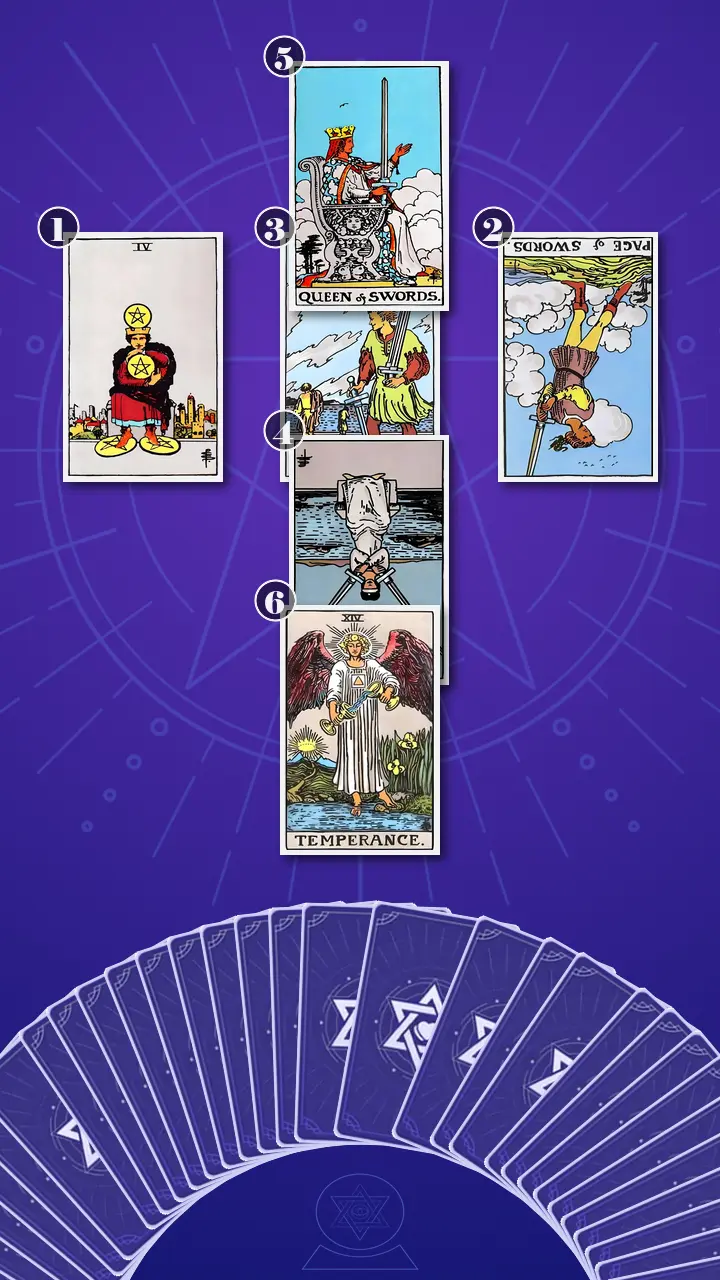
Reading the Map: Card Meanings in Context
Position 1 — Your boundary need: what you’re trying to protect and why it matters
“Now I’m turning over the card that represents your boundary need—what you’re trying to protect and why it matters to you right now.”
Four of Pentacles, upright.
In modern life, this looks like: you’re at a small group hangout in downtown Toronto and you catch yourself holding your phone face-down on your thigh like it’s classified information. Later, on the TTC home, you rewrite a simple text three times—removing anything personal—because you’ve learned that once your words leave your screen, they might not stay private.
That’s Four of Pentacles energy: protection. Not stinginess. Not being “dramatic.” It’s the instinct to keep what’s yours—your words, your dignity, your vulnerability—close to your chest because the environment hasn’t been safe with it.
Energetically, this card is an excess of control created by a lack of consent. You didn’t wake up wanting to self-censor. You adapted.
Maya let out a short laugh that had no humor in it. “That’s… painfully accurate. Like, wow. It’s kind of rude.” Her smile flickered, then disappeared as her fingers tightened around her iced coffee cup.
“It’s not rude,” I said gently. “It’s information. And it’s already showing us something practical: the cost isn’t only the moment at the table. It’s what happens afterward—how you start texting like you’re writing every Slack as if Legal is CC’d.”
Position 2 — Their communication style: how their behavior functions socially (regardless of intent)
“Now I’m turning over the card that represents their communication style—how their behavior functions socially, regardless of what they intend.”
Page of Swords, reversed.
This is the friend who treats your notification like a mic-drop moment. They read your text out loud with commentary, like they’re hosting a mini talk show at the table. Their voice gets louder as the room laughs, as if your message is a little ‘commentary track’ meant for everyone’s entertainment.
Reversed Page of Swords is an Air imbalance—a blockage of discretion. Words move fast, and the Page doesn’t pause to ask the adult question: “Do I have consent to share this?”
I watched Maya’s shoulders creep up toward her ears as I spoke, like her body was bracing for the next performance.
“Here’s the thing,” I continued. “We can separate intent vs impact. Maybe they mean playful. The impact is exposure. You don’t have to label them a bad friend to name a behavior you won’t accept.”
Maya’s eyes went slightly unfocused—like she’d just replayed a specific moment in HD. Then she nodded once, sharply. “It’s like… they get something from it. Like attention. Like the room turns toward them.”
“Exactly,” I said. “And that brings us to the shared dynamic.”
Position 3 — The current relational dynamic: what gets reinforced when the texts are read out loud
“Now I’m turning over the card that represents the current relational dynamic—what gets reinforced when your texts are read out loud.”
Five of Swords, upright.
This card is the conflict-aftertaste. In the moment, the group laughs and the vibe keeps moving. Public-you smiles. But private-you—later in bed—replays the clip: their voice reading your text, the laughter landing, your polite face. And then the drop in your stomach when you realize it wasn’t funny to you.
Five of Swords energy is a win/lose social dynamic. Someone “wins” the moment—gets the laughs, controls the room—and someone else quietly pays the bill in dignity.
Maya swallowed. Her hand drifted to her jaw like she’d been asked to notice it. “That’s the part that messes with me,” she said. “Because no one is being… evil. But I still feel used.”
“Right,” I said. “The Five of Swords doesn’t require a villain. It requires an audience and a power imbalance. And your silence—totally human, totally normal—accidentally teaches the room that your discomfort is part of the bit.”
Position 4 — What keeps you quiet: the fear, belief, or internal stalemate behind the hesitation
“Now I’m turning over the card that represents what keeps you quiet—the fear or stalemate behind the hesitation.”
Two of Swords, reversed.
Two of Swords reversed is that moment where avoidance stops being neutral. The blindfold is slipping. You can’t unsee the pattern, but you still try to keep the peace by not choosing a moment to speak.
Here’s how it shows up in real life: you open the chat to finally address it, type, “Hey, can you not read my texts out loud?” then delete it because you imagine the group labeling you “too sensitive.” So you stay ambiguous, act normal, and keep bracing—while the pressure builds every time your phone lights up around them.
I leaned slightly forward. “This card is the ‘unsent draft’ montage.”
You open Notes. You type a boundary. You delete it. You reopen it. You scroll Instagram to numb the discomfort. And the inner monologue runs like a split-screen:
“If I say it now → I’m dramatic. If I don’t say it → I’m consenting. So I do nothing and call it ‘keeping the peace.’”
Then, softly, I added the line that always matters here: “Laughing it off is still an answer—just not the one you want.”
Maya’s reaction came in a small three-beat chain: her breath paused; her gaze drifted past me as if she was watching herself do it; then she exhaled through her nose—quiet, defeated, relieved. “Oh… yeah,” she said. “That’s exactly what I do.”
When the Queen Held Her Sword Upright
Position 5 — The boundary move: the clearest way to communicate the limit and hold it with self-respect
I paused before turning the next card. Outside my studio window, a streetcar bell rang—clean, unapologetic. The room felt suddenly still, like we’d reached the center of the story.
“Now I’m turning over the card that represents the boundary move—the clearest way to communicate the limit and hold it with self-respect.”
Queen of Swords, upright.
The modern-life version is simple: it happens again, and instead of laughing it off, you look at them and say—calmly, once—“Please don’t read my texts out loud.” No apology. No paragraph. You let the room go a little quiet if it needs to.
Maya’s immediate instinct was to flinch away from the simplicity. I could see it in the way her lips parted like she was about to offer twelve clarifying footnotes.
And this is where my Wall Street brain always flashes back. On a trading floor, if you try to negotiate by over-explaining, you don’t get safety—you get picked apart. Clarity comes from terms you can repeat. A boundary is the same: not a courtroom argument, not a personality critique. It’s a consent rule for your words.
Setup: Maya was stuck in that familiar TTC-loop: it’s 8:47 PM on Line 1, her phone buzzes, and before she even reads the message her brain flashes, “If I text this, will it become a group bit later?” She rewrites it twice anyway—trying to sound casual while her jaw stays clenched.
Delivery:
Stop trying to stay ‘easygoing’ by staying silent; start speaking one clean boundary, like the Queen holding her sword upright.
Reinforcement: Maya’s body reacted before her confidence could catch up. First, she went very still—like the moment right after someone says your name in a meeting and your brain blanks. Then her eyebrows tightened and she whispered, almost angry, “But if I say that… won’t everyone think I’m killing the vibe?”
Her cheeks flushed again, the same heat as the brunch table, but this time it was mixed with something sharper: the grief of realizing she’d been doing emotional labor to keep belonging.
“Listen,” I said, keeping my tone level. “This is where I use what I call Negotiation Alchemy. You don’t need to convince the whole room. You need a repeatable line and a calm follow-through you control. In negotiation terms, your boundary is the term. Your consequence is your BATNA—your ‘what I’ll do if this continues.’ That’s not a threat. That’s self-respect with structure.”
I gave her a tiny practice container—my go-to from the resonance work we’d been circling anyway: a 10-minute “One Sentence, One Breath” drill. “Open Notes,” I told her. “Type exactly one boundary line you can say word-for-word: ‘Hey—please don’t read my texts out loud. If you want to share something, ask me first.’ Set a 60-second timer. Read it once, slowly. If you feel your chest tighten or you start bargaining—‘Maybe I should soften it…’—pause and take one full breath. You can stop at any point. This is practice, not a performance. Optional: record it as a voice memo and delete it right after.”
Her face changed in layers: resistance… then recognition… then her shoulders dropped as if someone had finally taken a heavy bag off her back. She blinked fast once, and laughed—this time with relief. “Okay,” she said. “I can do one sentence.”
I let a beat of silence do its work. Then I asked, “Now, with that new lens, can you think of last week—one moment when this happened—where saying that one clean line would’ve changed what your body felt?”
She didn’t answer right away. She just nodded again, slower. “At pre-drinks,” she said finally. “I could literally feel my throat close. If I’d said it then… I think I would’ve slept.”
And that—right there—was the shift: from an embarrassed freeze-and-laugh-it-off reflex toward grounded self-respect and clear, consent-based communication.
Position 6 — Integration: what the friendship can feel like when the boundary becomes normal practice
“Now I’m turning over the last card—the one that represents integration: what the friendship can feel like when the boundary becomes a normal practice.”
Temperance, upright.
Temperance isn’t a dramatic showdown. It’s the slow pour between two cups—the new rhythm forming through repetition.
In modern life, it looks like this: after you set the boundary, you notice a subtle shift over the next few hangs. Your friend starts asking, “Can I read this?” Or they stop reaching for the joke. The room doesn’t implode. Nobody dies of awkwardness. Your shoulders drop. Texting stops feeling like a risk assessment.
This card is balance—not perfect harmony. It’s the friendship recalibrating around a new default: consent before sharing.
“So it could… get better without it becoming a constant fight?” Maya asked.
“Yes,” I said. “Temperance is the proof-of-concept card. Not ‘everything will be perfect.’ More like: if you’re consistent, the system updates.”
From Feeling Stuck to Actionable Advice: The Minimum Viable Boundary
Here’s the story your spread told, end to end.
You started in Four of Pentacles: you’re protecting your privacy because your words stopped feeling safe. Then Page of Swords reversed showed the social mechanism on their side: they turn information into performance. Five of Swords revealed the shared cost: someone wins the laugh, and you lose dignity afterward. Two of Swords reversed named the internal choke point: you keep waiting for perfect timing, and the unsent draft becomes a mental tab you can’t close. The Queen of Swords offered the pivot: one clean boundary line, delivered calmly. And Temperance showed the integration: consistency turns awkwardness into a new normal.
Your cognitive blind spot—if we name it gently—is thinking you need to earn the right to be respected by providing the perfect explanation. That’s why your brain keeps trying to draft a TED Talk instead of shipping a single sentence.
The transformation direction is clearer: move from indirect hints and self-editing to one clear sentence that names the behavior and states the boundary—then a simple consequence you can calmly uphold. That’s how you stop feeling stuck. That’s how you rebuild trust signals in the friendship without turning it into a character trial.
I also gave Maya one extra tool from my own toolbox—because my work is where tarot meets real-life decision-making. I call it the Cocktail Party Algorithm: three phases for a boundary conversation that keeps things human and non-dramatic. Warm opener → clean boundary → pause. Not more. Not less.
- Ship the one-sentence boundary (your MVB)Pick your exact line ahead of time and keep it under 12 words. Use it in the moment: “Please don’t read my texts out loud.” If needed, add one follow-up: “If you want to share something, ask me first.”Expect your brain to argue for a 12-sentence explanation. That’s the old pattern trying to earn permission. Say it once, neutrally. If your voice shakes, it still counts.
- Use the 5-minute private check-in (low-drama container)Send a short setup text before the next hang: “Hey, quick thing—can we chat for 5 minutes before Friday?” Then use the three-part script: “When you read my texts out loud, I feel exposed. Please don’t do that without asking me first.”Let silence do some work. Don’t fill the pause with extra justification. Keep it behavioral: what happened, how it landed, what you need next.
- Choose one calm consequence you can actually follow through onDecide privately: “If it happens again, I’ll put my phone away / stop texting sensitive stuff / step out for a minute.” If it happens, repeat the boundary once, then follow through without lecturing.A consequence isn’t a threat—it’s your action plan. If adrenaline spikes, do a 2-minute reset (bathroom break, water, fresh air). Your nervous system needs a discharge, not a debate.
If you want a body-based “in the moment” assist: place your thumb lightly against the side of your index finger (a simple version of my Handshake Energy Exchange technique). Feel the pressure. Take one full breath. Then speak the line. It’s not mystical—just palmar biofeedback that reminds your body: I’m here, I’m safe, I can be clear.

A Week Later: A Boundary You Can Repeat Beats a Speech You Can’t
A week later, Maya sent me a message that made me exhale the way I do when a chart finally stops lying.
“It happened again,” she wrote. “I said it. Just the one line. The room got quiet for like… two seconds. Then we moved on. Later, they actually apologized.”
She added, almost as an afterthought: “I still woke up the next morning and thought, ‘Was I too intense?’ But then I remembered the Queen. And I didn’t rewrite my texts on the TTC today.”
That’s what I love about how tarot works in practice—especially with something as modern and weirdly intimate as phones and friend groups. A Relationship Spread tarot reading for friendship boundaries around privacy and consent doesn’t just describe the problem. It gives you a clean lever: one repeatable sentence, one grounded consequence, and a new internal reference point for self-respect.
When your private words get turned into a group moment, it’s not just awkward—you can feel your body clamp down, because you’re trying to keep belonging while quietly losing self-respect.
If you didn’t need to earn permission to be respected, what’s the one simple sentence you’d want to say the very next time it happens?