From Discord Exclusion Spirals to Self-Respect: Verify, Don’t Investigate

Finding Clarity in the 8:52 p.m. Scroll
You tell yourself you’re being “chill,” but the second you notice a side chat without you, you start refreshing like it’s an unpaid part-time job.
Jordan (name changed for privacy) sat across from me and said it the way people do when they’re trying to sound reasonable: “So… there’s a private Discord channel without me. And I’m spiraling. I know it’s just a server, but I can’t stop reading into reactions and timestamps like they’re… evidence.”
It was 8:52 p.m. on a Tuesday in their Toronto shared apartment. The Discord app glow was the only bright light in the room; the fridge hummed like it had an opinion. Their phone looked warm in their palm, almost too warm—like it had been holding their thumb hostage for the last hour. Every few seconds: refresh. Scroll. Pause. Refresh again.
I watched their throat work like it was trying to swallow a stone. Their hands kept re-gripping the phone, then loosening, then gripping again—restless, like a kettle that never quite reaches boil. The hurt wasn’t abstract. It was a heat-flush in the face and a tight, wintery band across the chest, as if the word private had turned the room temperature down.
“I hate that I care this much,” they added, quieter. “And I care enough that I’m drafting a message that looks casual, but it’s totally a vibe-check test. If I ask directly, I’ll ruin the vibe. If I don’t ask, I’ll keep torturing myself.”
I nodded, letting that land without rushing to fix it. “We’re not going to pretend this doesn’t hurt,” I said. “And we’re not going to let the hurt run your thumbs. Let’s make a map through the fog—something practical. A journey to clarity.”

Choosing the Compass: The Four-Layer Insight Ladder
I asked Jordan to put the phone face down—screen to table, like closing a laptop that’s overheating. “Just for a minute,” I said. “Not as a rule. As a reset.”
I shuffled slowly, not for drama, but for focus—the way I blend fragrance accords: one deliberate decision at a time. “We’re going to use a spread I call the Four-Layer Insight Ladder · Context Edition,” I explained. “It’s designed for situations like this—where the real problem isn’t prediction. It’s the way ambiguity gets turned into a verdict about your worth.”
For anyone reading this because you’re Googling something like tarot spread for feeling left out in a friend group, this ladder format works because it separates the layers cleanly: (1) what happened on the screen, (2) what it triggered in the body, (3) what old story got activated, (4) what coping pattern keeps the loop going—then it gives you (5) a stabilizing inner resource and (6) an actionable next step. Minimum structure, maximum clarity.
“Card 1 is the surface situation,” I said, placing the first card at the top. “Card 2 is the body-level trigger. Cards 3 and 4—those are the root and the loop. Card 5 is the turning point. Card 6 is what you do next in real life.”
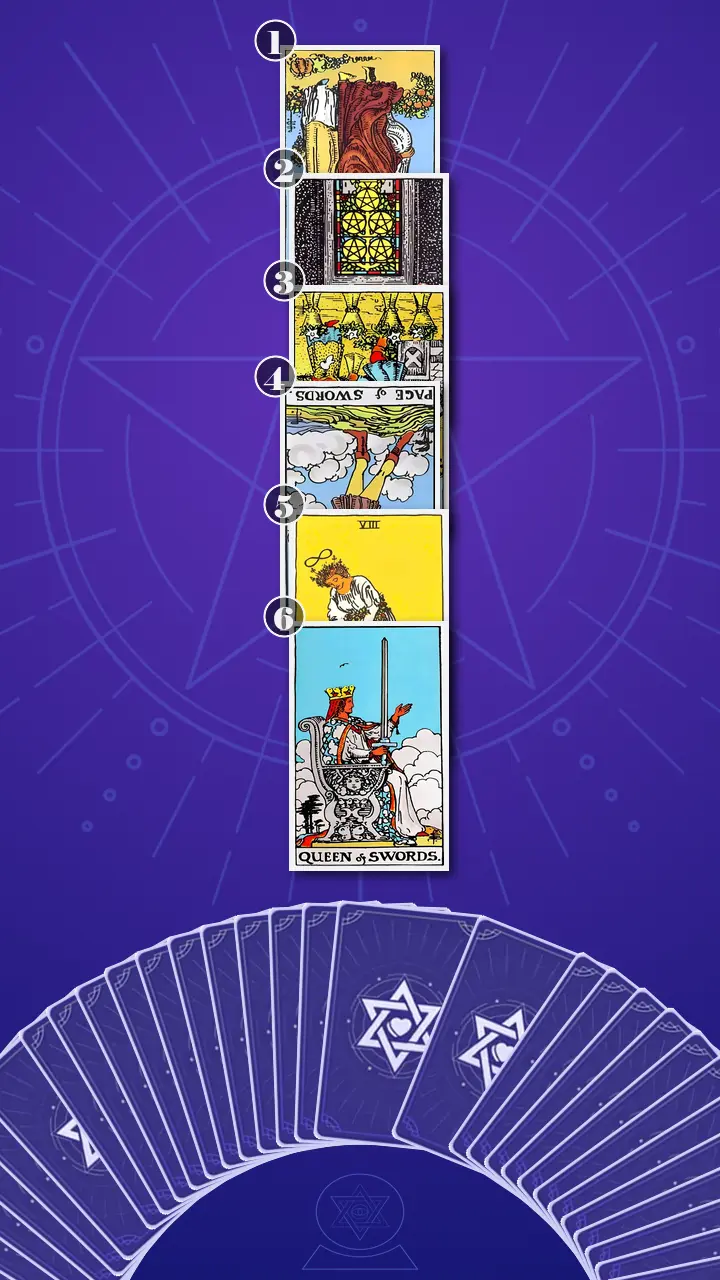
Reading the Map: How Tarot Works When You’re Feeling Left Out Online
Position 1: Surface situation — the social meaning your brain assigned
“Now we turn over the card that represents how the private Discord dynamic is landing and what it immediately activates socially,” I said.
Three of Cups, reversed.
In modern life terms, it’s painfully specific: you’re technically in the community—memes, jokes, casual chatter—but the vibe feels like a table that’s already full. You glance at the channel list and realize there’s a private space you can’t access. The sting isn’t “I’m missing content.” It’s “they’re celebrating without me,” and suddenly you’re scanning for whether you’re still wanted in the group at all.
Reversed, the Three of Cups isn’t a lack of people. It’s a mismatch in belonging: connection exists, but it doesn’t feel mutual or transparent. The energy here is blocked—community energy turned inward, becoming clique energy, closed-loop energy.
I asked the question this position demands: “When you saw the private space, what was the very first social conclusion your brain jumped to—before you had any facts?”
Jordan let out a tiny laugh that sounded like a paper cut. “That I’m… not in. Like, I’m adjacent. I’m the ‘fun sometimes’ person, not the ‘inner circle’ person.”
They shook their head, still half-smiling. “That’s so accurate it’s kind of rude.”
Position 2: Emotional trigger — what your nervous system heard
“Now we turn over the card that represents the body-level meaning you attach to being excluded,” I said. “Not the group’s intention. Your system’s interpretation.”
Five of Pentacles, upright.
This is the card of being outside in the cold while warmth glows behind glass. In real life: you’re physically safe—blanket, couch, rain tapping the window—but your nervous system drops in temperature the second you read private. Even if nobody has said anything about you, it lands like: “Help isn’t coming. I’m outside.”
The Five of Pentacles is deficiency energy—not because you lack friends, but because your body believes belonging is scarce. It’s the sensation of exclusion as a physical environment: cold street, tight chest, the feeling that you’re not allowed to knock.
As a perfumer, I’ve learned this: people think they live in their thoughts, but they really live in their sensations. Your body decides the story before your brain writes the dialogue. “A private channel can be a detail—not a diagnosis of your worth,” I told Jordan gently. “But right now your body is reading it as a diagnosis.”
Jordan pressed a thumb to the center of their chest like they were checking if the tightness had a button. “It’s like… my chest goes hollow,” they said. “And then I need to fill it with information.”
Position 3: Old outsider story — the past that time-travels into the present
“Now we turn over the card that represents the past template being replayed—the younger part of you that gets activated,” I said.
Six of Cups, reversed.
When this card is reversed, nostalgia stops being sweet and starts being sticky. It’s not, “I remember.” It’s, “I’m back there.”
I watched Jordan’s eyes shift a little, like a camera cutting scenes. Adult couch → childhood hallway. “How old do you feel when this hits?” I asked. “And what’s the earliest scene you can remember that has the same emotional flavor?”
Jordan’s fingers went cold around their mug; their face did that familiar hot thing again. “Twelve,” they said immediately, like the number had been waiting. “Middle school. People planning stuff right in front of me. I’d act like I didn’t care. I’d try to be… useful. Funny. Easy.”
The Six of Cups reversed is the urge to offer a “peace gift”—a joke, a link, extra availability—as if you can trade usefulness for belonging. The energy is regressive: the adult you gets temporarily replaced by the kid who couldn’t ask clean questions without risking humiliation.
“Back then,” I said, “you didn’t have much leverage. Now-you does.”
Position 4: Maintaining mechanism — the loop that masquerades as ‘research’
“Now we turn over the card that represents the specific mental and communication pattern that keeps the outsider story looping,” I said. “This is the choke point.”
Page of Swords, reversed.
Jordan didn’t even wait for me to translate it. Their mouth twitched like they knew what was coming.
This card is the digital detective loop in one image: toggling between servers and channels, checking who’s online, who reacted, and when. Rereading old threads to see if you “missed something.” Drafting a message that sounds casual but is designed to test the room—a joke that’s really a probe. The more you gather, the more ambiguous it gets—and the more your brain insists you need one more clue.
Reversed, the Page of Swords is excess Air energy—too much vigilance, not enough truth. It’s curiosity that’s been hijacked by fear. It’s words used as probes rather than bridges.
I leaned in a little. “This is like a true crime board,” I said, keeping my tone warm, not mocking. “Open tabs. Screenshots. Timelines. You’re trying to reverse-engineer an algorithm from three data points. And underneath it, the body is saying: If I can just find the clue, I won’t have to feel this.”
Jordan exhaled sharply—half laugh, half surrender. Their shoulders lifted like they were about to defend themselves, then dropped. And, without being told, they slid their phone a few inches farther away. The urge to check was still there, but you could see it lose about ten percent of its power.
“Here’s where my Social Pattern Analysis kicks in,” I added, because this is the part people miss: “Your mind is treating incomplete social data as if it’s complete. In groups—especially online—missing context is normal. People make private channels like they make folders: project-based, topic-based, or even admin-only. Your brain is trying to protect you, but it’s using the wrong tool. This is investigation. What you need is verification.”
I let one of my favorite interrupting phrases land cleanly: “Stop treating uncertainty like a verdict.”
Position 5: Key transformation — when Strength changes the whole climate
“We’re turning over the turning point now,” I said, and the room went a little quieter, as if even the fridge decided to listen. “This is the card for the inner capacity that interrupts the loop and restores choice.”
Strength, upright.
Setup: Jordan opens Discord “just to check one thing,” sees a channel they can’t access, and suddenly they’re deep in timestamps and reaction patterns like they’re building a case they never wanted to be assigned. They want closeness and belonging—badly—but they’re terrified that asking for clarity will confirm they’re not wanted. So the mind goes to work, because work feels safer than need.
Stop treating uncertainty as a verdict and start holding the ‘lion’ of hurt with steady hands, so you can choose directness without losing softness.
I paused after saying it, the way I pause after adding a powerful base note to a blend—because it needs air to become real.
Reinforcement: Jordan’s reaction came in layers. First, a tiny freeze: their breath caught, and their fingers hovered over their mug like they forgot what to do with their hands. Then the thought landed—slowly, visibly—like their eyes were replaying the last week in fast-forward: the locked channel, the jokes they didn’t get, the “lol what are you nerds up to” message that was really a test. Then, the release: their shoulders dropped a full inch, their jaw unclenched, and the tight throat softened into something like a sigh they’d been withholding. It wasn’t instant relief. It was permission—permission to respond like an adult instead of a detective.
“Strength doesn’t mean you stop caring,” I said. “It means you stop letting the hurt steer the story. In my work, I call this an inner regulation pivot: you stabilize your nervous system first, so your social pattern analysis becomes accurate instead of panicked.”
I reached into my bag and set a small blotter strip on the table—cedar and a touch of vetiver, a woody accord I use for professional presence enhancement. “Smell this,” I said. “Not because scent is magic. Because your body learns through sensory anchors. Woody notes signal groundedness—like feet on the floor. If your chest is tight and your hands are twitchy, give your system a cue that says: I’m safe enough to ask one clean question.”
“Now,” I added, “with this new lens—can you think of one moment last week when this insight would’ve changed how you felt?”
Jordan blinked hard, eyes a little shiny, not dramatic—just honest. “Last Thursday,” they said. “I saw someone react to someone else’s meme and not mine. I took it like… proof. I could’ve just… let it be a detail.”
This was the pivot of the whole reading: moving from hurt-driven social surveillance and shame to calm self-respect and direct clarity-seeking communication. Not certainty. Not control. Self-respect under uncertainty.
Position 6: Next step in practice — Queen of Swords, but make it humane
“Now we turn over the card that represents one mature, realistic move you can take to clarify and protect your dignity,” I said.
Queen of Swords, upright.
This is the card that takes Strength and turns it into language. Not a monologue. Not a meltdown. A clean sentence with an open hand.
In modern terms: you separate facts from stories. Fact—there’s a private channel. Story—I’m not wanted. And then you send one respectful message with no extra sarcasm, no five-paragraph backstory.
“Queen of Swords is a two-sentence Jira ticket,” I told Jordan. “Clear scope. Clear ask. No lore dump.”
I saw them smile, because they were a UX designer and that metaphor hit like a perfectly placed comma.
“Here’s the script,” I said, and I kept it short on purpose—first impression calibration through sillage control. In perfume, sillage is the trail you leave. Too much and you suffocate the room. Too little and you disappear. The Queen asks for the right trail: present, precise, not performative.
“Try: ‘Hey—noticed there’s a private channel on the server. Is it for a specific project/topic?’ Then stop.”
Jordan’s shoulders rose, then eased. “That’s… so much shorter than what I was drafting,” they said. “Mine was like… three paragraphs and a joke and then another joke.”
“One clear question beats twenty quiet tests,” I said. “And you can be direct without getting hard on yourself.”
The “Strength → Queen” Reset: Actionable Advice for the Next 48 Hours
Here’s the story the cards told, in plain language: the private Discord cue (Three of Cups reversed) hit your nervous system like a closed circle. Your body translated it into exile (Five of Pentacles): cold, outside, unhelped. That opened a trapdoor into an older lunch-table script (Six of Cups reversed), and then your mind tried to protect you with surveillance (Page of Swords reversed)—refreshing, rereading, hinting—because “doing something” feels safer than asking.
Your cognitive blind spot isn’t that you care. It’s that you treat ambiguity as proof. You assume the only way to keep dignity is to avoid directness—when the real transformation direction is the opposite: ask for clarity and keep your self-respect, whatever the answer is.
To make this practical, I gave Jordan a tiny protocol—something you can steal if you’re stuck in the same career-crossroads-level decision fatigue, but for relationships.
- Do the 7-minute “Strength” reset (before you type)Put your phone face down. Take two slow breaths, longer exhale than inhale. Name it in one line: “This is hurt + my outsider story.” If you have it, use a grounding cue—woody scent on a sleeve, or even just your feet flat on the floor—so your body gets the message that you’re not in danger.If your chest is still tight or your hands feel twitchy, wait 20 minutes (or until tomorrow daytime). You’re allowed to pause; you’re not obligated to process perfectly tonight.
- Write the two-sentence clarity message in Notes (don’t send yet)Draft: “Hey—noticed there’s a private channel on the server. Is it for a specific project/topic?” Stop after two sentences. No extra jokes to soften it. No apology tour. This is “verify, don’t investigate” in text form.If your brain says “cringe / needy,” treat that as a nervous-system alarm, not a moral truth. Lower the difficulty: you’re asking for context, not a life-commitment answer.
- Set a 24-hour “no-edit” rule + a 10-minute phone exileOnce the draft is written, don’t add paragraphs or send a second “lol just curious” follow-up. When you do send (ideally in daylight), DM one trusted person, not the whole group. After you hit send, put your phone in another room for 10 minutes and do something physical (dishwasher, shower, quick walk) to break the refresh loop.If you feel tempted to attach screenshots or list grievances, that’s your signal to pause. Clean language protects your dignity more than extra evidence ever will.
If you want one more sensory lever: a quick cleansing citrus spray (literal or imagined—lemon, bergamot, anything “fresh”) can function like opening a window in a stuffy room. Not to erase your feelings. To give you enough air to choose your next step instead of being dragged by it.

A Week Later: Daylight Information, Not Midnight Imagination
A week later, Jordan messaged me around lunchtime—not 11:37 p.m., not in the blue light glow zone. “Sent the two-sentence DM,” they wrote. “Put my phone in the bathroom like you said. Went and made coffee. I didn’t refresh. I felt insane for five minutes and then… less insane.”
The answer they got was ordinary, almost laughably un-dramatic: the private channel was for a specific project and some admin stuff. Nobody had been plotting. Nobody had been judging. It wasn’t a referendum. It was a folder.
And still—here’s the bittersweet part, the real part—they admitted something else: even with the neutral answer, they’d sat alone at a café for a few minutes afterward, staring at their empty inbox like their body was waiting for the other shoe. Not because they were broken. Because nervous systems learn on a lag.
But this time, they didn’t punish themselves for that lag. They noticed it. They breathed. They stayed in their own corner.
That’s what this Four-Layer Insight Ladder tarot spread (Context Edition) is for: online exclusion triggers and relationship clarity that doesn’t depend on mind-reading. Not to guarantee you’ll be included everywhere. To guarantee you can meet uncertainty with self-respect and clean communication.
When you want to belong so badly that you start treating a locked channel and a few missing replies like evidence, your chest tightens—not because you’re “dramatic,” but because some part of you is bracing to be unchosen again.
If you trusted—even just 5% more—that your dignity survives any answer, what’s the smallest clear question you’d be willing to ask this week?