Corrected Mid-Update in the Glass Room—And the Two Lines to Send

Corrected in the Meeting, Replaying It All Night
If you’ve ever been corrected in a meeting and felt your face go hot while you tried to look unfazed, you already know the whole “I’m being judged” spiral.
Taylor (name changed for privacy) sat across from me in my little reading space—London grey outside the window, that particular late-afternoon light that makes every screen feel brighter than it should. They were 27, early-career, sharp, and tired in the way you get when your brain has been doing overtime on something that lasted maybe ten seconds in real life.
“I don’t mind being corrected,” they said, then swallowed like the words had edges. “I mind the audience.”
They described it like a scene I’ve heard a hundred times, and still, each time it lands with fresh sting: 8:57 a.m., glass meeting room near Shoreditch, fluorescent lights slightly too bright, laptop fan whispering like it’s also nervous. Taylor was mid-sentence, walking the team through a timeline, when a colleague cut in with a correction—technically small, socially loud. Taylor nodded too fast. Smiled too fast. Tried to sound breezy while their throat tightened like a drawstring.
“And then,” they admitted, “I go home and… it’s like one comment rewrites my whole reputation.”
Their embarrassment wasn’t an abstract feeling. It was physical: a hot face that returned on command, a clenched stomach the second they pictured the room watching, a jaw set so hard it looked like they’d been chewing gravel. Under it was irritation—because yes, the content mattered, but the delivery mattered too.
“I keep drafting the perfect Slack follow-up,” they said. “Polite. Then sharper. Then… like a solicitor wrote it. And I still don’t send it, because if I respond now I look bitter, and if I don’t respond I look like I’m okay being talked down to.”
I let that hang for a second—because the contradiction is the whole engine: wanting to protect your credibility, while fearing that any pushback will make you look even worse in front of everyone.
“We’re not here to write a flawless comeback,” I told them. “We’re here to find clarity—what happened, why it hooks you so hard, and what a self-respecting next step looks like. Let’s draw a map through the fog.”

Choosing the Compass: The Five-Card Cross for Workplace Boundaries
I asked Taylor to take one slow breath—not as a mystical ritual, just a nervous-system reset. Then I shuffled with the kind of steady rhythm I learned long before tarot, back when I sat under fluorescent lights of a different sort and everyone’s “quick correction” could move millions.
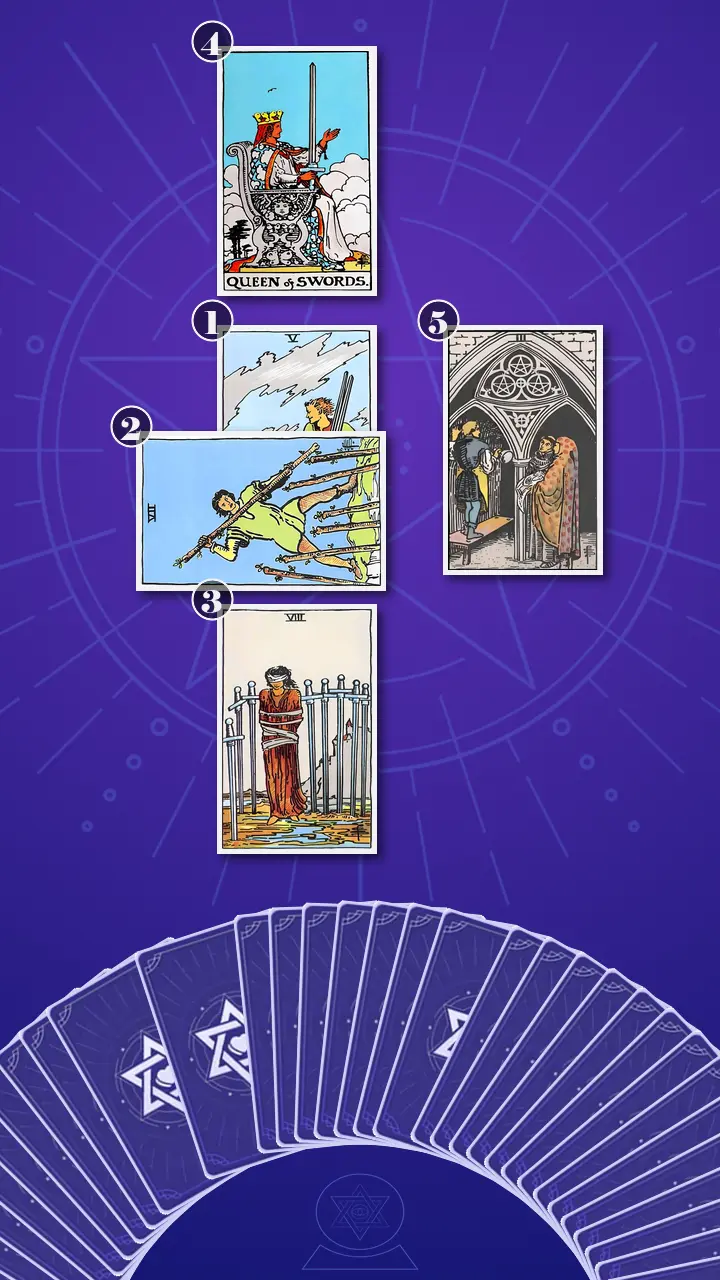
“Today, we’ll use a spread called the Five-Card Cross,” I said.
For readers who are curious about how tarot works in real-life situations like this: I like the Five-Card Cross because it doesn’t turn into fortune-telling. It gives structure. It captures the visible situation (the public correction), the immediate internal block (what happens in your body and voice while people are watching), the deeper root belief (what it threatens to prove about your worth), the healthiest response strategy (what protects credibility long-term), and the integration (what you can build so the pattern stops repeating).
I pointed to the layout as I dealt. “Card one is the moment as it lands in the room. Card two crosses it—your immediate obstacle in real time. Card three goes under it: the deeper belief driving the spiral. Card four above is advice—your best-response posture. Card five to the right is integration: what changes when you handle it with clarity, and what you can build going forward.”
Reading the Map: A Status Moment in a Slack-Heavy World
Position 1: What’s Actually Happening in the Room
“Now flipping over,” I said, “is the card representing The public correction moment as it lands psychologically: what dynamic is actually happening in the room.”
Five of Swords, upright.
This card is workplace status chess. The energy isn’t “feedback helps the work.” It’s “someone gets to be seen being right.” And in modern terms, it’s exactly this: you’re in a fast-moving meeting and someone corrects you in a way that feels like it’s for the room, not for the work. The factual note might be valid, but the delivery lands like a tiny status flex—suddenly you’re not discussing the project anymore, you’re managing how you look.
The Five of Swords is an excess of competitive energy—win/lose thinking spilling into a place that’s supposed to be shared problem-solving. It explains why your body reacts as if you’ve been publicly graded, not simply updated.
Taylor gave a tight little laugh—half recognition, half disgust. “That’s… honestly kind of brutal,” they said, eyes flicking down to the card. “Like, yes. It felt like a flex.”
“It can be true and still be delivered like a flex,” I said. “We’re not escalating. We’re separating content from delivery.”
Position 2: The Immediate Internal Obstacle
“Now flipping over is the card representing The immediate internal obstacle: what makes it hard to respond in a self-respecting way in the moment.”
Seven of Wands, reversed.
This is what happens in the exact second it becomes an audience. In modern life, it looks like: the second the correction happens, you default to being ‘easy’: quick nod, small laugh, ‘Yep, totally.’ Then you pull back—less talking, less risk, more self-censoring—because holding your ground in front of an audience feels like it could backfire.
Reversed, the Seven of Wands is a deficiency of footing. Not strength—footing. It’s the wobble that comes from trying to be “easy to work with” at the exact moment you most need a clean boundary.
I watched Taylor’s face as the memory hit. Their shoulders rose about half an inch. Their mouth did that polite-meeting smile that doesn’t reach the eyes.
“That’s me,” they said, wincing. “My voice goes higher. I smile too fast. I say ‘Yep, totally,’ and inside I’m like, ‘Not like that. Not in front of everyone.’”
“Right,” I said, keeping my tone steady. “And the danger isn’t that you’re ‘bad at meetings.’ The danger is you’re training your nervous system to associate visibility with risk.”
Position 3: The Belief Under the Reaction
“Now flipping over is the card representing The deeper belief/fear underneath the reaction: what the moment threatens to ‘prove’ about self-worth or competence.”
Eight of Swords, upright.
This card is the trap that feels like professionalism. The modern-life scenario is painfully specific: after the meeting, you tell yourself there’s only one acceptable response: perfectly calm, perfectly worded, zero emotion, zero edge. So you don’t respond at all—until you’ve edited it into something that can’t be misread. The trap is that the longer you wait, the bigger the moment feels, and the more powerless you feel.
The Eight of Swords is a blockage in perception. It’s not that you have no options; it’s that your mind insists there is only one “safe” option—silence until perfection.
As I spoke, I saw a tiny three-step chain move through Taylor: their breathing paused (freeze), their eyes unfocused like they were watching the Tube window reflection replay the scene (memory), and then the air left their chest in a small, defeated exhale (release).
“Ugh,” they said quietly. “Yeah. On the Central line, I’m re-reading the Slack thread in my head like people are screenshotting it for sport.”
“That’s the Eight of Swords rulebook,” I said. “The invisible policy that says: ‘If I don’t handle this flawlessly, everyone will think I’m incompetent.’ And that belief is expensive. It costs you visibility, energy, and self-trust.”
When the Queen Lifted Her Sword: Finding Clarity Without Sounding Defensive
Position 4: The Healthiest Response Strategy
I touched the top card lightly before turning it, because this position matters: “Now flipping over is the card representing The healthiest response strategy: what to say/do that aligns with boundaries and long-term credibility.”
The room felt quieter for a beat—the way it does when someone finally stops scrolling and looks up, fully present.
Queen of Swords, upright.
In modern terms, she’s a clean Jira ticket: clear, specific, no emotional essays—just what needs to happen next. The scenario is simple and almost relieving: you send a short, calm message that separates content from delivery: you acknowledge the correction (work), and you name the process you need (boundary). No apology tour. No clapback. Just: ‘Thanks for catching that—I’ll update X. Next time, can you flag corrections to me after the meeting?’
The Queen of Swords is balance in Air energy. Not the frantic, courtroom-Air of the Five and Eight—where you’re both defendant and judge—but refined Air: discernment, clean edges, and language that doesn’t leak heat.
The Setup: The Cursor-Blinking Loop
This was the exact place Taylor kept getting stuck: 11:30 p.m., Slack still open, cursor blinking like a metronome for self-judgment. They rewrote the same reply until it sounded “perfect”—not too apologetic, not too sharp—because the memory of the room watching kept replaying on loop.
Stop trying to win the room’s approval and start naming the boundary with the Queen’s upright sword—clean, direct, and focused on what happens next.
The Reinforcement: Two Sentences Instead of a Reputation Trial
Taylor’s reaction didn’t arrive as instant confidence. It arrived as physiology first. Their hands, which had been laced together too tightly, loosened. Their shoulders dropped like someone had quietly removed a backpack. Then there was a flicker of resistance—eyes narrowing, jaw tightening again. “But if I say something,” they said, voice sharper for a second, “doesn’t it look like I’m making it a big deal? Like I couldn’t handle feedback?”
I nodded, because that’s the honest fear. “That’s the Eight of Swords talking,” I said. “It tells you your only options are: be chill and swallow it, or be dramatic and explode. The Queen offers a third option: calm clarity.”
I pulled my phone out—not to be rude, but to mirror the real context. “Open your notes app,” I invited, “and write two lines. Max 200 characters each.”
As they typed, I watched another three-step chain: their breathing hitched (freeze), their eyes darted as if searching for the ‘perfect’ tone (policing), then their mouth softened and they exhaled through their nose (release). Their face was still pink with remembered embarrassment, but their gaze steadied on the screen.
“Read it once out loud,” I said. “And notice your body. If it tightens, we shorten the boundary line. Not add explanations.”
They read, quietly: “Good catch—updating X. For future, can you flag fixes to me after the meeting?”
“Oh,” they whispered, almost surprised. “That’s… actually doable.”
In my own head, I flashed back to the trading floor: the fastest way to lose credibility wasn’t being wrong—it was getting defensive about being wrong. The fastest way to keep it was a clean reset: acknowledge, correct, move forward. The Queen of Swords has always understood that.
Then I brought in my own lens—because I don’t just read cards, I read systems. “Here’s the business version,” I told them. “Your credibility is relationship capital. Every interaction either adds to it or withdraws from it.”
“When you stay silent and stew, you’re paying interest on a loan you never took out. When you send a short, process-based boundary, you’re doing what I call Influence Credit Scoring: you protect your credit without burning the relationship. Calm, direct, non-personal boundaries are high score behaviors. They’re how you stay respected and workable.”
I leaned in slightly. “Now, with this new frame—process over image—can you think of a moment last week when this would have changed how you felt?”
Taylor stared past the cards for a second, eyes glossy but not crying. “In the meeting,” they said. “When I laughed it off. If I’d just said, ‘Noted—let’s sync after,’ I wouldn’t have spent the entire Tube ride drafting imaginary replies.”
“Exactly,” I said. “This is the shift: from embarrassment-driven shutdown and perfection-edited replies to calm self-respect and process-based boundary clarity.”
Position 5: Integration and the Working Norm You Build
“Now flipping over is the card representing Integration and next-step direction: what changes when you respond with clarity and what to build going forward.”
Three of Pentacles, upright.
This card shifts the camera away from faces and onto the work: the shared doc, the project plan, the ticket, the deck. In modern life, it’s this: instead of this being a personal scar you carry into every meeting, it becomes a small team agreement: corrections can happen, but delivery has standards. The energy shifts from ‘who looked right’ to ‘how we collaborate well,’ and you feel more willing to contribute because the process feels safer.
The Three of Pentacles is balance in Earth energy—practical, repeatable, documented. It’s the opposite of “vibes.” It’s the part where a painful moment becomes a working agreement.
“Turn a status moment into a process conversation,” I said, and Taylor nodded like they’d been waiting for someone to give them permission to treat this as operations—not drama.
From Sting to Structure: Actionable Advice You Can Actually Use
Here’s the story your spread told, end to end: A public correction lands with a win/lose edge (Five of Swords). In the moment, your nervous system defaults to appeasing because being watched makes your footing wobble (Seven of Wands reversed). Afterward, you trap yourself in a perfection rule—one “safe” response, endlessly edited—so the correction grows into a reputation trial (Eight of Swords). The way out isn’t a smarter comeback; it’s Queen of Swords clarity: short, direct, process-not-person language. And when you do that, you can build a healthier collaboration norm (Three of Pentacles) so the same trigger doesn’t keep costing you confidence.
Your blind spot isn’t sensitivity. It’s treating delivery as something you’re not allowed to name. The transformation direction is clear: shift from “I must defend my image” to “I can name the process I need—privately, clearly, and without making it personal.”
I gave Taylor the smallest-possible next steps—because the goal is traction, not performance.
- The Two-Sentence ResetIn your notes app, draft two sentences only: (1) one sentence for the work (“Good catch—updating X.”) and (2) one sentence for the boundary (“For future, can you flag fixes to me after the meeting?”). Stop at two sentences, even if your brain begs for a third.If your chest tightens, shorten the boundary to 8–10 words. Shorter is often more professional.
- DM-First Feedback Reset (Channel Choice)Within 24–48 hours, send it as a private DM to the person—not in the public thread. Keep the tone neutral and process-focused: “Next time, can you flag corrections to me after the meeting?”Expect the cringe. That’s your Eight of Swords trying to keep you silent. If needed, save it as a Slack snippet and send when you’re calm.
- The “Cocktail Party Algorithm” for the 1:1If you have a 1:1 or a quick follow-up chat, use my three-phase template: Warm (“Quick one—appreciate you catching that.”), Work (“I’ll update X.”), Way-Forward (“For future, can we do fixes after the meeting?”). It’s the same boundary, just spoken.If your heart races, plant both feet on the floor and hold your mug or phone for two breaths—use the tension in your palms as a cue to simplify, not to over-explain.

A Week Later: Ownership, Not Certainty
A week later, I got a message from Taylor. No long explanation. Just: “I sent the two-sentence DM. My hands were shaking, but I did it.”
They added, “They replied, ‘Yep, fair—sorry about that.’ And in the next meeting, when they started to jump in, they paused and said, ‘I’ll DM you after.’ I didn’t feel euphoric. I felt… normal. Like I could breathe.”
That’s what a real Journey to Clarity usually looks like: not a dramatic transformation montage, but one clean sentence that changes the next interaction.
When someone corrects you in front of everyone, it’s not just the mistake—you can feel your body trying to disappear while your mind scrambles to prove you still deserve your seat at the table.
If you didn’t have to defend your image, what’s the simplest process request you’d feel okay naming—just once, calmly?
Author Profile