From Always-On Voice Notes to Calm Limits: A Boundary Reset for Friends

The 5:58 Voice Note on Line 1
If you’re the kind of Toronto 20-something who can write a perfect campaign brief but will rewrite a boundary text five times because you’re terrified of sounding ‘mean’—especially when a 5:58 voice note lands mid-commute.
Jordan said it like a confession, squeezed shoulder-to-shoulder on the TTC Line 1, rain streaking the windows into blurry gray ribbons. Her AirPods were in but silent. Her phone vibrated anyway. iMessage lit up: a voice note, timer climbing. She didn’t press play. She just stared at the little numbers like they were a mini invoice she hadn’t agreed to.
“My jaw goes tight,” she told me later in my studio, rubbing the hinge like it had been holding a door shut all day. “And my shoulders jump. And my stomach does that… drop. Then I’m like, ‘I’ll be nice later.’ But later is always my evening.”
What she wanted sounded so reasonable it almost hurt: keep the friendship easy and friendly, and stop letting long voice notes turn downtime into emotional labor. But the moment she imagined setting a boundary, her mind spun up the same loop—tone-policing, rehearsing, deleting drafts—like her phone was a tiny boss with unlimited access to her nervous system.
I nodded, slow and steady, the way you do when someone is finally describing the exact shape of a thing they’ve been carrying. “First,” I said, “A voice note isn’t a summons. Second—let’s get you out of the fog and into something you can actually repeat. That’s our Journey to Clarity today.”

Choosing the Compass: The Celtic Cross · Context Edition
I didn’t dim the lights or try to make it mystical. I asked Jordan to take one clean breath and do one simple thing: press her thumb lightly into the side of her index finger while she thought about that 5-minute timer. “Just notice,” I said. “Jaw. shoulders. stomach. No fixing yet.”
Then I shuffled—slow enough that her brain could downshift with the sound. “We’re using the Celtic Cross · Context Edition today,” I told her, and I also told you—the reader—why I reach for this spread when boundaries get sticky.
Because this isn’t really an etiquette question. It’s a repeating behavioral loop: trigger → fear → over-accommodation → resentment. The Celtic Cross is built for mapping chains like that. It shows the present reality, the immediate block, the deeper root, and—crucially—the cleanest lever for change. In this Context Edition, I keep the classic structure, but I micro-adjust two positions so we can look directly at your boundary posture and their communication style without losing the spine of the spread.
Here’s the roadmap: the center card shows what the voice notes are doing to your nervous system right now. The crossing card reveals what makes you hesitate. The card beneath takes us to the deeper fear driving the loop. And the near-future card—our key—shows the tone and wording style that will work best in real life, not in some perfect imaginary conversation.
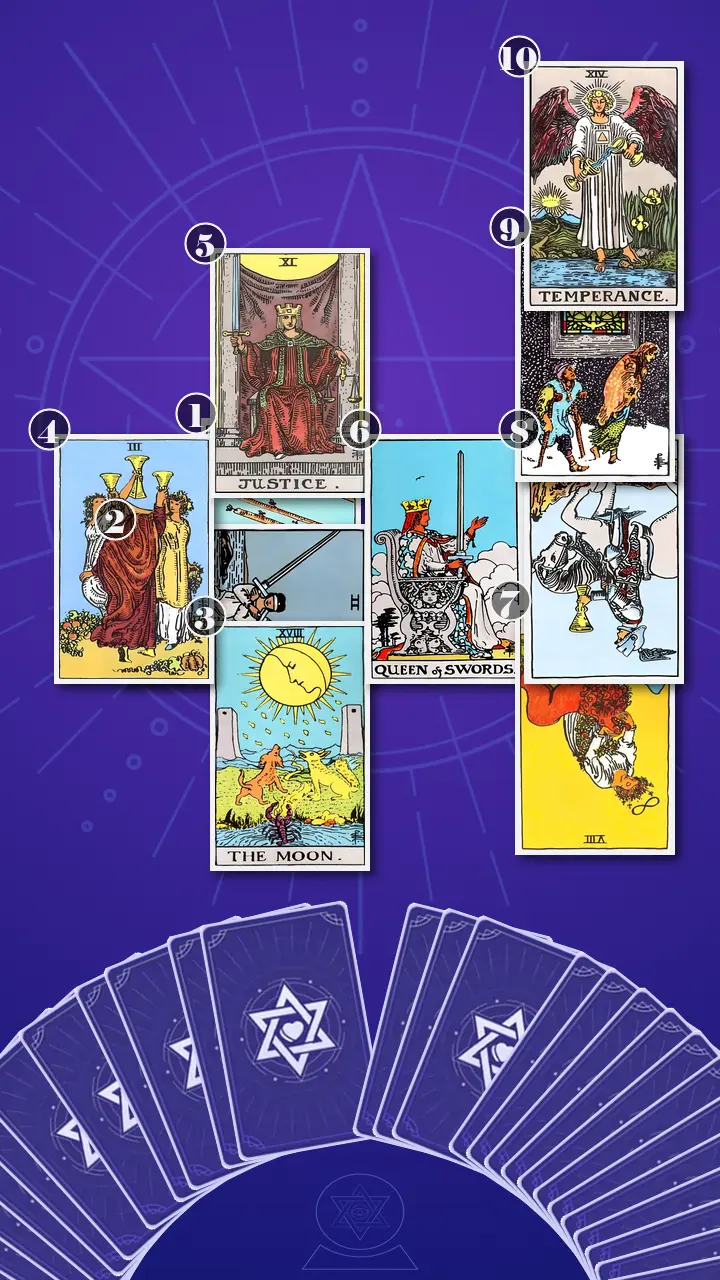
Reading the Map: Card Meanings in Context
Position 1: Your current communication reality
“Now turning over is the card that represents current communication reality: what the long voice notes are doing to your time, attention, and nervous system right now.”
Eight of Wands, reversed.
I didn’t have to reach for poetry—this one is painfully literal. “You’re on the TTC or between meetings and a 5–6 minute voice note drops,” I said, using the exact modern scenario the card points to. “You don’t have the bandwidth, so you leave it unread to avoid the ‘seen’ pressure. Later, you binge-listen at 1.5x while cooking or doing email, then fire off a rushed, overly warm reply that costs you your actual rest.”
Reversed, this isn’t ‘fast communication.’ It’s blocked momentum: a backlog that turns your day into inbox triage. Energy-wise, it’s a system that can’t find a landing pad—too many inputs, no buffer, no choice.
Jordan gave a small laugh that had no humor in it. “That’s… so accurate it’s kind of rude,” she said, and then she exhaled through her nose like she’d been caught doing something she never meant to do.
“It’s not rude,” I replied. “It’s a data point. Your body is telling the truth faster than your manners can.”
Position 2: The immediate block
“Now turning over is the card that represents the immediate block: what makes you hesitate to set the boundary in a direct way.”
Two of Swords, upright.
“This is the freeze,” I said. “You’ve written the boundary text in Notes three times, but you keep deleting it because you’re trying to avoid even 30 seconds of awkwardness. So you choose the ‘peace’ option—vague emojis, delayed replies, a ‘lol I’ll listen later’—and the backlog keeps stacking like unread emails you’re afraid to open.”
Upright Two of Swords is not a lack of intelligence. It’s a blocked decision. Air energy holding the blades across the chest: ‘If I don’t choose, I can’t be blamed.’ But the cost is paid in quiet resentment.
I pictured her Notes drafts—“boundary text v7”—the cursor blinking like a metronome in a dark room. I said it out loud: “This is the drafts folder problem. You keep polishing the message so you don’t have to tolerate the moment after you send it.”
Jordan winced, nodded once, and her fingers tightened around her iced coffee cup—then loosened, like she’d been caught holding tension she didn’t know she was holding.
Position 3: The root driver
“Now turning over is the card that represents the root driver: the deeper fear or assumption that keeps the pattern repeating.”
The Moon, upright.
“Before you even press play,” I said, “your mind writes an entire script about how they’ll react: they’ll think you’re cold, they’ll pull away, the friendship will change. The actual voice note is unknown, but your nervous system treats the imagined outcome as a fact—so the boundary feels like a threat instead of a simple preference.”
Moon energy is noisy water: distortion, projection, stories that feel real because you can feel them in your body. This is where people-pleasing becomes less about kindness and more about fear-management.
I held up my hand. “Let’s split it in two—Facts versus Stories. Fact: it’s a 5-minute voice note and you’re commuting. Story: ‘If I don’t listen now, I’m a bad friend.’”
Jordan swallowed. Her eyes went slightly unfocused—like she’d just replayed a dozen old moments of trying to sound ‘perfectly polite.’ Then she said, quietly, “I hate that I do that. It’s like… I’m already apologizing before anything even happened.”
Position 4: Recent momentum
“Now turning over is the card that represents recent momentum: how this dynamic was shaped by what’s been happening lately in the relationship.”
Three of Cups, upright.
“This friendship is genuinely warm,” I said. “Memes. Check-ins. Real affection. And that closeness quietly creates a norm: being responsive equals being caring. So when long voice notes show up, you feel like you should be able to handle them because you care—even if your schedule and energy say otherwise.”
This is balanced warmth that accidentally turns into an expectation. Not because anyone is malicious—because modern friendship often runs on ‘always-on’ messaging like it’s background oxygen.
Jordan’s shoulders dropped a fraction. “So it’s not that I’m a bad friend,” she said. “It’s that the format doesn’t fit my life.”
“Exactly,” I answered. “That’s a boundary conversation, not a character trial.”
Position 5: Your conscious goal
“Now turning over is the card that represents your conscious goal: what you want the boundary to protect, and what ‘fair’ communication would feel like.”
Justice, upright.
The energy in the room shifted. Not dramatic—clean. “You realize you’re not asking for less love—you’re asking for a fair format,” I said. “Text for quick things, short voice notes only, and if it’s a big emotional update, you plan a time. The boundary becomes an agreement you can live with, not a vibe-killer.”
This is where I hear my old Wall Street brain kick in—not the hustle part, the structure part. On a trading desk, ‘fair’ isn’t a vibe. It’s terms. It’s clarity. It’s what keeps relationships functional when things get fast.
“Clarity is kindness when it prevents resentment,” I added, watching her face soften at the idea that fairness could be loving.
Jordan let out a small, surprised exhale. “Okay. That framing feels doable. It’s not personal—it’s logistics.”
When the Queen of Swords Spoke: One Sentence That Changes the Pattern
Position 6 (Key Card): The next realistic move
When I slid the next card over, the air went still in that particular way it does when someone is about to stop bargaining with themselves.
“Now turning over is the card that represents the next realistic move: the tone and wording style that will work best for you in the near term.”
Queen of Swords, upright.
“You send one calm sentence,” I said, grounding it in the modern scenario. “No apology spiral. No paragraph. You let clarity do the work and trust that respectful people can handle respectful limits.”
Upright, the Queen is balanced Air: not cold, not cruel—just clean. Raised sword: truth. Open hand: invitation. This is compassion with edges.
Jordan immediately pushed back—not loudly, but with that reflexive defensiveness I see all the time in boundary work. “But if I’m that blunt,” she said, “won’t they think I’m… I don’t know. Cold?”
I nodded. “That’s The Moon talking. Let’s do the antidote.”
Setup: The moment you’re about to press play
It’s 10 PM, you finally sit down, and there it is again: a 5-minute voice note glowing on your screen—your shoulders tighten before you even press play. You’re trapped between ‘I want to be direct’ and ‘If I’m direct, I’ll be rejected,’ and you keep trying to write your way out of that tension.
Stop trying to sound endlessly ‘nice’; say one clean line with the Queen of Swords’ steady gaze, and let clarity do the work.
Reinforcement: One sentence. No courtroom. No closing argument.
Jordan’s body reacted before her mouth did—three quick beats I’ve learned to trust. First, a tiny freeze: her breath caught, and her fingers stopped moving as if she’d been typing in the air. Then the thought landed: her eyes shifted away from me to some middle distance, like she could see every “sorry I’m behind!!” she’d ever sent playing on a loop at 1.5x. Then the release: her shoulders slid down, and her jaw unclenched so suddenly she touched it like she didn’t recognize it relaxed.
“I… I always write a legal brief,” she said, voice thinner, not with shame but with clarity. “Like I’m trying to prove I’m allowed to have a preference.”
“Exactly,” I said. “Now—open Notes. Write one sentence that names your capacity and offers an alternative. Read it out loud once. If you start adding apologies, delete them and come back to the capacity line. Then pick one low-stakes moment this week to send it. Guardrail: do not explain more than one extra sentence.”
I paused. “Now, with that new lens—think back to last week. Was there a moment when this could’ve changed how you felt?”
Jordan nodded slowly. “Sunday night. Netflix paused. Three voice notes stacked. I sent a meme instead and felt relieved for ten seconds… then resentful for the rest of the night.”
“This,” I said gently, “is the step from pressure-and-people-pleasing into self-trust. Not perfection. Just the first clean line.”
Position 7: Your boundary posture (micro-adjusted)
“Now turning over is the card that represents your boundary posture: how you show up when you try to assert yourself, and where confidence leaks.”
Strength, reversed.
“You hit send on the boundary and immediately feel panic—so you start drafting a second message to soften it until it disappears,” I said. “Or you go silent for days hoping they notice. The real strength work is regulation: staying steady through the discomfort without performing extra niceness to earn safety.”
Reversed Strength is deficient steadiness, not deficient care. It’s your nervous system bracing for consequences that aren’t here yet.
“Don’t negotiate with yourself after you hit send,” I told her, and I watched her nod like she’d been waiting for permission to stop that internal bidding war.
Position 8: Their side of the pattern (micro-adjusted)
“Now turning over is the card that represents their side of the pattern: the other person’s communication style and how the environment reinforces it.”
Knight of Cups, reversed.
“They use voice notes like an emotional processing tool—long, unedited, sent in the moment—assuming you’ll hold attention for the whole arc,” I said. “It’s not evil; it’s a style. But it becomes one-way if you don’t set structure. Your job is to respond to the format—length, channel, timing—not diagnose their personality.”
Reversed, this is excess emotion in the channel with not enough awareness of the receiver’s bandwidth. Receiving is optional. Scheduling is allowed.
Jordan’s mouth twitched. “They do kind of… think out loud,” she admitted. “Over voice note.”
“Then the fairest thing you can do is give the container,” I replied.
Position 9: What you hope and fear
“Now turning over is the card that represents what you hope and fear: the emotional stakes you attach to the boundary conversation.”
Five of Pentacles, upright.
“The emotional stake is belonging,” I said. “You fear that if you’re not endlessly available, you’ll be left out. So a simple preference—‘please text’—starts to feel like you’re risking closeness itself.”
This is scarcity fear—not because you’re dramatic, but because your brain has learned to treat connection like something you can lose instantly.
Jordan’s eyes got a little glossy, then she blinked it back. “That’s the part I hate,” she said. “It feels embarrassing.”
“It’s human,” I said. “And it’s exactly why we use structure instead of spiraling.”
Position 10: Integration direction
“Now turning over is the card that represents integration direction: the most sustainable pattern that emerges when you act from clarity rather than guilt.”
Temperance, upright.
“You and the friendship settle into a rhythm that actually works,” I said. “Quick stuff by text, occasional short voice notes, deeper updates saved for a planned time when you can listen fully. You repeat your boundary calmly without escalating. The relationship gets quieter in a good way—less dread, more genuine presence.”
Temperance is balance—not an all-or-nothing stance. I tapped the card lightly. “Boundaries aren’t a door slam—they’re a volume knob.”
The One-Page Boundary Plan: From Insight to Actionable Advice
Here’s the story the spread told, in plain language. The Eight of Wands reversed showed the reality: your attention gets hijacked by bursty communication, and you end up paying for it with your evenings. The Two of Swords and The Moon explained why it repeats: you freeze because you’re trying to avoid awkwardness, and your mind fills the gap with worst-case stories about rejection. Three of Cups reminded us this isn’t a cold relationship—you actually care. Justice clarified your real goal: fairness and mutual respect. The Queen of Swords gave you the lever: one clean sentence. Strength reversed warned about the confidence leak—walking it back. Knight of Cups reversed explained the environment: their style is emotion-led and unfiltered. Five of Pentacles named the hidden stake: belonging fear. Temperance offered the sustainable endgame: a rhythm.
If there’s a cognitive blind spot here, it’s this: you’ve been treating a boundary like a court case—something you must win with perfect wording—when it’s really an interface setting. You’re choosing a channel, not judging a person.
My Oxford-and-Wall-Street side can’t help but run a quick SWOT on the situation. Strength: you’re thoughtful and kind. Weakness: you over-explain under stress. Opportunity: you can upgrade the system with one repeatable sentence. Threat: resentment leaks and makes you seem colder than a clear boundary ever would.
To make this easy to execute, I used one of my go-to communication tools—what I call the Cocktail Party Algorithm. It’s a three-phase template: warm opener → clear line → simple redirect. No speech. No apology parade.
- Write your One Clean Line (Queen of Swords)In Apple Notes, write one sentence you can repeat: “Hey—quick heads-up: I’m not able to keep up with long voice notes. If it’s more than ~1 min, can you text me the key point?”Read it out loud once. If you start adding disclaimers, ask: “Am I clarifying—or am I managing their feelings?” Delete anything that turns it into a courtroom closing argument.
- Use a “Capacity First” Template the moment it landsNext time a long voice note arrives, reply within 30 seconds with: “I’m not in a listening window right now—can you drop a TL;DR, or I can listen tonight after 8?”Lower-the-bar version: send only the first clause (“I’m not in a listening window right now”) and stop. You can add the option later if you want.
- Run the 24-Hour No-Walk-Back Experiment (Strength support)After you send the boundary, do not send any follow-up apology or softener for 24 hours. If you feel the urge, write the “walk-back” text in Notes instead.Set a 10-minute timer right after you hit send. Make tea, take a quick shower, or step outside—something sensory that tells your body, “We’re safe.”

A Week Later: The Quiet Proof
Eight days later, Jordan texted me a screenshot—not of their whole conversation, just one line highlighted like it was new muscle memory: “Hey—quick heads-up: I’m not great with long voice notes. If it’s more than a minute, can you text the key point?”
Under it she wrote: “I sent it. I didn’t add a second text. I literally put my phone face-down and walked to Loblaws like a person in a movie who’s trying to act normal.”
It wasn’t a triumphant montage. It was lighter and lonelier than that: she bought her groceries, stood for a second under the fluorescent lights, and noticed her shoulders were down. Her first thought the next morning was still, What if I did it wrong?—but then she caught herself and thought, Or what if I did it clean?
That’s the thing tarot is good at when you use it like a practical tool: it doesn’t hand you a perfect outcome. It hands you a map—from The Moon’s fog to Justice’s fairness to the Queen of Swords’ one sentence, and into Temperance: a rhythm you can live inside.
When a 5-minute voice note pings and your stomach drops, it’s not just annoyance—it’s that old fear that one honest limit could cost you closeness.
If you didn’t have to earn belonging by being endlessly available, what would your one clean sentence boundary sound like—just for this week?