From 'Maybe Later' to a Calm No: Keeping Your No-Drink Boundary

The 8:56 p.m. Shot-Glass Slide in Soho
You can be totally fine all day, then one shot glass appears on the table and your body does the tight-throat-tense-smile thing while you search for the “right” line that won’t start a debate.
That was the first thing Hannah (name changed for privacy) said to me, like she was confessing a weird glitch in her operating system. She was 27, a junior marketing professional in London, and she had that very modern mix of “I’m sober curious / Dry January energy, but I don’t want to make it a whole personality.”
She described a Friday night in Soho with the kind of detail you only remember when it’s bothered you for days: squeezed around a sticky high-top table, bass thumping through the floor from the next room, someone shouting, “Shots for the table!” A cold glass slid toward her and left a wet ring on the wood like a signature she didn’t agree to. Her throat tightened. Her smile arrived a half-second too late. Her stomach did that hard little clench that says, this isn’t fun anymore.
“I don’t even want to discuss why I’m not drinking,” she told me, rubbing her thumb along the edge of her water glass. “But I end up giving, like… a mini TED Talk. And then I feel exposed. And then I’m annoyed at myself for feeling exposed.”
The unease in her wasn’t an abstract anxiety—it was more like trying to breathe through a scarf that keeps getting pulled tighter every time someone says, “Come on, just one,” right when everyone’s watching.
I let that land, because rushing past it is how people learn to abandon themselves. “You’re not overreacting,” I said gently. “Social pressure can be incredibly physical. Tonight, let’s make this practical. We’re going to turn that messy moment into something you can actually navigate—like drawing a map through the noise, so you can keep your no-drink boundary without feeling like you’re killing the vibe.”

Choosing the Compass: How Tarot Works for Social Pressure
I’m Giulia Canale—Jungian psychologist by training, raised by the Venetian canals, and for years I worked on international cruise ships as an intuition trainer. On those ships, I learned something that applies perfectly to London nights out: when people are excited, they don’t always hear nuance. They hear momentum. And boundaries need to be designed for momentum.
I invited Hannah to take one slow breath—not as a mystical ritual, but as a nervous-system handrail. Then I shuffled, the soft rasp of cards like turning pages in a book we hadn’t read yet.
“Today I’m using a spread called the Relationship Spread · Context Edition,” I explained. “It’s a 6-card grid that lays out: you, them, the dynamic, the deeper driver, the exact boundary language that works, and the way to sustain it.”
For a situation like ‘friend keeps pushing shots—how do I keep my no-drink boundary?’ this layout is ideal because it doesn’t try to predict whether your friend is ‘good’ or ‘bad.’ It maps the interaction. It shows why your boundary turns into a performance, and it gives actionable advice—the kind you can use the next time someone slides a shot in front of you and everyone is watching.
“Pay attention,” I added, “to the bottom-left card. That position is the one we’ll use to create your one-line no script—clean, repeatable, no upgrades.”
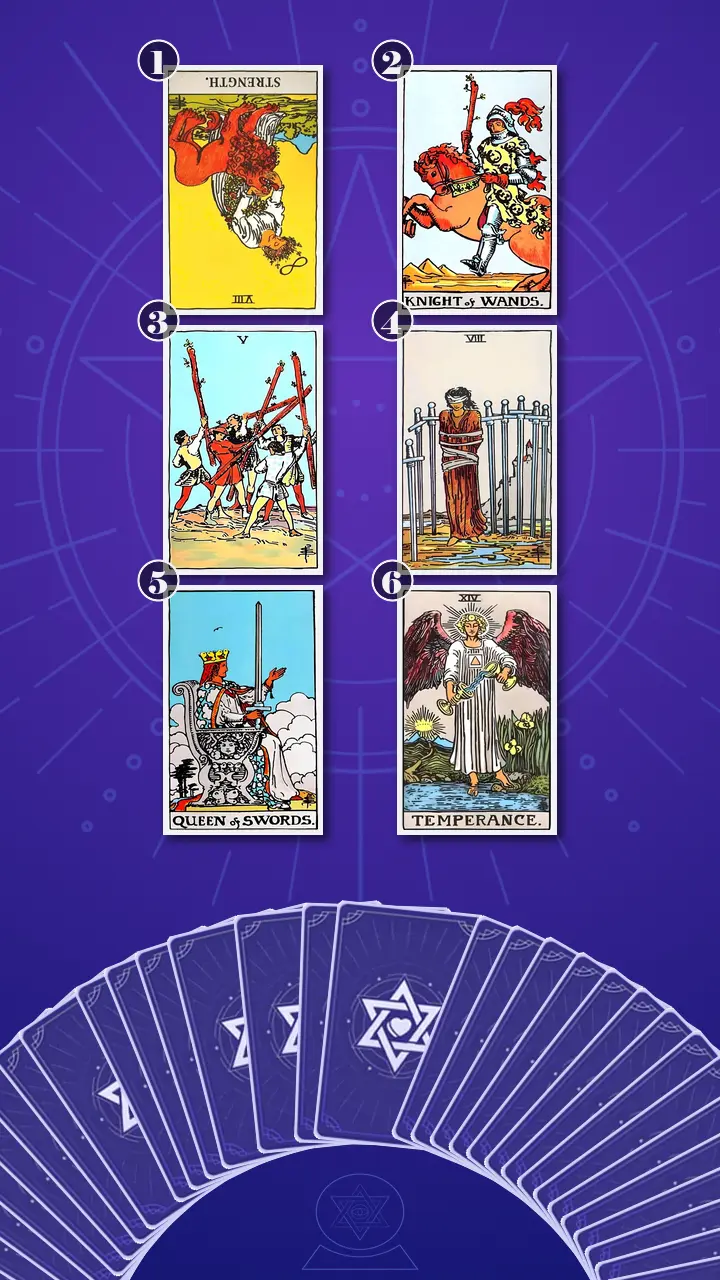
Reading the Map: A 6-Card Relationship Spread for a Boundary That Holds
Position 1: Your in-the-moment reaction (the visible boundary wobble)
I turned over the first card. “Now opened is the card that represents your in-the-moment reaction when shots are pushed—the body-level reflex before your ‘ideal self’ shows up.”
Strength, reversed.
In the Rider–Waite image, Strength is a woman with a gentle hand on a lion’s mouth—quiet control. Not force. Not drama. Reversed, that same energy turns inward and becomes hesitation: the moment you know your decision is solid, but you don’t trust it will be received, so you start managing other people’s comfort first.
“This,” I said, tapping the card lightly, “is the exact shot-glass moment: holding the glass with a tense smile, trying to look relaxed while your mind races for a ‘valid’ excuse. You can feel your boundary, but you don’t fully trust it will be accepted—so you manage the vibe instead of stating the line.”
Hannah gave a small laugh that had no joy in it. “That’s… brutal. Like, yes. It’s like my brain goes, ‘Say something normal.’ Then, ‘Make it funny.’ Then, ‘Don’t make it a thing.’”
Her shoulders rose like she was bracing for impact, even in my quiet room. I nodded. “Exactly. And here’s a phrase I want you to keep: A boundary isn’t a speech. It’s a line. Strength reversed isn’t weakness—it’s your system going into ‘appease’ mode when you feel watched.”
Position 2: Your friend’s energy (what they’re doing, not diagnosing why)
“Now opened is the card that represents your friend’s current energy and how they’re approaching the interaction—camera description, not therapy diagnosis.”
Knight of Wands, upright.
This is bold, hyped, momentum-first energy. The raised wand, the forward-leaning horse—it’s the friend who treats shots like the headline of the night. Not necessarily malicious. Often just loud enthusiasm with terrible consent-checking.
“This is the person who waves the bartender over, announces ‘shots for the table,’ and assumes everyone’s on the same page because the vibe is high,” I said. “They read hesitation as playful resistance, like it’s a cue to persuade harder.”
Hannah’s mouth tightened, then relaxed. “That’s literally him. He’s like… if the energy dips for one second, he panics.”
“Right,” I said. “And here’s the crucial distinction: their urgency is not your obligation.”
Position 3: The pressure mechanism (where the push hooks you)
“Now opened is the card that represents the social-pressure mechanism—where this actually hooks you: group dynamics, teasing, momentum.”
Five of Wands, upright.
In real life, this card is a room where five people are swinging sticks at once: not a private question, but a public pile-on. It’s the bar circle where one person chants “shots shots,” another is already filming a Story, someone else jokes, “Are you pregnant?” and suddenly your nervous system is handling five inputs at once.
“This is why it feels impossible to respond,” I told her. “It’s like you have multiple tabs open—five Slack pings while you’re trying to write one email. The content isn’t hard. The interruptions are.”
Hannah’s eyes widened in that sharp, immediate recognition. “Yes. It’s not even just him. It’s… everyone chiming in.”
“Exactly. So you stop personalizing it,” I said. “This isn’t ‘I’m bad at boundaries.’ This is ‘the group game is set up to reward performative belonging.’ You don’t have to win the game. You can step out of it.”
Position 4: What’s underneath (the deeper driver under your hesitation)
“Now opened is the card that represents what’s underneath your hesitation—the belief or fear that makes this feel high-stakes beyond the drink.”
Eight of Swords, upright.
The blindfold. The loose bindings. The swords that look like a trap, but aren’t airtight. This is analysis paralysis with a social filter: seeing ten ways it could go wrong and zero ways it could go neutral.
“This is the mental tunnel where you believe you have only two options,” I said: “drink to stay included, or say no and become the awkward one.”
Hannah swallowed, and I saw that tight-throat sensation return like a muscle memory. Her fingers curled around her glass, then loosened. A three-step reaction chain moved through her: a small freeze in her breathing, a faraway look like she was replaying a specific night, then a quiet exhale.
“I literally think,” she admitted, “if I’m direct, they’ll think I’m judging them. Or they’ll ice me out. Like I’ll be… outside the group.”
“That’s the core bind,” I said softly. “And it’s why your no-drink boundary turns into overexplaining. Your nervous system is trying to buy belonging with extra context.”
I let my own inner flashback flicker—standing on a cruise deck during a loud sail-away party, music shaking the railings, a guest insisting someone ‘has to’ drink champagne for the moment. On ships, we learned to separate celebration from compliance. The ocean taught me this: waves don’t stop because you negotiate with them. You choose how you stand.
When the Queen of Swords Held the Room
I turned the fifth card slowly. “We’re opening the key position now—the one that shows the clearest boundary language and communication stance to adopt.”
Queen of Swords, upright.
Her sword is upright: one clean decision. Her gaze is steady. Her open hand is both stop and we can still connect. This isn’t coldness. It’s clarity with a spine.
“In modern terms,” I said, “this is you saying, clearly and calmly: ‘No shots for me tonight.’ No extra details. Then you move the night forward with a redirect—‘Tell me about your week’—and you let any awkward silence sit there without rushing to rescue it.”
And then I shifted into one of my core tools—what I call Social Role Switching. “Hannah, you’ve been trying to do this in one mode: the Supportive Mode—being agreeable, funny, smoothing everything. That mode is brilliant for comforting friends. It’s not built for a boundary under spotlight pressure.”
“The Queen of Swords is your Assertive Mode,” I continued. “Not aggressive. Assertive. It’s the part of you that can hold the line without negotiating. And here’s the trick: you don’t stay in Assertive Mode all night. You switch in for ten seconds, deliver the line, then switch back into warmth.”
The room went oddly quiet for a beat—like even the city outside had paused to listen.
Setup: Hannah was stuck in that exact moment she’d described—shot glass landing like a verdict, brain speed-running excuses while her face tried to look “normal.” Her fear wasn’t the alcohol. It was the imagined social consequence: being branded difficult, boring, not part of the group.
Delivery:
Stop searching for the perfect excuse and start drawing one clean line, like the Queen of Swords holding her blade upright.
I didn’t rush to explain it. I let it hang in the air—clean, almost inconveniently simple.
Reinforcement: Hannah’s reaction came in layers. First, her eyes widened and held, like she’d been caught between wanting relief and wanting an escape hatch. Then her jaw unclenched in a way that looked almost unfamiliar to her. Her shoulders dropped a fraction, and her mouth opened as if to speak—then closed again. Finally, a breath left her chest with a tiny shake, not quite a laugh, not quite a sigh.
“But…” she started, and there it was—her reflex to add a clause. Her reflex to upgrade the reasons. The old Terms & Conditions popup.
I held her gaze, calm. “Notice the ‘but.’ That’s the negotiation reflex. Your body is asking for a permission slip.”
Her fingers hovered above the edge of the table, then settled flat, grounding. “So I just… say it,” she whispered. “And don’t add anything.”
“Yes,” I said. “Because clarity is kinder than negotiation. Negotiation teaches people they can keep trying. Clarity teaches them where the line is.”
I offered her a concrete drill, because insight without practice evaporates in a loud bar. “Before your next night out, do a 7-minute ‘One-Line No’ drill: open Notes, write your exact sentence—‘No shots for me tonight—I’m good with this.’ Set a two-minute timer and say it out loud five times with the same calm tone. Then practice one follow-up redirect question—‘How was your week?’—three times. If your throat tightens, hand on your chest, one slow breath, and you stop early. The goal isn’t to force confidence. It’s to make the sentence available under pressure.”
Then I asked, exactly as I always do when a breakthrough lands: “Now—with this new lens—think back to last week. Was there a moment when this would’ve changed how you felt?”
Hannah stared past my shoulder for a second, eyes unfocusing like she was rewinding a clip. “Yes,” she said. “When he put the shot in front of me and I picked it up. I could’ve just left it there. I didn’t have to… hold it like a prop.”
“That’s the shift,” I told her. “This isn’t just about what to say when someone hands you a shot and everyone is watching. It’s your nervous system moving from tense people-pleasing under social pressure to calm self-respect with a clear, repeatable no.”
Position 6: How to sustain it (systems, pacing, and environment support)
I turned the last card. “Now opened is the card that represents how to sustain the boundary through practical support—rituals, pacing, environment choices, allies.”
Temperance, upright.
The angel pours between two cups. One foot on land, one in water. This card is about integration—making your boundary normal and supported, not constantly defended.
“Temperance is what I call boundary infrastructure,” I said. “It’s boring on purpose, effective in practice. It’s the soda with lime. The NA Guinness. The choice to stand near the end of the table so you can move. It’s the pause button in a playlist that keeps auto-queuing hype tracks.”
Hannah nodded, then hesitated. “Okay, but… what if I genuinely can’t get a word in? It’s loud. People are talking over each other. I barely have five seconds, let alone five minutes to do some calm script thing.”
There was our practical obstacle—real life, not the ideal version of it. I leaned in slightly, warm but direct. “Perfect,” I said. “Then we make it smaller. Temperance isn’t about making the room quiet. It’s about changing the conditions so your boundary can run without crashing.”
I offered one more tool from my cruise-ship years—my Maritime Social Protocol. “On ships, we used to handle loud, celebratory guests with a simple rule: you match the warmth, not the speed. You don’t race their hype. You slow your own tempo.”
“So when the shot arrives, you do three things—tiny, almost invisible,” I said. “Make eye contact. Slow your speech. And deliver one sentence. That’s it.”
The One-Page Boundary Plan: Broken-Record Calm + Soda-in-Hand System
I pulled the whole spread together for her like a short story with a clear plot, because that’s what our minds can hold under pressure.
“Here’s what the cards say is happening,” I summarized. “When the shot glass appears, Strength reversed shows you wobble—not because you don’t know your choice, but because you start managing everyone’s comfort. Your friend, Knight of Wands, brings hype and momentum and treats resistance like banter. Five of Wands makes it a group sport—multiple people, multiple comments, a mini-performance. Underneath, Eight of Swords is the belief that a direct no risks belonging, so you feel trapped and overexplain. The way through is Queen of Swords: one clean line, repeated calmly without new reasons. And Temperance keeps it sustainable: systems, pacing, and environment choices so you’re not white-knuckling all night.”
“Your cognitive blind spot,” I added, “is thinking you need a perfect reason for your no to count. But every time you upgrade your reasons, you teach people your no is negotiable.”
“The transformation direction is simple,” I told her, “and I mean simple in the best way: from overexplaining and negotiating to stating a no once, then repeating it calmly without adding new reasons.”
Then I gave her next steps—small enough to actually do, specific enough to work the next time someone pressures you to do shots.
- Pin the One-Line NoIn Notes, save and pin: “No shots for me tonight—I’m good with this.” Use it verbatim next time you’re at a bar, a work social, or anywhere a round appears.Expect your brain to demand a “better reason.” Label it: “negotiation reflex.” Keep the sentence short on purpose.
- Use Broken-Record Calm (no upgrades)If someone presses, repeat the exact same words once—same tone, same face. After the second time, switch to a redirect: “Cheers—how’s your week been?”Let the silence do the work. If you fill the gap with explanations, you reopen the debate.
- Build Temperance InfrastructureOrder a non-alcoholic drink early (before the shots moment) and keep it in your hand. Choose a seat/spot near the end of the table or closer to the bar so you can move without announcing it.“Soda-in-hand is not a personality. It’s a system.” Empty hands invite props; a drink in hand reduces the spotlight moments.
Before we finished, I gave her one ready-to-use script from my toolkit—designed for when colleagues or friends overstep, without making it a speech: “Make eye contact, slow your speech, and say: ‘I need you to drop it—no shots for me.’ Then redirect.”

A Week Later: The Quiet Proof
A week later, Hannah messaged me on a Tuesday afternoon—one of those ordinary London days where the sky can’t decide what it’s doing. “Went out,” her text said. “He did the shots thing. I said my line. He pushed once. I repeated it. Then I asked about his new job. It was… fine. I stayed present.”
She added one more line: “I still felt a tiny wobble after, like—what if they secretly think I’m boring? But I didn’t spiral. I went home and didn’t replay it for an hour.”
That was the proof I care about. Not perfection. Not a magically respectful friend group overnight. Just the first clean line drawn without scribbling over it.
When I look back on our session, I think of the spread’s movement like a night-out soundtrack: hype track (Fire) → pause/breath (Air) → steady groove (Temperance). And I think of the real journey underneath it: from tense people-pleasing under social pressure to calm self-respect with a clear, repeatable no.
When the shot glass shows up, it can feel like you’re choosing between being liked and being honest, and your body tightens because you’re trying to keep belonging without betraying yourself.
If you let your “no” be one calm sentence—no justification—what might you notice you finally have energy to enjoy in the night again?