From Default Host Resentment to Mutual Plans: A Boundary Text That Holds

The Friday Text That Lands Like a Shift
If you’re the “reliable one” in a Toronto friend group and the Friday text always lands on “We can just come to yours, right?”—welcome to Default Host Syndrome.
Taylor (name changed for privacy) slid into the chair across from me with the careful posture of someone trying not to take up too much space. They were 28, a UX designer, and their whole vibe said: I can make this easy for everyone. Even now.
They described a moment I’ve heard in a hundred variations, but theirs was painfully specific: 6:12 p.m., condo elevator, fluorescent lights humming, tote bag strap biting into one shoulder. Phone buzzes—“Your place?”—and their chest tightens like they’re already late for something… except it’s their own evening.
“I don’t mind hosting,” Taylor said, staring at the little scratch on my table as if it could answer back. “I just hate that it’s assumed. And the second I push back, my brain goes full courtroom. Like I need exhibits and witnesses to prove I’m not a bad friend.”
I watched their shoulders creep up toward their ears, that braced, pre-conflict posture people get before anything has technically happened. Resentment, in their body, looked like holding a heavy door open with one hand while smiling through their teeth.
“You want closeness and ease,” I reflected, “but you’re scared that setting a boundary will make you seem difficult—less liked—so you end up hosting by default.” I softened my voice. “And for the record: your apartment is allowed to be a home, not a venue. Let’s make a map through the fog and find some clarity.”

Choosing the Compass: The Five-Card Relationship Spread
I’m Luca Moreau—Paris-trained perfumer turned intuitive consultant—and I’m very literal about environments. In fragrance, a tiny imbalance can ruin the whole composition. In friendships, it’s the same: one person always “adding the base notes” (space, snacks, cleanup) while everyone else just arrives for the top notes (fun, ease) eventually makes the whole thing sour.
I asked Taylor to take one slow breath—not as a mystical ritual, just a nervous-system reset—and to hold the question in plain language: They only want to hang at my place—what boundary do I set? Then I shuffled, slow and steady, until the cards felt like they’d stopped fighting my hands.
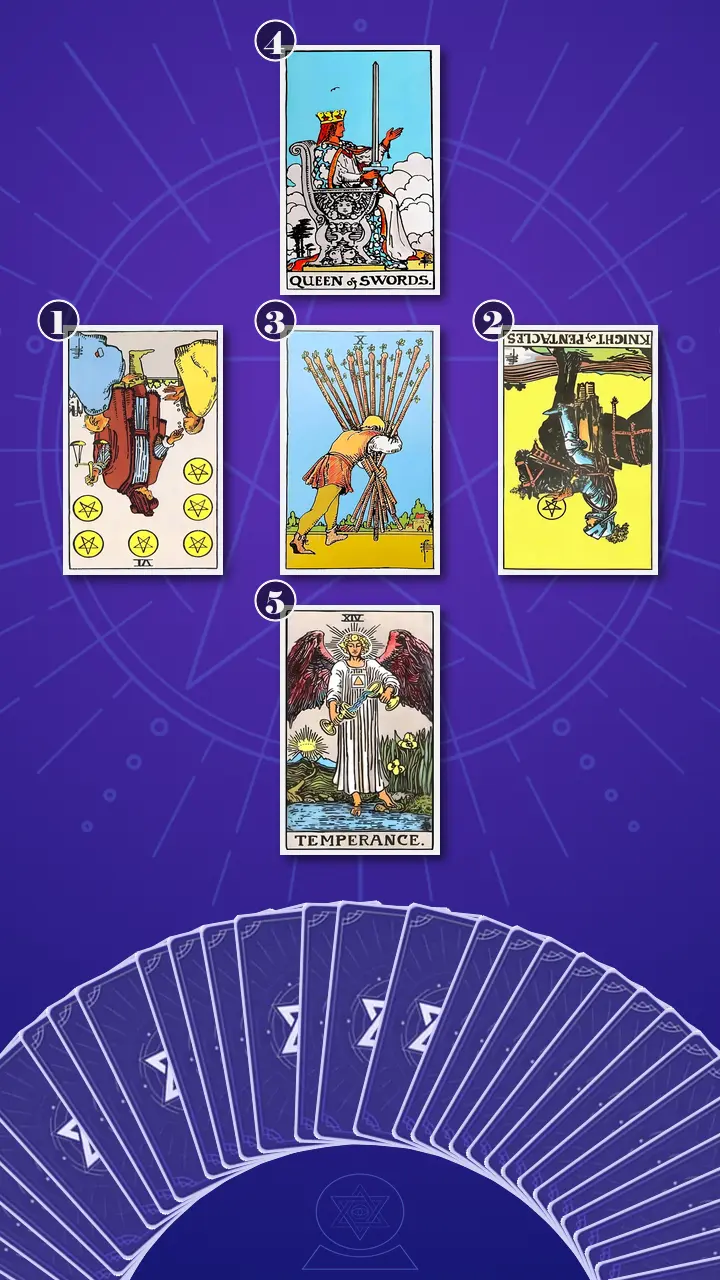
For this, I chose a simple Five-card Relationship Spread—a relationship tarot spread for friendship boundaries in a five card cross. It’s the smallest layout that still tells the whole truth: you / them / the dynamic / the boundary / the integration. No dramatic predictions. Just structure—because when you’re stuck in decision fatigue, structure is mercy.
I pointed to the positions as I laid them down. “This left card is how you’re showing up and what it’s costing you. The right card is their pattern—without mind-reading. The center is the real engine of the whole ‘only at my place’ routine. The card above it is the boundary to set—clean language. And the last card shows what a sustainable rhythm could look like once you actually stick to it.”
Reading the Map: Who’s Giving, Who’s Coasting, Who’s Carrying
Position 1 — You right now: the cost you’re paying in silence
“Now we turn over the card that represents You right now: the specific way you’re showing up in this hosting pattern and what it’s costing you.”
Six of Pentacles, reversed.
I nodded toward the image’s scales—an ancient symbol that still feels painfully modern. “This card is reciprocity. Reversed, it’s an uneven exchange that’s disguised as generosity.”
And I gave Taylor the exact translation the card was already speaking in their life: “You’re replying in the group chat like it’s no big deal, but your body already knows the bill is coming: a grocery run for snacks, a quick tidy that turns into a full reset, and the subtle loss of privacy in a small apartment. You don’t even ask for help because you don’t want to seem ‘transactional,’ so you pay in silence and call it being chill—until resentment starts showing up in your tone.”
“If you tracked it like a budget,” I added, keeping it grounded, “would it still feel ‘chill’? The $18 in snacks. The 35 minutes of cleaning. The next-day brain fog because your WFH space got disrupted.”
Taylor’s reaction surprised me—not a nod, not a quiet “yep.” They let out a small laugh that sounded like it caught in their throat on the way out. “That’s… wow. That’s mean,” they said, half-smiling. “Like, accurate-mean.”
“It’s not mean,” I said gently. “It’s specific. Resentment gets loud when your needs stay vague. This card is asking you to name the real cost—so you can set a limit without turning it into a moral trial.”
Position 2 — Them right now: convenience inertia (without villainizing)
“Now we turn over the card that represents Them right now: the pattern of effort, convenience, or expectation they’re bringing—without assuming intent.”
Knight of Pentacles, reversed.
“Upright, this Knight is consistency and follow-through,” I explained. “Reversed, it’s inertia—effort that never initiates. Not necessarily cruelty. Just a routine optimized for what’s easiest.”
I anchored it in the lived scenario: “When you suggest anything that requires planning—someone else hosting, picking a bar, booking a table—your friends get vague, slow, or ‘down for whatever.’ But the second you offer your place, they’re suddenly decisive and on their way. It’s not proof they’re malicious; it’s proof the routine is optimized for what’s easiest, and nobody has had to adjust because you’ve been carrying it.”
Taylor stared at the card, then at their phone face-down on my table, like it might light up with another “your place?” any second. Their jaw flexed once—irritation, yes, but also grief for how long they’d been making this easy.
“The question here,” I said, “isn’t ‘Are they bad friends?’ It’s: what effort shows up when it’s clearly requested, not silently hoped for?”
Position 3 — The dynamic: the hangout only works because you overfunction
“Now we turn over the card that represents The dynamic: what the ‘only at my place’ routine is really about.”
Ten of Wands, upright.
I didn’t rush this one. “This is the hidden load. Over-responsibility. The cost of always saying yes.”
Then I spoke it in the only language that lands: “The hangout ‘works’ because you do: you pre-clean, you host, you smooth over awkwardness, you make sure there are drinks, you reset the space afterward. Even while everyone’s laughing, a part of you stays on duty. You’re not mad because you hate your friends—you’re mad because your home is no longer restorative, and your yes has become a weight you carry.”
I used the cinematic contrast I rely on when someone needs to feel seen without being shamed: “The hangout starts… and your shift starts.” Trash bag in one hand. Clorox wipe in the other. Uber Eats order thumbed in like a reflex. And the inner monologue that flips mid-clean: If I don’t do it, who will? → Why am I the only one doing it?
Taylor exhaled so long it was almost a sigh of surrender. “Yeah,” they said quietly. “I’m literally collecting empty cans like a server while everyone’s laughing. And then I’m mad at myself for noticing.”
“If the plan only works because you overfunction,” I said, “it’s not a plan—it’s a burden.”
When the Queen of Swords Spoke: The Sentence That Redraws the Terms
Position 4 — The boundary to set: clean language, clean edges
“Now we turn over the card that represents The boundary to set: the clearest language/limit that addresses the imbalance without over-explaining.”
The room felt quieter when I flipped it—like the air itself was waiting.
Queen of Swords, upright.
“This is the boundary-setter,” I told Taylor. “Not cold. Not cruel. Just precise. A raised sword is a clean limit. An open hand is fairness: options, not punishment.”
I gave them the modern translation the card demanded: “You send the kind of text that doesn’t spiral: ‘I can’t host this week, but I’m down to meet at a café or I can come to yours.’ No apology essay. No pre-emptive defense. Just a clear boundary and a real alternative.”
Then I brought in my own lens—the one that makes my readings mine. As a perfumer, I do what I call a Relationship Vitality Assessment: I pay attention to what happens when two “scent profiles” share a space. Not just perfume—energy, expectation, who adjusts, who doesn’t. When a friendship is healthy, it leaves a room feeling lived-in, not taken-over. When it’s imbalanced, the air after people leave tells the truth: candle + disinfectant combo (the unofficial scent of hosting stress), plus a lingering note of someone else’s perfume like proof your space wasn’t yours that night.
Taylor’s eyes flicked up at that—fast—because it was exactly their reality. “I literally stand there after they leave and I’m like… why does it still smell like them?”
That was my setup, because I could feel where their mind always went next: into rehearsal loops, editing until “safe,” trying to earn permission to have a limit. They were stuck in the belief that boundaries equal conflict, and conflict equals losing belonging.
Stop trying to be the endlessly flexible host—pick up the Queen’s sword of clarity and let one simple sentence redraw the terms.
For a beat, Taylor froze—breath held, fingers hovering near their phone like they could almost feel the “send” button under their thumb. Then their gaze went slightly unfocused, like a memory replay: the group chat, the instant “sure!”, the speed-cleaning before confirmation. Finally, their shoulders dropped a fraction, as if their body believed the sentence before their brain fully did.
“But if I say it that plainly,” they blurted, and there it was—brief anger, brief resistance—“doesn’t that mean I’ve been doing this wrong the whole time?”
“It means you’ve been doing what works in the short term,” I said, steady. “And now you’re ready for what’s sustainable.”
I leaned in, voice kind but crisp—the way a clean citrus note cuts through heaviness. “A boundary doesn’t need a courtroom-level justification—just a clear sentence and a real alternative that keeps your home feeling like yours.”
“Now,” I asked, “with this new lens—can you remember a moment last week when you felt that braced feeling in your chest? A moment where one clean sentence could have changed your whole night?”
Position 5 — Integration: a rhythm that makes connection breathable again
“Now we turn over the card that represents Integration: what a sustainable hangout rhythm can look like once you communicate the boundary.”
Temperance, upright.
I smiled, because Temperance is the card I secretly trust the most. It’s not dramatic. It’s repeatable. “This is the alchemist,” I said. “The careful pour between two cups. Not all-or-nothing. A system.”
I let the card speak in modern life terms: “After the boundary is stated, the goal isn’t a dramatic standoff—it’s a new rhythm. Maybe it’s a simple rotation (yours once a month, theirs once a month, one neutral plan), or a default rule like ‘we meet out unless someone explicitly offers to host.’ Over time, the hangout becomes mutual again because the system makes effort visible and shared, not assumed and hidden.”
Taylor nodded, slower now. Their body looked less like a clenched fist and more like someone considering options—actual options.
From Insight to Action: The Queen of Swords Text, Plus a Real System
I pulled the whole spread into one clean story, the way I’d balance a formula on a scent blotter: the opening note, the heart, the base. “Here’s why this keeps happening,” I said. “You’re showing up as the giver in a reversed Six of Pentacles—generosity with strings you never meant to attach, because the ‘string’ is pressure. They’re showing up as a reversed Knight of Pentacles—convenience inertia. Then the Ten of Wands sits in the center: the hangout only works because you’re carrying it. The Queen of Swords is the intervention—clear language. Temperance is what makes it last: a repeatable rhythm that replaces autopilot.”
“Your cognitive blind spot,” I added gently, “is believing you need the perfect wording to avoid conflict. But over-explaining is still negotiating against yourself in the group chat. The shift is simpler: stop hinting and over-accommodating, and offer a clear, limited menu of options—what works, what doesn’t, and what you’re available for.”
Then I gave Taylor actionable advice—small enough to do, strong enough to change the pattern.
- The One-Line Boundary (Copy/Paste)In the next invite, send: “I’m not up for hosting tonight, but I’m down to meet at [specific café/bar] or I can come to yours.”Read it out loud once. If it sounds neutral out loud, it’s neutral in text. One friendly tone marker max (“Hey!”), then stop.
- Add One Logistics Rule (Only If Needed)If your place truly is on the table sometimes, add: “If we’re doing my place, I need 24 hours’ notice.”Rules are easier to repeat than reasons. Repeat the same sentence for two invites before you ‘improve’ it.
- The Two-Option Hosting TestFor one week, only offer (A) their place or (B) a neutral spot—no third option that’s your apartment. If they go vague, reply once: “Want to pick between those two?” then stop filling the gap.Treat it like a low-stakes experiment, not a moral test. Watch behavior, not promises.
Before we ended, I layered in one of my own strategies—not to make it “woo,” but to make it easier for Taylor’s body to cooperate with the boundary. “When you send that Queen of Swords text,” I said, “choose a ‘signature scent’ you associate with being yourself—clean, calm, not apologizing. It’s first impression management, but the impression is for your nervous system. A tiny sensory anchor that says: I’m allowed to have preferences.”
“And if you do host sometimes,” I added, “use a quick space-clearing reset afterward: open a window for two minutes, change the room’s scent back to you, and do a 10-minute reset—no heroic cleaning. Your home learns from repetition too.”

A Week Later: The Quiet Proof of Mutual Plans
Six days later, Taylor messaged me a screenshot—cropped tight so no one’s names showed. The group chat had the familiar prompt: “Your place?” And Taylor’s reply, clean and almost shockingly calm: “Not up for hosting this week, but I’m down to meet at Pamenar or I can come to yours.”
Someone responded, “Down—Pamenar works.” Another friend: “I can grab a table.” No drama. No trial. Just a plan that didn’t require Taylor’s apartment to pay the price.
In the small bittersweet afterglow, Taylor told me they still woke up the next morning with the reflexive thought—What if I made it weird?—but this time they noticed it, exhaled, and laughed a little. Their living room smelled like their own detergent and candle again, not like bleach and other people’s perfume.
That’s the real Journey to Clarity: not certainty, but self-respect you can repeat. From resentful bracing and guilt-driven over-accommodating to calm self-respect and mutual, sustainable connection—one clean sentence at a time.
When your home becomes the default plan, you start bracing for hangouts like they’re a shift you have to staff—wanting closeness, but quietly scared that one honest “I can’t host” will cost you belonging.
If you didn’t have to earn permission to have a limit, what’s one simple option you’d offer next time—your Queen of Swords sentence—so connection can stay mutual without your apartment paying the price?