From People-Pleasing DD to Fair Nights Out: One Clean Sentence at 6 PM

The Heater on Low Outside London Bridge
If you’re the 20-something in London who texts “I can drive” in the WhatsApp before anyone even asks—then spends the whole night in low-level resentment while everyone else is on their third round.
Jordan said it like it was a confession, not a fun fact.
We were on a video call—my side of the screen was a tiny Tokyo flat with a star chart pinned behind me (a leftover prop from my day job at the planetarium), hers was a London kitchen with a half-burnt candle and a hoodie hanging off a chair like it had given up. Outside her window, the streetlight made a pale rectangle across the counter.
“It’s always the same,” she told me, thumbs worrying the edge of her mug. “We’ll be near London Bridge or Shoreditch or wherever, and I’m in my car with the heater on low, bass thumping through the windows from the pub. I’m refreshing WhatsApp, typing ‘I’m outside’ again. My phone gets… hot. Like it’s angry at me.”
I watched her jaw set as she said it—tight, held. Her shoulders were creeping upward like a reflex, like her body was already bracing for the moment she’d have to do one more drop-off across Zones 2–4.
“And I don’t even get asked anymore,” she added, and her voice dropped. “I just… volunteer. It’s automatic. I stay sober. Everyone else is on rounds. And somehow I’m the transport app.”
I let that land for a beat. “You’re not the designated driver,” I said softly. “You’re the designated responsibility.”
Her eyes flicked up—recognition, and a little sting.
Under the resentment was something quieter and heavier: the fear that if she stopped being the reliable, easygoing friend, she’d stop being included at all. Like belonging had a price tag, and the currency was petrol, time, and swallowing her own needs.
“Tonight,” Jordan said, “they’re talking about Soho. And my hands are already tense.”
The feeling in her, as she described it, wasn’t just stress. It was like carrying the whole plan like a phone on 3% battery, still pretending you’re fine—still insisting you can take one more call.
“Let’s make this practical,” I told her. “No shaming. No ‘just communicate’ advice. We’re going to map the pattern, find the gravity that keeps pulling you into the driver seat, and get you a clean next step—so you can set a boundary without turning it into a personality makeover. This is a Journey to Clarity, not a trial.”

Choosing the Compass: Celtic Cross · Context Edition
I invited Jordan to take one slow breath in through her nose, out through her mouth. Not as a mystical ritual—just a nervous-system handoff from spiraling in the group chat to focusing on what she actually wanted.
While she breathed, I shuffled. The sound is always grounding to me—like a small meteor shower hitting the same roof, reminding you there’s a pattern even inside the noise.
“For this,” I said, “I want to use a Celtic Cross · Context Edition spread.”
To you reading this: a Celtic Cross is ideal when someone doesn’t need a yes/no answer, but a full chain—what keeps repeating, why it feels morally complicated, what the environment rewards, and what the next workable move is. Jordan’s issue isn’t ‘Should I ever drive?’ It’s ‘Why does it become me by default, and how do I interrupt that default without losing my place in the group?’
This version keeps the classic structure, but I micro-adjust two positions: card 7 becomes “your boundary muscle” (how you handle self-advocacy under discomfort), and card 8 becomes “group dynamics” (the social system and incentives). That matters here, because this is a friend-group algorithm: once a role is assigned, it keeps serving you the same part until you change the inputs.
“We’ll start with the visible burden,” I told Jordan, “then we’ll go beneath it—the rule you’re living by. We’ll also look at the group’s gravity, and then we’ll name the exact communication style that creates a fair plan.”
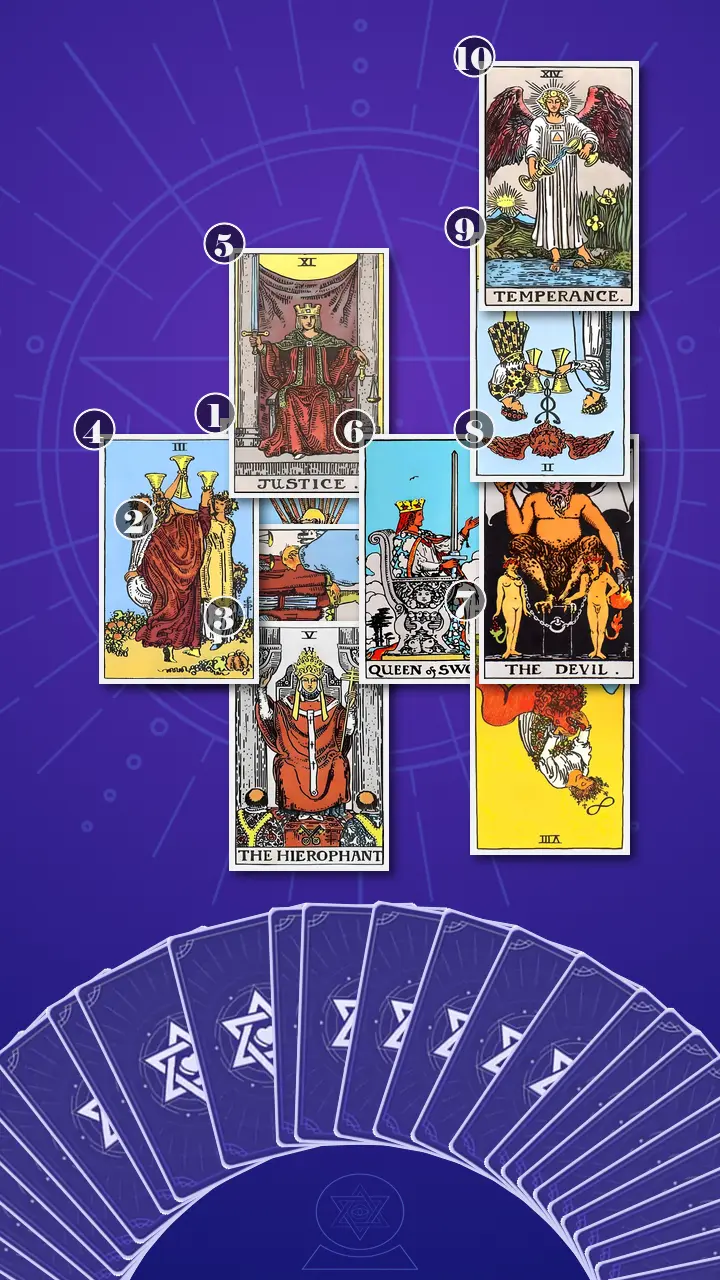
Reading the Map: Where the Night Turns into a Shift
Position 1 — Presenting pattern: the observable designated-driver loop
“Now the card we turn over is representing the presenting pattern: how the designated driver role is showing up right now in observable behavior and emotional load,” I said.
Ten of Wands, upright.
“This is the ‘end-of-night shift’ card,” I told her, and I made it concrete the way I always do. “It’s you staying sober, tracking who’s where, checking parking, timing the exits, then sitting outside texting ‘I’m outside’ like a chauffeuring app—while telling yourself it’s just being a good friend.”
In terms of energy, the Ten of Wands is excess: responsibility taken past the point where it serves connection. The image is so literal it almost hurts—arms full, posture hunched, vision blocked. The more you carry, the less you can see what you want.
Jordan let out a small laugh that wasn’t funny. She looked down at the card, then back at me, eyebrows lifted like she’d been caught on CCTV.
“That’s… too accurate,” she said. “Like, rude.”
“Brutal honesty is a kind of kindness when it points to something changeable,” I said. “And this is changeable.”
Position 2 — The main challenge: what keeps the boundary from being set cleanly
“Now the card we turn over is representing the main challenge: the friction point that keeps the boundary from being set cleanly,” I said.
Six of Pentacles, reversed.
“This is the split-bill-that-isn’t-a-split-bill,” I said. “The imbalance is practical: petrol, parking, time, sobriety. And it’s emotional: you’re being paid in ‘thanks!’ instead of actual shared responsibility.”
Reversed, the energy is blocked: giving and receiving can’t flow cleanly. People start treating the ride as a given, and you start tallying it privately. Out loud: ‘It’s fine!’ Inside: ‘Why am I always paying in time and sobriety?’
I mirrored what I suspected she had in her phone already. “Do you have receipts? Like literal receipts—petrol, parking apps, congestion/ULEZ charges?”
Jordan’s mouth tightened. “I have a photo of a petrol receipt in my camera roll because I… I thought maybe I’d ask people to chip in. And then I felt insane for even thinking it.”
That’s where the resentment becomes precise instead of petty. I could feel it in the room—like the air pressure changing before rain.
Position 3 — Root cause: the internal rule beneath the responsibility
“Now the card we turn over is representing the root cause: the internal rule or belief that makes you default to responsibility,” I said.
The Hierophant, upright.
“This is the unspoken rulebook,” I told her. “The part of you that believes, ‘A good friend makes sure everyone gets home safely,’ as if it’s a code you must follow to stay included.”
The Hierophant’s energy is structured, but it can become over-structured—a value turns into an obligation. You don’t just prefer safety; you feel morally assigned to it. That’s why saying no doesn’t feel like logistics. It feels like breaking a vow.
Jordan swallowed. Her hand went to her chest, almost unconsciously, like she was checking that heaviness she’d described earlier was still there.
“I do say it like it’s… the right thing,” she admitted. “Like if I don’t, I’m being irresponsible.”
“Your values are real,” I said. “But the role you’ve been playing is not the only way to express them.”
Position 4 — Recent context: what reinforced the pattern
“Now the card we turn over is representing the recent context: what social dynamic or experiences reinforced the pattern,” I said.
Three of Cups, upright.
“This matters,” I told her, tapping the edge of the card. “Because this isn’t happening among enemies. There is real friendship here—photos, voice notes, inside jokes, the little rush of being included.”
The Three of Cups is balance when joy is shared. But in your story, it also explains the fear: you don’t want to be the person who changes the vibe. You want to be in the circle—not on the perimeter holding the car keys.
Jordan’s eyes softened. “I don’t want to stop going out,” she said quickly, like she needed me to know. “I just want… to have fun too.”
“Exactly,” I said. “This isn’t a ‘dump your friends’ reading. It’s a ‘stop being the infrastructure’ reading.”
Position 5 — Conscious aim: what you want instead (fairness, respect, shared responsibility)
“Now the card we turn over is representing your conscious aim: what you’re trying to create instead,” I said.
Justice, upright.
The moment Justice showed up, my own brain did what it always does—I flashed back to guiding school groups through a planetarium show about orbital mechanics. Kids always ask why planets don’t crash into the sun. The answer is structure. Balance isn’t a vibe. It’s a system.
“Justice is your permission slip,” I told Jordan. “This isn’t about being colder. It’s about being fair. Fair isn’t mean. It’s just visible.”
Justice’s energy is clarifying. It turns feelings into standards. Receipts into scales. “I’m up for X, not Y.” It also mirrors the Six of Pentacles: the same image of scales, but in your hands now—not in the hands of the dynamic.
Jordan exhaled, small but real, like she’d been holding a breath she didn’t notice. “Wait,” she said. “I’m allowed to treat this like a normal boundary?”
“Yes,” I said. “A fairness policy, not a moral failure.”
When the Queen of Swords Hit ‘Send’
Position 6 — Near-term direction: the most effective boundary-setting approach to try next
I let the room go quieter before turning the next card. Even through a screen, you can feel when a reading reaches its hinge—like the moment in a planetarium when the lights dim and everyone stops whispering.
“Now the card we turn over is representing the near-term direction: the most effective boundary-setting approach to try next,” I said.
Queen of Swords, upright.
“This is the clean sentence,” I told her. “This is you sending one direct message—‘I’m not driving tonight’—and letting it be a complete sentence. Raised sword: clear words. Open hand: you’re still connected.”
Energy-wise, the Queen of Swords is balance in Air: directness without cruelty, honesty without emotional manipulation.
Then I brought in the lens I use when I’m studying how relationships get stuck—my Binary Star System framework. “Friend groups have gravity,” I said. “Not in a mystical way—in a behavioral way. If you keep providing the same stabilizing force, the system can become tidally locked. Like two stars that keep showing each other the same face.”
“So I’m… the same face,” Jordan said, half a question.
“The ‘responsible one’ face,” I said. “And it starts to feel like you don’t have other options, because the orbit has inertia. The Queen of Swords is the moment you add a clean new force: one sentence that changes the orbit. Not by drama. By clarity.”
The Aha Moment (Setup)
Jordan’s mind, I could tell, was already running the familiar movie: her in the car outside the pub again, dashboard light on her hands, WhatsApp open, typing “I’m outside.” Her shoulders tense—and she hasn’t even started driving yet. The fear wasn’t the route. It was the reaction. Someone’s disappointment, and her having to sit in it without fixing it.
The Aha Moment (Delivery)
Not “I’ll drive so everyone stays happy,” but “I’ll speak my limit and let the sword of clarity make space for a fair plan.”
I let the sentence hang for a beat, like a star held in the center of a dome before the projector moves on.
The Aha Moment (Reinforcement)
Jordan’s reaction came in a chain, not a single expression—because real change usually does.
First, a tiny freeze: her breath caught, and her fingers stopped moving on the mug like someone had paused the video.
Then the cognitive seep: her eyes unfocused just slightly, as if she was replaying a dozen nights—typing bubbles appearing and disappearing, the “just one more drink” delay, her own automatic “no worries.”
Then the release: her shoulders dropped a fraction, and she swallowed hard. Her eyes shone, not with tears exactly, but with that bright, uncomfortable truth of being seen.
“But if I say it like that,” she said, voice tight, a flash of anger crossing her face, “doesn’t that mean I’ve been doing it wrong this whole time?”
I shook my head. “No. It means you’ve been doing what kept you safe in the group. You used competence as belonging. That’s not wrong. It’s just expensive.”
I guided her into something extremely practical, because insight without a next step can turn into another form of overthinking.
“Open Notes,” I said. “Write the shortest boundary sentence: ‘I’m not driving tonight.’ Set a 30-second timer. Breathe once. Read it out loud.”
Jordan did it. As she spoke the sentence, her chest visibly tightened—then, a second later, loosened, like her body was learning the difference between danger and discomfort.
“If your chest tightens,” I added, “that’s information—not failure. Optional next step: paste it into a draft WhatsApp message. Don’t send yet. The goal is one small rep of clarity, not a perfect performance.”
This was the shift from her starting state—resentment and tightness—to the first real step toward her desired state: self-respect with connection. Not certainty. Not a guaranteed reaction. Just a clean boundary spoken out loud.
The Loose Chains and the Muscle That Shakes
Position 7 — Your boundary muscle: self-advocacy under discomfort
“Now the card we turn over is representing your boundary muscle: how you relate to self-advocacy and discomfort when you stop over-functioning,” I said.
Strength, reversed.
“This isn’t about you being weak,” I told her. “It’s about your nervous system being trained to keep the peace.”
Reversed Strength is deficiency in steadiness—not in character. It’s that surge of panic when you imagine someone annoyed, and then the old solution shows up: ‘I’ll just drive.’ You downplay your discomfort, laugh it off, say yes while your body is braced… then replay the night later and feel mad at yourself.
“That’s me,” Jordan said quietly. “I always think I’ll be chill, and then I’m… clenched.”
“Strength isn’t controlling the lion,” I said. “It’s holding your fear of conflict gently while still choosing the boundary.”
Position 8 — Group dynamics: the environment and norms that keep you in the role
“Now the card we turn over is representing the group dynamics: the social environment, norms, and incentives that keep you in the driver role,” I said.
The Devil, upright.
“This card gets misunderstood,” I told her. “It’s not ‘your friends are evil.’ It’s: the system rewards the old default.”
The Devil is excess in sticky incentive. A ‘just one more round’ culture quietly assigns someone to manage consequences. And because you’ve been reliable, the algorithm keeps serving you the same role because you keep clicking yes.
“Look at the chains,” I said. “They’re loose. That’s the key.”
Jordan stared at the card. “So if I name it,” she said, “they have to… adapt.”
“Yes,” I said. “And if someone doesn’t, that’s information too.”
I added, gently but clearly: “You can care about safety without being the group’s infrastructure.”
Position 9 — Hope/fear tension: what you want the boundary to protect, and what you fear it will cost
“Now the card we turn over is representing the hope/fear tension: what you most want the boundary to protect, and what you fear it will cost,” I said.
Two of Cups, reversed.
“This is the mutuality test,” I said. “You hope for being met halfway. And you fear that if you stop being useful, the warmth will cool.”
Reversed, the energy is misattuned: you compensate by being extra agreeable, hiding disappointment, trying to buy certainty instead of requesting reciprocity. And there’s a risk on the other side too—keeping score and turning the boundary into debt collection.
Jordan’s voice went smaller. “What if they don’t invite me,” she said, almost like she didn’t want the sentence to exist in the room.
I nodded. “That fear is real. And it’s also exactly why we set the boundary early and cleanly—so you’re not negotiating at 1 a.m., when everything feels like rejection.”
Position 10 — Integration outcome: what sustainable success looks like as a pattern
“Now the card we turn over is representing the integration outcome: what success looks like as a sustainable pattern you can practice,” I said.
Temperance, upright.
Temperance is balance through design. Not heroic rescue. Not all-or-nothing. It’s the angel mixing between two cups: fun and safety, connection and limits.
“This is the plan that gets designed at 6 p.m. instead of rescued at 1 a.m.,” I said. “Rotation. Split rideshare. Earlier leave. A repeatable template.”
Jordan’s shoulders were finally where shoulders belong—not up by her ears. “I like the idea of a system,” she said. “Like… I don’t have to decide every time.”
“Exactly,” I said. “Decision fatigue is part of the trap. Temperance builds a default that doesn’t default to you.”
The One-Page Star Map for Saying No (Actionable Next Steps)
I leaned back and stitched the whole spread into one clear story—because this is how tarot works when it’s useful: it turns a messy emotional loop into a readable system.
“Here’s what I see,” I said. “You’re carrying the night like a Ten of Wands—doing the end-of-night shift while everyone else gets the fun part. The challenge isn’t that you’re ‘too nice’; it’s that the exchange is unbalanced (Six of Pentacles reversed) and it’s been reinforced by a powerful script: ‘a good friend is the responsible one’ (The Hierophant). The environment rewards convenience and drinking culture (The Devil), and your boundary muscle shakes because you’ve learned that someone’s disappointment equals danger (Strength reversed). Underneath it all is the fear that mutuality might not be there (Two of Cups reversed).”
“And the way out,” I continued, “isn’t a perfect explanation. It’s Justice into Queen of Swords: a fair standard, spoken clearly, early—so the system has to adapt. Temperance then turns that one brave sentence into a sustainable pattern.”
The cognitive blind spot I named for her was gentle but direct: “You’ve been treating your boundary like a negotiation you must win with the right wording. But the real move is to state a limit and let other adults solve the logistics.”
“Okay,” Jordan said. Then, immediately: “But I literally don’t have time to do this perfectly. The chat moves fast. If I don’t answer, someone tags me like ‘Jordan can you drive??’”
“Good,” I said. “That’s an actual obstacle, not a personal flaw. So we’ll design a default response that’s faster than your rescue impulse.”
Then I brought in my planetarium brain and my Social Star Map strategy—my way of making boundaries feel like navigation, not confrontation.
“A star map doesn’t argue with the sky,” I told her. “It just tells you what’s happening and helps you plan your route. We’ll do the same with your social week.”
- The Clean Sentence (Copy-Paste Ready)Before the next night out—earlier that day if you can—send one WhatsApp line: “I’m not driving tonight.” Stop there. Don’t justify in the same message.If guilt spikes, do a one-breath pause before hitting send: inhale, exhale, then send the short version.
- One Alternative, Not a RescueOnly if you want, follow with exactly one option: “I’m still in if we do Uber/Bolt and split it,” or “Happy to do a driver rotation—who’s up this time?”Reply once if pushed: “Yeah, I’m not driving tonight—Uber split works for me,” then stop. Let the group solve the rest.
- The “Nights Out Logistics” Template (Temperance in Notes)Create a note titled “Nights Out Logistics” with two paste options: (A) rideshare split, (B) driver rotation. Use the same wording each time so you’re not reinventing the boundary at 11 p.m.When you’re anxious, commit to using the shortest version. One clean sentence beats a thousand silent resentments.
- Your Social Star Map (One-Month Rule)Privately set one rule for the next month: “I drive max once.” Put it in your calendar. Treat it like a transit schedule: you plan around it; you don’t debate it at midnight.If the plan has no transport by a set time, don’t rescue it. Decide your own route (Night Tube, CityMapper plan, taxi, leaving earlier) and communicate your attendance accordingly.
I added one more piece from my toolkit—the Zodiac Gravity Field, my way of identifying the easiest “social match” for a first boundary conversation. “If you’re going to do a 10-minute check-in,” I said, “choose the friend who’s most likely to respond like a grown-up. Not the loudest. Not the most fun. The one with the most stable gravity.”
“And if you notice someone’s warmth suddenly cooling after you set a fair limit,” I continued, “that’s what I call Cosmic Redshift Communication: early signs of distancing. Not to panic you—just to give you data. Your boundary doesn’t create the distance; it reveals what closeness was built on.”

A Week Later: The Quiet Proof
A week later, Jordan messaged me a screenshot.
Her WhatsApp, 6:12 p.m. A friend had typed: “Pub then maybe somewhere in Soho?” The familiar moment where her thumbs used to fly into “I can drive.”
Instead, one line from Jordan sat there—simple, almost calm: “I’m not driving tonight.”
Then, a second message: “I’m still in if we do Bolt and split it.”
Under it: two thumbs-up reactions. Someone else: “Yeah fair, I can’t be bothered with parking anyway.” Another: “I’ll sort it.”
No drama. No exile. Just a system adapting when the default was finally changed.
Jordan’s follow-up text to me was even smaller, and that’s why it mattered: “My chest did the tight thing when I hit send. Then it didn’t. I actually enjoyed the night.”
That’s the real Journey to Clarity: not becoming fearless, but becoming steady—reliability without self-sacrifice, connection without buying your place through labor.
When the group chat lights up and your shoulders tighten, it’s not just about driving—it’s that familiar fear that if you stop being the easy, dependable one, you might stop being chosen.
If you didn’t have to earn your place by being the transport plan, what’s one small limit you’d be curious to name—just once—before the next night even starts?
Every reading at AceTarot is a Journey to connect with inner wisdom and empower next step.
Learn more about our Journey to Clarity.