From Being 'On Call' to Self-Respect: One Small Boundary at a Time

The 9:22 p.m. Autopilot Reply
You’re a 20-something in a major city, trying to protect one quiet evening, and the second you get a “can I vent?” text you type “of course” on autopilot—hello, people-pleasing boundaries.
Alex sat across from me on my studio couch in Toronto, one leg tucked under the other the way people do when they’re trying to look casual while their body is bracing. She told me it usually hits at night—after work, after she’s promised herself a tiny restorative thing—right when the apartment finally goes quiet.
“Wednesday, 9:22,” she said, like she’d replayed it enough times it had a timestamp. “Tiny kitchen. Range hood buzzing. Garlic smell fading. Pasta water boiling over because I’m staring at my phone.”
She mimed the move: phone lights up, eyes lock, thumbs go. “Before I even check my calendar, I type ‘of course.’ And the second I hit send, my chest does this… clamp.” She tapped the center of her sternum. “Jaw too. Like I’m about to get yelled at.”
She wasn’t talking about being busy in a vague way. She meant: plans paused mid-breath. Dinner going lukewarm. A Notion to-do list sitting open like a guilt museum while she rewrites the same supportive sentence three times so she doesn’t sound cold. Then the conversation stretches—voice notes, “I’m here anytime,” more reassurance—until she’s drained and quietly mad at herself for resenting someone she genuinely cares about.
“I don’t mind being there for people,” she said. “I just hate how it eats my whole night.”
I nodded and let a beat of silence do what it always does: make the truth feel safe enough to land.
“Being kind isn’t the same thing as being endlessly available,” I said gently. “And tonight, we’re not here to shame your kindness. We’re here to understand the reflex—what trained it—and then find a way to keep your care without losing your evenings to it. Let’s see if we can turn this into a map. Finding clarity is the goal, not becoming a different person.”

Choosing the Compass: A Celtic Cross for People-Pleasing Boundaries
I asked Alex to take one slow breath and hold the exact moment in her mind: the phone lighting up, the thumbs typing “of course,” the tight chest, the clenched jaw. Not as a punishment—just as a focus point. Then I shuffled, the soft rasp of the cards sounding almost like a metronome, something steady enough to borrow when your nervous system is sprinting.
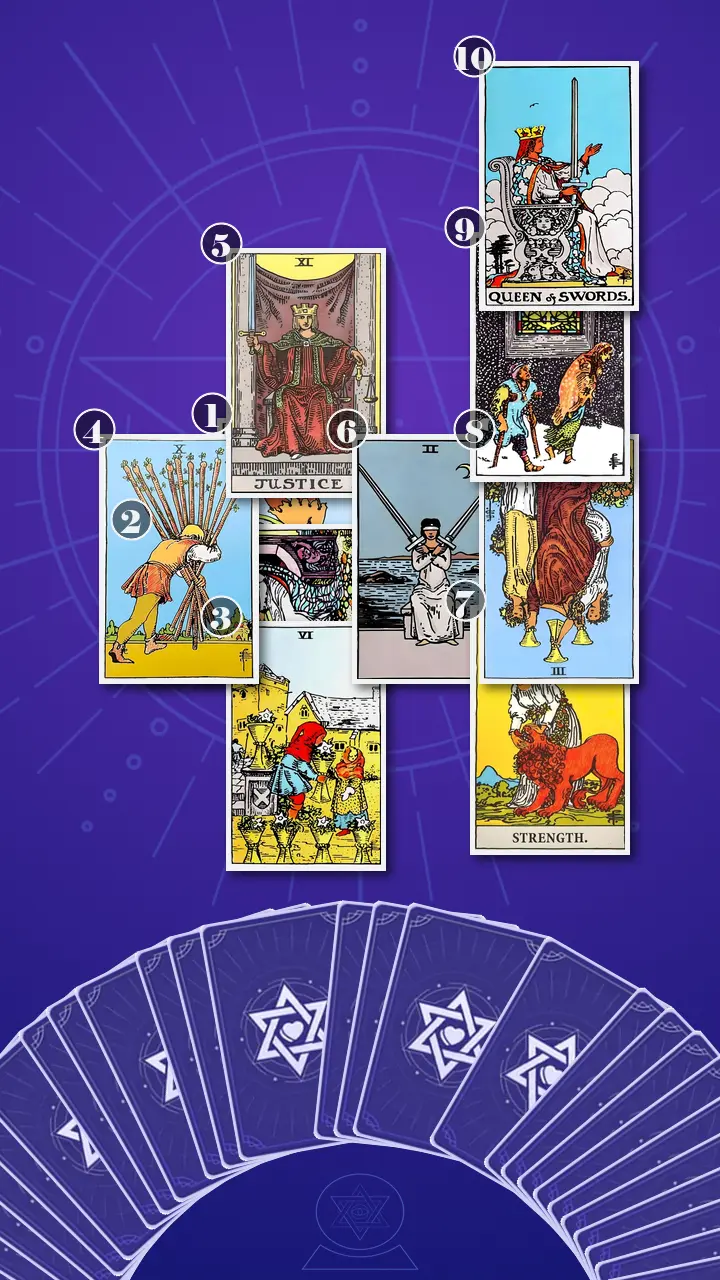
“For this,” I told her, “I’m using the Celtic Cross spread.”
And for you reading this: I chose it because her question isn’t really “Should I say yes or no?” It’s “Why is my yes automatic, and what’s underneath that?” The Celtic Cross is built for tracing a full chain—from the visible behavior, to the emotional obstacle, to the past-based template that taught the reflex, and then into a practical stance that can actually be practiced. It separates the immediate trigger from the deeper conditioning, and it gives us an integrated direction without reducing the issue to a single text message.
I pointed to the layout as I placed the cards. “Card one is the present pattern. Card two crosses it—the main challenge. Card three goes underneath—the root cause. Then we’ll move through what’s been reinforcing this lately, what you’re consciously trying to live by, and the near-term pivot that interrupts the reflex.”
Alex exhaled like she was relieved there would be a structure. Decision fatigue is real—especially when your phone makes other people’s urgency feel like your job.
The Cross: Where the Reflex Starts
Position 1 — Present situation: the immediate pattern that shows up
“Now we turn over the card representing the present situation: the immediate pattern that shows up when the ‘can I vent?’ text arrives,” I said.
Two of Pentacles, reversed.
“This is after work and you’re trying to do normal-life things—cook, laundry, a workout, maybe answer one email—when ‘can I vent?’ hits,” I told her, using the card’s modern translation like a subtitle to her life. “You say yes while already juggling, then your evening becomes constant tab-switching: stove → chat thread → half-listening → rewriting replies. Nothing feels fully done, and you end up paying for it with that heavy, wiped-out crash after you finally put your phone down.”
Reversed, the Two of Pentacles isn’t ‘busy.’ It’s imbalance—energy in a blocked, overloaded state. It’s like having 18 browser tabs open and your laptop fan screaming: nothing fully crashes, but nothing runs smoothly either. Your nervous system keeps rocking between “my life” and “their feelings” until both start to wobble.
Alex let out a small laugh that wasn’t happy—more like a bitter little puff of air. “That’s… cruelly accurate,” she said. “Like, you’re in my iMessage thread.”
“I’m not here to be cruel,” I said, keeping my voice level. “I’m here to be specific. Because specificity is what turns guilt into options.”
Position 2 — Primary challenge: what blocks healthy boundaries
“Now we turn over the card representing the primary challenge: what blocks healthy boundaries or turns support into overextension,” I said.
Queen of Cups, reversed.
“The real obstacle isn’t that you’re ‘too nice,’” I told her. “It’s that your empathy has no container. The moment someone’s upset, your body treats it like your responsibility to stabilize them. You keep soothing, checking in, and polishing your tone so they won’t feel hurt by you having limits. You’re not just listening—you’re absorbing and managing.”
In reversal, this Queen’s gift—emotional attunement—shows up as overflow. It’s empathy in excess. A sponge that absorbs the spill fast and totally, then gets left heavy and saturated.
I leaned slightly forward. “I want to show you something. In this card, she stares into an ornate cup. For you, the cup is the screen. The thread. The voice note. The ‘typing…’ bubble.”
And I narrated the loop the way I’d seen it in hundreds of clients—because it’s not a personal failure; it’s a pattern:
“Draft one is pure empathy: ‘Oh my god, I’m so sorry, that’s awful.’ Draft two is fixing: ‘Okay, here’s what you should do.’ Draft three is the over-apology: ‘Sorry if I’m not responding fast enough, I’m here, I promise.’”
“Compassion gets fused to responsibility-for-their-mood,” I said. “That fusion is the blockage. It’s why your jaw clenches while you type.”
Alex’s breath caught for half a second—like her lungs forgot the next inhale. Her eyes unfocused, not in dissociation, but in recognition—like she was watching herself from the outside, thumbs hovering over the keyboard. Then her shoulders dropped an inch.
“I hate that I do the apology thing,” she murmured. “Even when they didn’t ask for it.”
“That’s your nervous system trying to buy safety,” I said. “It makes sense. It’s just expensive.”
Position 3 — Root cause: the past-based conditioning behind the reflex
“Now we turn over the card representing the root cause: the past-based conditioning or early template that trained the reflex to say yes,” I said.
Six of Cups, upright.
“This points back to an early template,” I told her. “You learned closeness through being pleasant, accommodating, emotionally ‘good.’ Being the sweet, helpful one got rewarded—with peace, praise, connection—so now an adult boundary can feel like breaking a rule you learned before you had language for needs.”
The Six of Cups is tender, not accusatory. It’s a memory of what worked. Saying yes wasn’t random; it was a strategy that once kept relationships safe.
Alex swallowed, jaw working once as if it wanted to clamp again and decided not to. “I was… the easy kid,” she said quietly. “I could tell when my mom was stressed. If I didn’t add to it, things were fine.”
There it was: the origin story of the reflex. Not drama. Just training.
Position 4 — Recent past: what has been reinforcing the pattern lately
“Now we turn over the card representing the recent past: what has been reinforcing the pattern lately,” I said.
Ten of Wands, upright.
“Lately you’ve been carrying too much—work reliability, life admin, social responsiveness—and vent requests stack on top like extra weight you never set down,” I said. “Each new message feels heavier because it lands on an already-full system.”
Upright, the Ten of Wands is sustained load. The energy here isn’t blocked—it’s overextended. You can do it, technically. But it blocks your line of sight. You stop seeing what you need because your arms are full of what everyone else needs.
Alex nodded once, a sharp motion, like a checkmark. “I feel behind even on nights I don’t do anything wrong,” she said. “Because it’s never… complete.”
Position 5 — Conscious aim: what Alex thinks she should do
“Now we turn over the card representing your conscious aim: what you think you ‘should’ do, and the value you’re trying to live up to,” I said.
Justice, upright.
“Consciously, you’re trying to live by fairness,” I told her. “You want to be supportive and also truthful about your limits—because the imbalance is starting to feel wrong in your body.”
Justice is balanced energy—clean, centered. Not cold. Structured. It’s the part of you that knows ‘I matter too’ without villainizing anyone.
As a former Wall Street guy, Justice always flashes me back to a contract on a trading desk: every term explicit, no hidden fees. Fairness isn’t a vibe. It’s a structure you can point to.
“A fair boundary is not cruelty—it’s clarity,” I said, and I saw Alex’s mouth soften like she wanted to believe it.
Position 6 — Near-term pivot: what interrupts the reflex
“Now we turn over the card representing the near-term pivot: the next inner stance that can interrupt the reflex before it becomes a commitment,” I said.
Two of Swords, upright.
“The pivot is a pause,” I told her. “Not a dramatic boundary speech—just a small buffer that stops the automatic yes from becoming a commitment.”
This card’s energy is protective, not aggressive. The crossed swords are a boundary made of time. The blindfold is not denial; it’s choosing not to let someone else’s urgency decide for you.
I turned it into a micro-scene, because that’s how change becomes doable:
“You read the message. You put the phone face down. You set a five-minute timer. One sip of water. One glance at tomorrow’s calendar. And then you reply with a time-container. It’s urgency versus accuracy—and you’re choosing accuracy.”
Alex’s fingers, which had been worrying the cuff of her sweater, went still. She nodded slowly. “I could actually try that,” she said. “Five minutes feels… allowed.”
When Strength Held the Lion with Calm Hands
Position 7 — Self-position (Key Card): the inner strength you can practice
I let the room quiet down on purpose before we turned the next card. Outside, a streetcar bell sounded faintly—one clean note through winter air—like the city itself reminding us: pause is possible.
“Now we turn over the card representing your self-position: how you’re approaching the situation, and what inner strength you can practice to change the pattern,” I said. “This is the core of the reading.”
Strength, upright.
Setup: It’s 9:22 PM, your dinner’s getting cold, and your thumbs have already typed “of course” while your chest tightens—like you’re clocking into an emotional shift you didn’t schedule. You’re caught between wanting to be supportive and fearing that saying no will cost connection, and your body tries to solve the fear by moving faster.
Delivery:
Stop proving closeness by being instantly on-call; practice steady, gentle restraint—like Strength holding the lion with calm hands, not panic.
Reinforcement: Alex’s face did that split-second freeze people get when a sentence hits a part of them they didn’t realize was running the show. First: her breath paused. Second: her gaze drifted off the card and into the middle distance, like she was replaying ten different conversations at once. Third: the emotion landed—her eyes glassed slightly, and her jaw, almost imperceptibly, unclenched.
“But if I don’t respond right away,” she said, and her voice got thin, “it feels like I’m… I don’t know. Failing?”
“That’s the lion,” I said softly. “Not the person texting you. The lion is the panic that says, ‘Prove you belong. Prove you’re good. Prove it right now.’ Strength doesn’t kill that instinct. It holds it.”
Then I brought in the tool that’s become my signature since I left finance—because sometimes business language is the fastest way to make an invisible emotional economy visible.
“In my work I use something I call Influence Credit Scoring,” I told her. “Not to rate people as ‘good’ or ‘bad.’ To rate relational safety—how much a connection can hold reality.”
“A Tier 1 connection can handle: ‘Not tonight, tomorrow at lunch.’ A Tier 4 connection punishes limits with guilt or coldness. When your nervous system is in people-pleasing mode, it treats everyone like they’re Tier 4. Strength is you practicing the truth: some relationships can hold your humanity.”
Alex blinked hard, as if she was forcing tears back into a more manageable shape. “So the point isn’t to become colder,” she said. “It’s to stop… performing availability.”
“Exactly,” I replied. “A calm limit is a form of care—not a lack of it.”
I watched her hands while she processed. They’d been gripping her phone like it was part of her skeleton. Now her fingers loosened, and she set it on the coffee table—screen down—like a tiny act of faith.
“Now,” I asked, “with this lens—steady, gentle restraint—think back to last week. Was there a moment when you said yes instantly, and this could have helped you feel different?”
She nodded. “Sunday,” she said. “A voice note at midnight. I stayed up sending reassurance so they wouldn’t feel alone. And then I couldn’t sleep anyway.”
“That’s the shift,” I said, anchoring it clearly. “This isn’t just about one text thread. It’s moving from guilt-driven compliance toward steadier self-respect—support becoming a choice you make intentionally, not a reflex you perform.”
Position 8 — Environment: the social pressure around boundaries
“Now we turn over the card representing your environment: how friends, social norms, and communication patterns shape the boundary pressure,” I said.
Three of Cups, reversed.
“This is the group chat vibe,” I told her. “Closeness maintained through constant processing—venting becomes the main way the circle stays tight. If you step out, it can feel like stepping out of the friendship itself.”
Reversed, the Three of Cups isn’t ‘no friends.’ It’s co-rumination—togetherness that loops on stress without repair. The energy is stuck in repetition.
Alex made a face like she’d tasted something too sweet. “It’s always ‘holding space’,” she said, using the therapy-speak tone everyone half-jokes about in their chats. “But sometimes it’s just… spiraling.”
“And you feel pressured to participate so you don’t look like the one who doesn’t care,” I said. “That’s not you being broken. That’s a norm you’ve adapted to.”
Position 9 — Hopes and fears: the story underneath the guilt
“Now we turn over the card representing your hopes and fears: what you worry will happen if you say no, and what you secretly hope will be true instead,” I said.
Five of Pentacles, upright.
“This is the belonging scarcity script,” I told her. “One boundary feels like exile.”
The Five of Pentacles is cold street versus warm window. It’s the internal movie where you imagine everyone inside—laughing, close, moving on—and you’re outside, quietly replaced.
Alex’s throat moved like she was swallowing a stone. “I picture them remembering it,” she admitted. “Like, ‘Oh, Alex didn’t show up.’ And then… I don’t know. I drift.”
“That fear makes sense,” I said. “But we’re going to treat it as a hypothesis, not a fact.”
Position 10 — Integration outcome: the healthier pattern you can practice into
“Now we turn over the card representing the integration outcome: the most likely healthier pattern if you practice the key shift,” I said.
Queen of Swords, upright.
“This is you speaking cleanly,” I told her. “Clear, respectful boundaries and honest communication that protects your energy.”
Where the reversed Queen of Cups stared into the screen-cup and got lost, the Queen of Swords looks forward. Her sword is discernment; her open hand is humanity. The energy here is balanced Air: clarity without cruelty.
“It’s a reusable template response you trust,” I said. “Like a well-written out-of-office message for your time and attention. You don’t have to freestyle empathy at midnight.”
The One-Page Boundary Plan: From Insight to Actionable Advice
I leaned back and let the whole spread become one coherent story, not ten separate cards.
“Here’s the chain,” I told Alex. “Right now, you’re in overload and constant context-switching (Two of Pentacles reversed). The main blockage is that your empathy is porous—your body treats their distress like your emergency (Queen of Cups reversed). Under that is an old template: being easy, sweet, available earned closeness (Six of Cups). Lately you’ve been carrying too much already (Ten of Wands), while consciously craving fairness and integrity (Justice). The pivot is the pause (Two of Swords). The antidote is gentle courage—holding the lion without panic (Strength). And the direction is clear language with warmth (Queen of Swords).”
“If your yes is automatic, it’s not a choice—it’s a reflex,” I added, watching her expression shift from shame to something closer to relief.
“Your cognitive blind spot,” I said carefully, “is this: you keep treating immediacy as proof of love. Like your personal algorithm learned, years ago, that instant availability equals belonging. But that’s an outdated model. The transformation direction is updating the algorithm: from ‘automatic yes to earn closeness’ to ‘intentional yes (or no) based on real capacity, delivered with calm clarity.’”
Then I made it practical—because insight without a next step can turn into another thing to overthink.
- 90-Second Capacity CheckBefore you reply to “can I vent?”, open your calendar, glance at tomorrow morning, and rate your energy 0–10. Then send one of two replies: “Yes, I have 10–15 mins now” or “Not tonight—can we do tomorrow at lunch/after work?”If your chest is tight and your jaw is clenched, treat that as data, not guilt. Do the smallest version: wait 2 minutes, then send only the time-container line.
- One Reflect + One Question + PauseInside the vent conversation, reflect one feeling (“That sounds exhausting.”), ask one clarifying question (“What’s the part hitting you the hardest?”), then stop typing and let them respond.Notice the urge to fill silence with extra reassurance. That’s the Queen of Cups reversed trying to manage the mood. Let the pause do its job.
- Save a Kind-No Script (so you don’t reinvent courage)Write and save this in Notes (or a keyboard shortcut): “I care about you. I’m not up for a vent tonight, but I can check in tomorrow. Do you want a quick voice note then?”Use my “Cocktail Party Algorithm” for texts: (1) Care line, (2) Container line, (3) Clean close. Short is kinder than a long apology spiral.
“Pause first. Then choose. Then speak cleanly,” I said, because sometimes you need a sentence you can carry into the moment when your body wants to sprint.

A Week Later: The Quiet Proof
Six days later, Alex texted me a screenshot.
It was a group chat message—someone had written: “can I vent?” Alex’s reply was short and almost shockingly calm: “I care about you. I can do 10 mins right now—do you want support or just to be heard?” Under it, a little timer icon. Under that, after ten minutes: “I’m going to log off for the night. Tomorrow after work?”
Her follow-up message to me was even smaller: “I muted the chat for two hours after. I felt guilty for like… eight minutes. Then I made dinner and it was actually hot when I ate it.”
She added, “In the morning I still had a ‘what if they’re mad?’ thought. But I kind of smiled at it instead of obeying it.”
That’s what a Journey to Clarity looks like most of the time: not a dramatic reinvention, but one clean decision made with your shoulders lowered.
When a simple “can I vent?” makes your chest tighten and your jaw lock, it’s not because you don’t care—it’s because part of you still believes one boundary could put you outside the circle.
If you didn’t have to earn closeness with instant availability, what would your most honest, time-sized “yes” (or “not tonight”) sound like the next time your phone lights up?
Every reading at AceTarot is a Journey to connect with inner wisdom and empower next step.
Learn more about our Journey to Clarity.