When “Low-Maintenance” Felt Like a Verdict: Learning to Ask Cleanly

Finding Clarity in the 10:43 p.m. Group Chat Laugh
If you’ve ever been called “low-maintenance” in a group chat and everyone laughed while you went weirdly silent—welcome to the part where a “compliment” hits like a ranking.
Alex (name changed for privacy) sat down across from me with their phone face-down on the table like it was still warm from the moment. They’re 27, Toronto, early-career marketing coordinator—someone who can make a spreadsheet feel friendly, who can hold space for a friend’s messy breakup, and somehow still apologize for taking up five minutes.
They described it like a time-stamped memory: sweatpants, Sunday night, a shoebox apartment with the CN Tower glow leaking through a narrow window. The radiator clicked on and off like it had opinions. Their group chat was open, and the message was still there: “Alex is so low-maintenance lol.” The chat moved on in 0.3 seconds, reactions stacking like confetti.
“I laughed,” they told me, and I watched their throat work like they were trying to swallow the laugh back retroactively. “Like—did the little ‘haha’ reaction. Because what else do you do?”
Then came the part that sounded painfully familiar in 2026: the Notes app draft titled something like text??, the careful paragraph typed with two thumbs, deleted, retyped, deleted again. And finally, the meme—sent like emotional camouflage.
“I know they probably meant it as a compliment,” Alex said. “But it felt like a summary of why I don’t get chosen.”
Under that one label, I could feel the core contradiction tighten like a drawstring: Alex wanted to be seen as easygoing and lovable—while fearing that having needs would make them “too much,” and therefore not worth showing up for.
The feeling in their body wasn’t abstract. It lived in the tight chest and dry throat they kept touching without noticing, like words were getting stuck at customs on the way out. Shame-tinged hurt, yes—but specifically the kind that feels like you’re standing in a crowded room holding a paper cup that’s quietly cracking in your hand, trying to smile like nothing’s leaking.
I leaned forward, keeping my voice gentle and grounded. “You’re not dramatic for noticing what your nervous system noticed. Let’s make a map of this—so it stops living only as a spiral in your phone. Today is about finding clarity, not proving you’re ‘chill enough’ to deserve care.”

Choosing the Compass: The Four-Layer Insight Ladder Spread
I asked Alex to take one slow breath in through the nose, out through the mouth—nothing mystical, just a clean transition from reacting to observing. Then I shuffled, the soft riffle of the cards sounding a bit like rain against a window on a ship at night—familiar, steady, not here to judge you.
“For this,” I said, “I’m going to use a spread called the Four-Layer Insight Ladder · Context Edition—a four-card tarot spread for relationship self-worth and clean communication.”
To you reading this: the reason I choose it is simple and practical. This situation isn’t really about predicting what the friend “meant.” It’s about tracking how one word triggered a fast drop in self-worth, locating the hidden belief underneath, and turning that insight into one small, doable next step. The ladder layout mirrors real life: a comment lands (surface), a story activates (root), clarity is chosen (shift), and self-respect is practiced (action).
I pointed to the invisible structure we were about to build together:
“The first card is the presenting moment—what you did on the outside and what you swallowed on the inside. The second card goes underneath that: the root belief that turns a casual comment into a verdict. The third is the key reframe and the exact boundary language—two sentences, not a thesis. And the fourth is integration: the embodied posture and the tiny action that helps self-worth become steadier, regardless of the response.”
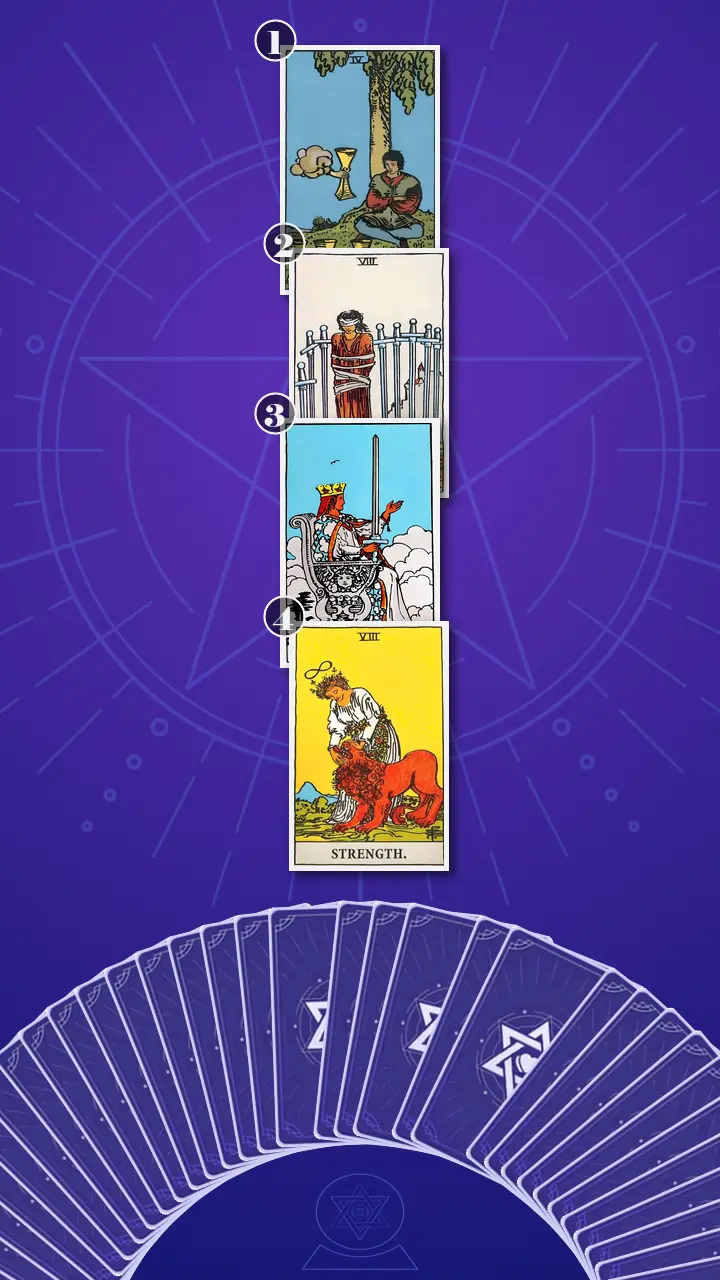
Reading the Map: Four Cards, No More Hiding
Position 1 — The Presenting Moment You Played Cool: Four of Cups (upright)
“Now we’re opening the card that represents the presenting moment: the immediate emotional/behavioral reaction to being called ‘low-maintenance,’ captured in observable relational cues,” I said, and turned the first card over.
The Four of Cups, upright.
I tapped the image lightly. “Crossed arms. Averted gaze. It’s the ‘I’m fine’ posture.”
And because tarot is only useful when it touches the real world, I translated it into the exact modern-life scene: It’s the moment in the group chat when “low-maintenance” gets said, you give a polite laugh, and you instantly switch into neutral mode—then later you realize you weren’t craving ‘more attention,’ you were craving one specific form of care (a check-in, a plan made in advance, a little consideration) that you trained yourself not to ask for.
“Being easy to be around isn’t the same as being okay with less,” I added, watching Alex’s eyes flick down to their hands.
Energetically, the Four of Cups here isn’t dramatic. It’s blocked Water: feelings are present, but withheld. Not because you don’t care—because caring feels risky. You shut the lid fast, so nobody sees what’s inside.
I did a scene-close-up the way I do on cruise decks when someone smiles too hard at a joke that stung: “Out loud, it’s ‘haha, totally.’ In your head, it’s ‘why do I suddenly feel rejected?’ And later—because the moment has passed—you replay it like a clip you can’t stop scrubbing.”
Alex let out a small laugh that didn’t reach their eyes. “Yeah,” they said, voice a little flat. “That’s… honestly a bit brutal. But also exactly it.”
That reaction mattered. It told me we’d hit recognition without shaming—same-frequency resonance. The reading could go deeper.
Position 2 — The Hidden Rule That Turned It Into a Verdict: Eight of Swords (upright)
“Now we’re opening the card that represents the root belief and core fear: the inner rule that makes a casual comment convert into a self-worth verdict.”
The Eight of Swords, upright.
The blindfold. The loose bindings. The swords like a fence you can’t quite see a gate in—until you notice there’s a gap.
I used the phone-screen metaphor because it’s literally how this plays out: You’re staring at a drafted message like it’s a cliff edge: asking feels risky, so you decide silence is safer. You tell yourself you’re being “mature” by not needing anything—when really you’re trying to avoid the one thing you can’t control: a response that might prove you’re not prioritized.
This is Air energy in deficiency-and-excess at once: not enough clear information, but too many thoughts. A mind that turns one label into a full spreadsheet of proof. The Eight of Swords doesn’t say “you are trapped.” It says “you are obeying a rule that feels like truth.”
“Unsent drafts are a form of self-protection—and a slow leak of closeness,” I said softly, not as a scold, but as a description of the mechanism.
Alex’s throat bobbed with a tight swallow. Their shoulders rose a fraction, then held there. “My Notes app is… embarrassing,” they admitted. “It’s like version control. I keep ‘fixing’ it. But I never push the change live.”
That was the bind in one clean sentence: belonging vs dignity. If they speak, they risk being “too much.” If they stay silent, they keep the belonging—on the condition of disappearing.
I let a small piece of my own background surface, the way an honest compass needle shows itself: on transoceanic voyages, I used to train crew in social dynamics—how a single offhand comment at a crowded cocktail hour could ripple for days if nobody repaired it plainly. People thought the ocean was the stressor. It wasn’t. It was the unspoken rules. Here too, the water isn’t the problem. The unspoken rule is.
Position 3 — The Sentence That Protects Your Dignity: Queen of Swords (upright)
“Now we’re opening the card that represents the key reframe and boundary language: how to translate feelings into clarity without self-abandonment or over-explaining.”
The Queen of Swords, upright.
Her direct gaze always changes the room. Even when the room is just a kitchen table and a phone screen that’s been running too hot.
Here’s the modern translation we needed: Instead of a paragraph of softening and disclaimers, you send a clean two-to-three sentence text: you name impact, assume reasonable intent, and make one specific request. You stop auditioning for the ‘cool, easy friend’ role and speak like your feelings are valid enough to take up a line of text.
Energetically, this is balanced Air: thoughts become a tool, not a cage. The Queen doesn’t mind-read. She doesn’t build a case. She states what’s true.
“Clarity is not aggression,” I told Alex. “It’s kindness with edges.”
And I showed them the before/after script, because language is the first lever:
Before (the Notes-app paragraph): a long, careful explanation with escape hatches—“sorry,” “maybe I’m overthinking,” “it’s not a big deal,” “ignore me.”
After (Queen of Swords): “When you called me low-maintenance, it landed like my needs don’t matter. I know you might’ve meant it nicely. Can you check in with me mid-week this week?”
As I read the short version out loud, I noticed the tiniest environmental co-conspiracy: the radiator that had been clicking went quiet for a beat, like the apartment itself paused to listen.
Alex exhaled, slow and surprised. “Wait,” they said. “I could just… say it like that?”
“Yes,” I said. “Two sentences. No courtroom. No audition.”
And this was where I brought in one of my signature tools—not as branding, but as a way to make it immediately usable. “On ships,” I taught what I now call Social Role Switching. Not fake personas—just choosing the right mode for the moment. You’ve been stuck in ‘Easygoing Mode’ so long it’s become a survival reflex. The Queen of Swords is Assertive Mode: clean eye contact, slow speech, one point. You can still be warm. You just stop being vague.”
Alex nodded, but their eyes were shiny with that specific fear: okay, but can I survive the moment after I send it?
When Strength Put a Quiet Hand on the Lion
Position 4 — The Embodied Integration: Strength (upright)
I let my palm rest on the deck for a second. “This next one,” I said, “is the heart of the ladder—the part that makes the insight sustainable.”
“Now we’re opening the card that represents integration and action: the inner posture to practice and the next concrete step you can take this week to rebuild self-worth and relational reciprocity.”
Strength, upright.
In the card, the hands on the lion aren’t fighting it. They’re steady. They’re saying: I can hold this.
Here’s the modern-life scenario in plain language: You make the ask—and then you don’t immediately backtrack. You feel the heat of vulnerability (the urge to add “but it’s fine!”) and you breathe through it. Your self-worth stops being negotiated via silence and starts being protected through calm courage, regardless of whether they respond perfectly.
And I saw Alex’s familiar moment arriving—the one described in their body: the throat tightening like a scarf pulled too snug, the chest bracing for impact as if the “send” button were a trapdoor.
Setup: This is the moment you know too well: the chat moves on, everyone reacts with “lol,” and you’re staring at your screen thinking, “Why did that compliment feel like a verdict?” Meanwhile your throat tightens like you can’t quite find the words without sounding ‘needy.’
Delivery:
Stop trying to earn love by being ‘easy’ and practice gentle courage, like Strength’s quiet hand on the lion.
I let the sentence hang there, the way foghorns hang in sea air—low, unavoidable, meant to keep you from crashing into your own silence.
Reinforcement: Alex’s reaction came in a three-part wave. First, a brief physiological freeze: their breath paused mid-inhale, fingers hovering over the edge of their phone as if they’d been caught doing something forbidden. Second, the cognitive seep-in: their eyes unfocused slightly, like they were replaying a recent moment—thumb hovering over “Send,” the exact second they chose the meme instead. Third, the emotional release: a sound that was half laugh, half ache, followed by their shoulders dropping as if they’d been carrying a backpack they forgot they were wearing.
“But if I stop doing that,” they said, and there was a flash of anger under the vulnerability, honest and sharp, “doesn’t it mean I’ve been… wrong? Like I’ve been playing myself?”
I didn’t rush to soothe it away. “It means you’ve been surviving with the tools you had,” I said. “Strength isn’t about being hard on yourself. It’s about being loyal to yourself. The lion here is your vulnerability. Not your weakness—your aliveness.”
I asked, “Now, with that new lens: can you think of one moment last week when this could’ve changed the outcome—not dramatically, just internally? Like a moment you could’ve said one true sentence instead of disappearing?”
Alex stared at the card, then nodded once. “Friday,” they said. “Outside that bar on Queen Street. They texted ‘we’re already inside—come through!’ And I typed ‘no worries!’ even though I wanted… a plan. A heads-up. I could’ve said it.”
“Exactly,” I said. “This is the shift from your starting state—shame-tinged hurt and self-silencing—to the desired state: self-respecting clarity and gentle courage in asking for care. Not because you can control them. Because you can stop measuring your worth by how little space you take.”
From Insight to Action: The One-Need, One-Ask Experiment
I gathered the four cards into one story, because integration is where tarot becomes actionable advice instead of an aesthetic moment.
“Here’s what your ladder says,” I told Alex. “On the surface, you went neutral and polite (Four of Cups) to avoid the risk of being seen wanting something. Underneath, your mind turned that word into a rule—if I ask for effort, I’ll be too much—and you trapped yourself in unsent drafts (Eight of Swords). The exit isn’t a bigger performance. It’s one clean sentence that treats your needs as reasonable (Queen of Swords). And the practice is Strength: staying soft with the feeling while staying firm in self-respect, especially in the minutes after you ask.”
The cognitive blind spot was clear: Alex had been treating “easy” as the price of belonging—so the moment they felt hurt, they assumed the problem was their sensitivity, not the lack of clear communication. The transformation direction, the key shift, was equally clear: shift from earning closeness by being “easy” to building closeness by naming one specific need and making one specific request.
“Let’s give you a micro-plan,” I said, “so this doesn’t turn into another draft you keep private.” Then I brought in my other toolbox—something I call Maritime Social Protocol, adapted from years of watching tiny social ruptures on cruise ships either dissolve into awkwardness or become stronger bonds through simple repair. On a ship, you don’t get infinite space to avoid people. So you learn: short, calm, direct, kind. No speeches in the buffet line. Just truth with good posture.
- The “One-Need, One-Ask” Draft (10 minutes max)Open Notes. Write: “When you said ____, it landed like ____.” Then add one ask that takes them under 10 minutes: “Can you check in with me mid-week?” or “Can we pick a day/time for plans instead of last-minute?” Read it out loud once—slower than you want.If your chest tightens, pause and do 3 slow exhales. This is practice, not a performance. You don’t have to send it today; the win is naming it cleanly.
- The Queen of Swords “No-Paragraph Rule” (60 seconds)Before you hit send, delete any sentence that starts with “Sorry,” “I might be overthinking,” or “It’s not a big deal.” Keep only: impact + one specific ask. Two to three sentences total.If it feels “cringe,” make the ask smaller, not longer. Time-bounded requests are easier for both nervous systems.
- Strength Breath + 20-Minute No-Checking WindowRight before you send or say the ask: inhale for 4, exhale for 6, twice. After you send it, set a timer for 20 minutes: no rereading the thread, no counting effort, no scrolling back months of messages.Do one grounding action for five minutes (tea, shower, short walk). Teach your body: asking is survivable, even when the outcome is unknown.
- A Ready-to-Use Script for When Someone OverstepsUse Assertive Mode: make eye contact, slow your speech, and say: “I need you to not label me like that. When you said ‘low-maintenance,’ it landed like my needs don’t matter. Please check in with me mid-week.”If you worry you’ll sound harsh, soften the tone—not the message. Kindness with edges is still kindness.
I watched Alex take a breath that actually moved their shoulders down instead of up. That was Strength showing up—not as confidence, but as capacity.

A Week Later: Ownership, Not Certainty
Six days later, Alex messaged me a screenshot—not of a perfect friendship outcome, not of a dramatic apology. Just proof of action.
Their text was short. Queen of Swords short. “When you called me low-maintenance, it landed like my needs don’t matter. I know you didn’t mean it badly. Can you check in with me mid-week this week?”
Underneath, Alex had typed: “I did the Strength breath. I wanted to add ‘lol’ so bad. I didn’t.”
They told me they’d sent it, then made tea, then took a five-minute walk around the block in the cold. It was bright in that Toronto way—winter sunlight like clean glass. They didn’t celebrate with anyone. They just stood in the convenience store aisle for a second, staring at gum, feeling their jaw unclench and thinking, if they respond weird, I’ll still be glad I didn’t disappear. (Clear, but still a little tender.)
That’s the real Journey to Clarity: not a guarantee of how someone else will behave, but a shift in where your self-worth lives—from other people’s convenience to your own self-respect.
When being called “low-maintenance” makes your chest tighten, it’s because part of you has been trying to earn closeness by needing less—so you never have to risk finding out you weren’t worth the effort.
If you didn’t have to prove you’re “easy” to deserve care, what’s one small, specific thing you’d let yourself ask for this week—just to see what self-respect feels like in real time?