From Being Thrown Off by Small Plan Changes to Steadier Evenings

The 6:12 Kitchen Buzz: When Small Plan Changes Throw Me Off
When Maya (name changed for privacy) sat across from me, she brought in a question I hear in whispered versions all the time, and one people really do type into a search bar after midnight: why do small plan changes throw me off? She was twenty-seven, a project coordinator in Toronto, living the hybrid-work version of city life where evenings are the one part of the day that still feel remotely hers.
She described 6:12 p.m. on a Tuesday in her condo kitchen: pasta water clicking at the boil, garlic and steam in the air, the overhead light humming, her phone buzzing against the counter. Her roommate texted, “Friend stopping by later.” Maya wiped her hands on a dish towel, opened Google Calendar, then Notes, then her grocery list. By then she was no longer making dinner. She was trying to rescue the whole shape of the night.
“I know it’s a small change,” she said, already half-apologizing. “But my whole brain latches onto it.” Hybrid work left her wrung out by the end of the day, and in a city where rent makes downtime feel expensive, her evening routine had stopped being simple organization. It had become emotional life support.
What she wanted was predictability at home. What frightened her was the thought that even a small timing shift would knock everything off balance. The unease hit her body like an elevator dropping half an inch before it catches—stomach tightening, shoulders lifting, focus disappearing through the floor. I told her softly, “A changed plan is not the same thing as a ruined night.” Then I added, “Let’s draw a map for the fog. That’s our journey to clarity today.”

Choosing the Compass: A Four-Card Map for Finding Clarity
I asked her to place both feet on the floor and take one slow breath while I shuffled. Beside the deck, I set a blotter strip touched with neroli—not as theatre, just as focus. Scent can help the body step out of alarm faster than explanation can, and sometimes that matters at the very start.
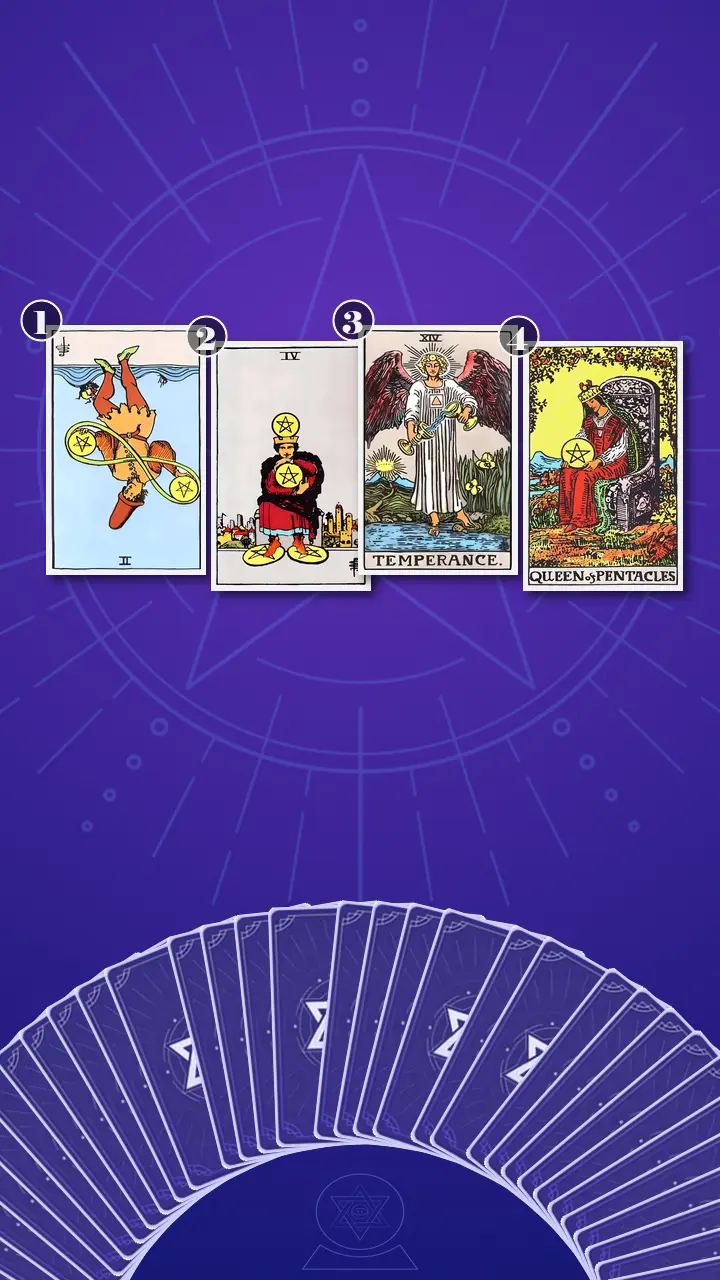
For her question, I chose a Situation-Obstacle-Advice-Outcome spread, a clean four-card tarot spread for home plan change anxiety. I like this structure because it follows the smallest complete arc for a specific inner problem: what happens, what blocks, what reorients, and what integration looks like. A larger spread would add noise. A shorter one would miss either the core fear or the practical landing point.
I told her the first card would show the immediate symptom—the concrete moment a small household change knocks focus, mood, and momentum sideways. The second would reveal the deeper block: the safety-through-control pattern underneath. The third, the most important card in this reading, would name the inner shift that could help her keep structure without treating flexibility like danger. The fourth would show what grounded life at home might feel like when that guidance is actually practiced.
Reading the Full-System Rewrite
Position 1: The Loop That Starts in the Kitchen
I turned over the card representing the immediate symptom: the concrete moment when a small household change disrupts focus, mood, and momentum. The Two of Pentacles, reversed.
This card never looks dramatic at first glance. It is just a figure trying to keep multiple moving parts in motion. But reversed, the rhythm slips. I told Maya this was exactly what happens when she is halfway through dinner or just closing work mode and one text changes the timing at home: instead of responding to one update, her brain treats it as if every moving part of the evening now has to be rebalanced at once. It is like missing one turn on Google Maps and instantly feeling the whole trip has gone sideways.
Here the energy was strained and overloaded—earth energy trying too hard to prevent wobble. The infinity loop around the pentacles felt like endless mental reshuffling. The raised foot was that unstable, mid-task feeling she knew so well. The rough sea in the background was the private panic of, “If this moved, what else is about to move?” I looked at her and said, “The update isn’t always the problem. The full-system rewrite is.”
She let out one short laugh, the kind that arrives wearing a bruise. “That’s… annoyingly accurate,” she said. Her fingers worked the seam of her paper cup flat and then rough again. I asked her, “What actually changed—and what did your brain immediately assume now had to be redone?”
Position 2: Wearing the Schedule Like Armor
Then I turned the card representing the deeper block: the safety-through-control pattern that makes small changes feel bigger than they are. The Four of Pentacles, upright.
This was the part beneath the visible stress. In real life, I told her, it looks like follow-up questions that sound practical but feel emotionally urgent: How much later? Is your friend staying long? Should I wait to eat? The deeper issue is not the changed timing itself, but how tightly her nervous system has attached safety to the original plan. It is like refreshing a delivery ETA or a live location because certainty feels almost as calming as control.
The energy here was not absent. It was excessive and defensive. The figure presses the coin to the chest the way Maya had been pressing the evening schedule against herself, hoping structure could do the job of emotional armor. The feet planted on the other coins said the same thing: I can relax only when I feel pinned down. In shared homes, people often speak different dialects of safety; one person says, “We’ll figure it out,” and another person’s body hears, “Brace.”
“So I’m not really upset because they changed dinner,” she said quietly. “I’m upset because I don’t know where to put myself anymore.”
That was the moment her gaze unfocused for a beat, as if she were replaying the scene in her kitchen doorway—hovering, checking the clock, rereading texts. Then came the tight nod. Her hand rose, almost unconsciously, to the center of her chest. I answered, “Exactly. Holding structure has been doing the job of comfort. But holding structure isn’t the same as clutching it.”
When Temperance Poured Between Two Cups
Position 3: The Antidote in Plain Sight
When I turned over the third card, the room changed. A stripe of late light landed across the gold on the image, and even the neroli on the blotter seemed cleaner in the air. This was the card representing the key inner shift: how to move from rigid control into measured adaptation without abandoning structure. Temperance, upright.
Its image is simple and difficult in the best way—water flowing between two cups, one foot in water and one on land, a path leading forward rather than a finish line demanding perfection. In modern life, this is not “just be chill.” It is making one measured adjustment, taking one grounding breath, and letting the rest of the night stay unwritten until it actually needs updating. More small patch update than full hard reset. What if flexibility is not performing spontaneity, but building enough inner footing that a detour stays a detour?
In perfumery, the fastest way to ruin a formula is to correct every note at once. I learned that in Paris, standing over test strips and thinking I could force harmony by over-handling it. You cannot. You adjust one drop, let the blend breathe, and then you smell again. That is why, in my own Conflict Transformation System, I separate the fact from the alarm before I ask anyone to act. Maya was not in a fight with her roommate. She was in a collision between two inner voices: the one that wanted order, and the one that feared collapse.
The Sentence That Changed the Air
You’re in the kitchen, the phone buzzes, dinner shifts by half an hour, and before you’ve even answered anyone, your brain is already trying to rescue the whole night from falling apart.
You do not need to clutch the schedule to stay okay; like Temperance's two cups, let gentle adjustment become your new form of stability.
She froze first. Not dramatically—just a suspended breath, fingers hovering over the edge of the card as if she had forgotten what she was about to do. Then her eyes lost focus for a second, the way they do when memory starts replaying faster than speech. When she came back, it was not relief that surfaced first. It was resistance. “But doesn’t that mean I’ve been doing it wrong this whole time?” she asked, and her voice had that sharp edge people use when they are one inch away from turning insight into self-punishment.
I shook my head. “No. It means your system found a fast way to create safety. It just became expensive.” I watched her jaw unlock by degrees. One shoulder dropped, then the other. She exhaled like something had been stacked high under her ribs for months. There was still a flicker of disorientation in the release—clarity can do that, especially when it hands responsibility back to you—but the room felt different now. “A plan change is not automatically a danger signal,” I told her. “The steadier version of you is not the one who controls every detail. It’s the one who can adjust without abandoning herself.” Then I gave her the practice immediately: both feet on the floor, one slow exhale, and two lines in Notes—What actually changed? What is the next true adjustment? Leave the rest alone for now. I asked, “Now, with this new angle, think about last week. Was there a moment when one breath and one 30-minute adjustment would have changed the feeling?”
She nodded slowly. “Tuesday,” she said. “I could’ve just lowered the heat and kept cooking.”
That was the crossing point. Not from chaos to perfection, but from hyper-vigilant over-replanning to grounded flexibility at home. From clutching the schedule to holding it lightly.
Position 4: Home as Support, Not Surveillance
I turned the final card, the one representing the integrated next step: a grounded home presence that can stay resourced even when details change. The Queen of Pentacles, upright.
This card always feels to me like a room someone has actually lived in. Warm lamp light. Food handled before anyone gets depleted. A door that can close. A mug already clean. In modern life, it says stability can come from the environment and care you build around yourself—eating before you are running on fumes, protecting one pocket of quiet, putting on a playlist, turning your apartment into a charging dock instead of a performance of perfection.
Here the earth energy had matured. The Queen holds her pentacle close, but not in a chokehold. That difference mattered. Four of Pentacles clutched. The Queen cradled. Same desire for steadiness, completely different relationship to it. I said, “Home feels safer when it has anchors, not just timelines.”
Maya smiled then, small but real. Her shoulders were lower now. “So the question isn’t ‘How do I get the exact plan back?’” she said. “It’s ‘What would help the next hour feel supported?’”
“Exactly,” I told her. “That is what integration looks like.”
From Insight to Action: The Next 30 Minutes
When I laid the whole line of cards together, the story was remarkably coherent. The reversed Two of Pentacles showed the visible wobble: one small update and her internal GPS yelled rerouting. The Four of Pentacles showed why the wobble escalated so fast: she had outsourced calm to a fixed evening structure. Temperance offered the reorientation—measured flexibility, not forced spontaneity. And the Queen of Pentacles grounded that lesson in something practical: self-support strong enough to survive real life.
The blind spot was not that Maya needed less structure. It was that she had been treating precision as the only available source of safety. The transformation was kinder than that. She was not being asked to become casual overnight. She was being asked to build a short reset ritual that proved she could adapt without losing her footing. I told her, “You do not need the whole night figured out to take the next steady step.”
Because her stress lived in shared space, I folded in one of the scent-based tools I use often—Dialogue Atmosphere Enhancement with Calming Scents—alongside a tiny version of Shared Space Optimization through Citrus-Based Aromas. In plain English: give the room and the body one stable cue before you ask the mind to solve anything. A little bergamot or neroli hand cream by the kitchen door is not magic. It is a reminder that self-regulation can arrive through the senses as well as through thought.
- The 90-Second ResetThe next time dinner, errands, or a visitor shifts at home, keep your phone in your hand but do not reopen the whole evening. Put both feet on the floor, unclench your jaw, take one slow exhale, name the feeling in one word, and make one practical adjustment only.If ninety seconds feels like a lot, do the one-exhale version. Feeling silly about it is part of the pattern, not proof the ritual is wrong.
- The 30-Minute Replan RuleOpen Notes and write only two lines: “What actually changed?” and “What is the next true adjustment?” Then move only the next thirty minutes of your evening—nothing beyond that—and return to the task you were already doing for three breaths.When your brain says, “But I need the whole picture,” treat that voice as familiar, not authoritative. This is a two-minute experiment, not a personality overhaul.
- Anchor-First Home RhythmPick two non-timing anchors for the week: a lamp you switch on at seven, a ready snack, a playlist, a shower window, or a citrus hand cream by the kitchen door. If plans shift, reach for one anchor before you reach for more information.Little supports are not trivial. They teach your body that home can feel steady because it is resourced, not because every detail stayed fixed.

A Week Later, the Quiet Proof
A week later, Maya sent me a message. Her roommate had texted, “Friend stopping by later,” and she felt the first flare anyway—the stomach drop, the old urge to remap everything. But she kept stirring the pasta, moved one block by twenty minutes, turned on her lamp, and ate before the guest arrived. She still stared at the reshaped evening for a beat afterward. Then she let it be.
I smiled because that is what a real journey to clarity usually looks like: not a personality transplant, not perfect calm, just one steady choice made sooner than before. That Situation-Obstacle-Advice-Outcome spread had not fixed her life for her. It had given her back authorship.
When a 20-minute plan change makes your stomach drop, it is often not about dinner at all—it is that split-second fear that if the evening loses its shape, you might lose your footing with it.
If the next small change at home did not have to mean the whole night was slipping away, what tiny reset would you want to reach for first—the slow exhale, the two-line note, or the lamp that reminds your body you are still home?
Every reading at AceTarot is a Journey to connect with inner wisdom and empower next step.
Learn more about our Journey to Clarity.