From On-Call Resentment to Calm Limits: Family Tech Support Hours

The 8:47 p.m. Buzzing Kitchen
If you’re the 28-year-old in Toronto with a hybrid job who can’t eat dinner without getting a “quick tech question” text—congrats, you’re the family help desk (and the Sunday Scaries don’t even wait for Monday).
Alex sat across from me on a video call, shoulders angled forward like they were bracing for impact. They told me about Tuesday at 8:47 PM in their condo kitchen: the overhead light buzzing, pasta half-eaten, their phone screen glowing against a dark countertop. A parent’s text—“My laptop is acting weird”—and before the words fully landed, Alex’s thumb was already moving: Settings → Wi‑Fi → Forget This Network.
“I didn’t agree to be on-call tonight,” they said, and the sentence came out calm, but their jaw didn’t match it—tight, almost locked.
I could hear that particular strain I’ve heard in thousands of conversations—back when I trained cruise staff to read a room’s emotional weather before it turned into a storm. It’s the sound of someone being “helpful” while quietly disappearing.
Alex kept talking, fast, like they were trying to troubleshoot their own life: “It’s never actually a quick question. If I don’t answer now, it turns into a whole thing. And then I feel like a bad kid the moment I set a limit.”
Resentment, in this context, isn’t loud. It’s physical. It’s a wired, contracted “on-call” feeling—like your body is a phone vibrating on a table even when nothing is happening.
I nodded. “You’re not selfish—you’re just tired of being on-call without consent. Let’s make a map of this moment—what pulls you in, what keeps you there, and what boundary can actually hold without turning into an argument.”

Choosing the Compass: The Celtic Cross · Context Edition
I asked Alex to take one slow breath—not as a mystical ritual, just a nervous-system handbrake—and to hold the exact question in mind: When I’m family tech support again, what boundary can I set?
As I shuffled, I explained what I was doing in plain terms: “This is how tarot works at its best—it gives us a structured way to look at a pattern you already live inside, so we can stop arguing with it and start choosing inside it.”
“Today we’ll use a spread called the Celtic Cross · Context Edition,” I said. “A boundary question needs more than a single ‘advice card.’ It needs a chain: what happens in the moment, what belief is underneath, and what social pressure makes ‘not tonight’ feel risky.”
For you reading along: this is why I love the Celtic Cross for family boundaries. It’s basically a relationship X‑ray. It shows the visible pattern and the hidden driver. In this version, position 6 is explicitly the boundary to try next, and position 10 is what changes if you hold it—because actionable advice and next steps matter more than vague reassurance.
“We’ll read the core cross first,” I told Alex, “so we can move from the immediate tech-support moment back to the root script—and then forward to a concrete boundary. Then we’ll read the staff to see what’s happening in you, in them, and in the emotional hinge where guilt spikes.”
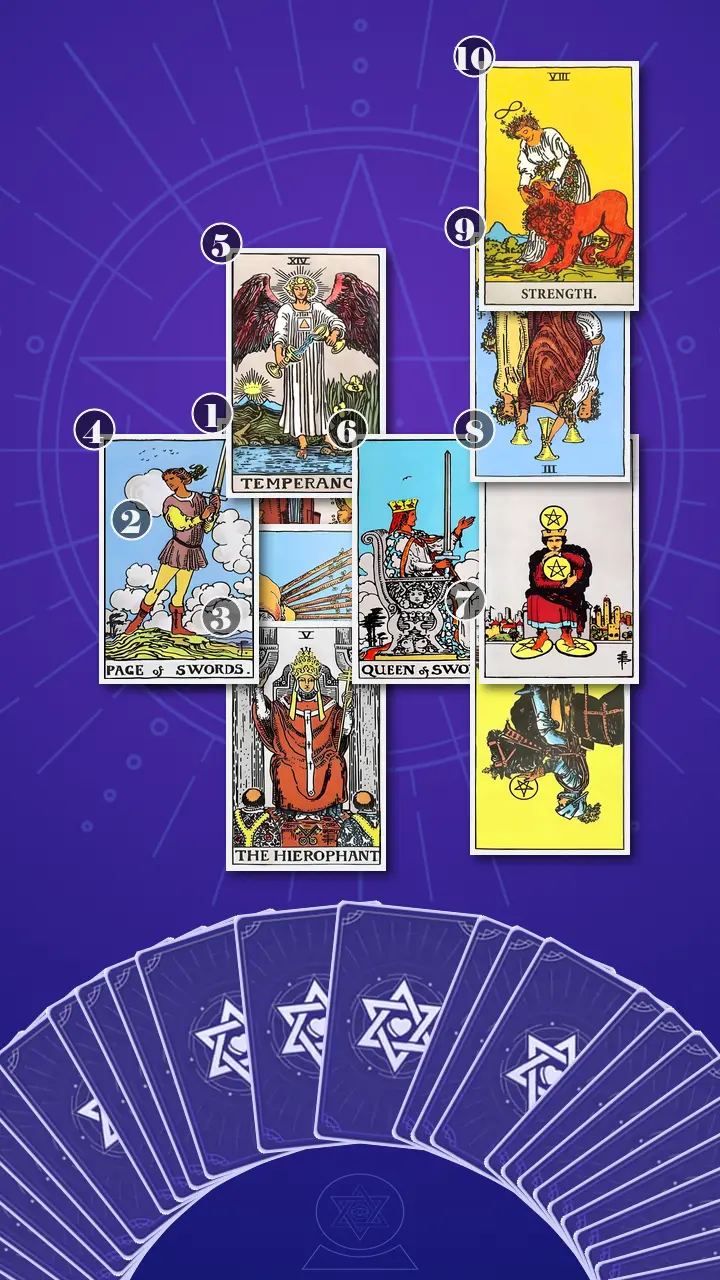
Reading the Map: The Fairness Ledger and the Second-Shift Weight
Position 1: What happens in the moment
“Now we’re turning over the card that represents what happens in the moment: the current tech-support dynamic you’re living inside.”
Six of Pentacles, reversed.
“This is you mid-week, finally trying to decompress after work, when a family text arrives like a tiny invoice: ‘Can you help real quick?’ You say yes automatically, then spend your evening handing out time in little chunks—screenshots, links, voice notes—while a silent part of you keeps a fairness ledger: how often you show up vs. how often anyone protects your time.”
Reversed, the energy here is a blockage: giving isn’t flowing because it’s not being chosen anymore—it’s being assumed. The scales in the image tilt, and I can feel that tilt in Alex’s body. Help becomes a power dynamic when you’re always the one dispensing time downward.
Alex let out a small laugh that wasn’t amused. “That’s… kind of brutal,” they said, blinking hard once. “Because I literally keep score in my head. And then I still answer.”
“That laugh makes sense,” I said gently. “It’s your psyche saying, ‘Finally—someone is naming the real job you’re doing.’”
Position 2: What crosses you
“Now we’re turning over the card that represents what crosses you: the main pressure that makes the boundary hard to hold.”
Ten of Wands, upright.
“What makes the boundary hard isn’t the tech—it’s the weight. One ‘small’ ask becomes passwords, updates, two-factor codes, and emotional soothing, until your whole evening feels like carrying a stack of tasks you can’t set down without feeling like the bad guy.”
This is excess energy—too much responsibility, carried too long, too alone. The figure’s face is blocked by what they’re carrying. That’s the part I want you to notice: when Alex is in tech support mode, their view of their own life gets blocked.
And here the “second shift” metaphor isn’t even a metaphor. The moment they answer, their evening becomes a ticket queue.
I watched Alex’s shoulders creep up, almost reenacting the card. Their eyes drifted to the side of the screen, like they were seeing their own kitchen clock.
“It wasn’t the request that broke you,” I said, keeping my voice calm and specific. “It’s realizing how normal it’s become.”
Alex’s mouth opened slightly, then closed. A quiet, surprised “oh” lived in their expression without them having to say it.
Position 3: The root script
“Now we’re turning over the card that represents the root script: the deeper belief about family, duty, and your role that keeps the pattern running.”
The Hierophant, upright.
“Underneath the texts is a family rule you never signed but still follow: the capable one helps, immediately, politely, and all the way to the finish. Saying no doesn’t feel like logistics—it feels like breaking a value, risking the chill in the room, risking your belonging.”
This card is structure—but not always your structure. It’s the inherited policy manual. As a Jungian psychologist, I don’t treat that as blame; I treat it as a script. A script can be updated.
Alex swallowed. “It’s like… if I don’t do it, I’m not good. Not helpful. Not… part of the team.”
“Exactly,” I said. “This is why your boundary doesn’t just feel like a scheduling decision. It feels like identity.”
Position 4: What shaped it
“Now we’re turning over the card that represents what shaped it: a recent or repeating past dynamic that trained your nervous system to respond fast.”
Page of Swords, upright.
“You became the default tech person because you’re fast and sharp: you can Google anything, you can spot the setting that’s wrong, you can talk someone through it calmly. Your family learned: ask Alex and it gets solved. The skill is real—the expectation that comes with it is what’s exhausting.”
This is balance in your mind—quick, capable, proud even—but it becomes a problem when it gets recruited as your only role. The windy sky in this card is your nervous system snapping into alert fix-it mode the moment you get pinged.
I offered a question, very simple: “Before you even reply—where do you feel the on-call response first? Jaw, shoulders, chest?”
“Jaw,” Alex said instantly, touching the side of their face like it was a familiar bruise.
Position 5: What you think you’re aiming for
“Now we’re turning over the card that represents what you think you’re aiming for: the conscious ideal you want—peace, connection, fairness.”
Temperance, upright.
“What you’re aiming for isn’t a dramatic cutoff—it’s a blended life where you can be kind and still have an evening. You want support to have pacing: scheduled help, limited time, and enough room left over for actual conversation and rest.”
This is balance as an actual practice. One foot on land, one in water. That’s the goal: warmth and structure. Connection and a protected nervous system.
I let that settle. “You’re not trying to become cold,” I said. “You’re trying to stop buying peace with your time.”
When the Queen of Swords Spoke: A Boundary You Can Repeat
Position 6: The boundary to set next
“We’re turning over the card that represents the boundary to set next: a clear limit you can state and repeat without over-explaining.”
The air in my office felt sharper for a second—like the room got quieter on purpose.
Queen of Swords, upright.
“The boundary is simple and calm: you stop troubleshooting in real time. You respond with one clear line—‘I’m not available tonight. I can do 20 minutes tomorrow at 7, or I can send a link’—and you don’t add the five-paragraph justification that turns it into a negotiation.”
This is clarity energy in balance: direct communication and self-respect without cruelty. The sword is the limit. The open hand is the humane option.
Alex’s face tightened, and something like defiance flashed up—not at me, but at the idea itself. “But… if I say it that cleanly,” they said, voice rising a notch, “won’t I sound mean? Like I’m punishing them?”
I didn’t rush to soothe that. I just held it, the way you hold a moment when you know it’s the hinge.
Here’s what I’ve learned from Venice: in a narrow canal, sound travels. Words echo off stone. If your family has been using urgency as a shortcut to closeness, your “not tonight” will echo at first like rejection—until the system learns a new rhythm.
And this is where I used my Generational Echo Mapping lens—the way I track patterns the way canal acoustics carry a call from one bridge to another. “Alex,” I said, “your fear isn’t actually about the Wi‑Fi. It’s about coldness—that if you don’t rescue the vibe instantly, you’ll lose belonging. That’s an old echo.”
Then I gave the setup, exactly as it lives in their body: It’s 9 PM, the phone lights up with “quick question,” and their jaw tightens before their brain finishes reading. The impulse is to fix fast so nobody gets frustrated, so nobody gets quiet, so nobody gets distant.
A boundary isn’t a debate you have to win; it’s a line you’re willing to repeat.
And then I delivered the sentence that matters most—clean, not negotiable, and said like a truth instead of a plea:
Stop trying to earn approval by being endlessly available; choose one clear line and hold it like the Queen of Swords holds her sword—steady, direct, and without apology.
Alex froze first. Their breathing paused; their lips parted like they were about to argue, then didn’t. Their eyes unfocused for a beat, like a memory replayed: holiday visits, being handed a phone like a baton, laughter down the hall while they stood alone in a hallway staring at “Storage Full.”
Then the tension shifted. Their shoulders dropped—just a few millimeters at first—like a load sliding off a hook. Their jaw loosened enough that I saw their tongue press against their teeth, testing the release. They exhaled, and it sounded shaky, almost annoyed at how much relief was in it.
“But… doesn’t that mean I’ve been doing this wrong?” they asked quietly. Not angry now—more vulnerable. Like clarity brought responsibility with it.
“It means you’ve been doing what worked,” I said. “And now you’re ready for what’s healthier.”
I leaned in, voice soft but steady. “Now, with this new lens—think back to last week. Was there a moment when you could have said the boundary, and it would have changed how you felt?”
Alex blinked, slow. “Tuesday. The pasta night.” They almost smiled, but it didn’t fully arrive. “I could’ve said, ‘Not tonight. Tomorrow at 7.’ And I would’ve eaten dinner like a person.”
That was the shift right there: from hyper-responsible rescue mode to supportive-by-choice. From contracted resentment to grounded self-respect.
Position 7: Your stance
“Now we’re turning over the card that represents your stance: how you show up internally when the request comes in.”
Knight of Pentacles, reversed.
“Inside, you go into duty mode: once you start, you feel responsible to finish, even if you’re tired or annoyed. You treat the request like a task you must complete correctly, and that reliability—normally a strength—turns into a trap when it replaces choice.”
This is stuck energy—responsibility without flexibility. It’s the part of you that says, I started it, so I must finish, even when no one asked you to finish tonight.
I offered a small reframe that’s basically therapy in one line: “Guilt is data, not a command.”
Position 8: Their side of the equation
“Now we’re turning over the card that represents their side of the equation: what the family system is rewarding, expecting, or reinforcing.”
Four of Pentacles, upright.
“Your family system is optimizing for immediate comfort: the device fixed now, no frustration, no learning curve. A new boundary feels like disruption, so the system subtly pressures you to restore the old normal—by urgency, by guilt, by ‘just this once.’”
This is control energy, tight and protective. Not necessarily malicious. Just change-averse.
“So if they push back,” Alex said, “it doesn’t mean I’m terrible. It means they’re uncomfortable.”
“Yes,” I said. “That distinction is everything.”
Position 9: The emotional hinge
“Now we’re turning over the card that represents the emotional hinge: what you hope will happen if you set a boundary, and what you fear will happen.”
Three of Cups, reversed.
“You’re afraid that if you stop being the fixer, the warmth will drop—like you won’t know how to belong in the room without being useful. And yet the irony is: being tech support is already stealing the very closeness you’re trying to protect.”
This is deficiency in connection. The missing toast. The vibe you’re trying to rescue is already getting replaced by logistics.
Alex’s eyes softened. “That’s the sad part,” they admitted. “I’m ‘helping’ and still feeling disconnected.”
Position 10: Integration if you hold it
“Now we’re turning over the card that represents integration if you hold it: what changes inside the relationship when you keep your limit with steadiness.”
Strength, upright.
“If you hold the limit, the relationship doesn’t have to turn cold—it just has to adjust. Strength looks like staying kind but unmovable: repeating the same boundary without snapping, arguing, or caving, until the system learns you’re supportive by choice, not by default access.”
This is regulated courage. Not a hard no. A steady no. A nervous system that doesn’t sprint just because someone else is panicking.
I watched Alex’s shoulders lower again, this time on purpose, like they were practicing the feeling of being off-call.
The One-Line Boundary: From Insight to Actionable Advice
Here’s the story the spread told, end to end: an imbalance in reciprocity (Six of Pentacles reversed) turns family help into assumed access. That creates the burden loop (Ten of Wands)—a second shift that eats your evenings. Underneath, an inherited “good family member” contract (The Hierophant) makes saying no feel like breaking a value, not setting a schedule. Your quick mind (Page of Swords) built the role. Your heart wants a both/and life—kindness with pacing (Temperance). The antidote is clean communication (Queen of Swords), and the integration is staying steady through the awkward adjustment period (Strength).
The cognitive blind spot is subtle but brutal: you’ve been treating their discomfort as an emergency you must prevent, instead of a normal feeling they can tolerate while learning a new pattern.
The transformation direction is equally clear: you’re shifting from instant rescue to a stated support window and a clear handoff—what you can do, what you won’t do, and what they can try next.
To make it practical, I offered Alex my Bollard Marking Method—a Venetian dock image I use for boundaries. A bollard isn’t a wall. Boats still come in. But the rope goes to one fixed post. Your “support window” is that post: one place to tie the request, so it doesn’t drift into every part of your life.
- Save the Support Window ScriptOpen Notes and write one copy/paste reply: “I’m not available to troubleshoot tonight. I can do 20 minutes tomorrow at 7pm, or I can send a link.” Save it as a keyboard shortcut (iPhone Text Replacement / Gboard).Keep it to three sentences max—Clarity is kinder than a five-paragraph apology.
- Put One Tech-Support Window on Your CalendarPick one day/time (example: Wednesday 7:00–7:20 PM). Create a real calendar event called “Family Tech Support.” When requests come outside it, reply with the window instead of starting the fix.Lower the difficulty: you’re not holding the boundary forever—just for one request this week.
- Use a Timer + a Handoff on CallsIf you take a call, say up front: “I’ve got 20 minutes—let’s see how far we get.” When the timer goes off: “That’s all I can do tonight. We’ll pick this up during the next window, or you can try the link I sent.”Expect “But it’ll only take a second” (Four of Pentacles comfort-seeking). Respond: Same message, same tone, no extra justification.

A Week Later: The Quiet Proof
Six days later, Alex messaged me: “Okay. It happened. Tuesday night again. Same parent, same ‘quick question.’ I felt the jaw thing start, I almost launched into troubleshooting… and then I sent the script.”
They told me the pushback was immediate—“It’ll only take a second.” Alex felt the familiar guilt spike, the urge to explain their whole character in a paragraph. Instead, they did the Strength move: phone face-down, one breath, shoulders rolled once, and then they repeated the same sentence. No new arguments. No apology essay.
“It was awkward,” they admitted. “And then… it was fine. I ate dinner. Like a person.”
That’s a Journey to Clarity I trust: not a fantasy where your family instantly becomes perfect, but a real shift from being the default fixer to being a supportive adult with chosen availability—warmth with structure.
When your phone lights up with “quick question” and your jaw clenches before you even read it, that’s the moment you realize you’re not just fixing a device—you’re trying to prevent coldness by rescuing the vibe.
If you didn’t have to earn belonging by being instantly available, what would your most honest ‘I can help, but not right now’ sound like—in one sentence you could actually repeat?
Every reading at AceTarot is a Journey to connect with inner wisdom and empower next step.
Learn more about our Journey to Clarity.