When Booking a Trip Feels Like a Trap: Learning a Paced Yes

The 10:41 p.m. Travel Booking Freeze
When a late-20s city professional can lead a design review all day but goes blank when a partner texts, “Pick the dates and I’ll book the flights,” I already know I’m not looking at simple indecision. I’m looking at the kind of commitment freeze around making plans that sends people into Google at 11 p.m. asking why they freeze when booking a trip with a partner.
Maya (name changed for privacy), a 29-year-old product designer in Toronto, described Tuesday at 10:41 p.m. in her west-end one-bedroom so clearly I could almost hear it: radiator hissing, peppermint tea gone cold on the coffee table, Google Flights and Hopper open beside Airbnb, the shared travel note glowing on her phone like a small accusation. Her legs were folded under her on the couch, but her shoulders were up near her ears. Every time her partner’s text—“These dates work for me. Should I book?”—lit the screen, her breath stalled high in her chest and she zoomed into baggage rules instead.
“I want to go,” she told me. “I just can’t seem to click the button. It’s not the trip. It’s the feeling that once it’s booked, I can’t breathe.” The contradiction was painfully clean: she wanted the intimacy of saying yes to a trip together, and froze the second old chaos got activated. The apprehension in her body felt, as she described it, like the fire exit had quietly vanished from the room.
I nodded. “That makes sense to me,” I said. “Your body is not acting like this is a vacation plan. It’s acting like this is impact.” Then I rested my hands on the table between us. “So let’s not force a big answer. Let’s make a map of the fog and find the clarity underneath this travel booking anxiety with a partner.”

Choosing the Compass: The Shadow Spread
I asked her to put both feet on the floor, exhale once, and hold one question in mind: not Where should we go? but What old chaos makes me freeze when this becomes real? Then I shuffled. For me, tarot works best as pattern recognition with symbols—less fortune-telling, more a clean way of seeing the circuitry underneath a reaction.
For this question, I chose The Shadow Spread. A destination spread would have over-focused on flights, cities, and timing, but this was not really about Lisbon versus Montreal. It was about why shared commitment activated a freeze response. The Shadow Spread is precise because it uses the fewest cards needed to track the whole arc: the surface symptom, the hidden root, the healing medicine, and the grounded next step.
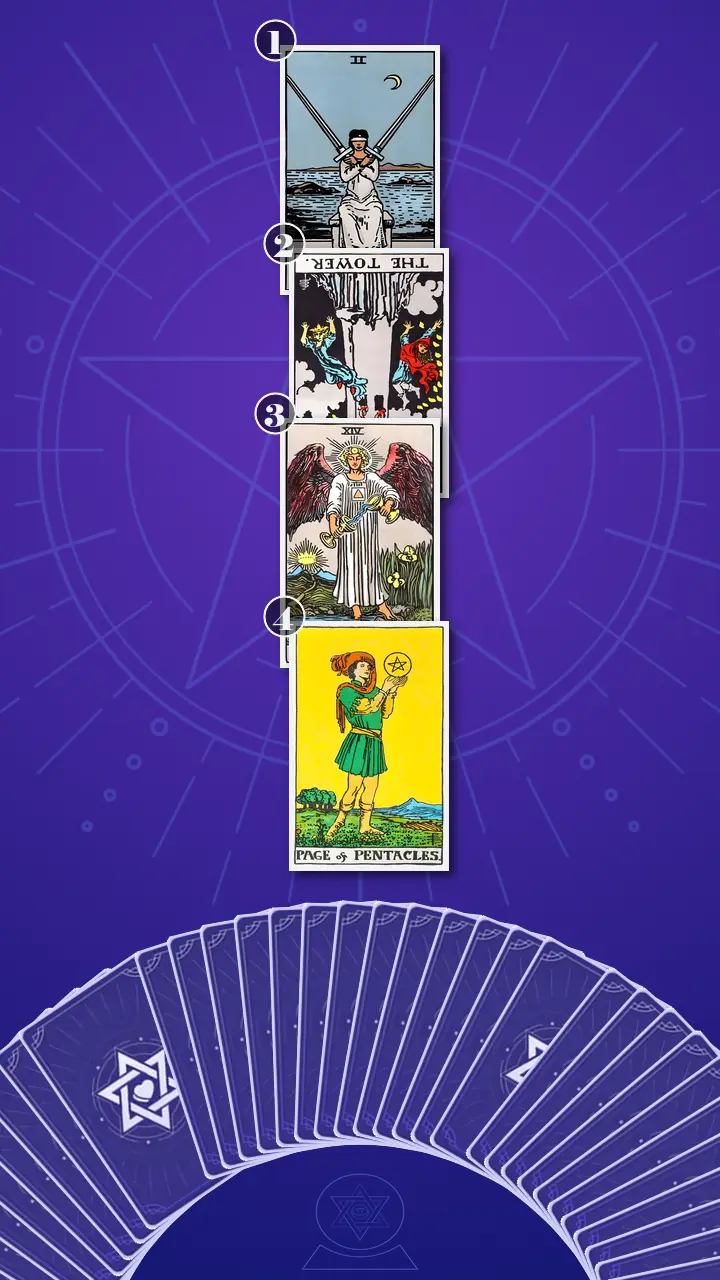
I laid the cards in a vertical line, the way I often do when a reading needs a descent and return. The first position would show the conscious issue—the booking freeze itself. The second would take us underneath it, into the older shadow logic that made non-commitment feel safer than movement. The third would show the antidote, the way back into regulation and co-operation. The fourth would translate all of that into one real-world step Maya could actually do.
Reading the Basement Under the Booking
Position 1: The Loop That Calls Itself Research
The first card I turned over represented the conscious issue: the booking freeze, guarded indecision, and the difficulty of giving a clean yes once plans became concrete. The Two of Swords, upright.
I looked at the blindfold, the crossed swords over the chest, the still water behind the figure, and I said what the image was already saying. “This is you on the couch with the shared note open, three apps glowing, one unsent text draft sitting there. Your partner is asking for a clean yes, and your mind says, ‘I do want it, I just need one more piece of information.’” In modern life, this card is the checkout screen with everything in the cart and Face ID ready, but no purchase going through because paying would make the fantasy real.
Energetically, the Two of Swords is blocked air: thought without resolution, analysis used as a shield. The logistics are not always the issue; sometimes they’re the hiding place. Maya had a Figma-and-Jira brain trained to find edge cases, and this card showed that intelligence turning inward as emotional camouflage. The closer the trip came to symbolizing actual relational closeness, the more her body recruited practicality to keep an exit route open.
Maya let out a short laugh that carried more sting than humor and glanced down at her cold tea. “That is brutally specific,” she said. Her thumb started rubbing the paper sleeve around the cup, small circles, then stopped. I softened my voice. “Not brutal. Precise. This card is not saying you don’t want the trip. It’s showing how self-protection can wear the costume of indecision.”
Position 2: The Smoke Alarm Beneath the Plan
The second card sat in the position of the hidden root: the old chaos, the fear around control, and the shadow logic that made staying unbooked feel safer than moving forward. The Tower, reversed.
Whenever I see The Tower reversed in a reading like this, I do not think first of catastrophe. I think of internalized catastrophe—fire trapped inside the walls. This was Maya at a calm brunch on Ossington hearing, “Let’s just do refundable flights and lock it in,” while the espresso grinder screamed, cold air brushed her ankles, and her stomach dropped before there was any evidence of danger. This card said the alarm was arriving before the facts. Like a smoke detector that became hyper-sensitive after one real fire, her system was treating steam like an emergency.
I asked her, “Once payment clears in your mind, what exact disaster scene do you start rehearsing—an argument, a mood shift, being stuck, wasting money, losing control?” She didn’t answer immediately. Her inhale paused. Her eyes lost focus for a beat, as if a memory had opened on another screen behind them. Then her shoulders held even tighter and she said, very quietly, “That the vibe changes, something blows up, and I’m the one trapped in the fallout.”
Growing up beside Venetian canals taught me that sound never arrives only once; it ricochets. In my Jungian work, I call this Generational Echo Mapping: a present moment can carry older acoustics underneath it. A partner says, “Want to book tonight?” and somewhere deeper the body hears an older rule—plans become dangerous, moods turn fast, control disappears. I did not need her full family archive in that moment to recognize the echo. The Tower reversed showed me that old instability was still being treated like a live threat. Your body isn’t refusing the trip, I told her. It’s refusing the feeling of being trapped.
That mattered because the blind spot was beginning to show itself: delaying the booking calmed her body in the short term because nothing was final yet, but every delay also taught the system, again and again, that commitment itself was unsafe.
When Temperance Poured Between Two Cups
Position 3: The Antidote
When I turned the third card, the room went strangely still. Even the street noise outside seemed to flatten for a second. This was the position of the healing energy—the key transformation needed to loosen the freeze and create a new relationship to uncertainty, closeness, and co-regulation. Temperance, upright.
Here the imagery softened everything the previous card had tightened. One foot on land, one in water. Two cups passing liquid between them without spilling. A path in the distance instead of a cliff edge. “This,” I said, “is not rom-com spontaneity. This is co-op mode. This is you saying, ‘Can we pick refundable dates tonight and do payment tomorrow?’ The trip stops being one giant emotional verdict and becomes a sequence of manageable agreements.” At 10:41 p.m., with cold tea beside her and that message still unanswered, her brain had been treating the moment like a pass-fail exam. Either leap without fear or stall until the price changed. No wonder she kept freezing.
You do not have to brace for disaster before saying yes; like Temperance's steady hands blending two cups, closeness can be built through pacing, not panic.
The words landed visibly. First, Maya went very still, the kind of stillness that is really a nervous system listening. Then her fingers—hooked together so tightly the knuckles had gone pale—loosened one at a time. Her jaw unclenched. Her eyes watered, not in a dramatic way, just enough to catch the light. I have watched this many times: relief can arrive so quickly it leaves a person slightly dizzy, as if setting down a backpack they forgot they were carrying. Her shoulders dropped, then paused halfway, as though her body was checking whether it was truly allowed. “Oh,” she said, and the word came out on a long exhale. “So the answer isn’t that I need to be chill. I need a pace I can stay inside.”
“Exactly,” I said. Temperance always reminds me of what I call Water Mirror Dialogue: not arguing with fear, not glorifying it either, just reflecting both truths cleanly enough that a bridge can appear. “You want the closeness, and you need the process to stay breathable. Both can be true.” Then I asked her, “Use this new lens and think back over last week. Was there a moment when this would have changed how it felt?” She nodded almost at once. At the café, she said, if she had known she could ask for two steps instead of one giant leap, her whole body would have reacted differently.
That was the pivot of the reading: not from scared to fearless, but from guarded tension and threat-scanning to cautious cooperation and grounded trust. A paced yes is still a yes.
Position 4: The Prototype, Not the Perfect Future
The fourth card was the grounded next step: the real-world expression of everything Temperance was teaching. The Page of Pentacles, upright.
I smiled when I saw it, because Maya would understand this card instantly. “This is version one, not full launch,” I said. “It’s shipping a prototype, not trying to control the next six months.” In modern life, the Page of Pentacles is choosing one tangible task—a budget cap, a calendar hold, one refundable reservation—and studying that one task long enough for the body to learn, through experience, that commitment can happen without chaos.
Energetically, this is balanced earth. No drama, no grand speech, no demand for a total personality transplant. Just one humble, buildable action. You don’t need total certainty. You need one workable next step. When I said that, Maya gave me her first full nod of the session.
From Container-Not-Cage to a Paced Yes
When I looked at the whole spread together, the architecture was beautifully clear. The Two of Swords and The Tower reversed formed a closed circuit: the mind barred the gate while the hidden system expected collapse. That is why a simple shared trip started to feel like a trap. The blind spot was not that Maya cared too much about details; it was that she kept mistaking non-commitment for safety. It soothed her for the night, but it handed the relationship a growing pile of tension. Temperance and the Page of Pentacles opened the circuit again. They showed the transformation direction cleanly: commitment did not need to be a threat. It could become a paced experiment with flexibility, communication, and shared repair. Plans can be containers, not cages.
Maya frowned a little and gave me the most practical objection possible. “But what if I can’t even do a whole planning night after work? By the time I’m home, I’m hungry, Slack is still going, and everything feels louder.” I laughed softly. “Then we make the container smaller. The point is not to perform ease. The point is to make the next step honest enough that your nervous system can stay with it.”
In Venice, boats are not secured by hugging the whole shoreline; they are tied to specific posts. When I need to help someone build boundaries without making them rigid, I use my Bollard Marking Method: choose the few fixed points that keep the rest from drifting into chaos. For Maya, those bollards were simple.
- The Paced Yes TextBefore the next planning session, send one honest sentence to her partner from her phone or a copied draft in Notes: ‘I do want this trip. I just do better if we book in smaller steps. Can we choose dates tonight and do payment tomorrow?’ It takes under two minutes and works best before any apps are opened.If even that feels exposing, trim it to one line: ‘I’m in—I just need a slower booking pace.’ One honest sentence can do more than ten extra tabs.
- Three Bollards in Apple NotesCreate a shared note with only three rules: a max total budget in CAD, refundable-first, and one decision per session. Set it up at a calm time—weekday evening, fed, not mid-work messages—and keep the planning window to 15 minutes.If 15 minutes feels like too much, do the five-minute version and name just one rule out loud. A smaller container still counts.
- The One-Reservation ExperimentBook exactly one flexible item this week—one refundable hotel night, a train ticket hold, or a flight hold—but never all three at once. When the timer ends, close the tabs and let the booking be the only task completed that night.If activation spikes above a 7 out of 10 afterward, say, ‘I want this, and I’m overwhelmed—not pulling away. Can we slow it down?’ Then drink water and do not reopen the research loop the same night unless you consciously choose to.

A Week Later: The Quiet Proof
A week later, Maya sent me a message at 9:12 p.m. It was brief, which I loved. “We did the budget cap first,” she wrote. “Then we set a calendar block literally called ‘book one thing only’ and booked one refundable hotel night. I still felt the stomach drop. But I didn’t disappear.”
There was one more line after that: “I slept properly, then woke up with the thought ‘what if it’s a mistake?’—and didn’t open Hopper.” That is the kind of micro-proof I trust. Not a movie ending. Not instant fearlessness. Just a nervous system learning, in real time, that a healthy relationship can hold one real plan without turning into an emergency.
That is what this four-card Shadow Spread tarot reading for relationship planning freeze and old chaos triggers was really for. It named the symptom, found the hidden root, offered the medicine, and grounded the next step. More importantly, it helped Maya move from bracing for impact to staying present—from guarded tension and threat-scanning to cautious cooperation and grounded trust.
When a simple yes makes your chest tighten like the exit just disappeared, it makes sense that you reach for more tabs, more rules, and more time—even when what you really wanted was the closeness on the other side of the booking.
If your own trip did not have to prove anything—only become one paced experiment in trust—what tiny bollard could you tie it to first: one date, one budget, or one refundable night?