Roommate Gave Notice: Choosing Move-In vs Solo Without Needing Certainty

Finding Clarity in the Sunday-Night Rental Scroll
You got the “I’m giving notice” roommate text and immediately felt your brain split-screen into Rental Market Panic + Relationship Milestone Panic—classic choice paralysis on a deadline.
When Jordan said that to me, I could practically see the screenshot of their night without them showing me their phone.
They were 29, a marketing specialist in Toronto, and the kind of person whose competence normally shows up as color-coded calendars and perfectly worded emails. But tonight, competence looked like bracing.
“It’s 11:46 PM,” Jordan told me, voice quiet like they didn’t want to wake their own anxiety. “CN Tower glow through the window. Rentals.ca in one tab, Viewit in another. Notes app titled ‘Move in vs Solo.’ And this half-written text to my partner that starts with ‘Can we talk budget?’… and I keep deleting it.”
In their apartment, the screen light was warm on their knees. The room was too quiet except for the fridge hum. Their jaw was clenched hard enough to make their temples ache—like their body was trying to hold the whole decision in place through muscle tension alone.
What they wanted was simple: a stable, clear next living situation after the roommate’s notice. What they were afraid of was brutal: that committing to the “wrong” setup would cost either the relationship or their independence.
Uncertainty, for Jordan, didn’t feel like a thought. It felt like chewing on aluminum foil. Like a wired-but-tired buzz at midnight where you’re exhausted, but your mind keeps opening new tabs anyway—hoping an algorithm will deliver the correct apartment and the correct relationship milestone at the same time.
I kept my voice steady. “Okay,” I said, soft but direct. “We’re not going to make this a character test. We’re going to make it a map. Let’s aim for clarity you can actually use—something practical enough that tomorrow doesn’t feel like a cliff.”

Choosing the Compass: The Decision Cross · Context Edition
I’m Lucas Voss. I used to work in finance—Wall Street, after Oxford Business School—where deadlines don’t politely wait for your feelings to catch up. Tarot became my second career because I kept watching smart people confuse “more analysis” with “more certainty.” In markets, that can cost you money. In real life, it can cost you time, peace, and honest connection.
Before I read, I don’t do anything theatrical. I asked Jordan to put both feet on the floor and take one slow breath with me—just enough to shift from doom-scroll mode into decision mode. I shuffled while they held the question in plain language: Roommate gave notice—move in with my partner or live alone?
“Today I’m going to use a spread called the Decision Cross · Context Edition,” I said. “It’s designed for exactly this kind of situation: a practical choice with a real deadline, where either option could be healthy—but the process matters more than a ‘fated’ answer.”
For you reading this: the reason I like this spread for a move-in-with-partner vs live-alone housing decision is that it does two ethical things at once. First, it compares Option A and Option B side by side without pretending there’s one magically correct outcome. Second, it surfaces the hidden driver—the fear/control point—that makes both options feel like a verdict. That’s where choice paralysis lives.
I pointed to the layout on the table. “Card 1 is the pressure point: what your mind and body are doing right now. Card 2 is Path A—moving in—what it develops if you handle it consciously. Card 3 is Path B—living alone—what it strengthens if you choose it consciously. Card 4 is the root factor under the whole thing. And Card 5 is integration: your best next-step method, not a prophecy.”
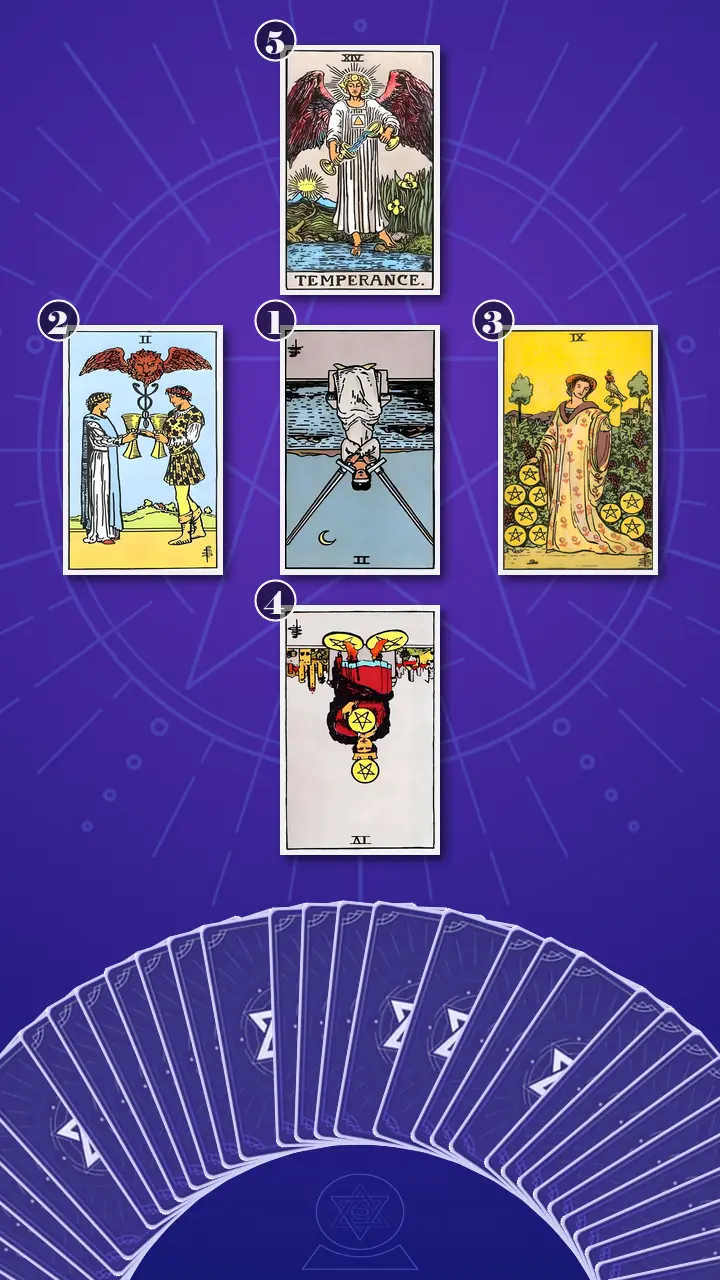
The Blindfold in Your Notes App
Position 1: The Immediate Dilemma Under Time Pressure
“Now we flip the card that represents the immediate dilemma under time pressure: what your mind and body are doing right now when you try to decide,” I said.
Two of Swords, reversed.
This one is painfully modern. The image is a blindfold and crossed swords held tight at the chest—calm on the outside, braced on the inside.
And the lived version of it, for Jordan, was exact: eight rental tabs open, calendar open, a Notes app pros/cons list—yet they won’t hit “send” on the one text that would start a real budget and timeline conversation. Outwardly it looks reasonable and chill; internally it’s a stalemate that costs options every day the market moves.
“Research isn’t the same as information—sometimes information only shows up after the conversation,” I said, and I watched Jordan’s mouth do that tiny, involuntary twitch that means called out.
Energetically, reversed, the Two of Swords is a blockage that’s starting to break. Not because you suddenly feel ready—but because reality is forcing movement. The roommate notice is the moment the blindfold slips. The cost of waiting is no longer theoretical.
Jordan let out a short laugh—one part humor, one part flinch. “That’s… so accurate it’s kind of rude,” they said, and then they looked down at their hands like they’d just realized they were gripping their own fingers.
I nodded. “It’s not here to shame you. It’s here to show you the posture you’re in: you’re trying to stay neutral so you don’t have to risk wanting something out loud.”
Position 2: Path A (Move In) — What This Option Develops
“Now we flip the card that represents Path A—moving in with your partner: what this option develops in you and the relationship if handled consciously,” I said.
Two of Cups, upright.
This card doesn’t mean “move in, it’s destiny.” It means: if you choose the togetherness path, the skill you’ll need is mutuality—face-to-face clarity instead of hypothetical planning in your head.
In modern terms, it’s this: moving in works best when you treat it like a joint build. A sit-down logistics talk. A shared definition of “home.” Agreements that protect both people’s needs. Not vibes-only. Not “we’ll figure it out.”
I leaned back a little, deliberately. “You can’t co-design a home in your head,” I said. “This is like a project kickoff—calendar invite, agenda, shared doc. The modern exchange of cups.”
Jordan’s shoulders dropped by maybe half an inch—small, but real.
“If this went well,” I asked, “what would make it feel like a chosen commitment, not a rent rescue plan?”
Jordan swallowed. “I’d need… alone time to be normal. Not a fight. And money to be transparent. And I don’t want to be the only one doing the mental load.”
“Good,” I said. “Two of Cups energy is equal voice. A simple mirrored line: ‘Here’s what I need to feel safe—what about you?’”
Position 3: Path B (Live Alone) — What This Option Strengthens
“Now we flip the card that represents Path B—living alone: what this option develops in you and your stability if handled consciously,” I said.
Nine of Pentacles, upright.
I’ve always liked how unashamed this card is. It doesn’t apologize for wanting a sanctuary. It’s a walled garden—curated, intentional, calm.
In Jordan’s life, it translated cleanly: coming home to a quiet space where routines don’t require negotiation—lighting, mess level, guest boundaries, decompression time. Not as a breakup signal. As a stability chapter that could make them more grounded and less reactive in the relationship.
I watched Jordan’s eyes soften in that faraway way people get when they imagine a specific kind of peace. “I can picture my own lamp,” they said, almost embarrassed. “And like… not having to explain why I’m quiet after work.”
“That’s not selfish,” I said. “That’s self-regulation.”
Then I held both options up together, because this was the moment Jordan kept turning into a moral referendum: love vs independence.
“Here’s the reframe,” I said. “Sanctuary and mutuality are two legitimate needs. If you live together, you’ll practice shared decisions and shared meaning. If you live alone, you’ll practice self-trust and baseline calm. Neither is a statement about your worth.”
Jordan’s lips pressed into a thin line, then released. “I keep acting like living alone means I’m not serious,” they admitted.
“Independence isn’t a wall,” I said. “It’s a boundary with a door.”
Position 4: The Key Factor Beneath the Choice
“Now we flip the card that represents the key factor beneath the choice: the underlying fear/control point that makes either option feel high-stakes,” I said.
Four of Pentacles, reversed.
The image is a person holding coins tight to their chest, with more pinned under their feet—control as a posture. Safety bought at the price of movement.
In modern life, it looked exactly like Jordan’s private security audit: tracking every dollar, imagining every conflict, tensing up at the idea of someone else influencing their home routines. The control is meant to keep them safe—but it also turns the choice into an identity test: If I choose wrong, it proves I can’t trust my judgment.
I used a conflict-contrast frame because this pairing—Two of Swords reversed on top, Four of Pentacles reversed underneath—is where the whole paralysis lives.
“You look calm,” I said, “like you’re being responsible. But your body is braced—jaw locked, shoulders up—while your screen shows ‘productive’ research.”
Jordan’s breath caught, like they’d just been seen from the inside.
“Toronto rent stress doesn’t help,” I added, grounding it in the real micro-details: “Credit checks, viewing queues, the sense that if you don’t jump fast you’re out. So your nervous system tightens its grip, and suddenly you’re not choosing a home—you’re trying to control all possible futures.”
Jordan did the exact three-step reaction I see when a card hits: a brief freeze (their hands went still), then the look of memory replay (their eyes unfocused like they were back on their couch with the tabs), then the exhale—long, shaky, real.
“If it has to be perfect to be safe,” I said gently, “it’s probably control— not clarity.”
Jordan nodded once, like they were signing something internally. “To prove I’m not dependent,” they said, “I keep wanting to pick living alone… but it’s not even about the apartment. It’s about not wanting to feel exposed.”
When Temperance Poured Between Two Cups
Position 5: Integration and Next Step — Your Method Forward
I let the room get quiet on purpose. The fridge hum suddenly sounded louder, like the apartment itself was leaning in. “We’re flipping the integrating guidance now,” I said. “This is the card that tells us how to make the decision in an empowered way—process, boundaries, and a plan you can actually execute.”
Temperance, upright.
Temperance is the alchemist. One foot on land, one in water. A steady pour between two cups. It’s not an all-or-nothing leap; it’s a practiced blend.
In Jordan’s world, Temperance was immediate and practical: a time-bound, adjustable plan. A 90-day pilot. Money rules, alone-time blocks, chore expectations, a review date. A choice that’s allowed to evolve.
Setup: Jordan was still stuck in the same late-night loop: 11:46 PM on the couch, rentals open in three tabs, a Notes app pros/cons list, and a half-drafted text about budgeting they kept deleting—because hitting “send” makes it real.
Delivery:
Stop treating this like a one-shot verdict and start treating it like Temperance’s pour: blend love and autonomy through a time-bound experiment with clear boundaries.
I didn’t rush past the silence after that. I let it ring in the air like a bell you can feel in your ribs.
Reinforcement: Jordan’s face changed in layers. First, their eyebrows lifted slightly—surprise. Then their jaw loosened in a way that looked almost unfamiliar to them, like they’d been wearing armor so long they forgot it had weight. Their shoulders lowered, but not all at once—more like a slow unhooking. They swallowed and blinked a few times, and their eyes went glossy with that specific mix of relief and grief: relief that they weren’t required to predict the entire future, grief that they’d been punishing themself for not being able to.
They gave a small, frustrated laugh that wasn’t funny. “But if I do that,” they said, a flicker of anger under the fear, “doesn’t it mean I’ve been doing it wrong? Like… I should’ve been able to just decide like an adult.”
I kept my tone level—more coach than comforter in that moment. “In trading, the adult move isn’t ‘never be wrong.’ The adult move is risk management. You don’t need a perfect prophecy; you need terms you can live with.”
Then I gave them a micro-ritual—my old trading floor focus technique, repurposed for human life. “Set a 10-minute timer,” I said. “Open a note and write two lines only: (1) ‘My non-negotiable for feeling like myself at home is: ____.’ (2) ‘One thing I’m flexible about for the next 3 months is: ____.’ If you feel your chest tighten or your jaw clench, pause and do three slow breaths—this isn’t a test, it’s information. When the timer ends, stop. Your only next step is to copy/paste those two lines into a text to your partner that says: ‘Can we do a 45-min logistics-only chat this week? I wrote two things I want to start from.’”
Jordan stared at the table, breathing like they’d just come up from underwater. Then they looked at me. “That… feels doable,” they said, voice a little shaky. “It also feels terrifying.”
“Good,” I said. “That’s the difference between clarity and control. Clarity usually comes with a little vulnerability.”
I asked the question that turns insight into lived memory: “Now, with this Temperance lens—process over verdict—think back over last week. Was there a moment this could’ve helped? A moment you could’ve said, ‘This plan serves me for a season’ instead of ‘This choice defines me’?”
Jordan’s eyes darted left, like they were scanning a timeline. “Tuesday,” they said. “My partner texted ‘miss you—dinner?’ while I had a spreadsheet open. I sent a heart and closed the sheet because I couldn’t handle money and romance in the same minute. If I’d had a plan, I could’ve just… scheduled the talk.”
That was the shift landing: from deadline-driven overthinking and control-gripping to grounded clarity through adjustable agreements and practical self-trust. Not certainty—trust in a method.
From Cards to Contract: The 90-Day Living Plan (Actionable Advice)
I gathered the thread of the whole spread into one clean story—because scattered insights don’t help when the lease clock is ticking.
“Here’s what the cards are saying,” I told Jordan. “Right now, you’re in Two of Swords reversed—staying ‘neutral’ while your body is braced, hoping more research will replace the need for a real conversation. Path A—Two of Cups—works when you treat cohabiting like co-design: equal voice, explicit agreements. Path B—Nine of Pentacles—works when you treat living alone as a sanctuary chapter, not a relationship statement. Underneath it all is Four of Pentacles reversed: the fear that if you choose wrong, it proves you don’t have control. And Temperance is the way through: a time-bound experiment with a review date, so the decision becomes a process you can refine.”
“Your cognitive blind spot,” I added, “is that you’ve been treating this like a one-shot exam. That’s why you keep rewriting pros/cons like a novel and still can’t choose. The transformation direction is different: you’re not searching for a perfect permanent answer—you’re designing a values-based living experiment with clear agreements and exit options.”
In my old life, I would’ve called this a valuation problem with incomplete information. So I brought in my signature approach—not as jargon, but as relief. “This is where I use what I call Strategic Crossroads Analysis,” I said. “It’s the same idea as probability-weighting scenarios in M&A: you stop demanding one certain future and start building a plan that performs well across multiple plausible futures.”
Then I switched into the practical container Jordan actually needed: my SWOT–TAROT 10-minute rapid assessment plus a boardroom-style decision ledger. No mysticism—just structure that calms the nervous system.
- Schedule the real conversation (45 minutes)Tonight or tomorrow morning, send a calendar invite titled “Move logistics (45 min)” to your partner. Include 5 bullets: budget range, timeline, chores, guests, alone-time routines. Treat it like a project kickoff, not a romantic vibe check.If it feels awkward, remind yourself: awkward is cheaper than resentment. Keep the first meeting logistics-only—if emotions spike, pause and return to numbers and routines.
- Write “v0.1” of a shared living agreementOpen Notes or Google Docs and draft one page called “Shared Living Agreement (v0.1).” Write 3 non-negotiables (e.g., alone time blocks, money transparency, kitchen standards) and 3 flexibles (what you can live with for the next 3 months). Add one review date.Name it v0.1 on purpose. You’re not choosing a destiny. You’re choosing a first draft.
- Pick a review date now (and an exit option)Choose a review date—“90 days after move-in,” or “end of month one,” or “two weeks after I sign a solo lease.” Write one sentence: “Working looks like ____.” Also write an exit option (sublet plan, spare room plan, savings buffer) so your nervous system stops treating the choice like a trap.A review-date decision reduces choice paralysis fast because it turns fear into a calendar event—something you can handle.
Jordan looked at the list like it was a handrail. “This is… the first time it’s felt like there’s a way to do this without losing myself,” they said.
I nodded. “That’s Temperance. Structure without rigidity. Flow without chaos.”

A Week Later: Ownership, Not Certainty
Six days later, Jordan messaged me a screenshot.
It was a calendar invite: Move logistics (45 min). Five bullets. A time. A little green checkmark next to “sent.”
Under it, Jordan typed: “We did it. I was sweating. But it didn’t explode. We picked a 90-day plan with a review date. I still feel nervous… but I can breathe.”
There was a bittersweet honesty in the follow-up: they said they slept through the night for the first time in weeks—then woke up and their first thought was still, What if I’m wrong? But this time, they noticed their jaw wasn’t clenched. They actually smiled a little, like, Okay. I can handle a season.
That’s the quiet proof I look for. Not perfect certainty. Ownership. A process you can trust. Agreements you can name out loud. A plan you’re allowed to adjust.
When you’re holding two futures like they’re both breakable, your jaw tightens and your brain tries to spreadsheet away the risk—because it feels like one “wrong” lease could cost either the relationship or your sense of self.
If you didn’t have to be 100% certain, what would a three-month version of “home” look like that protects your independence and still lets love be real?