When 'Miss You' Meant Relief, Not Reconnection: Breaking the Reply Ref

When an Ex Texted ‘Miss You’ and the Whole Condo Changed Shape
If you’re a late-20s hybrid-work woman in Toronto who can run a campaign wrap-up all day and still feel your whole chest tighten when an ex texts ‘miss you’ at 10:47 p.m., I want to say this first: you are not overreacting. When Maya (name changed for privacy) came to me, she wasn’t asking for a prediction so much as an explanation for why one vague message could hijack an otherwise normal night.
She told me about a Wednesday around 10:13 p.m., standing in socks in her condo kitchen near St. Clair West, leftover takeout going cold on the counter. The fridge hummed. Blue phone light washed over the cabinets. The sweet-salty smell of dinner hung in the air while her thumb opened a pinned iMessage thread before she had fully exhaled. ‘It was just one text,’ she said, ‘and suddenly my whole evening had a center of gravity.’
That was the contradiction sitting right in front of us: she wanted to feel wanted and connected again, and she was also afraid of the old loneliness that rose up the second she didn’t reply. Her body knew it before her mind did. She described the tight chest, the drop in her stomach, the almost magnetic pull toward the phone. Longing, in her case, wasn’t some poetic ache from Normal People; it was like a hidden hook behind the sternum, tugging her back toward a screen that had already disappointed her before.
‘I know better,’ she told me, looking equal parts embarrassed and exhausted. ‘But I still want to see what happens if I answer.’
I nodded. ‘The text is brief. The loneliness it wakes up isn’t. And that doesn’t make you weak. It makes you human.’
I could feel how practiced she was at being high-functioning in public and privately rearranging her whole nervous system around one person’s typing bubble. So I met her there, gently. I told her we weren’t here to shame the reply. We were here to understand the loop underneath it and, together, make a map toward clarity.

Choosing the Keyhole: Why I Used the Shadow Spread
I asked Maya to put both feet on the floor and take one breath out longer than the inhale. Then I shuffled slowly, not to perform mystery, but to give her mind a place to step down from the ledge. In my work, that pause matters. It helps the body arrive before the interpretation does.
For her question, I chose a five-position tarot spread I use often for hidden emotional mechanisms: The Shadow Spread. When people ask me how tarot works in moments like this, this is the answer I give: the cards are most useful when they stop us from obsessing over what the other person might do and start showing us what our own pattern is doing in real time.
I didn’t need a broad spread with outcome noise. I needed a clean structure for an ex-text spiral: the visible symptom, the older wound beneath it, the protective payoff of the behavior, the illuminating truth, and the integrated response. The Shadow Spread fit because Maya’s real question wasn’t, ‘Will he come back?’ It was, ‘Why do I keep replying for relief, and what old loneliness is running the show when I do?’
I explained the layout to her as I placed the cards. The top card would show the surface pattern activated by the text. The two below it would reveal the hidden engine: wound on one side, payoff on the other. Then the card beneath them would act as the turning point, and the final card would ground the insight into boundaries, language, and self-respect. Visually, it forms a kind of keyhole. You start with the bright little trigger, descend into the deeper chamber of the pattern, and come back out with discernment.
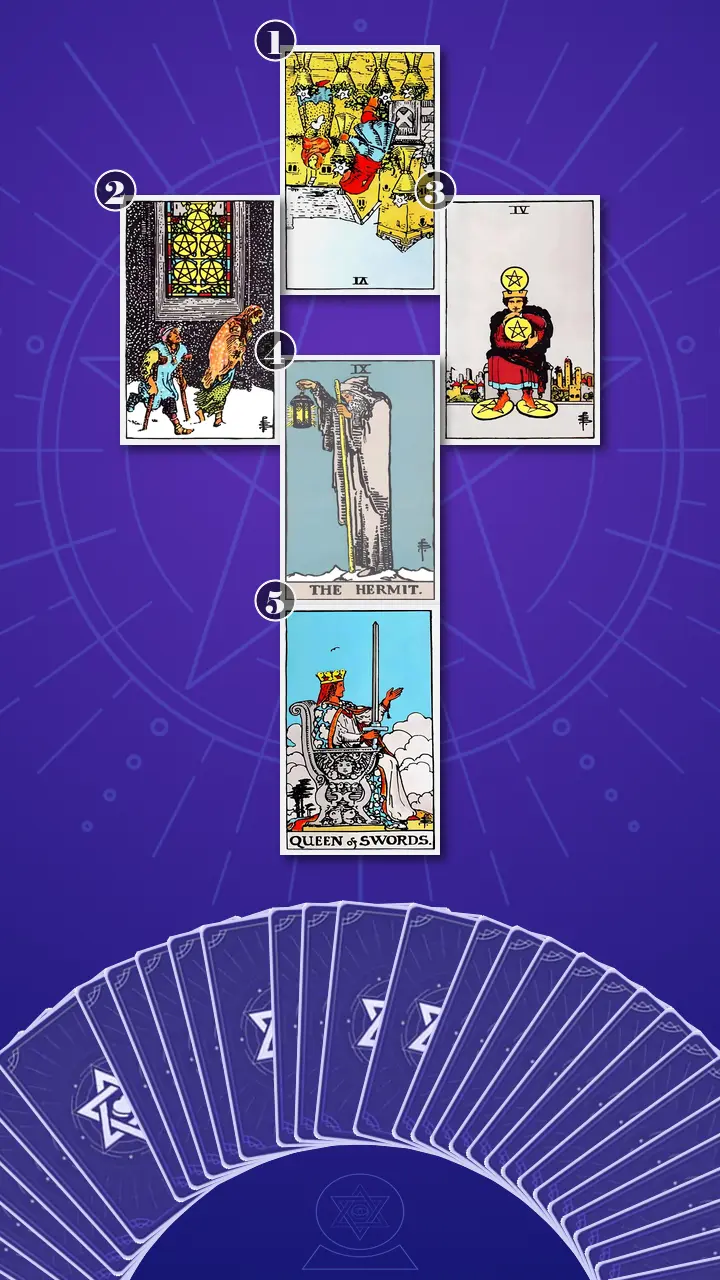
The Countdown Beneath the Pinned Thread
As I turned the first three cards, I noticed something I always pay attention to: Six, Five, Four. A countdown. In radio, I learned that when a sound narrows like that, it usually means the signal is collapsing into one dominant channel. That was exactly what her nights were doing. Memory narrowed into lack. Lack hardened into holding.
Position 1: Six of Cups Reversed — The Highlight Reel Opens
Now I turned the card representing the visible symptom: the emotional and behavioral pull that gets activated when the ex sends a tender message. The card was Six of Cups, reversed.
I told her this was the classic camera-roll highlight reel card. A single ‘miss you’ becomes a whole private montage: pinned thread open, old screenshots reopened, the safest memories queued up like a curated album. In real life, Maya wasn’t responding only to tonight’s message. She was responding to the softened edit of the relationship her mind could build in under sixty seconds.
In energetic terms, this reversal showed water moving backward. Nostalgia was in excess; discernment was blocked. The sweetness of the card was still present, but it had stopped being innocent. One soft line from him could pull her into a younger, more dependent version of longing before she asked the adult question: what do I actually want from this conversation?
‘It’s like Instagram Memories serving the cutest clip while your body remembers the rest,’ I said. ‘This card is saying the text doesn’t just reach tonight. It reaches the edited past.’
She let out a short laugh that landed with more sting than humor. ‘Okay,’ she said, rubbing her thumb along the rim of her water glass, ‘that felt weirdly specific. I do exactly that.’
I asked her the practical version of the card’s question: what did she do in the first ten minutes after the last warm but vague text? Re-read? Screenshot? Draft? Quietly cancel her own plans in her head? Her eyes dropped to the table. That was answer enough before she said, softly, ‘All of it.’
Position 2: Five of Pentacles — Outside the Warmth
The next card represented the older loneliness underneath the reaction, the wound the text was waking up. It was Five of Pentacles, upright.
This is one of the clearest cards I know for the feeling of being near warmth but somehow still outside it. I translated it for her in the most ordinary way possible: getting home after a long hybrid-work day, stepping into a warm condo lobby, and still feeling emotionally out in the cold. The city is glowing. Other people seem tucked into softness. Your apartment is objectively fine. And somehow you feel as if you are standing outside the life everyone else got invited into.
Here the earth element wasn’t balanced; it was showing a deficiency of felt belonging. The ex’s text mattered not only because it came from him, but because it briefly acted like a temporary pass back into warmth. Not stable warmth. Not mutual warmth. Borrowed warmth.
‘This card doesn’t say you’re dramatic,’ I told her. ‘It says the sting is older than this man. The message lands on a place in you that already fears being left outside love.’
Her jaw tightened. She looked past me toward the rain-dulled window, eyes unfocusing the way they do when someone has stopped hearing the room and started hearing an old memory instead. When I asked what the deepest sting was after the thread went quiet—getting her hopes up again, feeling forgettable, or falling back into that old alone feeling—she swallowed and said, ‘The last one. Definitely the last one.’
Position 3: Four of Pentacles — Keeping the Door Cracked
The third card showed what replying was protecting or temporarily providing: the hidden payoff of staying emotionally available. It was Four of Pentacles, upright.
I pointed to the image of the pentacle pressed against the chest and translated it into her actual life. She kept the thread alive just enough—quick reply, warm tone, no direct question about intentions—because an open door felt safer than a closed one. The contact became emotional insurance: not intimacy, not commitment, but enough access to delay the full hit of loneliness.
This was earth energy in overcorrection. After the exposed ache of Five of Pentacles, the system answered with gripping. Control stepped in where trust was missing. If the conversation stayed technically open, then the night didn’t have to drop all at once.
‘Attention can feel like intimacy when you’re starving for warmth,’ I said. ‘That’s what this card knows. It’s the difference between belonging and access.’
Then I linked the second and third cards the way they wanted to be read together. ‘This is like getting home to a warm building and still feeling emotionally outside it, so you leave one door cracked open in winter because fully closing it feels colder. The thread stays alive not because it’s nourishing you, but because part of you is thinking, “If I keep access, I do not have to feel the whole drop tonight.”’
That landed. I saw it physically before I heard it verbally: first her breath caught high in her chest, then her gaze dropped to the Four of Pentacles as if it had ratted her out, and then her shoulders lowered by a fraction. ‘Yes,’ she said, almost under her breath. ‘That is exactly why I keep the thread alive.’
I told her something I wanted her to keep: replying fast can be a bid for relief, not a vote for the relationship. Shame had been making the pattern feel more romantic than it was. In truth, it was a coping loop.
When the Hermit Lifted the Lantern
The room changed when I turned the fourth card. Even the small lamp beside us seemed to sharpen; its reflection caught the gold of the card so the lantern looked lit from within. Outside, a streetcar bell sounded and faded, and the quiet that followed felt useful.
Position 4: The Hermit — Borrowed Warmth or Self-Carried Light
Now I turned the card representing the key insight that brings the shadow pattern into awareness and interrupts the automatic reply loop. It was The Hermit, upright.
At 11:56 p.m., with the room dark, the charger buzzing, and that pinned thread brighter than anything else in the apartment, it can honestly feel like replying is the only thing standing between you and a hollow night. Maya was trapped in that exact logic: if she didn’t answer, the emptiness would get the final word.
Not every flicker on your screen is real closeness; lift the Hermit’s lantern inward and let self-trust, not nostalgia, decide what deserves a reply.
I let that sit between us for a moment.
Then I translated the card into the version of solitude most people actually live. Not a mountaintop. Not some cinematic healing sequence. More like putting the phone face down, stepping out for a quiet lap around the block with no podcast, and hearing yourself clearly enough to realize: maybe I do not miss him; maybe I miss being soothed.
Because my work is rooted in music therapy, this is where I often use one of my signature tools: Conflict Mediation. In a studio, when one sharp frequency is spiking, I don’t argue with the sound. I lower the harshness so the true signal can come through. That is what The Hermit does. He lowers the frequency of urgency. He lets the quieter note underneath become audible. In Maya’s case, the quieter note was loneliness asking to be witnessed directly instead of outsourced to someone inconsistent.
‘The ache behind text back is not reliable evidence that the relationship is right,’ I said more softly. ‘A lot of the time, it is loneliness asking not to be outsourced to someone inconsistent.’
Her reaction came in layers. First, she went completely still, fingers suspended above her mug as if her body needed a second to catch up. Then her eyes shifted away from the cards and toward the floor, not avoiding me so much as replaying something private. I could almost see the late-night condo, the cold pillow, the blue-lit thread, the waiting. Then came the emotional release, but not in a neat, grateful way. Her eyes shone. Her mouth tightened. And she said, with a flash of resistance that mattered, ‘But if that’s true, does that mean I wasn’t even missing him? Does it mean I’ve just been doing this wrong?’
‘No,’ I told her immediately. ‘It means you were trying to protect yourself with the tool that was nearest. Wrong isn’t the useful word here. Protective is. Human is. But a soft message is not the same thing as a safe connection.’
I watched that distinction land. Her shoulders unclenched. The breath she let out this time was shaky, almost surprised, the kind that comes when someone has been bracing for impact and finally realizes they are not being judged. There was relief in it, but also a new vulnerability, that slight dizziness people get when the familiar loop stops running and they have to stand in clearer air. I asked her, ‘With this new lens, can you think of a moment last week when it would have felt different if you had named the loneliness before you answered?’
She nodded slowly. ‘Sunday night,’ she said. ‘I got home after brunch and the bookstore with friends. I was scrolling Stories of people cooking with their partners, and I kept checking if his typing bubble came back. I don’t think I even wanted him. I wanted shelter.’
That was the crossing point of the whole reading. Not from pain to perfection, but from reflexive ex-text spiraling and borrowed warmth to the first real inch of self-respecting clarity. The Hermit wasn’t asking her to become cold. He was asking her to carry some light of her own.
Position 5: Queen of Swords — The Daylight-Safe Reply
The final card represented the healthier response style: boundaries, language, and self-respect. It was Queen of Swords, upright.
I always love this card when someone is afraid clarity will make them cruel. The Queen of Swords says otherwise. She allows feelings, but she does not make access automatic. In modern life, she is the text you can still stand by with coffee at 9 a.m., or the decision not to reply at all without turning it into a dramatic performance.
This was air energy in balance. After the backward water of nostalgia and the heavy earth of scarcity and gripping, the reading finally opened into clean thought. I told Maya that integration here looked like separating tenderness from access. She could acknowledge that the message stirred something real without reopening a door she could not safely hold.
‘Brief does not mean rude. Clear does not mean cold,’ I said. ‘Think of this as app permissions: feelings allowed, access not automatic.’
That made her smile in a way that was almost a wince, but lighter. She opened her Notes app right there, which told me the card had reached behavior, not just insight. Tomorrow-morning her, not 11 p.m. her, was finally getting a vote.
From Borrowed Warmth to Boundaries
When I gathered the reading back into one story for her, the pattern was clean. Six of Cups reversed showed the nostalgic edit: one tender line from the past turning into a whole softer movie than the relationship really was. Five of Pentacles named the deeper wound: the old loneliness of being near warmth and still feeling outside it. Four of Pentacles showed the protective move: keeping the thread alive because access felt easier than the full drop of emptiness. Then The Hermit interrupted the reflex by asking her to meet the loneliness directly. And Queen of Swords turned that insight into language and limits.
The blind spot was this: Maya had been treating relief as evidence. If the text eased the night for ten minutes, part of her took that as proof the connection still meant safety. But relief is not the same thing as alignment. Access is not the same thing as belonging. The transformation direction was equally clear: stop using his message to soothe the loneliness, name the loneliness directly, and let contact become a conscious choice made from self-respect instead of a reflex used to escape the room she was in.
I gave her a few very practical next steps. I wanted them small enough to survive real life, especially on lonely nights.
- The Lantern Pause + Soundproof BarrierThe next time his name lights up, set a 20-minute timer and place the phone face down in the kitchen, bathroom, or across the room. If you need support, use my Soundproof Barrier approach: play one low-lyric instrumental track, no podcast, no doomscrolling, and let the sound create just enough personal space for the feeling to surface. Then name three things out loud: ‘This is longing. This is anticipation. This is shame or fear.’If 20 minutes feels impossible, use a five-minute version or one song length. The magnetic urge to grab the phone back does not mean the pause is failing; it usually means you found the exact loop.
- The Three-Fact Thread Reality CheckBefore sending anything, open Notes and write three plain facts about the full relationship: one tender truth, one painful truth, and one repeated pattern. If you feel tempted to reread, look at the last 30 days of the thread instead of your favorite screenshot or photo.Rename any hidden album or screenshots folder to ‘Part of the story’ so your phone stops presenting nostalgia as the whole truth. Knowing the facts abstractly is different from feeling them in the moment.
- The Morning-After Boundary TestDraft only the reply you could still respect at 9 a.m. tomorrow, not the one that matches the emotional charge of 11 p.m. Keep one or two lines saved in Notes, such as ‘I hear you. I’m not available for casual check-ins right now,’ or ‘Hope you’re okay. I’m keeping some distance, so I won’t be reopening this.’ If no reply feels truest, mute the thread for 24 hours before deciding anything permanent.You do not owe a long explanation to protect your clarity. No response is also a response. Start with the smallest version if needed: do not answer tonight.
I told her plainly, because some truths need to sound almost boring to be useful: you do not have to make contact the cure for a lonely night.

A Week Later, the Room Sounded Different
A week after our session, Maya sent me a short message. Not a dramatic breakthrough update. Just this: ‘He texted again. I did the timer. Put my phone in the kitchen. Walked one block with no podcast. Realized what I wanted was comfort, not him. I didn’t answer that night.’
That was the proof I care about most. Not a solved life. Not a perfectly detached heart. Just a different choice made inside the same trigger.
She told me she slept through the night afterward, though when she woke up the next morning her first thought was still, what if I misread it? Then she laughed, made coffee, and left the thread muted. Clearer, not invincible. Steadier, not numb.
That is what a real journey to clarity usually looks like in my practice. Not a thunderclap. More like borrowed warmth losing its monopoly. More like self-trust coming back online one pause at a time.
Sometimes the hardest part is not missing them. It’s hearing your own chest tighten in a quiet room and wondering whether letting the text fade means admitting you were never as safely held as you wanted to be.
If tonight you did not have to hand that loneliness back to one glowing thread, what tiny choice might help you feel a little more like yourself in the next ten minutes?