A Warm Phone, an Unsent 'Hey,' and the Message vs Pattern Turn

The 12:18 p.m. “Miss You” Spiral
If you are a late-20s hybrid-office worker who can handle Slack, decks, and downtown rent just fine but still lose an entire lunch break because your ex texted “miss you,” I know exactly what that post-breakup breadcrumb paralysis looks like in the body.
Emma (name changed for privacy) came to me in Toronto with the kind of question people usually type into Google at 11:42 p.m.: my ex texted “miss you” after no contact—do I reply, or do I keep healing? But the moment she described to me was not midnight. It was 12:18 p.m. on a Wednesday in the PATH food court. A half-eaten salad going warm beside her laptop. Fluorescent lights buzzing overhead. Soy sauce drifting from the next table. She opened the thread between Slack notifications, typed “hey,” backspaced it, checked the timestamp again, and locked her phone like the meaning might update if she waited ten more minutes.
“I know it’s just two words,” she said, wrapping both hands around a coffee that had already gone cold, “but it feels loaded.”
I could see the whole contradiction sitting in her posture before I named it. Her jaw was tight. Her chest looked braced. Her hands had that restless, nowhere-to-go energy I have seen in traders before market opens and in heartbreak long after it should have become quiet. She wanted to feel chosen by him again, and she also did not want to restart healing from day one. Longing was moving through her like twenty-seven browser tabs open in the nervous system while one tiny notification sound kept hijacking the entire screen.
Then she said the line that told me exactly where we were: “Why does one text get this much power over my whole day?”
“Because your mind thinks it’s solving a message,” I told her, “when really your body is responding to a pattern.” I kept my voice calm, companionable. “That doesn’t make you dramatic. It makes you activated. So today, we’re not going to treat his text like a verdict on the whole relationship or on your value. We’re going to draw a map through the fog and find the clearest next step.”

Choosing the Compass: A Decision Cross Tarot Spread for Whether to Reply to an Ex
I asked her to put the phone face down, take one slow breath with one hand on her chest and one on her stomach, and hold the question in plain language: Do I reply, or do I keep healing? Then I shuffled slowly. Not for theater. Not for mystique. Just to create a clean transition between the spike of emotion and the work of seeing clearly.
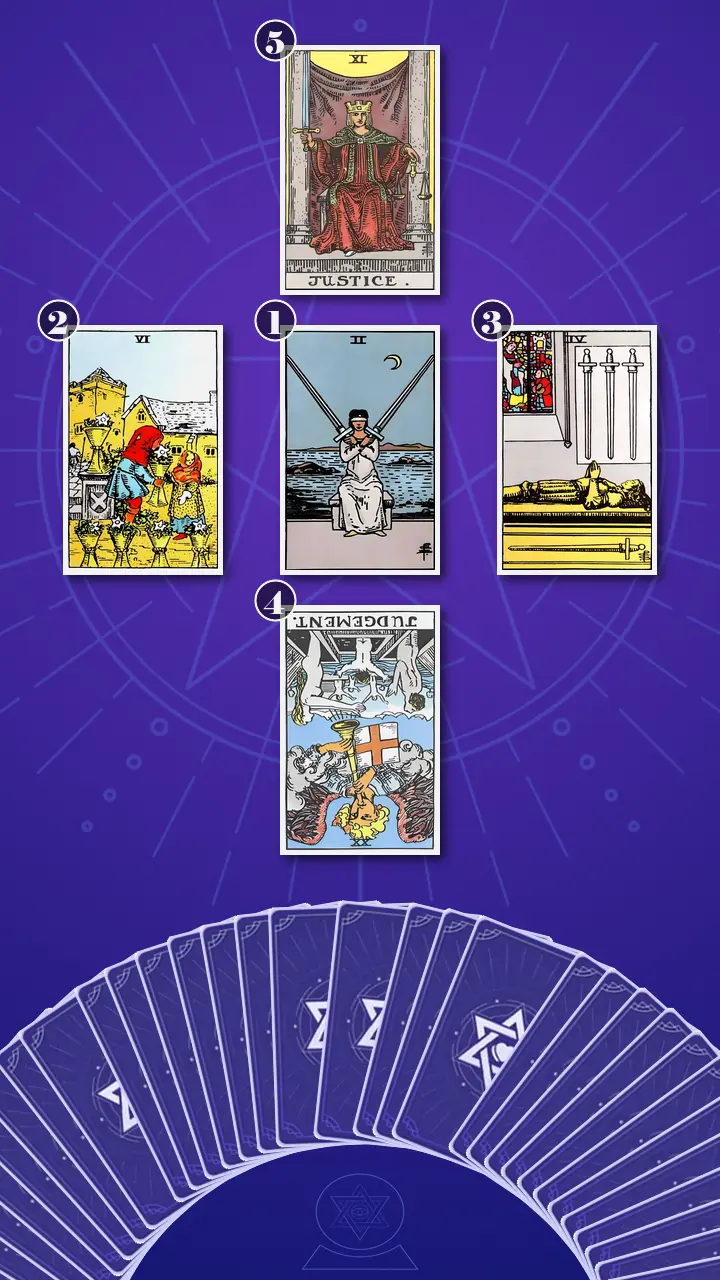
I told her I was using the Decision Cross · Context Edition. It is one of my favorite spreads for moments exactly like this, when a soft message from an ex creates a reactive relationship choice and the mind starts spinning. This is how tarot works at its best for me: not as fate, not as a rom-com plot twist, but as a structure that slows a decision down enough for the truth to become observable.
This spread fits because the surface question is simple and split cleanly in two: reply, or keep healing. But instead of pretending tarot should predict what the ex “really means,” the left and right positions examine what each path is emotionally serving. The center card shows the immediate freeze. The lower card exposes the hidden wound making the choice feel so heavy. The upper card gives guidance rooted in standards rather than impulse. Five cards are enough. Anything more, in a moment like this, would just help rumination put on nicer clothes.
I laid the cards in a compass cross on the table: the present at the center, the pull to reply on the left, the protection of distance on the right, the deeper root beneath, and the clearest line of sight above. As I placed the final card, a pale stripe of afternoon light crossed the cloth so neatly it looked almost measured. The room felt less mystical than precise, which is exactly how I like it.
Reading the Map: Card Meanings in Context Before the Ping Becomes a Verdict
The Freeze Before the Reply
Now I turned over the card representing the immediate crossroads created by the ex’s message, including the visible freeze response she had described. It was the Two of Swords, upright.
I pointed to the blindfold and the swords crossed over the figure’s chest. “This is not a lack-of-information card,” I told her. “This is a blockage card. Your mind is working very hard, but it’s working as armor.” I translated it straight into her actual day: opening the thread between Slack pings, typing a one-word reply, deleting it, checking the timestamp again, then carrying the unsent answer around for hours like it had become part of her body.
The energy here was blocked air. Not clarity. Not calm. Just overthinking disguised as neutrality. Any move felt impossible because both directions had been inflated: if she answered, maybe she reopened the wound; if she didn’t, maybe she closed the last chance to be chosen. The card made it plain that she was hovering over “send” so long the draft had become its own emotional weather system.
Emma gave a short laugh that landed somewhere between recognition and embarrassment. “That is literally me,” she said. Then she shook her head. “Also kind of mean how accurate that is.”
“Not mean,” I said, smiling a little. “Just specific. And specificity is how we get out.” I tapped the card once. “Pause is not playing games; pause is data. This card is asking what you already know when you stop rereading and listen to your body for ten seconds.”
The Sweetness You Want to Trust
Next I turned the card representing what replying is emotionally seeking, especially the pull toward comfort, validation, and being chosen again. It was the Six of Cups, upright.
I have seen this card do what Spotify autoplay does after a breakup: serve only the prettiest tracks and skip the breakdown scenes. “This is the warm edit,” I told her. “This is you reading ‘miss you’ and instantly getting pulled toward old photos, inside jokes, weekend drives, the playlist, the version of the relationship that felt easy before the confusion took over.”
The energy here was excess water. Tenderness overflowing its actual container. The emotional promise of replying was not really proof; it was relief. Relief from loneliness. Relief from grief. Relief from the ache of not being chosen. The offered cup in the card was sweet, but sweetness is not the same thing as safety.
“Soft isn’t the same as safe,” I said.
Her eyes snapped up to mine. That line landed exactly where the card wanted it to. She looked back down and pressed her lips together. “I hate that part of me still wants it to mean he finally gets it,” she said.
“Of course you do,” I replied. “That doesn’t make you foolish. It makes you attached to something that mattered. But this card is asking whether you would be replying to the person in front of you now, or to the highlight reel grief can cue on command.”
The Peace Already Under Construction
Then I turned the card representing what keeping distance is protecting and restoring, especially the healing process already in motion. It was the Four of Swords, upright.
This is one of the clearest cards I know for a pause-before-replying-after-breakup moment. People often read it as avoidance. I almost never do. I read it as regulation. I translated it into her actual life: putting the phone face down, muting the thread for a day, stepping outside into cold air after work, unclenching the jaw, letting the first wave pass before deciding what contact means.
The energy here was balance returning through stillness. Not punishment. Not mind games. Not a silent strategy to get him to chase. This was her nervous system asking for recovery. Like putting the whole internal dashboard on Do Not Disturb after too many push notifications. I reminded her of the steadier routines she had already built: better sleep, fewer profile checks, more time with friends, quieter mornings that did not begin with digital archaeology.
At that, her shoulders dropped a fraction. Small, but unmistakable. In readings like this, that kind of exhale is often the first real opening.
“Okay,” she said, breathing out through her nose. “That actually feels true. I don’t have to answer from the first wave.”
“Exactly,” I said. “Chemistry is loud. Regulation is quieter, but it tells the truth for longer.”
The Retrial You Keep Scheduling
Then I turned the card beneath the center, the one representing the hidden root shaping the decision, especially the unfinished wound and fear of finality maintaining the loop. It was Judgement, reversed.
Reversed, this card shows blockage. The awakening is there, but it does not fully land. It always makes me think of someone reopening the same file again and again, convinced the answer is in one more pass. I told her what I saw in modern terms: screenshotting the text to the group chat, reopening old chats, mentally retrying the breakup like a case file, hoping this tiny contact might finally settle what the relationship meant and what she was worth.
“This,” I said gently, “is what makes two words feel huge. Not because the message is huge, but because it’s carrying unfinished grief and fear of finality. If you can decode this perfectly, maybe you don’t have to feel the ending yet.”
Her body reacted before her face did. First her breathing stopped for a beat. Then her eyes unfocused, as if a private replay had begun somewhere behind them. When she came back into the room, her voice was low and careful. “If I don’t reply,” she said, “it feels like I’m the one closing the last door.”
“And that,” I told her, “is not really a texting question. It’s a worth question. You do not need one more breadcrumb to validate the whole relationship.”
The room went quiet enough for me to hear the radiator click on. It sounded like a small mechanical sigh, which was exactly what she let out next.
When Justice Spoke: The Message vs Pattern Turn
The Guidance Card at the Top of the Cross
We turned the final card together. This position offered the healing-aligned principle for response, the standard that could translate insight into something clear. It was Justice, upright.
A line of window light caught the gold on the card as soon as it landed. Balanced scales. Upright sword. Straight-backed figure between pillars. In an ex-texting situation, this is what Justice tarot meaning comes down to: less rom-com plot twist, more receipts.
Justice always wakes up my old Wall Street brain. For half a second, I was back on a trading floor listening to polished stories wrapped around ugly exposure. A pitch deck can sound gorgeous; the real risk lives in the pattern. That is why I trust this card so much. It does not care what feels persuasive in the moment. It asks what has been consistent over time.
I showed Emma the visual dialogue between this card and the first one. “The Two of Swords sat blindfolded with intellect crossed over the heart,” I said. “Justice has eyes open. Same mind, different use.” Then I brought in one of my own diagnostic lenses, the Potential Mapping System. “Right now you’re toggling between Sprinter energy—reply now before the chance disappears—and Deep Thinker energy—decode every syllable until the perfect answer appears. Both are fear modes. Justice asks for a third mode: the Arbiter. The part of you that weighs evidence instead of adrenaline.”
She stared at the card without blinking. The room seemed to narrow around it.
You are standing in the same moment again: lunch break, phone warm in your hand, his two words on the screen, your body already tightening before your mind can decide whether this is hope or danger.
Stop letting one soft message outweigh the full pattern; place this connection in Justice's scales and choose what is balanced, true, and self-respecting.
A tender text can be real and still not be enough. The question is not whether the message feels meaningful; it is whether the pattern has earned access to your peace.
I let that sit between us without rushing to fill it.
Her first response was not relief. It was resistance. Her jaw flexed. “But doesn’t that mean,” she said, then stopped and tried again, “that I’ve been giving two words way too much power?”
“It means you’ve been human in an activated moment,” I said. “And it means the decision gets cleaner when it stops being about whether this text proves anything about your value.”
Then the real shift happened in layers. First came the freeze: her inhale caught halfway, and her fingers hung in the air as if still hovering over Send. Then came the seep-through: her gaze drifted past me, not gone, just inward, replaying lunch breaks, lock-screen jolts, and screenshot spirals under a new light. Then came the release: her shoulders lowered, her mouth softened, and she let out one shaky breath that sounded half laugh, half grief. Her eyes filled, but she did not collapse. She looked like someone who had just set down a bag she forgot she’d been carrying across the whole city, and was a little unsteady simply because the weight was gone.
“What is emotionally loud is not always relationally true,” I said. “Let the pattern speak louder than the ping.”
I slid her phone back across the table. “Set a ten-minute timer,” I told her. “Open Notes. Make two headers: ‘message’ and ‘pattern.’ Under ‘message,’ copy the exact words he sent. Under ‘pattern,’ list three repeated behaviors from the relationship. If your chest tightens or you catch yourself bargaining with the facts, stop there. You do not have to choose a reply tonight.”
Then I asked her the question that matters after any real insight: “Using this new lens, was there a moment last week when this could have changed how you felt?”
She nodded slowly. “Sunday night,” she said. “I opened old photos right after the text. If I’d asked ‘message or pattern?’ I would’ve stopped way sooner.”
That was the turning point of the whole reading for me. Not because her feelings disappeared. Because the direction had changed. This was the beginning of the movement from hope-spike spiraling and screenshot analysis toward steady self-trust and boundary-led clarity. Not certainty. Better than certainty. Self-respect with its eyes open.
The Pattern Over Ping Check
When I gathered the five cards into one story, the logic was clean. The center showed paralysis, not because the text held some hidden magical answer, but because indecision had become a way to avoid immediate grief. The left side showed nostalgia offering comfort and the fantasy of being chosen again. The right side showed that distance was already doing something real: protecting sleep, focus, daily routine, and the quieter self she had been rebuilding. Underneath it all, Judgement reversed exposed the deepest weight: she was treating this small message as if replying or not replying would settle her worth. Justice corrected the entire frame. The real shift was from asking, “What does this text mean about us?” to asking, “What pattern has this person consistently shown, and what response protects my peace?”
I told her the biggest cognitive blind spot was simple but brutal: she had been treating tone as evidence. In business, that is how people buy the pitch and miss the liability. In love, that is how one soft ping becomes an all-day referendum. Justice wanted evidence-based clarity, not chemistry-led access.
So I gave her next steps small enough to do that night, not aspirational things she would ignore by morning. I also brought in one of my own tools, the 5-Minute Decision Tool, because when feelings are loud, clean structure is kindness.
- 24-Hour Nervous-System PauseTonight, mute this specific conversation and remove lock-screen previews for his contact. Then put the phone face down for ten minutes and walk one lap around your block, office floor, or nearest coffee shop without reopening the thread.If 24 hours feels impossible, do one hour. The rule is simple: do not turn activation into access.
- Message vs Pattern NoteOpen your Notes app and make two short columns: “what the text says” and “what the pattern has shown.” Under the first, copy the exact words. Under the second, list three repeated behaviors from the relationship—consistency, avoidance, repair, ambiguity, whatever is actually true.Lowest-effort version: write one sentence under each column and stop. Facts first, interpretation later.
- The 5-Minute Justice FilterSet a timer for five minutes and use my tri-axis check: Advantage, Risk, Breakthrough. Write one real advantage of replying now, one real risk to your healing, and one breakthrough condition that would need to exist before renewed contact counts as healthy—such as accountability, consistency over time, or a direct conversation instead of vague check-ins.If the Breakthrough column stays empty, that is information. You do not owe immediate access while the facts are still thin.
Before we closed, I gave her one last sentence to keep: “A tender text is not the same as repaired behavior.” She repeated it back to me the way people do when a phrase finally fits the shape of their own experience.

A Week Later: The Quiet Proof
Six days later, Emma sent me a short follow-up. She had muted the thread that night, texted one friend, “Please don’t decode this with me yet,” and made the message-vs-pattern note instead of reopening old photos. She did not reply that evening. More importantly, she slept.
The bittersweet part was honest and small: the next morning she still looked at the silent chat for a minute, stomach dipping on instinct, then put the phone down and made coffee anyway.
That is what a real Journey to Clarity usually looks like at the beginning. Not a cinematic ending. A quieter nervous system. Less screenshot analysis. More steady self-trust. The room inside the decision gets bigger, and suddenly you are no longer trapped in the doorway you already walked out of.
Sometimes the tightest chest comes from trying to protect your peace while still secretly hoping one small message will finally prove you were worth choosing all along. If that is where you are tonight, noticing the tug-of-war is already a form of clarity.
So if a soft ping lands this week, and you place it in Justice’s scales before chemistry gets the mic, what kind of reply—or silence—would feel easiest to carry in your body tomorrow morning?