Queen Streetcar Draft-Delete Loop—and the First Fair Handoff

The Queen Streetcar Draft-Delete Loop
If you’re the late-20s city sibling who can run a shared project board at work but still freeze over a “just tell me” text on the TTC, I know how quickly that can turn into family overfunctioning and invisible emotional labor. When Alex (name changed for privacy), a 29-year-old project coordinator from Toronto, sat down across from me, she looked composed in the way high-functioning people often do right before the truth starts leaking through the seams.
Before I even touched the deck, she gave me the scene that mattered. Tuesday, 6:12 p.m., standing on the Queen streetcar, one hand on the pole, one thumb hovering over her sibling’s “just tell me” text while the family group chat kept bumping the screen upward. The fluorescent light flickered. Her phone felt warm in her palm. Her shoulders were so high she nearly missed her stop. She had typed the real update, deleted the hardest lines, and sent the softened version instead.
“They said to tell them,” she said, looking down at her hands, “but I still feel like I should already have it handled.” Then, after a beat: “If I say all of it out loud, it becomes real.”
Her overwhelm wasn’t abstract. It had a body. Tight shoulders. A clenched jaw. A stomach that never fully settled. It felt, as she described it, like having 47 browser tabs open and one of them blasting audio she couldn’t locate. She wanted support, but the moment support became possible, her body treated honesty like danger. The contradiction was right there in the room: wanting to stop carrying family stuff alone versus fearing what would happen if she actually stopped editing the truth for everyone else’s comfort.
I nodded. “That makes sense,” I told her. “The edited update is still a burden—just one you’re carrying alone.” I let that settle before I added, more gently, “We’re not here to force a dramatic reveal. We’re here to make a map. Let’s find the part that’s yours, the part that isn’t, and the first clean step toward clarity.”

Choosing a Map for Family Overfunctioning
I asked her to shuffle while holding the question itself, not as a mystical performance but as a way to bring the nervous system and the mind into the same room. Then I passed her a paper blotter touched with bergamot and cedar. “One slow inhale,” I said. “Not to make this pretty. Just to give your body a cue other than alarm.”
I chose the Transformation Path Grid · Context Edition. For anyone who has ever wondered how tarot works in a practical reading like this, this is the part I trust most: the cards create structure. A standard relationship spread would have over-centered the sibling’s perspective and missed the real engine of the problem—the loop where Alex says less, carries more, feels more alone, and then concludes she has to keep carrying it alone. This grid is small, but it shows the whole arc clearly: visible overload, protective blockage, old family script, catalytic truth, practical redistribution, and the kind of connection that becomes possible once support is shared instead of hidden.
I laid the first three cards in a top row for diagnosis: the observable pattern, the immediate blockage, and the deeper inherited role beneath it. Then I placed the next three directly below them: the rebalancing truth, the concrete action, and the integrated relational state that could emerge. It looked like a split-screen floor plan—the hidden operating system above, the new operating procedure below.
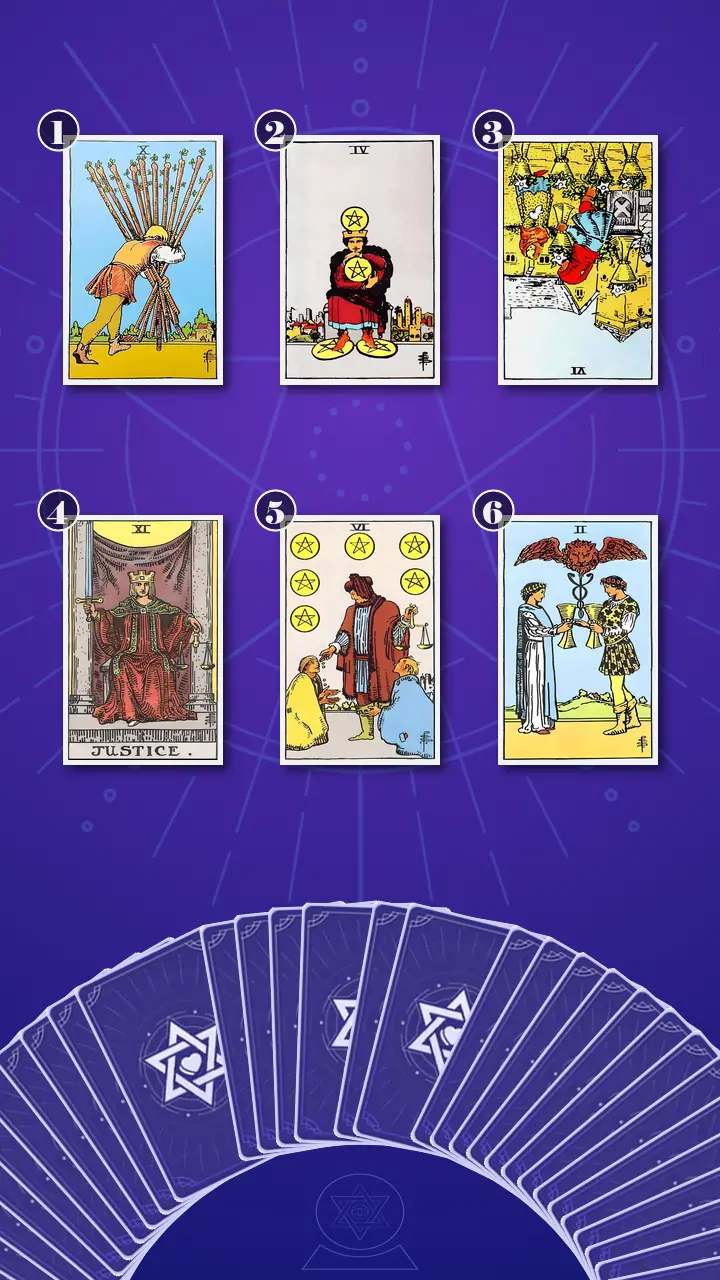
The Hidden Operating System Beneath the Group Chat
Position 1: The Load That Blocks the View
The first card I turned was the one showing the observable over-carrying pattern described in her daily life: Ten of Wands, upright. I didn’t have to stretch for the translation. It was the TTC version immediately—laptop bag digging into one shoulder, groceries cutting into fingers, three family threads open in the mind, and the sibling texting “just tell me” while she still replies, “I’ve got it.” This is excess fire burdened by duty. The energy isn’t wrong; it’s overloaded. And like the figure on the card, she’s carrying so much pressed to her chest that she can barely see the path ahead.
“In the last week,” I asked her, “when did you say it was handled even though you were already drained?”
She didn’t even have to think. “After the doctor call,” she said. “I gave my sibling the cleaned-up version. Then I spent the whole evening fielding messages and deciding what not to mention.”
That was the Ten of Wands exactly: being helpful quietly mutating into being the one person holding the full weight. I told her what I tell many people in this pattern: being useful can feel safer than being vulnerable, but usefulness can also become camouflage. The card was showing her the body-cost of that camouflage. She gave one short laugh, the kind that carries more recognition than amusement. “Okay,” she said. “That’s rude. But accurate.”
Position 2: The Safe Version Held to the Chest
The next card revealed the immediate blocking strategy that keeps support out and pressure in: Four of Pentacles, upright. Late-night kitchen energy. Microwave humming. Voicemail replayed on low speaker. The blunt version written in Notes first, then shaved down into the safer version before it ever reaches the sibling. This is earth in blockage—protection hardened into rigidity. The coin over the heart on the card is the whole move: keeping the real situation pressed to the chest and calling that responsibility.
I said it plainly. “This is the pattern where control depends on private containment. If you say the whole thing, you’re not just sharing facts—you’re also imagining you’ll have to manage everyone’s reaction to them. So you share less, feel momentarily safer, and get even less actual support.”
Years of perfume work flashed through me then. In fragrance, notes sealed too tightly never fully bloom; the wish to preserve them changes them. People do this with truth too. Alex was trying to preserve stability by capping the message. But capped truth becomes distorted truth.
Her throat moved in a small swallow. She nodded once, slow and reluctant. “I didn’t realize how much I do that,” she said.
“Being the reliable one,” I told her, “is not the same as being the only one allowed to know.”
Position 3: The Old Role That Answers First
The third card exposed the older family script and core fear beneath the current habit: Six of Cups, reversed. One message from home turns an adult evening into an old role. Dinner goes cold. Coffee loses its taste. The nervous system loads the peacekeeper app before the adult self has even had a vote. This is water caught in reverse—emotion pulled backward into memory, loyalty, and old reflexes rather than flowing through the present moment.
I told her, “Your adult life keeps moving, but one message drops you back into an older operating system.” Her eyes lifted fast at that. She knew.
This is where my intergenerational communication work often becomes useful. Some families teach direct feeling. Others teach anticipation: read the room, predict the fallout, smooth the edges before anyone asks. Alex’s family had taught her a dialect of care where love sounded like pre-translation. That is real care—but in adult life it can become quietly confining. The card wasn’t accusing her of living in the past. It was showing that memory was wearing today’s clothes.
For a few seconds she said nothing. First her fingers tightened around the cup, then loosened. Then her gaze drifted past my shoulder, as if she had just seen three different ages of herself line up in the same hallway. “That’s the part that gets me,” she said softly. “It happens so fast.”
When Justice Spoke: Finding Clarity in One Clean Sentence
Position 4: Clear Is Not Cruel
When I turned the fourth card, the room changed. The bergamot in the diffuser, almost invisible until then, lifted above the cedar in one bright line, and the late-afternoon light fell across the table in a narrow, exact strip. It was the position that names the rebalancing truth that directly challenges the whole contradiction: Justice, upright.
In ordinary life, Justice looks less dramatic than people expect. It looks like one clean sentence instead of a beautifully managed paragraph. It looks like: “Here’s what’s actually happening. I can’t coordinate every call myself. Can you take Tuesday’s check-in and text me after?” This is balanced discernment. The sword and the scales are honest language plus fair division. Not care versus distance—care versus fairness.
This was the moment where I brought in what I call my Conflict Transformation System. In family tension, three things get blended until they feel inseparable: fact, fear, and cleanup. Fact is what actually happened. Fear is what you think will happen if you tell the truth. Cleanup is all the emotional labor you volunteer for before anyone has even reacted. Justice separates them. It empties the whole tangled mess onto the table so proportion becomes possible again. On the streetcar home, with her phone warm in her hand and the family chat buzzing under fluorescent light, Alex could feel herself doing that familiar split-screen thing: one part triaging, one part pretending this was still manageable alone.
Not ‘I keep the peace by carrying everything,’ but ‘I restore balance by naming what is mine and what is not’—Justice asks you to trust the sword of clarity and the scales of fairness.
I let that hang in the air for a beat, then said, “You do not protect the family by becoming its private storage unit; care gets fairer when the facts leave your body and enter the conversation.”
Silence can feel responsible and still be unfair.
She went very still. First her breath caught halfway in, and the hand she had resting on the table flattened as if bracing against a sudden stop. Then her eyes lost focus for a second—not dissociation, exactly, more like old footage suddenly replaying. When she finally looked up, there was heat in it. “But if that’s true,” she said, voice tight now, “doesn’t that mean I’ve been doing this wrong the whole time?”
It was the right question, and a painful one. I shook my head. “No. It means you learned a survival rule that kept the system steady enough. But survival rules are not the same as fair rules.” Some of the fight went out of her shoulders at that. Not all of it. Just enough.
“Now,” I asked, “using this lens, can you think of a moment from last week when this would have changed how it felt?”
She laughed once through her nose, softer this time. “The Queen streetcar text,” she said. “If I’d sent the real line, I would’ve panicked for like five minutes. But I also wouldn’t have spent the whole evening privately holding the rest of it.”
Exactly. Not instant peace, but a little more oxygen. That was the shift in real time—from silent overfunctioning and control-based isolation toward proportionate responsibility and steadier sibling support.
Position 5: Help Needs an Owner
The fifth card translated that truth into one concrete support-sharing action with the sibling: Six of Pentacles, upright. This is balanced earth in motion—support made visible. In city-life terms, it means a named owner, a named task, a named time. Not a vague “keep me posted.” Not “let me know if you can help.” It means the sibling books the appointment, takes Tuesday’s call, or posts the next family update by 8 p.m. Help becomes real when it stops living as implied goodwill and starts existing as distributed responsibility.
“Support needs an entry point, not a hint,” I said.
Alex sat up so quickly the chair gave a small scrape. “So not, like, ‘if you want, maybe you could…’”
“Exactly,” I said. “That phrasing sounds polite, but it still leaves you privately project-managing the whole thing.”
Position 6: Two Adults in the Same Reality
The final card showed the relational state that emerges when the burden is shared instead of hidden: Two of Cups, upright. Equal height. Direct gaze. Mutual exchange. This is balanced water at last—not perfect emotional harmony, but cleaner contact. I told her the image mattered because it was the opposite of her current dynamic. The goal was not one manager briefing one bystander. The goal was two adults sharing reality.
That seemed to land somewhere deeper than logic. Her jaw loosened. She looked back at the card and said, very quietly, “That would feel completely different.”
From Edited Update to Fair Share
When I stepped back from the grid, the story it told was clean. Ten of Wands showed the raw overload: too much carried by one body. Four of Pentacles showed the clamp: edited information, private control, support kept outside the door. Six of Cups reversed showed why the clamp felt moral instead of optional—one family message and the old fixer role took the wheel. Then Justice interrupted the pattern, Six of Pentacles redistributed it, and Two of Cups revealed the adult-to-adult support loop waiting on the other side. The same caring impulse was there the whole time; it just needed to grow up from inherited duty into visible reciprocity.
The cognitive blind spot was simple and brutal: Alex had started treating filtered communication as responsibility. But the filtered update was keeping her alone. Her transformation direction was the exact shift the cards kept repeating—name what is yours, name what is not, and name what your sibling can concretely hold with you. Set the heavy bag on the table so its contents can be sorted instead of carried in secret.
Because I work with scent as well as cards, I gave her one extra bridge between insight and action. I call it dialogue atmosphere enhancement with calming scents. Not as a mystical fix, and not to make a hard conversation smell prettier—simply as a way to stop the body from treating every honest message like an alarm siren. A familiar calming citrus or neroli note can help mark the shift from triage to clarity.
- The Boundary-First UpdateBefore your next family reply, open Notes for 90 seconds and make three headings: ‘fact,’ ‘fear,’ and ‘cleanup.’ Then text your sibling only the fact and the plain limit. For example: ‘Here’s the actual situation. I can’t coordinate all of it myself.’If your chest spikes, pause after the draft. Use one familiar calming scent—a hand cream, tea bag, or blotter with bergamot or neroli—and unclench your jaw once before you decide whether to send.
- The One-Task HandoffAsk your sibling to fully own one specific task by one specific time: ‘Can you take Tuesday’s check-in with Mom at 6 and text the group after?’ This is the Fair Share Script in practice.Don’t sand it down into something optional, and don’t quietly take it back unless there is a real emergency. Help is not really shared if you are still supervising it in secret.
- The 15-Minute Reality CheckBook a short call and say, ‘I don’t want to give you the polished version this time. I want us on the same page. What are you taking from here, and what am I taking?’ End with a mutual summary.Set a timer. If live conversation feels too intense, send a voice note first—or crack a window, let a bright citrus note change the room, and take the call from a space that does not feel like your after-hours emergency desk.

A Week Later: More Oxygen
Five days later, Alex sent me a message. She had used the first two steps almost word for word: one plain update, one specific handoff. Her sibling took the Tuesday check-in and sent the family update without being chased. Alex told me she stared at the thread for three full minutes after pressing send, then went to a café alone and drank the rest of her coffee before she could feel her hands unclench. Lighter, but not triumphant. Real.
That night she slept straight through. In the morning, her first thought was still, What if I sounded harsh?—and then she laughed, because nothing had blown up and the task was no longer sitting in her body alone.
That is what a journey to clarity often looks like in family dynamics. Not a cinematic breakthrough. Not a perfectly healed system. Just a cleaner division of weight, less dread when the screen lights up, and a steadier way of being in contact. I’ve learned, in readings like this and in rooms full of scent strips and hard truths, that you can care deeply without becoming the family’s private storage unit.
Sometimes the loneliest part isn’t the family chaos itself—it’s feeling your jaw lock around the full truth because you think the minute you set one thing down, the whole bag will split open and somehow become your fault. If that’s where you are tonight, remember that noticing the grip is already the beginning of release. When the next “just tell me” lights up your screen, what one plain fact—or one specific task—might you be willing to place on the table with your sibling this week?