From Boundary Guilt to Calm Self-Respect: Setting a Family Couch Limit

Finding Clarity in the 8:46 p.m. Couch Stare
If you’re a late-20s city renter who treats your couch like your only decompression zone, and your family texts “We’ll crash on your couch next week” like it’s already decided—hello, boundary guilt in small-space living.
Jordan’s video tile flickered on from Toronto, the kind of one-bedroom where every object has a double life. Behind them: a couch with a throw blanket folded too neatly, a laptop stand three feet away, and a yoga mat half-tucked under the arm like it was trying to disappear.
“It was Tuesday,” they told me, shoulders still slightly lifted like they hadn’t quite come down from the moment. “8:46. The kitchen light was doing that annoying hum. My phone buzzed and it was just… ‘We’ll crash on your couch next week.’ Not a question.”
I watched their hand drift to their chest without them noticing, like their body was bracing before their mind could negotiate. “Every time my phone goes off,” they said, “it’s like my ribs are prepping for impact.”
In my Tokyo office at the planetarium, the projector vents gave a soft, steady breath behind me. I’d just finished a morning school-group show—ten-year-olds shouting at Saturn’s rings—so the contrast with Jordan’s quiet dread felt sharp. I could almost hear their apartment: the laptop fan, the buzz of light, the city’s constant low-frequency pressure.
Jordan exhaled. “I want to be supportive. I don’t want to make it a thing. But it is a thing. My place is small. It’s also my work setup. If I say yes, I’m resentful, and if I say no, I’m the villain.”
The core contradiction was already humming between us: wanting to keep the peace with family versus fearing their home would stop feeling like theirs—until resentment moved in quietly, like an unwanted long-stay guest.
I said gently, “We’re not here to decide whether you’re ‘good.’ We’re here to find clarity—what you can genuinely offer, what you can’t, and how to say it in a way your nervous system can live with.”

Choosing the Compass: How the Celtic Cross Works for Boundary Questions
I asked Jordan to take one slow breath—not for mysticism, just as a clean mental transition. Then I shuffled while they kept their question in mind: Family wants to stay on my couch—what boundary do I set?
“Today I’m using the Celtic Cross spread,” I told them. “It’s classic, but it’s also practical. A boundary question isn’t only yes/no—it’s relational. Identity gets involved. Belonging gets involved. And your apartment—your literal square footage—gets involved.”
For anyone reading along: the Celtic Cross is useful here because it separates the present pressure from the deeper family script, clarifies the inner conflict, and then points to a concrete communication stance and a sustainable way to integrate generosity with limits—without treating anyone’s reaction like destiny.
“The first card shows what’s happening in your body and home right now,” I said, tapping the center position. “The crossing card shows the main challenge. The foundation card is the deeper belief running under the whole situation. And there’s a near-term direction card—how to communicate your boundary with the clearest posture.”
As I laid the cards, I thought of the spread’s shape the way I think about doors in a tiny apartment: the cross is the lock mechanism, and the staff is the hallway of consequences and choices. You’re not building a wall. You’re installing a door that actually closes.
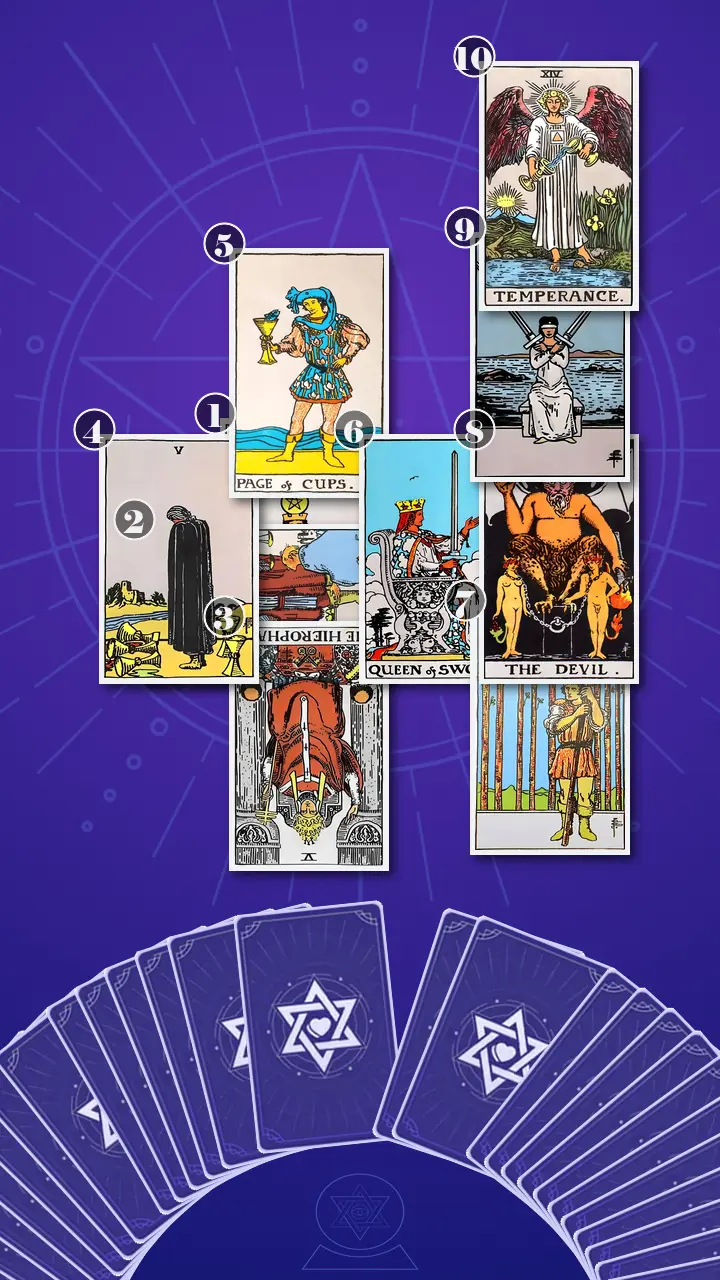
Reading the Map: Card Meanings in Context
Position 1: The Lived Reality in Your Home and Nervous System
“Now flipped over,” I said, “is the card for what’s happening right now in the boundary situation—the lived reality in your home and nervous system.”
Four of Pentacles, upright.
I angled the card toward the camera. “This is you standing in your Toronto living room after work, staring at the couch like it’s not furniture—it’s your only buffer against burnout. The family request makes you feel like your limited space, quiet, and recovery time are being claimed before you’ve even consented.”
“Energy-wise,” I continued, “this is protection—but it’s protection in a contracted state. Not enjoying what you have. Clutching it. The coin held to the chest is your tight chest. Your body isn’t being dramatic. It’s being honest about capacity.”
Jordan let out a quick laugh that sounded like it had edges. “That’s… so accurate it’s kind of rude,” they said, then rubbed the heel of their palm over their sternum like they could smooth the tension out.
I nodded. “It’s not saying you’re selfish. It’s saying your space is your security system—and it’s currently flashing red.”
Position 2: The Main Challenge—Why This Boundary Feels So Hard
“Now flipped over,” I said, “is the card for the main challenge—what makes the boundary hard to set or hold cleanly.”
Six of Pentacles, reversed.
“This is the invisible ledger moment,” I told them. “You say ‘sure, for a bit’ and instantly the invisible bill starts running: extra cleaning, rearranging your WFH setup, losing sleep, managing everyone’s moods. No one agreed to the terms, so you’re left carrying the imbalance and quietly resenting it.”
The card’s scales mattered here. “Reversed, the scales tip. And in modern life, tipped scales look like subscription creep: one small yes turns into a recurring charge you didn’t consent to.”
Jordan’s eyes drifted off-screen, like they were seeing their own browser tabs. “I literally had Airbnb open,” they admitted. “Like, ‘private room, free cancellation, near subway.’ And I was mad at myself for even looking.”
“You’re not being stingy,” I said. “You’re noticing the exchange. In a small-space city life, that’s not pettiness. That’s data.”
Position 3: The Deeper Root—The Family Script Underneath
“Now flipped over,” I said, “is the card for the deeper root—the value, belief, or family script driving the default response.”
The Hierophant, reversed.
“In your head,” I said, “you’re not just deciding about a couch—you’re negotiating an old family rule: ‘good family members don’t say no.’ You feel like you need a permission slip to set an adult boundary in your own home.”
I paused, because the planetarium behind me had that quiet, cathedral-like stillness it gets between shows. The Hierophant always reminds me of institutions—beautiful, stabilizing, and sometimes outdated in how they expect obedience.
“Reversed,” I added, “this isn’t ‘reject your family.’ It’s ‘update the rulebook.’ The keys on this card are about access—who gets entry to your space and under what rules.”
Jordan’s mouth tightened. “I hate that it feels like… if I don’t host, I’m rejecting them.”
“That’s the script talking,” I said quietly. “Not reality.”
Position 4: Recent Past—Why Your Body Braces Before You Decide
“Now flipped over,” I said, “is the card for recent past—what earlier experiences taught you to brace or comply.”
Five of Cups, upright.
“You remember the last ‘quick stay’ that stretched longer, got louder, or left you drained,” I said. “That one disappointment is now tinting every new request, so you brace early and assume it’ll go badly again—even if this time could be different with better structure.”
“Energy-wise, this is focus,” I explained. “But it’s focus stuck on loss. The spilled cups are the ‘last time’ that still lives in your body. And the bridge in the background is important—there’s a practical way forward. Not by becoming colder. By becoming clearer.”
Jordan swallowed, then nodded once, small. “Last time, they ‘might extend’ and then it became my problem to manage it without being rude.”
“Exactly,” I said. “So the boundary needs to target the repeatable detail—not the whole relationship.”
Position 5: Conscious Aim—How You Want to Be Seen
“Now flipped over,” I said, “is the card for your conscious aim—what you wish were true, and how you want to be seen.”
Page of Cups, upright.
“You genuinely want to respond with warmth—like, ‘I love you, I want to help,’” I said. “You want the boundary to sound human, not like a slap.”
“This is a beautiful card,” I told them, “because it says your goal isn’t dominance. It’s connection. But the risk here is using warmth as a way to avoid clarity—turning the message into a negotiation of your worth.”
Jordan gave a tired smile. “I always end up writing a paragraph that basically says, ‘Please don’t be mad.’”
“Warmth can be the tone,” I said. “It can’t be the entire strategy.”
Position 6: Near-Term Direction—The Clearest Way to Communicate
When I reached for the next card, the room felt like it got quieter—not in a supernatural way, but in the way a conversation changes when you finally stop circling the hard thing.
“Now flipped over,” I said, “is the card for near-term direction—the next best way to communicate a boundary: tone, posture, clarity.”
Queen of Swords, upright.
“This is the two-sentence text,” I told them, showing the card. “One short, respectful message that includes the actual terms: dates, number of nights, and one house rule—or a clean no with one alternative. No apology paragraph. No courtroom closing statement.”
Setup: Jordan had been trying to solve this by rehearsing—the perfect explanation, the perfect softness—because they believed that if they managed everyone’s feelings first, they’d be allowed to have a limit. That belief had them stuck in decision fatigue, typing and deleting, living in drafts.
Stop trying to earn permission to have limits; speak your boundary like the Queen of Swords—simple, direct, and anchored in truth.
Reinforcement: Jordan’s reaction came in layers. First, a physical freeze: their breath caught, and their eyes went very still on the screen, like their brain had paused to buffer. Then I saw the cognitive shift land—focus softening, gaze unfixed, as if they were replaying that 8:46 p.m. text and seeing a different option appear. Finally, the emotion moved: their shoulders dropped by a fraction, and a shaky exhale escaped that sounded half like relief and half like grief for how long they’d been bracing.
“But if I say it like that,” they said, voice suddenly sharper, “won’t they think I’m… cold?”
I didn’t rush to comfort the fear away. “This is where my astronomy brain kicks in,” I said. “In Light-Year Communication, I think about distance and signal. The more we panic, the more we add static—extra justifications, extra apologies, extra noise. Your family doesn’t need a wall of signal. They need a clean transmission.”
I held up the Queen card again. “This isn’t icy. Look at her left hand—it’s open. Measured openness. She’s saying: ‘I’m available within reality.’”
I leaned in a little. “Now, use this new lens and think back: last week, when you drafted five versions of that reply, was there a moment where this clarity would’ve changed how your body felt?”
Jordan blinked hard once. “Yeah,” they whispered. “I would’ve stopped cleaning. I would’ve stopped refreshing Airbnb like it was going to save me from being honest.”
“That steadier feeling in your chest?” I said. “That’s you moving from earning approval through accommodation to stating a specific boundary with a specific offer—and letting adults manage their reactions.”
I added, because they needed it named: “Clarity isn’t cruelty—vagueness is just a slow leak.”
Position 7: Self-Position—Your Capacity and Resilience
“Now flipped over,” I said, “is the card for how you’re showing up—your current capacity and resilience.”
Nine of Wands, upright.
“You’re tired,” I said plainly, “and your body already knows the pattern: hosting takes more than it ‘should.’ You’re not fragile—you’re experienced.”
“Energy-wise, this is resilience,” I continued, “but it’s resilience that’s been living in a guarded posture. The fence imagery here matters. Boundaries are structure, not hostility.”
Jordan nodded slowly, like they’d been waiting for permission to call it fatigue without calling it failure.
Position 8: Environment—The Pressure Pattern Around the Request
“Now flipped over,” I said, “is the card for the environment—family expectations, pressures, the relational dynamics around the request.”
The Devil, upright.
Jordan flinched at the image, and I didn’t blame them. “This card gets dramatized,” I said. “But in real life, it often looks like guilt hooks.”
“Family expectations come with a charge: if you don’t accommodate, it’s framed as rejection,” I said. “You feel trapped by what they might think, even though the chains are loose enough to remove.”
I used the echo I’ve heard from hundreds of people. “The inner monologue goes: If they’re upset, I did something wrong. And then your thumb hovers over the group chat like the chat is a trap.”
Jordan’s eyes went glossy for a second, then they looked down. “That’s… exactly it.”
“Discomfort isn’t a command,” I said, letting the sentence sit like a small anchor. “Their disappointment can be real and still not an emergency you have to fix by handing over your home.”
Position 9: Hopes and Fears—The Stalemate That Keeps You Stalling
“Now flipped over,” I said, “is the card for hopes and fears—what you fear will happen if you set a boundary, and what you hope a boundary will protect.”
Two of Swords, upright.
“You keep the conversation in limbo—‘let me check’—because if you don’t decide, you don’t have to feel responsible for conflict,” I said. “But the stalemate is costing you. The vague yes is already rearranging your week in your head.”
“Energy-wise,” I added, “this is avoidance that feels like peace. The blindfold is the part of you that hopes if you don’t look directly at the truth, it won’t demand action. But it already is.”
Jordan made a face—half wince, half laugh. “The microwave beep scene,” they said. “I literally don’t open the message in the office kitchen.”
“That’s your body trying to keep you safe,” I said. “And the Queen of Swords is your next upgrade: choosing reality over stalemate.”
Position 10: Integration—A Workable Boundary That Keeps Love Visible
“Now flipped over,” I said, “is the card for integration—what a workable boundary looks like when you balance compassion with self-respect.”
Temperance, upright.
“This is the recipe,” I told them, smiling a little. “Compassion plus clear terms. Not extremes—neither self-sacrifice nor scorched earth.”
“In modern life,” I said, “this looks like a limited stay with clear start/end dates, quiet hours, and your work needs respected—or you decline hosting and offer another form of support. You feel steady afterward, not resentful.”
I traced the angel’s pour with my finger. “Support has a shape. Access isn’t automatic. The smallest yes that doesn’t become a hidden no to you—that’s the sweet spot.”
The One-Text Boundary: Actionable Advice You Can Send Tonight
I leaned back and let the whole spread line up like constellations. “Here’s the story I see,” I said. “You’re protecting a scarce, precious resource—your home and recovery time (Four of Pentacles). The challenge is the invisible favor ledger created by vague yeses (Six of Pentacles reversed). Underneath it all is an inherited rule that equates love with access (Hierophant reversed), made heavier by guilt pressure in the environment (Devil). You stall to avoid being the ‘bad one’ (Two of Swords), even though your body is already paying the cost. The unlock is clean, adult-to-adult language (Queen of Swords) with a humane tone (Page of Cups), leading to a sustainable middle path (Temperance).”
“Your cognitive blind spot,” I added, “is thinking you need to manage their feelings first so you’re allowed to have a boundary. That’s the old rulebook. The transformation direction is the opposite: state a specific boundary with a specific offer (or a clean no), and let adults handle their reactions.”
Jordan’s shoulders were lower now, but I could tell the practical obstacle was coming—the part where real life tries to interrupt growth.
“Okay,” they said. “But I literally don’t have time for this whole careful conversation. I’ve got a Monday presentation. I don’t even have five minutes to get into it.”
I nodded. “Perfect. Then we won’t.”
“In my work,” I said—half planetarium guide, half occult researcher—“I use a tool I call Solar Eclipse Mediation. It’s three steps: alignment, boundary line, and re-entry. It’s how you let something pass between you and someone else without letting it blot out your whole sky.”
“Let’s turn that into next steps you can actually do.”
- The 7-Minute SendBefore you start ‘prep mode’ (cleaning, rearranging, opening Airbnb), set a 7-minute timer. Draft your reply in Notes using One Sentence + One Option: “I can’t host overnight next week—my place is also my work setup. I can help you find a nearby spot / I can do dinner on Thursday if you’re in town.” When the timer ends, send it as-is.If your chest tightens, take one slow breath and still hit send. You don’t need a court case. You need a sentence.
- Fair Exchange Check (2 minutes)Before you reply, write three bullets: (1) What I’m giving (space/sleep/time), (2) what I’m protecting (work/rest/privacy), (3) what I can offer instead (two nights max, dinner, helping book a room). Then build your text from those bullets.Boundary cue: vague yes = hidden no to your future self. Measurement beats vibes.
- Make the Yes Measurable (if you choose yes)If you can host, make it specific: “I can do two nights: Fri–Sun. Check-in after 7pm, and I need quiet after 10pm because I’m up early for work.” Put arrival/departure and your non-negotiable rest block into Google Calendar immediately.If you get pushback, repeat the same calm line (broken-record style) instead of adding more reasons.
I watched Jordan’s face as they imagined sending it—the clean sentence, the clean limit. Their fear wasn’t gone. But it wasn’t driving the car anymore.

A Week Later: The Quiet Proof
Six days later, my phone lit up in Tokyo with a message from Jordan. It was short—Queen of Swords short.
“I sent it,” they wrote. “Two sentences. No apology paragraph. They weren’t thrilled, but they booked a place near Line 1. We’re doing dinner instead.”
They added, almost as an afterthought: “I slept through the night for the first time in a week. Woke up and my first thought was still ‘what if I was mean?’—but then I laughed a little. My couch looked normal again.”
That’s what I love about a real journey to clarity: it doesn’t end with fireworks. It ends with your nervous system getting evidence that your home can be yours, and you can still be loving.
When your phone buzzes and your chest tightens, it’s not because you don’t love them—it’s because you’re trying to keep the peace and keep your home at the same time, and your body already knows you can’t do both without a clear line.
If you didn’t have to earn belonging through being endlessly accommodating, what’s the simplest, most honest sentence you’d send today—and what tiny term would make your home feel like yours again?
Every reading at AceTarot is a Journey to connect with inner wisdom and empower next step.
Learn more about our Journey to Clarity.