Leaving the Group Chat Courtroom: Setting a No-Jury, 1:1 Rule

The 10:13 p.m. Group Chat Courtroom
You’re 27, trying to build an adult life in Toronto, and somehow one argument with your mom turns into a group chat where your aunt is suddenly the guest judge—hello family triangulation.
Maya (name changed for privacy) met me on video from a tiny kitchen that looked like it had been designed by someone who’d never tried to emotionally survive in it. The overhead light buzzed with that cheap-bright intensity; the counter was scattered with a mug, a charger cable, and the quiet evidence of a long day. She leaned one hip against the cabinet, barefoot on cold tile, phone in one hand and her Notes app open in the other.
“It’s like… I’m not even mad about the original thing anymore,” she said, eyes flicking down the screen. “I’m mad that it becomes a group project. Like I have to defend myself to an audience.”
I watched her jaw as she spoke—tight, almost locked—and the way her thumb kept hovering as if speed could prove innocence. The frustration wasn’t abstract; it was a buzzing, restless urge to reply immediately, like her nervous system was a smoke alarm that wouldn’t stop chirping.
“I want to be heard like an adult,” she said, voice careful in that over-polite way that’s really a form of armor. “But if I set a hard boundary, I’ll look cold. Ungrateful. Disrespectful. And then… it’s like I can’t compete with a family narrative.”
“I get it,” I told her, keeping my tone steady and kind. “We’re not here to craft the perfect closing argument. We’re here to find clarity—so you can name the boundary, choose the channel, and stop this from becoming a pile-on.”

Choosing the Compass: A Relationship Spread for Family Conflict
I asked Maya to take one slow breath in, then let the exhale run a beat longer than the inhale—just enough to tell her body it didn’t have to sprint. While she did, I shuffled in my lap, not as a performance, but as a focusing tool: a way to move from reaction into observation.
“Today I’m going to use a classic Relationship Spread,” I said. “It’s designed for situations like this—where the real problem isn’t one sentence you said, but an interaction pattern that keeps repeating.”
For you reading along: this spread works well at a career crossroads, a friendship rupture, or a family blow-up—any time you’re feeling stuck in a loop—because it separates what you are doing, what they are doing, what the dynamic is doing, and then it gives a practical next step. In a family group chat conflict, that matters. It’s often the container—who’s included, what channel you’re using, how fast you’re responding—that keeps the fire burning.
“We’ll lay it out like a face-to-face line,” I continued. “One card for your stance, one for your mom’s stance, a center card for the shared weather system. Then we look at what you’re each trying to protect, where the third-party pile-on enters, and finally, the integration card—your next move.”
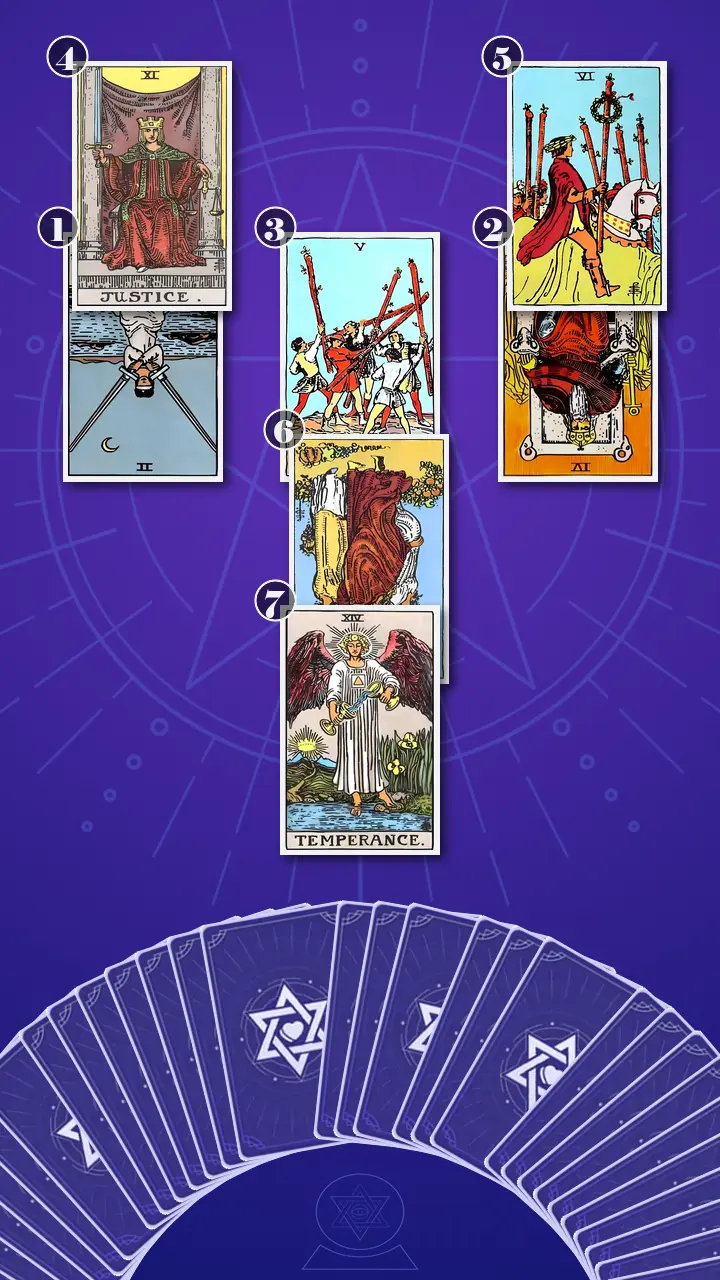
Reading the Weather System: From Airy Overthinking to Firefight
Position 1: Maya’s current stance — Two of Swords (reversed)
Now I turned over the card that represents Maya’s current stance: how she is showing up in the conflict moment-to-moment (tone, impulse, coping style).
Two of Swords, reversed.
“This,” I said gently, “is exactly that toggling you described—‘I won’t reply’ and ‘I need to fix this right now.’ It’s the half-boundary, half-defense text. And because the line isn’t clean, it pulls you back in to clarify.”
Energetically, reversed Two of Swords is blocked Air: the mind trying to hold neutrality, but breaking into mental overload. It’s not that you’re indecisive as a personality trait; it’s that your self-protection strategy is to carry multiple arguments at once so no one can corner you. It’s exhausting.
Maya let out a small laugh that wasn’t amused—more like a bitter cough. “That’s… brutal,” she said. “Because I literally draft in Notes like I’m… submitting evidence.”
“And your body gives you away,” I said. “Tight jaw. Shoulders up. That buzzy urgency. Before we even touch ‘what to say,’ we have to notice: your nervous system thinks you’re on trial.”
Position 2: Mom’s current stance — The Emperor (reversed)
Now I turned over the card that represents Mom’s current stance: how she is showing up and what strategy she is using to hold her position.
The Emperor, reversed.
“Your mom is holding this like a rank-and-respect issue,” I said. “And the ‘we’ language—bringing your aunt in as reinforcement—turns your boundary into ‘disobedience.’ Like she’s setting policy instead of having a direct conversation.”
In energy terms, this is Fire and Earth in excess—authority hardening into control. I’ve seen this in family systems for decades: when someone feels unsafe with disagreement, they reach for structure—but distorted structure. Not a fair structure. A hierarchy.
This is where my Generational Pattern Reading clicks in. I told Maya, “If this is familiar—if conflict in your family tends to become ‘who’s being respectful’ instead of ‘what’s actually happening’—that’s a pattern older than this one text thread. It’s an inherited way of keeping belonging: recruit the clan, settle it by consensus, don’t let the ‘young one’ define the rules.”
She swallowed, eyes briefly unfocusing like she’d just replayed a memory. Then she gave a slow, reluctant nod. “My aunt has always been the ‘mediator.’ Which means… she’s always there.”
Position 3: The shared dynamic — Five of Wands (upright)
Now I turned over the card that represents the shared dynamic: what the conflict is actually doing between you two (the ‘weather system’ of the relationship right now).
Five of Wands, upright.
“This is the notification storm,” I said. “Each reply adds a new point. The original issue gets buried. It feels like you’re arguing the atmosphere, not solving a problem.”
Five of Wands is Fire in excess: heat without direction. No leader, no single topic, no repair. In modern terms? It’s a Slack thread that should’ve been a 1:1, turning into a channel pile-on with @everyone energy.
I watched Maya’s thumb tighten around her phone. “Yes,” she breathed. “And then I don’t even know what I’m defending anymore. I’m just… defending.”
“Exactly,” I said. “This isn’t a conversation anymore—it’s a pile-on container.”
Position 4: What Maya is trying to protect — Justice (upright)
Now I turned over the card that represents what Maya is trying to protect: the value underneath her reaction and the fairness she’s seeking.
Justice, upright.
“Here’s your heart,” I said. “You’re not trying to win. You’re trying to be treated fairly. Direct accountability. No audience. No jury.”
Justice is balanced Air—clean, level, precise. But it has a shadow when you’re triggered: it can turn into courtroom texting. Screenshots as exhibits. Bullet points as evidence.
I leaned in slightly. “Let’s make it literal for a second. In this ‘trial’—who’s the judge? Who’s the jury? What counts as evidence? And the big one: who agreed to these rules?”
Maya’s eyes widened, then she exhaled through her nose, sharp and quiet. “I didn’t,” she said. “I didn’t agree to any of it.”
“That’s the shift,” I told her. “Justice isn’t asking you to win the case. It’s asking you to define the rules of engagement. You don’t need an airtight argument. You need a clean boundary.”
Position 5: What Mom is trying to protect — Six of Wands (upright)
Now I turned over the card that represents what Mom is trying to protect: the need underneath her escalation and desire for validation.
Six of Wands, upright.
“This is the crowd,” I said. “The need to feel publicly backed up. If she can get your aunt to echo her, she doesn’t have to sit in the discomfort of disagreement one-to-one.”
Energetically, this is Fire seeking applause. It’s not automatically malicious; it’s a strategy. But it changes the game—because now you’re not speaking to one person. You’re speaking to a system that rewards performance.
Maya’s mouth tightened again. “So if I keep replying… I’m feeding the performance.”
“Yes,” I said. “And you can choose not to.”
Position 6: The challenge factor — Three of Cups (reversed)
Now I turned over the card that represents the challenge factor: where the pile-on/triangulation is entering and how it escalates the conflict.
Three of Cups, reversed.
“There it is,” I said. “Third-party involvement. Clique energy. The aunt’s ‘just checking in’ texts that carry the same framing as your mom’s messages. The challenge isn’t the topic—it’s that a third person is being positioned as a decider.”
Three of Cups reversed is Water distorted: connection used as pressure. And I want to name the loop I hear in your life, because it’s so common in triangulation:
Split-screen. On the left: you hovering over Do Not Disturb, wanting to mute the thread and breathe. On the right: you writing bullet points like a legal brief—because the second you stop, your brain says, “If I don’t fully explain myself right now, they’ll decide I’m disrespectful.”
Maya went still in a very specific way—like her breath paused mid-chest. Then her gaze slid off-camera, as if she’d just seen herself in that split-screen. Finally, her shoulders dropped a fraction. “Oh wow,” she whispered. “That is exactly it.”
“And because you care about repair,” I said, “you keep offering more context, more politeness, more proof. But in a pile-on container, more explanation is just more surface area for debate.”
When Temperance Turned the Thermostat
Position 7: Integration & next step — Temperance (upright)
The room felt quieter when I reached for the last card—like even the buzzing kitchen light on Maya’s side had softened.
Now I turned over the card that represents integration & next step: the most constructive boundary-and-communication move that de-escalates without self-erasure.
Temperance, upright.
“Temperance is the thermostat,” I said. “Not shutting the whole system down. Not letting it run wild. Adjusting the temperature so you can stay in contact without getting burned.”
In modern life, this is: instead of replying in real time, you choose a scheduled one-on-one conversation or a single contained message. You repeat one calm boundary without adding fuel, and you stop engaging when the conversation tries to turn into a debate.
Setup: This is that late-night moment where you’re rereading the thread, drafting in Notes, jaw tight—trying to make your side so airtight nobody can twist it. You can feel the urge to reply like it’s a moral emergency, because silence feels like guilt.
Stop trying to win the family argument; start mixing firmness and calm like Temperance, so your boundary holds without turning into another fire.
I let that sentence sit. Maya’s face did a whole sequence in three beats: first, a tiny freeze—eyes wide, breath caught. Second, her focus went far away, like she was replaying every “We’re just worried about you” message she’d ever swallowed. Third, her mouth trembled into a half-smile that looked more like grief leaving than happiness arriving.
“But… if I do that,” she said, and her voice flashed with quick anger—an unexpected, honest edge—“doesn’t it mean I was wrong for trying so hard? Like I made it worse?”
“It means you were trying to survive the rules you were handed,” I replied. “And now you’re rewriting the rules. That’s not ‘wrong.’ That’s growth.”
I softened my tone. “And here’s the part your body needs to hear: you can leave the courtroom without losing the case.”
Reinforcement: “Right now,” I told her, “open Notes and write one sentence that names only the container—not the backstory.” I watched her thumb move, slower now. “Example: ‘I’m willing to talk with you directly. I’m not discussing this in a group chat.’ Then set a 15-minute timer before you send anything. If your body gets more activated while the timer runs, you can choose not to send today—pausing is allowed.”
Her jaw unclenched like a fist opening. She rolled her shoulders back once, like she’d been carrying a backpack she forgot she put on. Then she looked up at the camera. “Okay,” she said, quieter. “I can do one sentence.”
“Good,” I said. “Now, with this new lens—think back to last week. Was there a moment when your aunt chimed in and you felt that buzzy urgency? How would it have felt to choose the channel instead of proving the point?”
Maya blinked a few times, eyes shining but steady. “It would’ve felt… terrifying,” she admitted. “And also… like relief. Like I’m not performing.”
“That’s the emotional transformation right there,” I said. “From chaotic defensiveness and reputation-protection to calm boundary-setting and steadier self-trust.”
The No-Jury Boundary: Actionable Next Steps
I pulled the whole spread together for her in plain language: your reflex is to over-explain (Two of Swords reversed) because being labeled “disrespectful” feels like exile. Your mom escalates through rank and ‘we’ language (Emperor reversed), and the dynamic turns into competitive noise (Five of Wands). Underneath your reaction is a real value—fair process (Justice)—while she’s reaching for public validation (Six of Wands). The obstacle is triangulation itself (Three of Cups reversed). The way out is Temperance: lower the heat, keep the line.
The cognitive blind spot I named gently was this: you’ve been treating wording as the solution when the container is the problem. Your transformation direction is simple, not easy: shift from “convince the whole family” to “name the boundary and choose the channel.”
Then I gave her a short plan—practical, copy/paste-able, and designed for real life when your phone is buzzing and your nervous system is loud.
- Create the “One-to-one only” noteIn Notes, save two 2-line scripts: (A) warm, (B) firm. Use this exact line when needed: “I’m willing to talk one-to-one. I’m not discussing this in a group thread.”Tip: If you catch yourself typing anything that starts with “because” or “for context,” delete it. What’s left is usually the boundary.
- Mute-then-respond timer (Temperance pacing)Mute the family thread for 12 hours. Set a calendar reminder: “Re-open when I’m regulated.” When the reminder hits, wait 15 minutes before sending anything.Tip: If 12 hours feels impossible, start with 2 hours. Muting is not giving up—it’s turning down the stove.
- Redirect the aunt in 3 lines, then stopIf your aunt texts you separately, send one redirect: “I hear you. I’m handling this directly with Mom, so I’m not discussing details with anyone else.” Then do not add a follow-up paragraph.Tip: Use the broken-record rule: same sentence, minimal variation, no new evidence.
I added one piece from my own toolkit—something I’ve watched help people hold boundaries without going cold. “After you send the boundary,” I said, “do a tiny ‘exit ritual’ so your body knows the trial is over.”
“Like what?” she asked, already half-skeptical.
“My three-minute family energy check,” I said. “Look at one houseplant. Seriously. Is it drooping? Is it thirsty? You don’t have to fix your whole family in three minutes—you just have to return to something you can tend. Then do one simple chore—wipe the counter, rinse your mug. Relationship harmonizing through daily chores isn’t magical; it’s sensory. It brings you back into your own space.”
Maya frowned. “But I don’t even have five minutes sometimes. I’m at my desk, I’m at the TTC, I’m… just trying to survive my job.”
“Then we do the two-minute version,” I said. “Phone face down. One long exhale. One sip of water. That still counts as choosing the channel. Small steps are not small when they interrupt a loop.”

A Week Later: The Quiet Proof
Six days later, Maya messaged me a screenshot—just one line, no essay attached: “Muted the thread. DMed my mom: ‘Can we talk 1:1?’ My aunt texted me separately and I used the three-line redirect. Then I put my phone in the other room.”
Clear but vulnerable: she slept a full night, then woke up and her first thought was, What if they think I’m disrespectful? She stared at the ceiling for a beat—then breathed out, and opened Notes instead of the group chat.
That’s what a real Journey to Clarity looks like in the beginning: not certainty, but ownership. Not winning, but choosing the terms.
When a private conflict becomes a group chat courtroom, it makes your body sprint into defense—because being labeled “disrespectful” can feel like being exiled from belonging.
If you didn’t have to convince the whole room, what would your one clean sentence be—and what channel would you choose to say it in?
Every reading at AceTarot is a journey to connect with inner wisdom and empower your next step. The stories shared here are psychological mirrors, not private records—crafted to reflect universal emotional loops and help you find your own clarity. Learn more about our Journey to Clarity.