From Dad-Ringtone Dread to Self-Led Choice: Practicing the Pause

Finding Clarity in the 8:12 p.m. Kitchen Jolt (Parent Ringtone Anxiety)
If hearing your dad’s ringtone makes your body go full “performance mode” before you even see the screen—welcome to parent phone call anxiety.
Jordan (name changed for privacy) sat across from me with their hoodie sleeves pulled over their hands, like they were trying to keep their nervous system from leaking out. They live in Toronto, and they described a scene I could practically hear: 8:12 p.m. on a Wednesday, condo kitchen, stove fan humming like a tired metronome, half-chopped onion sweating on the cutting board. Their laptop was still open to Slack—one last message culture, still lit, still demanding. Then the ringtone hit.
“It’s just a ringtone,” they said, and their laugh came out thin. “But my body acts like it’s an alarm.”
As they spoke, I watched the reflex arrive in them even in memory: shoulders lifting toward their ears, breath tightening like someone quietly cinched a drawstring around their ribs. Their hand mimed the movement—thumb already sliding to answer—before the adult part of them got a vote.
They told me the script that plays in the first three seconds: Answer now. Sound pleasant. Don’t make it a thing. And under that: If I don’t respond right away, he’ll think I’m disrespectful.
The dread in their voice wasn’t abstract. It was a stomach-drop that felt like missing a step on a staircase, followed by a chest-flutter, like their heart was trying to sprint in place. Dread, guilt, irritation, shame—layered like feedback noise on a call you can’t hang up.
“I don’t want to fight,” Jordan said, eyes on the table between us. “But I also don’t want to keep performing.”
I nodded, letting the silence hold them for a beat. “We’re not here to judge the reaction,” I said. “We’re here to understand it—so you can get your choice back. Let’s make a map through the fog and find some clarity you can actually use the next time that ringtone hits.”

Choosing the Compass: The Four-Layer Insight Ladder Spread
I asked Jordan to take one slow inhale and one slow exhale—not as a mystical ritual, but as a clean transition. A nervous system can’t change a pattern while it’s still braced for impact. While they breathed, I shuffled in a steady rhythm, the kind I learned long before tarot—working in radio, you learn that the tiniest timing shift can change everything. A pause isn’t nothing. A pause is structure.
“For this,” I said, “I want to use an original spread called the Four-Layer Insight Ladder · Context Edition.”
For anyone reading along: this spread works beautifully for family triggers and authority patterns because it’s not trying to predict your future—it’s trying to decode your present. It maps a sensory cue (like a ringtone) to the learned rule-set underneath it, then names the deeper fear fueling the reaction. After that, it shows your protective strategy and the most effective inner shift to practice—so you can move from reflex to choice.
In this ladder layout, we read the top row first—Trigger → Root Pattern → Underlying Fear—then we drop down to the bottom row—Protection → Key Shift → Integration. It’s like walking down a staircase from your mind’s instant story into your body’s strategy, and then up into adult-to-adult communication.
“The first card,” I told Jordan, “is the camera-shot moment—the first three seconds. The middle top card will show the childhood authority template that gets activated. And the key shift card—our turning point—will show the lever that gives you the most freedom.”
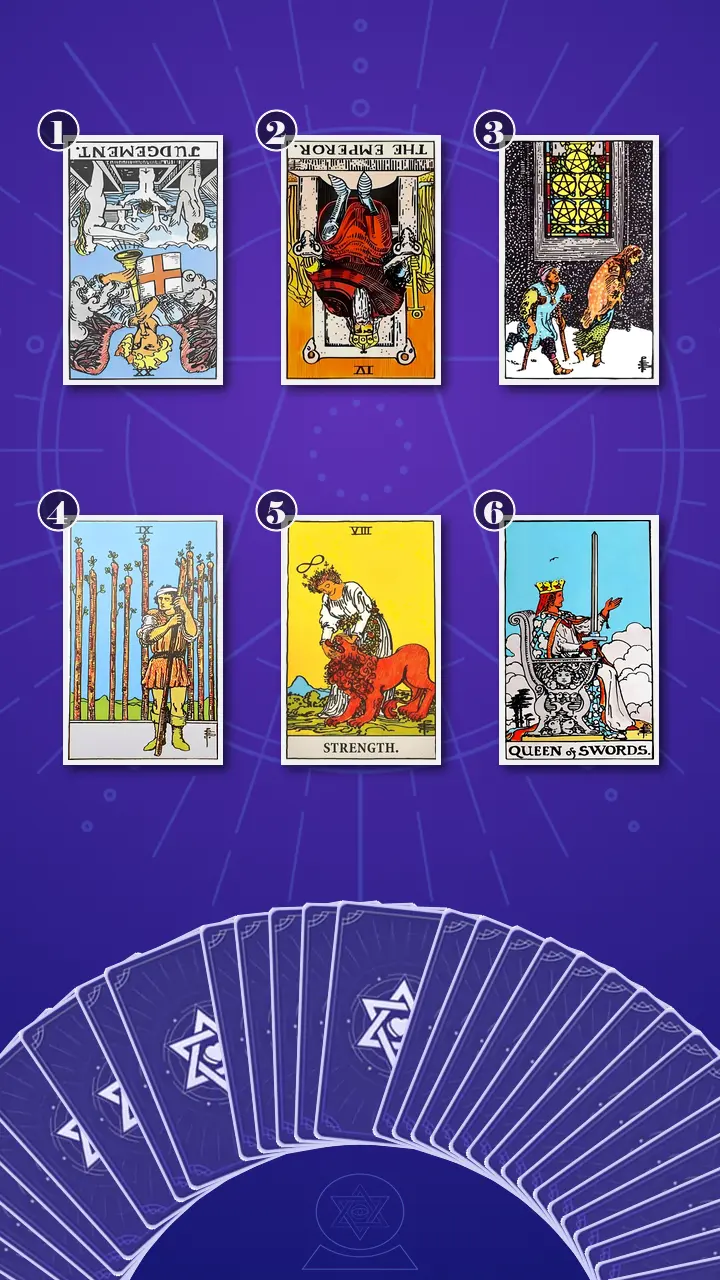
Reading the Map: What the Ringtone Wakes Up
Position 1 — Surface Trigger: the first 3 seconds
“Now flipped,” I said, “is the card representing your surface trigger and immediate automatic reaction to hearing your dad’s ringtone—the camera-shot moment.”
Judgement, reversed.
The image on the card—an angel’s trumpet calling people up—can feel ancient until you modernize it. And for Jordan, it modernized itself.
I used the life scene exactly as it arrived in the spread: “You’re halfway through sending a Slack update, phone on the counter. The ringtone hits and your body moves before you choose—thumb already sliding to answer while your brain spins up a closing argument: ‘I’m busy, I’m good, I’m not disrespectful.’ You pick up with a too-bright voice because the call feels like a grade, not a conversation.”
Reversed, Judgement isn’t about awakening—it’s about fear of evaluation. It’s energy in blockage: instead of hearing a call as information, your mind hears a verdict being prepared. You become the prosecutor, the defense attorney, and the judge in under a second.
“What story are you assuming the call means about you?” I asked. “Before you even say hello.”
Jordan let out a small, bitter laugh—an unexpected reaction, more sharp than sad. “That’s… exactly it,” they said. “It’s so accurate it’s kind of rude.”
I kept my voice warm. “Good. Not rude—useful. If we can name it, we can interrupt it. And just so your nervous system hears it clearly: This is a call, not a verdict.”
Their gaze flicked down to their phone as if it might light up on cue, then back to me. Their shoulders stayed high, but one hand unclenched.
Position 2 — Root Pattern: the learned authority template
“Now flipped,” I said, “is the card representing the childhood authority template being activated—the learned rule-set about dad/authority.”
The Emperor, reversed.
In modern life, this is the card of walking into a building with strict security. You don’t even think about it—you just start walking straighter. Voice gets more “proper.” You scan for what rule you broke.
I anchored it in the spread’s scenario: “The moment you see Dad calling, you unconsciously sit up straighter and start speaking like you’re in trouble. You scan for what you might’ve done wrong. You manage the interaction like a hierarchy—your job is to comply, soothe, and not provoke critique—rather than two adults talking.”
Reversed, The Emperor is authority energy in distortion. Not leadership as stability, but leadership as control, surveillance, and conditional approval. It’s the part of you that confuses respect with submission.
I watched Jordan’s jaw tighten as if their body recognized the card before their mind did. Their eyes narrowed—not angry at me, but at the accuracy. That tight recognition landed exactly where this card is meant to land.
“Here’s a question,” I said gently, “and it’s not rhetorical: When you picture your dad as ‘authority,’ what rule do you feel you have to follow—tone, speed, gratitude—even if it costs you your evening?”
Jordan swallowed. “I have to sound… fine,” they said. “Like I’m not tired, not annoyed, not busy. Like I’m available. Like I’m a good person.”
In my head, I had a quiet radio-host flashback: the way callers change their voice when they think they’re being recorded. Not because they’re fake—because they’re trying to be safe. The Emperor reversed is that switch, but inside your own family.
Position 3 — Underlying Fear: what feels at stake
“Now flipped,” I said, “is the card representing the deeper fear underneath the reaction—what feels at stake.”
Five of Pentacles, upright.
I pointed to the lit window on the card and the figures outside in the cold. “This,” I said, “is the fear of being shut out. Not necessarily literally—emotionally. Warmth inside, cold outside.”
Then I brought it into their life: “You consider letting the call go to voicemail, and instantly your mind jumps to scarcity: colder replies later, a guilt trip, being labeled ungrateful, the warmth getting withheld. It’s not just about time—it’s about ‘do I stay inside the circle of support, or do I get left out for being difficult?’”
This is fear energy in deficiency: a felt shortage of belonging. Even if your adult life is stable, the body remembers what it meant when warmth depended on behaving correctly. And for Jordan, money was stable-but-not-abundant—so the “safety net” anxiety added bass to the whole song.
I said it plainly, because shame hates plain language: “You don’t need a perfect tone to deserve belonging.”
Jordan’s chest softened a fraction—like a sweater sleeve sliding down after you’ve been holding your shoulders up for too long. Their eyes went slightly glossy, not in a dramatic way, just in that quiet way people get when something finally names the real thing.
Position 4 — Protective Strategy: how you brace and cope
“Now flipped,” I said, “is the card representing the protective stance you take during or around the call—how you brace, perform, or manage the interaction.”
Nine of Wands, upright.
This card is resilience, yes—but also a life lived in incident response mode. Like keeping 37 browser tabs open “just in case” and calling it readiness.
I connected it directly to the spread’s modern scene: “You answer and immediately go guarded: short responses, careful tone, no extra information he could critique. You pace, grip the phone, and keep your guard up like you’re managing damage. You’re resilient—but it feels like endurance, not connection.”
Here the energy is in excess: too much vigilance. The body braces for a hit that hasn’t happened yet, because it remembers prior hits—correction, criticism, the subtle tone shift that means “you’re disappointing me.”
Jordan did exactly what the echo predicted: a half-laugh, painful and familiar. “I literally pace,” they said. “And my voice goes like… 20% brighter. Like customer service.”
“That’s the armor,” I said. “And it makes sense. It helped you survive the old rule-set. But it also costs you something now: you don’t get to practice having a boundary without a battle stance.”
When Strength Held the Lion: Freedom in the Pause
Position 5 — Key Shift: the lever that loosens the pattern
I let my hands rest on the deck for a second before turning the next card. The condo’s ambient sounds—fridge hum, distant city hush—suddenly felt louder, like the room itself leaned in. “This,” I said, “is the turning point. The most effective transformation lever.”
Strength, upright.
And instantly the whole spread changed temperature. Not because the problem vanished—but because a different kind of power entered the room. Strength isn’t hype. It’s steadiness. It’s the adult you who can stay present when the body jolts.
I grounded it in the modern scene: “The ringtone hits and you feel the jolt. Instead of performing instantly, you take one breath and notice: ‘This is my body bracing.’ You decide your response on purpose—answer now with a time limit, or text a specific callback time—without apologizing for having a life.”
Setup (the moment before the insight): Jordan was right back in that kitchen: mid-Slack message, dinner half-made, phone lighting up. Their brain trying to sprint ahead of the conversation—drafting an apology for a crime they didn’t commit—because urgency has always been the price of peace.
Delivery (the sentence I wanted to land like a tuning fork):
This isn’t a verdict you must pass; it’s a moment to soften your grip and steady the lion before you speak.
Reinforcement (what shifted in their body): Jordan’s breathing actually paused—just for a beat—like someone hit “mute” in a Zoom call. Their fingers went still on their sleeve. Then their eyes unfocused, not dissociating, but replaying a memory: the voice switch, the rehearsed cheer, the racing explanations. I saw the micro-sequence run across their face: jolt → hand reaches → voice changes. And then, for the first time in the session, I watched a new sequence appear: jolt → exhale → choice.
They exhaled long and low, the kind you can feel in the chest. Their shoulders dropped a centimeter, then another—like they’d been holding a weight that was never actually in their hands. Their mouth opened and closed once, searching for words. When they finally spoke, their voice shook, not with fear, but with recognition. “I’m always trying to wrestle it,” they said. “Like, beat the reaction.”
“Exactly,” I replied. “Strength doesn’t crush the lion. It steadies it.”
Then I brought in my signature lens—the part of my work that comes from sound energy research and music psychology, not spiritual fog. “I call this a Conflict Mediation moment,” I said. “Not between you and your dad—between your alarm system and your adult self. Your nervous system hears that ringtone like a sharp, high-frequency cue: urgent, evaluating. Strength is you adding a lower, steadier rhythm before you respond. One breath is literally a tempo change.”
I asked them, softly but directly: “Now, with this new lens—steady the lion before you speak—can you remember a moment last week when that one breath would’ve changed the call?”
Jordan blinked, and a quick flare of irritation crossed their face—another unexpected, honest reaction. “But if I pause,” they said, “he’s going to think I’m being weird. Or avoiding.”
I nodded. “Of course. That’s the old agreement talking. And here’s the adult update: a ringtone isn’t a command—it’s information. Pausing isn’t disrespect. It’s agency.”
That was the bridge—the shift from dread-driven people-pleasing and automatic compliance to calm, self-led choice. Not perfect confidence. Just the first real inch of freedom.
Clarity Isn’t Cruelty: Scripts, Timers, and Soundproof Boundaries
Position 6 — Integration: what to do next time
“Now flipped,” I said, “is the card representing your concrete integration step—how to communicate differently the next time the ringtone happens.”
Queen of Swords, upright.
This card is clean language. It’s the opposite of stacking reasons like legal evidence. It’s not cold—it’s clear. Upright sword, open hand: boundary plus a path forward.
I tied it to the modern scenario: “You respond with one steady sentence that doesn’t beg for approval: ‘I can talk for ten minutes,’ or ‘I can’t talk right now—free at 7:30.’ You don’t stack reasons like a legal defense. If he reacts, you let him have his reaction without trying to manage it with extra niceness.”
Queen of Swords is communication energy in balance: direct without being cruel. And I gave Jordan the phrase I wanted them to borrow until it felt like theirs: “Clarity isn’t cruelty. Over-explaining is not kindness.”
Then I summarized the spread as a single story—because insight without a storyline doesn’t stick:
“Your dad’s ringtone (Judgement reversed) doesn’t just signal a call—it triggers an inner courtroom where you assume you’re about to be evaluated. Underneath that is a learned authority template (Emperor reversed): authority equals correction, so your body goes ‘be proper, be quick, be good.’ The deeper fuel is belonging fear (Five of Pentacles): if you disappoint him, you risk losing warmth or support. So you cope with guarded endurance (Nine of Wands): bright voice, careful edits, damage-control. Strength is the new lever: regulate first, then choose. And Queen of Swords is how that choice sounds out loud.”
I named the blind spot gently: “The cognitive blind spot here is that you keep treating speed as respect. But speed is often just a survival habit dressed up as politeness.”
“Okay,” Jordan said, and for the first time they sounded more curious than braced. “So what do I actually do when it happens?”
I gave them actionable advice—small, repeatable, boring-on-purpose next steps. Not a personality overhaul. A new default.
- The One-Breath Choice PauseWhen the ringtone hits: hear it → exhale once (all the way out) before you touch the screen → then decide. You’re not trying to feel calm. You’re practicing one breath of agency.If your body floods, stop at the exhale and choose the least activating option: send a callback-time text instead of forcing yourself to answer.
- The Two-Option Callback Script (copy/paste-ready)Make a Note titled “Dad Call Script.” Option A: “Hey—can talk for 10 mins.” Option B: “Can’t talk right now—free at 7:30 for 10 mins.” Use it verbatim next time. No rewriting. No extra apologies.Expect the thought “this feels dramatic.” Treat it as part of the old script, not a verdict on you. Lower the bar: one clean sentence is the win.
- The 10-Minute Container + Queen of Swords LineIf you do answer, set a phone timer for 10 minutes and say, in a steady boring tone: “I can talk for a few minutes, then I need to get back to my evening.” When the timer goes off, you can end with: “I’m going to hop off now—we can talk later.”Practice the line once out loud when you’re alone—like a vocal warm-up. If your voice shakes, that’s information, not failure.
Because sound is part of Jordan’s trigger, I added one extra support—my Soundproof Barrier strategy—without making it weird or elaborate. “If you want a private buffer,” I said, “pick a 60–80 BPM instrumental track—something neutral, no lyrics. Let it play quietly while you decide. It gives your body a steadier rhythm than the ringtone. It’s not magic. It’s just giving your nervous system a different beat to follow.”

A Week Later: Ownership, Not Perfection
A week later, Jordan sent me a message at 9:41 p.m. The screenshot showed their Notes app: “Dad Call Script,” two lines, unchanged. Under it, a text they’d actually sent: “Can’t talk right now—free at 7:30 for 10 mins.” No apology. No courtroom. Just reality.
“He replied ‘ok’,” they wrote. “And I didn’t spend the next hour replaying my tone. I still felt the jolt, but it didn’t run the whole night.”
The change wasn’t fireworks. It was quieter than that—more like finally turning down a background hum you didn’t realize was exhausting you. Clear but still a little tender: they told me they slept a full night, then woke up with the old thought—What if I’m being disrespectful?—and for the first time, they noticed it and let it pass without obeying it.
That’s the Journey to Clarity I trust: not “you’ll never feel dread again,” but “you’ll recognize the pattern sooner and choose anyway.” From dread-driven people-pleasing to calm, self-led choice. From child-to-authority to adult-to-adult communication.
When a ringtone can make your shoulders rise and your voice switch into “good kid” mode, it’s not because you’re weak—it’s because somewhere in you, belonging still feels conditional on getting it right fast.
If you treated the next ring as information—not an order—what would your smallest, kindest “pause” look like before you decide how (or when) to respond?