The Panel-Interview Parent Call—And the One Sentence I Could Repeat

The 8:41 p.m. Speakerphone Tribunal
If you open your Notes app before a three-way call and draft three ‘safe’ versions of your truth, then still end up saying “Yeah, totally” while your throat tightens—this is that exact freeze-and-people-please loop.
Taylor (name changed for privacy) showed up on my screen from a Toronto condo living room with the kind of careful smile people use right before they say, please don’t make me the problem. They were 28, tech-adjacent, the kind of person who could walk into a tense work meeting and hold their own… until it was Mom and Dad on the same line.
“It’s a three-way call,” they said, and even the way they said it made it sound like a calendar invite they dreaded. “The second they’re both on speaker, it’s like I’m answering to a panel.”
They described the exact slice of time: 8:41 p.m. on a Wednesday, the streetcar bell pinging outside, the fridge hum suddenly loud. Socks on hardwood. Phone warm in their hand. Notes app open with three versions of the same boundary—one “nice,” one “firm,” one “perfect.” And then: the call connects, both parents talking at once, the pace picking up like an episode of The Bear where everyone’s shouting over the same pot.
“My throat tightens,” Taylor admitted. “My jaw clenches. And I hear myself go, ‘Yeah—mm-hmm—totally,’ even when my stomach drops. Then after, I’m on the couch typing an iMessage like a legal brief. Bullet points. Clarifications. I hate what I didn’t say.”
The core contradiction was already right there, sharp as a cut: Taylor wanted to speak clearly and be taken seriously—adult to adult—while also fearing conflict and being seen as ungrateful. Their self-doubt wasn’t an abstract feeling. It was physical: like trying to swallow when your mouth’s gone dry, like your own voice turning into sand before it even leaves your body.
I’m Luca Moreau—Paris-trained perfumer, and an intuitive consultant who’s spent fifteen years learning how invisible things shape real behavior. Scent, memory, nervous systems, the way an old family role can hit you like a familiar base note before you even realize you’ve inhaled.
“You’re not here to become harsher,” I told them. “And you’re not here to win an argument. We’re here to find a boundary that keeps your voice in your body—in the moment. Let’s draw a map through this fog. Let’s make it practical.”

Choosing the Compass: The Energy Diagnostic Map (7)
I asked Taylor to take one normal breath—nothing dramatic—just enough to signal to their system: we’re not in the call right now. While they exhaled, I shuffled slowly. Not as a performance, but as a psychological doorway: from spiraling into observing.
“Today, I’m using a spread I call the Energy Diagnostic Map (7) · Context Edition,” I said.
For anyone reading who’s ever Googled how tarot works and gotten a wall of mysticism: this is closer to a structured conversation tool. A standard relationship spread assumes two people. But Taylor’s problem wasn’t just “me and Mom” or “me and Dad.” It was triadic—Taylor + Mom + Dad—with that united-front effect that turns a normal update into cross-examination.
This seven-card layout is the smallest one I trust for a “panel interview” family call because it separates what’s happening on the surface (the pace, the interruptions), what’s happening inside Taylor (the freeze), what the parents’ role-energy demands, and then—critically—what exact boundary language can be spoken on the next call.
I described the layout as I placed the cards: a 3–1–3 grid. Three cards across the top to show the real-time call climate, one card in the center as the choke point, then three across the bottom as the resource, the turning point, and the speakable next step. “It’s like an hourglass,” I said. “Noise funnels into one tight blockage… then we build a clean path out.”
“So the first card shows what the call feels like,” Taylor said, watching my hands.
“Exactly,” I replied. “Then we’ll name the internal tug-of-war. Then the family-rule pressure. The center card will show what actually steals your voice. And the last row is where we build the boundary—something fair, repeatable, and boring enough to survive interruptions.”
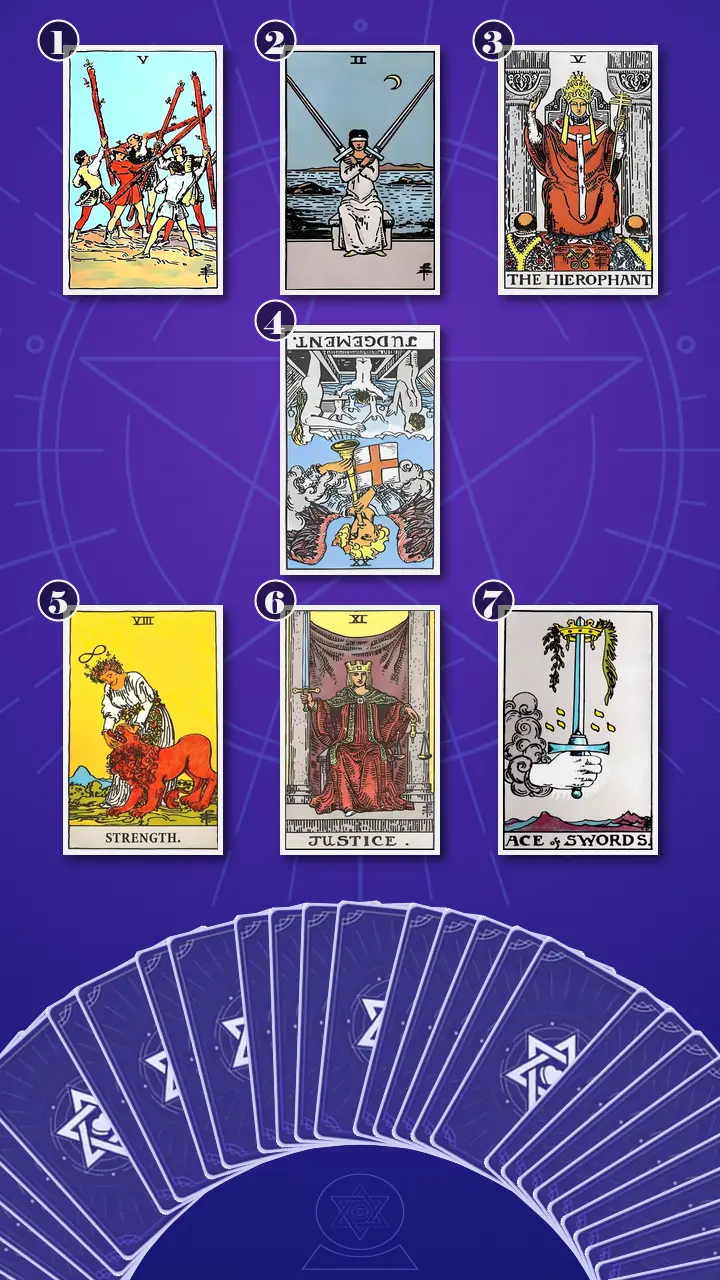
Reading the Map: Why You Freeze in Real Time
Position 1: What the three-way call feels like on the surface
“Now flipped over,” I said, “is the card representing what the three-way call feels like on the surface—the observable conversational climate that drowns out your voice.”
Five of Wands, upright.
I didn’t have to over-explain this one. The image itself is a room with no moderator, everyone swinging their own staff, no shared rhythm. And in modern life terms, it’s painfully specific: The call starts and it’s instantly loud—Mom asks a question, Dad answers for her, then adds another question, and suddenly you’re tracking two conversations at once. You keep waiting for a gap to speak, but the tempo never drops. You can feel yourself getting shorter and shorter with your answers just to keep up.
“That’s it,” Taylor said, and it came out as a quick, almost relieved laugh. Then a nod—small but intense—like I’d just described the exact audio waveform of their dread.
Five of Wands is fire energy in excess: not evil, not even necessarily hostile—just fast, restless, overlapping. And when the noise floor is that high, the quietest person doesn’t need more confidence. They need structure.
I let the words land and added one of my own reframes, the kind I wish someone had offered me when I was younger: “You’re not ‘bad at boundaries.’ You’re trying to speak in a noisy room with no turn-taking.”
Taylor’s eyes flicked away from the screen as if hearing their own inner OS: I’ll jump in after this… after this… never mind.
Position 2: The internal tug-of-war in real time
“Now,” I said, “we’re looking at your internal tug-of-war in the moment—what you’re trying to protect by staying careful or quiet.”
Two of Swords, upright.
This card always feels like a body posture before it feels like a thought: arms crossed, heart guarded, eyes blindfolded—not because you don’t know, but because knowing feels risky.
Its modern translation fit Taylor like a tailored jacket: You hear a loaded question—something that smells like ‘justify your choices’—and you instantly go into careful mode. You keep your tone even, smile you can’t be seen, and answer with the smallest possible truth so nothing sparks. Later you realize you didn’t lie—you just didn’t speak.
Two of Swords is air energy locked into a stalemate—control as protection. “You’re holding two truths at the same time,” I told them. “One: you want to be honest. Two: you want the call to stay calm.”
Taylor pressed their lips together, then released them. Their shoulders didn’t drop yet—but their eyes softened in recognition.
“I keep thinking if I just phrase it correctly,” they said, “they won’t… make it a thing.”
“And your system has learned that silence is safer than a messy sentence,” I replied. “But safety has a cost. Every time you cross your own words out, you pay with self-trust.”
Position 3: The external pressure of family roles and expectations
“Now we flip the card for the external pressure of family roles and expectations—what Mom and Dad, together, implicitly demand from the conversation.”
The Hierophant, upright.
In tarot, The Hierophant is tradition, rules, authority. In family calls, it’s the invisible handbook: how to sound “respectful,” when gratitude is required, how disagreement gets interpreted.
The modern scenario is almost a transcript: The conversation shifts into “We only want what’s best,” and suddenly you’re not sharing an update—you’re applying for approval. You start explaining your reasoning like you’re trying to prove you’re a Responsible Adult™, and you can feel old rules kick in: gratitude first, then maybe you’re allowed an opinion.
The Hierophant isn’t automatically wrong. Parents worry. Parents have values. But the energy here is external authority trying to run a conversation that should be adult-to-adult.
“It’s like… I can be independent in every other part of my life,” Taylor said quietly. “But one call and I’m fourteen again.”
I nodded. “That’s not a character flaw. That’s conditioning plus a fast-paced environment. And when both parents are on the line, the ‘rules’ get louder.”
I paused, then brought in a piece of my own work—what I call Intergenerational Communication Decoding. “Different generations often use different ‘languages’ for care,” I said. “For some parents, ‘concern’ comes out as questions, advice, corrections—because that’s how they learned to show love. But you experience it as evaluation. The mismatch is where your throat tightens.”
Taylor’s gaze sharpened. “Yes. Like I’m being graded.”
Position 4: The core blockage that steals your voice
I touched the center card of the hourglass. “Now we’re at the choke point,” I said. “This is the core blockage that steals your voice—the deepest belief/fear that triggers self-censorship.”
Judgement, reversed.
Reversed Judgement doesn’t mean you’re doomed. It means the call to speak is present—but it gets muffled by fear of being evaluated. The trumpet is there. The sound just doesn’t reach your throat in time.
The modern-life translation is brutally simple: You’re about to say what you actually want, but you can already hear their reaction in your head—skeptical, disappointed, corrective. So you edit your sentence while you’re speaking. You soften it, vague it up, turn it into something unchallengeable… and also untrue. The call ends peacefully, and you feel quietly wrecked.
I used the inner-courtroom metaphor because it’s exactly what this card feels like in family dynamics. “Judgement reversed is the internal tribunal,” I told them. “You walk into the call already cross-examining yourself.”
Then I mapped the three-step inner monologue out loud, slowly enough that Taylor could feel it in their body:
(1) “If I say it plainly…”
(2) “They’ll read it as…”
(3) “So I’ll edit it down to nothing.”
Taylor swallowed. I watched their throat move—small, involuntary. Their eyes blinked faster once, twice, then held. A stomach-drop, visible even through a screen: breath caught, gaze went slightly unfocused as if replaying last week’s call, and then a long exhale that sounded like someone finally setting down a heavy bag.
“That’s literally what happens,” they said, voice thinner now. “I can hear them preparing their response while I’m still talking. So I… disappear.”
Judgement reversed is air energy blocked by self-judgement. And there’s an overcorrection risk here too: if Taylor tries to avoid being judged by over-explaining every detail, the call becomes a debate—more material for cross-examination, more interruptions, more self-doubt.
“Explaining is how your boundary turns into a debate,” I said gently. “And I know you’re doing it to be seen as reasonable. But it’s also the fastest way to lose your voice.”
Position 5: A usable resource you can access during the call
“Now,” I said, “we look at a resource you can access during the call to stay regulated and present—what makes speaking possible.”
Strength, upright.
Strength is not volume. It’s not domination. It’s the quiet competence of staying in your body when you’d rather float away and manage everyone’s feelings.
The scenario is almost a practice instruction: You take one slow breath before you answer. You speak 10% slower than usual. When they react, you don’t rush to rescue the mood. You let a beat of silence happen. For the first time, you feel your voice stay inside your body instead of floating away to manage their feelings.
I slowed my own voice as I spoke, because this card demands it. “Put both feet on the floor,” I coached. “Just for a second right now. And drop your shoulders on an exhale.”
Taylor did it. Their face changed slightly—like someone lowering their guard one notch. They wrapped their hand around a mug, thumb pressing lightly into the ceramic as a tactile anchor.
“This is the gentle hand on the lion,” I said. “Not winning. Staying.”
As a perfumer, I think of Strength as the moment you stop flooding a formula with extra notes because you’re afraid it won’t be liked. You let one accord be itself—steady, clean. That steadiness is what gives a fragrance its presence. It’s what gives a sentence its weight.
When Justice Spoke: Fair Terms, Not Permission
Position 6: The key transformation boundary energy
I held the next card a beat longer. “This,” I said, “is the turning point. The key transformation boundary energy—the standard that protects your voice without escalating.”
Justice, upright.
Justice is where the story stops being about convincing and starts being about terms. Scales and sword: concise statement + clear limit. Fairness over approval.
Taylor leaned in, then immediately leaned back—like their body knew what was coming and wanted to brace. Their expression tightened, not in disagreement, but in fear of what clarity might require.
Setup (the moment right before the shift): I named it the way it happens in real time. “You know that moment when the call connects, both of them are already mid-thought, and you can literally feel your throat tighten while your brain races to draft the ‘right’ answer in real time.”
Delivery (the sentence that changed the temperature):
Stop auditioning for approval and start stating fair terms—let Justice’s scales set the limit and its sword deliver the sentence.
I let silence sit there for a second—an intentional pause, like leaving space between notes so the heart of a perfume can bloom instead of getting crushed by noise.
Reinforcement (what landed in Taylor’s body): Their breathing stopped for half a beat, fingers hovering near their phone as if they were about to type, delete, type again. Then their gaze drifted off to the side—eyes unfocusing the way people look when a memory replays with new subtitles. Finally, their shoulders dropped, not dramatically, but with the unmistakable weight of release. Their lower lip trembled once. “But…” they began, and the word came out with a flash of irritation. “But doesn’t that mean I’ve been doing it wrong? Like I’ve been—” They cut themselves off, cheeks warming, the old urge to defend themselves even here.
I met that moment with steadiness. “It doesn’t mean you were wrong,” I said. “It means your system chose what kept you safe. Justice isn’t calling you immature. It’s offering you adulthood as a structure you’re allowed to set.”
Then I asked the question that turns insight into memory: “Now, with this new lens—fair terms, not permission—can you think of a moment on last week’s call where you felt your throat tighten? What would have changed if you’d said one sentence and stopped?”
Taylor blinked hard, then nodded once. “When they started asking about money,” they said. “I started giving numbers. And then I was trapped.”
That was the emotional transformation right there: not from fear to fearlessness, but from self-doubt to quiet self-respect; from auditioning for approval to naming one fair term out loud.
This is also where I brought in my Conflict Transformation System—not as theory, but as leverage. “A conflict doesn’t become constructive because you say the perfect thing,” I told them. “It becomes constructive when the rules of engagement change. Justice is your rule-change.”
And because I’m a perfumer, I offered a sensory version of that same principle. “Before the call,” I said, “choose one calming scent you personally associate with steadiness—something clean, not emotional. If you’re not sensitive to fragrance, a tiny bit of unscented hand cream plus one drop of bergamot or a lightly citrus tea can work. Not to ‘perform calm.’ To tell your nervous system: new room, new rules.”
Position 7: A concrete, speakable next step
“Now,” I said, “we take Justice and turn it into language. This card is a concrete, speakable next step—a one-sentence boundary you can use on the next call.”
Ace of Swords, upright.
The Ace of Swords is the clean blade: one point, one sentence, no extra paragraphs. And its modern-life scenario is exactly the kind of line you can copy/paste into your brain under pressure: You come in with a single line and you actually use it early: “I’m not making a decision on this call.” When they push for reasons, you repeat the exact same sentence. No extra context. No disclaimers. It’s not cold—it’s clean. And because it’s clean, it holds.
I told Taylor the rule I wanted them to remember when the pace sped up: “One point, one sentence. The failure mode is a long explanation that invites cross-exam. The success mode is a short line, repeated, then you stop.”
To make it real, I played it out like an interruption you can almost hear:
Parent: “But why?”
Taylor: “I’m not discussing that.”
(silence)
Parent: “We’re just worried.”
Taylor: “I’m not discussing that.”
I looked straight into the camera. “A boundary can work even if nobody claps for it,” I said. “The call doesn’t have to feel good for the boundary to work.”
From Insight to Action: The One-Sentence, One-Breath Plan
I gathered the whole spread into one story, because that’s where tarot becomes actionable advice instead of an interesting conversation.
“Here’s the pattern,” I said. “On the surface, the call is Five of Wands: fast, overlapping, no moderator. Inside you, Two of Swords kicks in: neutrality as safety. Then The Hierophant shows up as the family rulebook—respect equals compliance, updates become approval auditions. At the center, Judgement reversed is the internal tribunal: you pre-judge your words before anyone else can. Strength gives you regulation. Justice gives you fair terms. And Ace of Swords gives you one clean sentence that survives the noise.”
“So the blind spot,” Taylor said slowly, “is that I keep trying to be… convincing.”
“Yes,” I replied. “Your cognitive blind spot is thinking the way to keep your voice is to earn permission through the perfect explanation. The transformation direction is the opposite: set a simple call structure and name one clear boundary sentence out loud.”
Then I gave Taylor a plan designed for real life—Toronto, weeknight energy, phone in hand, not a fantasy version of ‘being confident.’
- The 20-Minute Container OpenerWithin the first 30 seconds of the next call, say: “I’ve got about 20 minutes, then I need to go.” (If you prefer, pick 10 or 45—make it fair.)Decide your end time in advance like a calendar invite. If you anticipate pushback, remind yourself: silence isn’t rudeness. Take one slow exhale before you say it.
- One-Person-at-a-Time RequestUse it once, early: “Can we do one person at a time? I want to actually answer.” This isn’t a lecture—it’s a structure reset.If it feels awkward, make it smaller: “Hang on—Dad, can I answer Mom first?” You’re not out-arguing the room. You’re changing the structure.
- One Sentence, One Breath, Then StopWrite one Ace-of-Swords line in Notes and pin it (example: “I’m not making a decision on this call.”). On the call, say it once, then stop talking. If they push, repeat the exact same sentence verbatim twice—no upgrades, no extra reasons—then change structure: “If we keep circling this, I’m going to hop off.”Practice out loud three times while doing something neutral (dishes, a quick walk). Keep it under 12 words. If you add a second sentence, restart—calm and boring beats convincing.
Because my work lives in sensory psychology as much as language, I added one optional layer—my Dialogue Atmosphere Enhancement strategy. “Pick one scent you only use for calls,” I suggested. “Not as a ritual to fix your parents—just as a memory anchor for your nervous system. Citrus is great for clarity—bergamot, grapefruit, even a clean citrus hand soap. It’s like telling your body: this is adult-you time.”

A Week Later, the Call Still Didn’t Clap—and It Still Worked
A week later, Taylor messaged me a screenshot—one line highlighted in their Notes app, pinned at the top like a tiny flag: I’ve got 20 minutes today.
“I said it in the first thirty seconds,” they wrote. “My voice shook for like half a second. They didn’t love it. There was a pause. And I didn’t fill it. Then I repeated it once when they tried to keep going.”
They added: “After the call, I didn’t write a legal brief text. I just… made tea. I felt weirdly proud and weirdly guilty at the same time.”
That’s the real journey to clarity. It’s not fireworks. It’s the quiet proof: you can be respectful without being available, and you can protect your voice without turning your parents into villains.
When the call turns into a two-voice “concern” spiral, it’s not that you don’t know what you think—it’s that your throat tightens because you’re trying to be respected and avoid being labeled ungrateful at the exact same time.
If you didn’t have to earn permission to speak, what’s the one fair sentence you’d be willing to say once—and then let stand?