From Brunch Shame to Calm Self-Respect: Saying One Sentence Out Loud

Finding Clarity in the Saturday Brunch Performance Review
You’re 27, living in Toronto, and family brunch somehow turns into a public “life update” where your parents casually compare you to your cousin—then you’re stuck managing your tone so you don’t look “too sensitive.”
Alex (name changed for privacy) told me that line like she’d said it a hundred times already—once to friends, once to her therapist, once to herself on the TTC—yet it still sounded new in her mouth. Like it shouldn’t be this hard to eat eggs and talk about your week.
She described 11:12 a.m. on a bright Saturday on Queen West: squeezing into a booth, plates clattering, the espresso machine hissing like it had opinions. The air smelled like maple syrup and fryer oil. Her phone was still warm from a last-second LinkedIn scroll in the Uber. And then—like a cue in a script her body knew by heart—her parent said, “Your cousin is already…”
“My face goes hot,” she said, touching her jaw like she could still feel the tension there. “My throat tightens. And I’m smiling. Like I’m on autopilot.”
I could hear the core contradiction underneath every detail: Alex wanted to be treated as her own person, but she feared that interrupting her parents—especially in front of other relatives—would make her look disrespectful and cost her their approval.
The shame wasn’t abstract. It was physical, specific—like swallowing a smooth stone and realizing, too late, it’s lodged right where your voice should pass through.
“You’re not too sensitive,” I said gently. “You’re tired of being scored in public. And today, let’s make this practical. We’re going to find one clean way to interrupt the comparison loop—without turning brunch into a courtroom.”

Choosing the Compass: The Horseshoe Spread at a Curved Dinner Table
I asked Alex to take one slow breath—not as a mystical thing, just a nervous-system handoff from rehearsal mode into reality. Then I shuffled while she held one clear question in mind: Parents compare me to my cousin at brunch—how do I interrupt it?
“Today I’m using the Horseshoe Spread · Context Edition,” I told her.
For anyone wondering how tarot works in a moment like this: I’m not using the cards to predict whether Alex’s parents will magically become perfect communicators. I’m using them like a map—one that shows the repeating pattern (past conditioning → present dynamic), the hidden pressure, the exact internal obstacle, and then the most effective next move. It’s a practical tarot spread for setting boundaries with parents without escalating.
This spread is especially good for family conflict because it walks us through a whole social ecosystem, not just one comment. In this layout, the positions that matter most for Alex are:
• Position 2: what’s happening at brunch in real time (the visible dynamic).
• Position 4: the obstacle—what specifically blocks her voice in the moment.
• Position 6: advice—the cleanest boundary + redirect that works at the table.
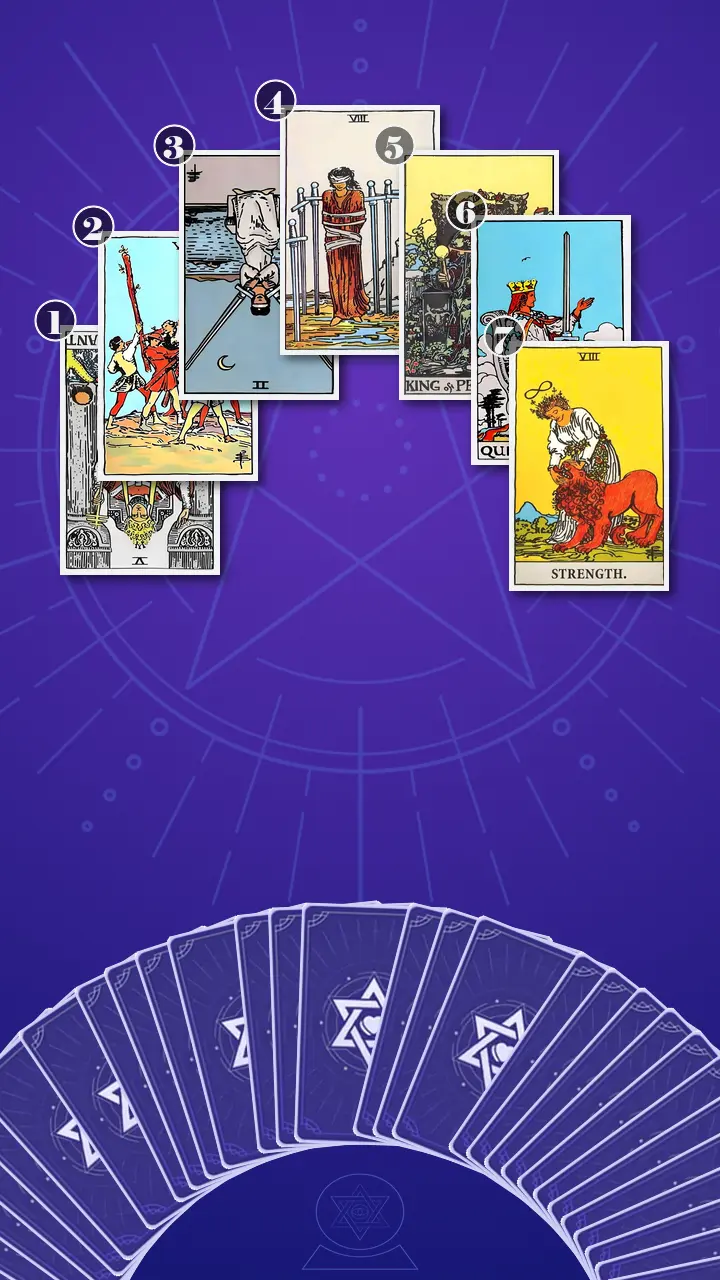
I arranged the seven cards in a horseshoe arc like a curved dinner table, because that’s what it feels like for her: the conversation travels around the table, and she keeps getting seated in the same place—right under the scoreboard.
Reading the Map: Card Meanings in Context
Position 1 — Past conditioning: the family script
“Now we’re turning over the card for Past conditioning: the family script Alex learned about respect, success, and not contradicting parents,” I said.
The Hierophant, reversed.
This lands like: You walk into brunch already braced for a quiz: job title, timeline, “what’s next.” The old script says being a ‘good’ adult means being agreeable and letting parents narrate what success should look like—even when it turns your life into a comparison chart.
Energetically, reversed Hierophant is a blockage of borrowed authority. The “rules” are loud, but they’re not necessarily yours anymore. The card isn’t saying your family values are bad—it’s saying the inherited script is outdated for the adult relationship you’re trying to build.
Alex let out a short laugh that wasn’t amused. More like air escaping a balloon.
“That’s… yeah,” she said, and her smile went a little bitter. “It’s so accurate it’s kind of brutal.”
I nodded. “It is brutal when you realize you’ve been trying to pass an exam no one formally assigned. Reversed Hierophant asks one key question: Does respect have to equal silence? Or can respect include a clear boundary?”
Position 2 — Present dynamic: what happens at brunch right now
“Now we’re turning over the card for Present dynamic: what is happening at brunch right now when the comparison starts,” I said.
Five of Wands, upright.
This lands like: Brunch becomes a chaotic group-thread argument where everyone tosses in a stat—salary, promotion, relationship milestone—like they’re commentating a game. You’re not failing; you’re in a conversation structure that rewards interruption and ranking.
Energetically, Five of Wands is excess Fire in the room: heat without direction. It’s not a calm, one-on-one check-in. It’s a pile-on dynamic—like a group chat where five people reply at once and you’re suddenly defending five threads.
And that matters, because it means your nervous system isn’t overreacting. It’s responding to a competitive format.
Alex did a half-laugh—this time softer. Relief-adjacent.
“So I’m not losing,” she said. “It’s just… the whole conversation is set up like a contest.”
“Exactly,” I said. “Don’t win the comparison. End the comparison.”
Position 3 — Hidden influence: the unspoken boundary
“Now we’re turning over the card for Hidden influence: the unspoken boundary Alex has, and the internal pressure that makes her hesitate,” I said.
Two of Swords, reversed.
This lands like: You’re smiling and nodding while internally drafting a full closing argument you’ll only deliver later in your head. The reversal is the crack in the pattern: part of you is done paying for politeness with self-erasure.
Energetically, reversed Two of Swords is a stalemate that can’t hold. Your internal “no” is getting louder than your external smile.
I leaned in slightly. “This is the micro-moment,” I said. “You feel yourself smiling while your stomach drops. And you’re already composing the perfect comeback… for the subway ride home. It’s like drafting a long email you never send, because hitting send would make it real.”
Alex winced—then nodded like the card had read her Notes app out loud.
“I literally do that,” she said. “On Line 1. AirPods in. Nothing playing.”
“That’s your hidden boundary,” I said. “It exists. We’re not inventing it. We’re just giving it a voice that won’t burn the room down.”
Position 4 — Obstacle: the permission trap
“Now we’re turning over the card for Obstacle: what blocks Alex from interrupting in real time,” I said.
Eight of Swords, upright.
This lands like: You wait for the perfect phrasing that guarantees no one reacts badly, so you say nothing until the moment passes. Then you over-explain to make the discomfort go away, which teaches everyone the comparison is allowed.
Energetically, Eight of Swords is Air turned into a cage: thoughts that restrict movement. Not because you’re actually powerless—but because your mind is charging you an impossible “permission fee” to speak.
I described it in the tight close-up Alex already knew: the exact second your jaw tightens, the moment you start drafting the perfect respectful sentence in your head while everyone keeps talking. The inner binary that locks you up: peace vs self-respect. polite vs present. And the looping line that keeps you trapped: If I say it wrong, I’ll be the problem.
Her reaction came in a three-beat wave: her breathing paused; her eyes unfocused like she was replaying brunch in her mind; then a small exhale slid out, quiet but stunned.
“Oh,” she said. “That’s the trap.”
“Yes,” I said. “And the bindings in this card are always looser than they look. It’s not that you can’t speak. It’s that you believe you must choose between connection and dignity.”
Position 5 — Others’ stance: the lens your parents bring
“Now we’re turning over the card for Others’ stance: the value system or lens the parents bring into the conversation,” I said.
King of Pentacles, upright.
This lands like: Your parents talk like risk managers: they’re scanning for ‘secure outcomes’ and using your cousin as a case study of a safe path. It doesn’t make the comparison okay, but it explains why they keep returning to metrics and milestones when they’re anxious.
Energetically, King of Pentacles is Earth in balance—but emotionally blunt. Grounded. Practical. Protective. The kind of energy that says, “If we can measure it, we can relax.”
Here’s where my day job always sneaks into my tarot work. I spend nights in a Tokyo planetarium explaining gravity—how the biggest bodies shape the motion of everything near them. And families can feel like that: the “provider” values become the center of gravity, and everyone else’s choices get pulled into orbit whether they signed up for it or not.
In my Galactic Gravity Analysis, I don’t label anyone as the villain. I ask: What is the gravitational law in this system? For your parents, security is the sun. They love you through outcomes they can see. And your cousin becomes a reference point—an orbit marker—because it calms their anxiety.
Alex’s shoulders lowered a fraction. “So when they compare… it’s not always meant as an insult,” she said. “It’s like… their weird way of trying to make sure I’m okay.”
“Right,” I said. “We can acknowledge the value—security—without accepting the method—ranking you.”
When the Queen of Swords Spoke, the Room Got Quiet
Position 6 — Advice: the cleanest boundary + redirect
I let my hands hover over the next card for a beat. The way I do when I know the reading is about to stop being descriptive and start being useful. Even through a video call, you can feel that shift—like the air before a show begins in the dome of a planetarium, when the chatter fades and everyone looks up.
“Now we’re turning over the card for Advice: the most effective boundary/communication move to interrupt comparisons while keeping self-respect and steadiness,” I said.
Queen of Swords, upright.
This lands like: You interrupt the moment the comparison starts with one calm line—no résumé defense, no debate—and then you redirect. Example: “I know you mean well, but I’m not doing comparisons. I’m happy to update you on me.” Then you ask a new question and let the pause be awkward without rescuing it.
Energetically, Queen of Swords is Air in balance: clean thought, clean speech, clean boundary. Not harsh. Not performative. Precise.
Alex’s face tightened as if she could already hear the brunch table go silent. That familiar inner monologue flickered: Don’t be dramatic. Don’t make this a thing. Don’t embarrass them.
That’s the setup she’d been living in: checking LinkedIn before brunch, rehearsing a “normal” way to describe her job, and still feeling her throat lock the second her cousin’s name showed up… because this was never about accomplishments. It was about belonging.
Stop trying to outscore your cousin, start lifting the Queen of Swords’ blade of clarity: one clean boundary cuts the comparison loop without a fight.
I let the sentence sit there, like a star you can’t unsee once someone points it out.
Alex’s reaction unfolded in layers. First: a freeze—her lips parted, but no sound came out. Then: her eyes widened slightly, not in fear, but in recognition, as if her brain had finally found the file name for what she’d been living through. Then: her shoulders dropped, and she took a breath that reached lower than her chest.
“But… if I say it,” she said, and her voice tipped toward irritation, “doesn’t that mean I’ve just been letting it happen? Like I was… okay with it?”
It was the kind of question that sounds like anger, but is actually grief wearing a sharper jacket.
“No,” I said, steady. “It means you were using the tools you had. Silence was your way of protecting connection. The Queen just offers you a different tool that protects your dignity too.”
I shifted into my Light-Year Communication lens—the cosmic-scale technique I use for generational gaps. When people are far apart in worldview, long emotional speeches get distorted across distance, like static. Short, clear signals travel better.
“A boundary isn’t a speech,” I told her. “It’s a sentence. One that can survive the noise of a brunch table.”
Her jaw unclenched—then clenched again, like her body was testing the new rule. She swallowed, nodded once, and whispered, “I can actually do that.”
“Now,” I added, “use this new lens and rewind the last time it happened. If you could go back ten seconds—right at ‘Your cousin is already…’—what would you say once, calmly?”
She looked slightly off-camera, as if seeing the booth, the plates, the relatives. “I’d say… ‘I know you mean well, but I’m not doing comparisons. Can we switch topics?’”
“Perfect,” I said. “Short. Calm. Repeatable. Cutting through, not cutting people down.”
Position 7 — Integration: calm courage that holds the line
“Now we’re turning over the card for Integration: what changes when Alex practices the interruption consistently,” I said.
Strength, upright.
This lands like: You feel the heat rise in your face and still choose a steady voice. The win isn’t making everyone agree—it’s staying connected to yourself while staying in the room. Each repetition makes the boundary feel less like a confrontation and more like a normal rule of engagement.
Energetically, Strength is Fire regulated. Not suppression. Not explosion. It’s the courage to stay present through the awkward beat after you speak—without apologizing for existing.
“Awkward is just the sound of a new rule entering the room,” I said. “Strength is you letting that sound happen.”
The One-Sentence Cut-Off: Actionable Advice for Your Next Brunch
I drew the thread back through the whole arc, so it became a single story Alex could hold without spiraling.
The Hierophant reversed showed the inherited rulebook: respect equals silence, success equals visible milestones. Five of Wands showed why brunch feels like a competition you didn’t enter—too many voices, too much heat. Two of Swords reversed revealed the truth: you already have a boundary; you’ve just been keeping it internal. Eight of Swords named the trap: you think you need the perfect phrasing (a password) to earn permission to speak. King of Pentacles explained the parents’ lens: security, metrics, “proof.” And then Queen of Swords offered the lever that changes everything: one clean boundary plus a redirect, held inside Strength’s steady body.
The cognitive blind spot here is subtle but powerful: you’ve been treating “peace” and “self-respect” as mutually exclusive. The transformation direction is the opposite. It’s learning you can keep connection and protect dignity—with one sentence.
To make it practical, I gave Alex a version of my Solar Eclipse Mediation strategy—three steps based on celestial mechanics. In an eclipse, you don’t destroy the sun or the moon. You change alignment. You create a brief shadow. And then the light returns. That’s exactly what a good boundary does at a table.
- Write the 10-second lineOpen Notes and type one sentence you can say in under 10 seconds: “I know you mean well, but I’m not doing comparisons. Can we switch topics?” Read it once silently, then once out loud.If it feels “rude,” soften your tone—not your boundary. Calm voice, neutral face.
- Do the “Queen of Swords Line” drill (7 minutes)Set a 60-second timer and say the line out loud three times, slower than feels natural. Then pick one redirect question and add it right after: “What’s everyone watching lately?” / “How’s your week been?” / “What’s the best thing you’ve eaten recently?”Boundary + low-stakes redirect is the whole move. No explaining. Stop early if you feel overwhelmed.
- Use the eclipse pause (sip-of-water beat)At brunch, interrupt earlier than you want to—right after the first comparison phrase, before you start defending your job. Say your line once, then take one sip of water or coffee and let the pause exist.If they push back, repeat the same sentence once—no upgrades, no speeches. “I’m happy to update you on me, just not compared to anyone.”
Alex’s practical obstacle came right on cue: “But I can’t even find five minutes before brunch,” she said. “I’m already stressed. And I’m usually in an Uber.”
“Then we make it commuter-proof,” I said. “One minute version. Read the line once in your head in the Uber. Whisper it once if you can. Your goal isn’t to feel fearless. Your goal is to be able to say it once while your body is loud.”

A Week Later: The Quiet Proof of Self-Respect
A week later, Alex messaged me: “It happened. Like… immediately. ‘Your cousin is already—’ and I said the line. My voice shook a tiny bit. Then I sipped my coffee. No one died.”
She told me there was a brief silence—the kind that used to make her panic and start over-explaining. This time she didn’t rescue it. Someone changed the topic to a show they were watching. Brunch continued. And afterward, instead of replaying the conversation like evidence on the TTC, she noticed something smaller and stranger: her jaw didn’t ache.
She didn’t celebrate with a big victory lap. She sat alone in a café afterward for twenty minutes, staring out at the streetcars and feeling a little shaky—clear, but still tender. The first thought the next morning was still, “What if I did it wrong?”—and then, quietly, “I did it anyway.”
That’s the real Journey to Clarity in family dynamics: not a perfect family, not perfect words—just a shift from shame-driven people-pleasing and freezing at the table to calm, one-sentence self-respect and steadier connection.
When your parents compare you in public, it can feel like your throat locks because you’re trying to keep the connection and protect your dignity at the exact same time.
If you didn’t have to win the comparison—just end it—what’s the one sentence you’d be willing to say once, calmly, and let the room deal with the pause?