The Slack Message Rewritten at 9:12 PM—And the 'No-Sorry Draft' Pivot

Finding Clarity in the 9:12 p.m. Slack Draft
If you’re a NYC corporate girlie who types “sorry if this is obvious” into Slack before asking a basic question, this is for you.
Casey (name changed for privacy) sank into the chair across from me like she’d been holding her breath since lunch. She told me she’d just rewritten the same Slack message three times—laptop balanced on her knees, blue light sharp in her eyes—then deleted it, then retyped it with three extra lines of context. The radiator in her studio clicked like a metronome. Her phone buzzed once on the table and she flinched, shoulders creeping up as if the notification could correct her.
“It’s such a normal question,” she said, voice already softening. “Like… ‘Do we have the latest deck?’ And my fingers just add, ‘Sorry if this is obvious.’ Like it’s… the entry fee.”
Her throat tightened on the word fee. I watched her press the tip of her tongue to the roof of her mouth—an unconscious brace—right before she spoke again.
“And then I spiral,” she admitted. “I reread threads. I backtrack mid-sentence. I send the follow-up ‘just checking’ text. It’s like I’m apologizing for existing.”
The shame didn’t read like a thought; it read like a physical posture—small, guarded, chest slightly caved in, like she was trying to take up less oxygen. The feeling had a texture: like swallowing through a narrow straw, every word forced through a tight throat.
“My mom used to joke I was a ‘crybaby,’” she said, trying to smile like it didn’t matter. “And I know it was ‘just joking,’ but… why am I like this now? Why do I apologize when I did nothing wrong?”
I nodded, keeping my voice warm and plain. “We’re not here to diagnose you as ‘too sensitive.’ We’re here to map the reflex—where it started, what keeps it running, and what it looks like to speak without auditioning for permission. Let’s use the cards to find clarity, not a verdict.”

Choosing the Compass: The Four-Layer Insight Ladder · Context Edition
I asked Casey to take one slow breath and place a hand lightly on her chest—not as a ritual, but as a way to give her nervous system a new starting line. While she focused on the question—“Mom joked I was a crybaby—why do I overapologize now?”—I shuffled until the deck felt quiet in my hands.
Today, I told her, we’d use a spread I rely on when someone isn’t asking for prediction—they’re asking for root cause and a real-life pivot: the Four-Layer Insight Ladder · Context Edition.
For you reading this: the reason this tarot spread works for people-pleasing and overapologizing is that it climbs in layers. It starts with the visible habit (what happens on a random Tuesday), then traces the childhood imprint underneath, then names the shame-based binding belief that keeps the cycle alive. The last two cards are built for change: one for the reframe, one for the actionable communication shift.
I pointed to the ladder layout. “The first card will show the pattern as it happens in real time. The middle will show what old memory gets triggered and what fear binds you to the reflex. Then we’ll look for the medicine—what replaces apology-as-control with self-respect—and finally, one concrete next step for cleaner communication.”
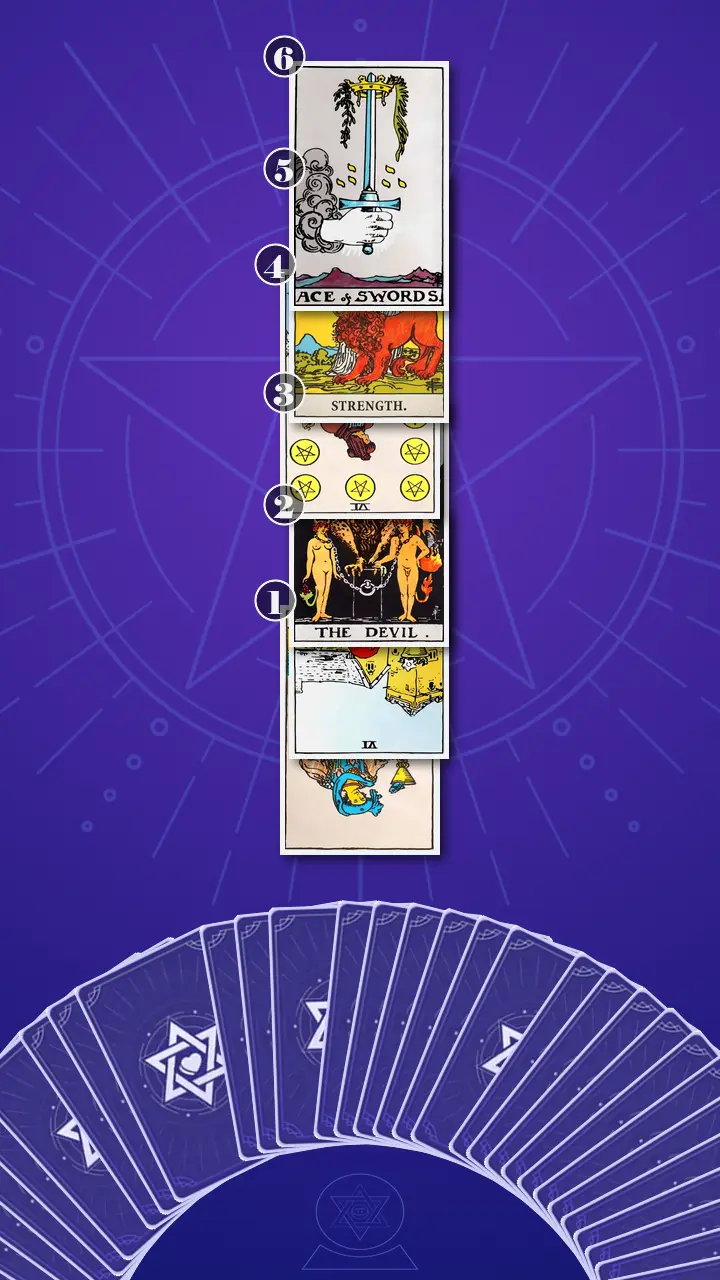
Reading the Ladder: From Reflex to Root
Position 1: The visible pattern right now
“Now we’re turning over the card that represents the visible pattern right now: what overapologizing looks like in real time,” I said.
Page of Cups, reversed.
“This is so specific it almost hurts,” I told her, and I meant it. “It’s you drafting a basic Slack question—something normal like ‘Do we have the latest deck?’—but your fingers automatically add a softener: ‘Sorry if this is obvious.’ You reread it twice, scan for any hint of annoyance you might provoke, and hit send with your shoulders slightly raised like you’re bracing for impact.”
Reversed, the Page’s energy is blocked: emotional openness turns into emotional self-consciousness. Feelings arrive—like that fish popping out of the cup—and instead of letting the feeling simply be information, the inner narrator prosecutes it. “Is this stupid? Am I being dramatic? Should I delete it?”
Casey gave a short laugh that had a bitter edge. “Okay. That’s… rude. But true.” Her eyes flicked away from the card like it was too accurate.
Position 2: The trigger memory layer
“Now we’re turning over the card that represents the trigger memory layer: what past imprint gets activated when you feel judged or teased,” I said.
Six of Cups, reversed.
“This is the time-travel effect,” I explained. “A friend jokes, ‘You’re so dramatic,’ and you laugh too fast—like you have a script. On the walk home, it doesn’t feel like the friend anymore. It feels like being a kid at the dinner table when your mom called you a ‘crybaby’ and everyone laughed. Your adult brain knows it was ‘just a joke,’ but your body reacts like the room got unsafe.”
Reversed, this isn’t nostalgia—it’s a memory that intrudes. The energy here is stuck: your present-day tone anxiety gets fed by an older lesson about what emotions cost you.
Casey’s fingers tightened around her mug, then loosened. A tiny swallow. “I hate that it still gets me,” she said, quietly.
“Belonging shouldn’t require you to shrink your feelings into a joke,” I said, and let the sentence sit between us without rushing to soften it.
Position 3: The root bind
“Now we’re turning over the card that represents the root bind: the deepest fear or belief that makes the reflex feel necessary for safety and belonging,” I said.
The Devil, upright.
“Here’s the mechanism,” I told her. “You catch yourself apologizing even when no one asked for it—like you’re paying a fee to keep people calm. You feel the urge to send the follow-up text—‘Sorry if that came off weird, I didn’t mean…’—not because you did harm, but because silence feels like danger and your mind wants to control the outcome.”
This is The Devil’s energy as bondage: shame-bonding, people-pleasing, and the belief that acceptance is conditional on you being low-maintenance. The chains are loose—meaning it’s learned, not fate—but your nervous system treats it like law: If I apologize first, they can’t reject me for having feelings.
I said it plainly, because she needed plain. “You’re not overapologizing because you’re polite—you’re overapologizing because you’re trying to stay safe.”
Casey’s face tightened, then she exhaled through her nose like she’d been holding pressure behind her eyes. “That’s exactly it,” she said. “It’s like I can’t stand not knowing if they’re mad.”
Position 4: The maintaining behavior
“Now we’re turning over the card that represents the maintaining behavior: how you try to keep connection stable—the social strategy that backfires,” I said.
Six of Pentacles, reversed.
“This is apologizing as currency,” I said. “At work, someone asks for a quick turnaround. The deadline is tight but doable. You deliver—and still say, ‘Sorry this took so long,’ then volunteer to tweak it again ‘just in case.’ Later you feel oddly irritated, like you donated energy you didn’t have, and no one even noticed the sacrifice you made to be ‘easy.’”
Reversed, the Six’s energy is imbalanced. It’s the invisible spreadsheet: who’s allowed to have needs, who has to earn them. In NYC work culture—fast, blunt, text-based—it’s easy for your brain to treat every unanswered message like a verdict. So you tip extra. You overgive. You overexplain. You apologize pre-emptively, hoping it buys you steadiness.
Casey’s mouth twisted. “And then I resent them for not reading my mind,” she said, half-confessing, half-angry with herself for confessing.
“That resentment makes sense,” I replied. “It’s the part of you that knows connection shouldn’t cost you a piece of yourself every time.”
When Strength Spoke: The Lion Moment Without an Apology
Position 5: The transformative reframe
I slowed my hands before turning the next card. The room felt suddenly quieter—the radiator’s clicking louder, the city outside more distant—as if the reading had been walking us toward one door.
“Now we’re turning over the card that represents the transformative reframe: the inner capacity that dissolves shame and rebuilds self-trust,” I said.
Strength, upright.
“This looks like you feeling that tight-throat moment before speaking up in a meeting,” I told her, “and instead of rushing into ‘Sorry, just one thing,’ you take one breath, keep your voice steady, and say, ‘I have a concern about the timeline.’ Your face is warm, your chest feels braced—but you stay there. You don’t punish yourself for having a nervous system.”
Strength’s energy is balance: not suppression, not explosion—presence. It’s maturity that isn’t cold. It’s gentle self-possession.
And because I’m a perfumer by training, I reached for the lens I use when family dynamics have left a sensory imprint. “Casey, I want to try something I call a Family Energy Diagnosis,” I said. “Not to blame anyone—just to map the emotional air you grew up breathing.”
“Okay,” she said, wary but curious.
“When you think of your family dinner table—the ‘crybaby’ joke vibe—what’s the smell?” I asked.
She blinked, then her gaze went unfocused for a second, like a tab switching in her brain. “Dish soap,” she said immediately. “Like… lemony. And coffee. And this sharp perfume my mom wore.”
“Right,” I said softly. “So your body doesn’t just remember the words. It remembers the atmosphere. A sharp scent, a bright lemon-clean kind of ‘be chill,’ and the social rule: don’t make the room uncomfortable. Strength is you changing the atmosphere from the inside—not by paying with apology, but by staying steady while the lion of feeling is right there.”
Her breath hitched—just a little—like the first moment of a cry she wouldn’t allow herself to label as embarrassing.
For the key shift, I mirrored the exact moment her old script lived in: “It’s 9:12pm, you’re on your couch with Slack still open, and you’re rereading a totally normal message—your throat tight, finger hovering—adding ‘sorry’ like it’s the entry fee to be allowed to speak.”
Stop trying to un-feel yourself to stay safe; start holding your feelings with steady strength—like the woman who calms the lion without fear or apology.
Casey’s reaction came in a chain, not a single beat.
First, a freeze: her lips parted, but no sound came out. Her shoulders stayed high for a second, like her body didn’t trust the floor to hold her.
Then, the cognitive seep: her eyes went slightly glassy, unfocused—like she was replaying years of “just joking” moments and seeing the pattern instead of the isolated scenes.
Then, the release: a long exhale that seemed to come from her ribs. Her shoulders dropped. She rubbed her throat once, not dramatically—just acknowledging it existed. “But if I don’t apologize,” she said, a flash of anger surfacing, “doesn’t that mean I’ve been doing it wrong this whole time?”
I shook my head. “No. It means you’ve been surviving with the best tool you had. An apology isn’t an entry fee. It was a security behavior. And security behaviors aren’t ‘wrong’—they’re just expensive.”
I leaned in, gentle but direct. “Now, with this new lens, think back to last week. Was there one moment—one Slack message, one friend text, one meeting—where this insight could’ve changed how you felt in your body?”
She swallowed, slower this time. “Yesterday,” she said. “My manager asked for something last-minute. I typed, ‘Sorry—’ before I even knew what I was apologizing for.”
“That’s the crossing,” I told her. “Not from ‘too sensitive’ to ‘not sensitive.’ From braced shame—speaking from behind a glass wall—to grounded self-respect. Sensitivity isn’t the problem—self-prosecution is.”
Position 6: Integration step—clean communication
“Now we’re turning over the card that represents the integration step: a concrete communication shift you can practice so apologies become intentional and specific,” I said.
Ace of Swords, upright.
“This is the clean swap,” I explained. “You replace ‘Sorry to bug you’ with: ‘Quick question—can you confirm which version we’re using?’ Or you use a one-sentence boundary: ‘I can’t take that on today.’ It’s not cold; it’s specific. You stop wrapping truth in apologies and start using words like a straight path instead of a maze.”
Ace of Swords is clarity as a practice. And I always remind people: Clarity is not aggression.
Casey nodded once—small, decisive. Like she could feel the difference between being direct and being cruel.
The One-Page Reset: From “Sorry” to Self-Validated Honesty
Here’s the story the whole ladder told, stitched into one thread: the reversed Page of Cups showed the moment your emotion rises and immediately gets policed—like you have to prove you’re not “too much.” The reversed Six of Cups explained why the reaction is so fast: your body learned, early, that feelings could be mocked. The Devil named the binding belief—belonging is conditional, and apology is how you buy safety. The reversed Six of Pentacles showed how you try to stabilize connection by over-giving, over-explaining, and paying with niceness—until resentment builds. Strength replaced bargaining with steadiness. Ace of Swords gave your steadiness a sentence.
Your cognitive blind spot isn’t that you have feelings. It’s that you treat the feeling as evidence against you, then try to manage other people’s reactions before you even know what they are.
The transformation direction is simple and hard in the best way: from pre-emptive apologizing to self-validated honesty—feel it, stay present, ask for what you need without auditioning for permission.
I gave Casey the smallest, most practical next steps—because change sticks when it starts on a random Tuesday.
- The No-Sorry Draft (90 seconds)Open one low-stakes message you’re about to send (Slack or text). Write Version A the reflex way (with the apology). Then write Version B with zero apologies and one clear sentence about what you need.Before sending anything, do a body-first pause: unclench your jaw, drop your shoulders, one slow breath into your chest. If anxiety spikes, save Version B in Notes—practice, not performance.
- Harm vs. Discomfort CheckRight before you type “sorry,” say out loud: “Did I cause harm, or am I just uncomfortable?” If it’s discomfort, choose clarity or gratitude instead.If dropping “sorry” feels too sharp, use a bridge line: “Thanks for your patience” or “Appreciate you.” Your nervous system may protest—that’s a sign the reflex is being interrupted.
- Scented Boundary Cue (my perfumer’s shortcut)Before a meeting or a tough text, add one calming scent cue—lavender on your wrist, or a soft, clean hand lotion. Pair it with your two-line script: “I’m having a feeling about this.” / “What I need is ____.”Use the scent as an anchor for Strength: it’s your reminder to stay with the lion for 10 seconds—no apology, no defense paragraph—then speak once.

A Week Later: The Quiet Proof
Eight days later, Casey DM’d me a screenshot: a Slack message that began with “Quick question—can you confirm which version we’re using?” No “sorry.” No apology sandwich. Under it she wrote, “My throat did the thing. I hit send anyway. Then I just… rode the subway and didn’t rewrite my whole personality.”
That’s what a real Journey to Clarity often looks like—not a personality transplant, but a tiny, repeatable pivot: less bargaining, more self-respect; fewer disclaimers, cleaner words.
When you’ve been trained that normal feelings make you “too sensitive,” your throat tightens before you speak—not because you’re wrong, but because you’re bracing to be judged.
If you didn’t have to audition for permission, what’s one true sentence you’d let yourself say this week—just once—without an apology wrapped around it?
Every reading at AceTarot is a journey to connect with inner wisdom and empower your next step. The stories shared here are psychological mirrors, not private records—crafted to reflect universal emotional loops and help you find your own clarity. Learn more about our Journey to Clarity.