From Polite Smiles to Self-Respect: A Boundary Plan for Family Dinners

Finding Clarity in the “So What Do You Think?” Spotlight
You’re the one who can feel your jaw tighten the second your uncle starts politics at dinner—and you immediately go into “polite smile + internal dissertation” mode.
When Jordan said that to me on our call, I watched their throat work like they were swallowing a sentence they’d already swallowed a hundred times. They were in Toronto. I was in Tokyo, in a little back office at the planetarium—still faintly smelling of projector heat and the lemony disinfectant we use between shows. Different cities, same nervous system.
They described 6:42 p.m. on a Sunday: a warm kitchen that’s somehow slightly too bright, cutlery clinking, a pot lid rattling, someone’s perfume tangled up with roasted garlic. Then the pivot—“Did you see the news?”—and the whole table subtly tilts like a boat taking weight on one side.
“I’m not trying to win a debate at dinner,” Jordan said, voice flat in a way that sounded like effort. “I’m trying to eat.”
And still: their shoulders rose a fraction, jaw locked, breath shallow. The tension had a specific texture—like wearing a tight collar you can’t unbutton because everyone’s watching. They wanted the night to stay peaceful and connected, but they also didn’t want connection to cost them their own voice. Belonging versus boundary. That’s the whole dilemma.
I nodded, slow. “Let’s not make this about the perfect argument,” I said. “Let’s make a map for the moment your body braces—so you can stay present without being recruited into a fight. That’s our Journey to Clarity today.”

Choosing the Compass: The Celtic Cross · Context Edition
I asked Jordan to plant both feet on the floor, just for ten seconds, and take one longer exhale than inhale—nothing mystical, just giving the nervous system a signal: we’re here, we’re safe enough to look. While they did that, I shuffled slowly, the soft rasp of cardstock loud in my small room.
“Today I’m going to use the Celtic Cross · Context Edition,” I told them.
For readers who’ve ever googled how tarot works in the middle of a spiral: this spread is useful because it doesn’t just say “here’s the vibe.” It shows a chain: what’s happening in the exact moment, what’s amplifying it, what belief is underneath, and—crucially for family systems—you versus the environment. That matters when the question isn’t “Who’s right?” but “How do I hold my boundary with family about politics at dinner without starting a fight?”
I previewed the parts I knew we’d lean on most.
“Card 1 will show the freeze pattern right at the table,” I said. “Card 8 will show the pressure coming from the room—power dynamics, dominance, that ‘you have to respond’ feeling. And Card 10 will show what a sustainable boundary style looks like: not a showdown, a practice.”
Jordan exhaled again, quieter this time. “Okay. I can do a practice.”
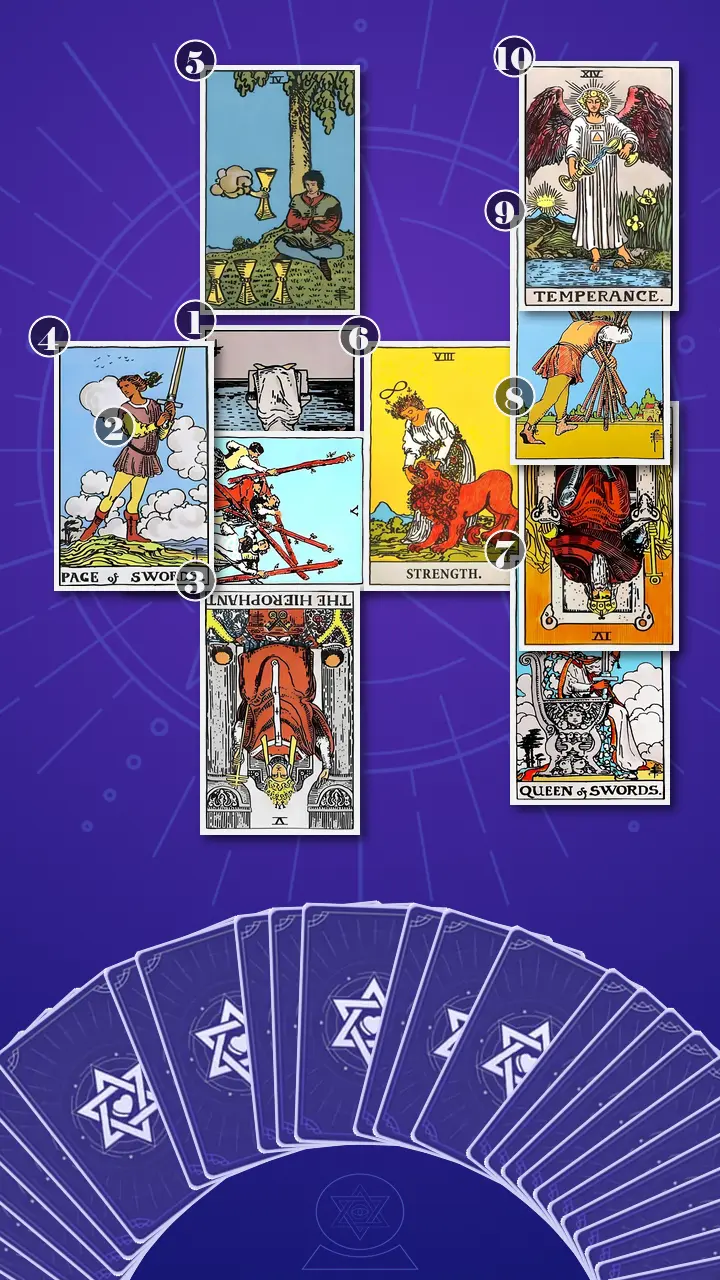
Reading the Table Like a Sky Chart
When I guide planetarium tours, I tell people that constellations aren’t lines in the sky—they’re patterns our brains draw to make meaning. Family dinners are like that too. A few repeated moments, and suddenly your body can predict the whole night.
I turned over the first card.
Position 1 (Current moment at the dinner table): Two of Swords, reversed
“Now we turn over the card that represents your current moment at the dinner table—the exact boundary freeze,” I said. “This is Two of Swords, reversed.”
The imagery landed immediately: the blindfold slipping, the crossed swords no longer holding the line the way they used to.
I connected it to Jordan’s real life the way I always do: “This is that exact thing you described—your face stays neutral, polite. But your chest feels locked because two tracks are running at once: ‘keep the peace’ and ‘say something.’ It’s like having two tabs open that you can’t close: Don’t be rude vs Don’t abandon yourself.”
Energetically, reversed Two of Swords is blockage turning into unsustainability. The ‘I’ll just endure it’ strategy starts cracking. The not-choosing stops feeling neutral and starts feeling like self-erasure.
Jordan let out a small laugh that wasn’t amused—more like a wince with sound. “That’s… brutal,” they said. “Like, yeah. I stare at my plate like it has subtitles.”
I kept my voice warm. “It’s not brutal. It’s data. And here’s the key question: if you didn’t need the perfect sentence—if you only needed a good-enough boundary—what would it sound like?”
Position 2 (The immediate challenge): Five of Wands, upright
“Now we turn over the card that represents the immediate challenge—what escalates it in real time,” I said. “This is Five of Wands, upright.”
I pointed at the chaotic sparring in the image. “This is the table turning into a live comment section. Not necessarily because everyone is yelling—sometimes it’s just one person holding court—but the energy shifts from connection to point-scoring.”
Five of Wands is excess fire: agitation, interruption, the sense that anything you say becomes fuel. That’s why trying to craft nuance at the table feels impossible. A nuanced sentence gets treated like a debate invitation.
“So the boundary can’t be built like an argument,” I said. “It has to be built like a door: closed, simple, and not trying to convince anyone it’s a door.”
Jordan’s eyes narrowed, thoughtful. “Yeah. It’s like… he’s not listening. He’s performing.”
Position 3 (Deep root): The Hierophant, reversed
“Now we turn over the card that represents the deep root—the hidden rule about family harmony and ‘how you’re supposed to behave’,” I said. “This is The Hierophant, reversed.”
“This isn’t only politics,” I told Jordan. “This is a family rule that says: ‘Go along to get along.’ Or: ‘Elders set the tone.’ And when that rule no longer fits your values, the guilt makes it feel like you’re breaking something sacred just by saying, ‘Not tonight.’”
Hierophant reversed often shows deficiency of consent in tradition: a script you never agreed to, still running in the background like an old app you can’t delete.
Jordan’s thumb rubbed the side of their mug. “It feels… disrespectful, even if I’m being normal,” they said. “Like I’m doing something wrong.”
“That’s exactly the root,” I said gently. “Your boundary is not a political statement. It’s you opting out of a tradition of letting one person define the whole table.”
Position 4 (Recent past): Page of Swords, upright
“Now we turn over the card that represents the recent past—the mental stance that trained your reflex,” I said. “This is Page of Swords, upright.”
Page of Swords is the Watchful Truth-Seeker. Smart. Quick. A little too ready.
“This is you arriving pre-braced,” I said. “Like you’re getting dressed for dinner the way you’d prep for a meeting you don’t want. You track tone. You monitor phrasing. You anticipate the ‘gotcha.’ And even if you don’t plan to debate, your nervous system comes in holding a sword.”
Energetically, that’s excess air: too much mental scanning. It’s why the moment your uncle turns to you, your brain tries to draft an essay in real time.
“The Page’s gift isn’t a courtroom brief,” I said. “It’s preparation of one clean line.”
Position 5 (Near influence): Four of Cups, upright
“Now we turn over the card that represents where you drift if nothing changes,” I said. “This is Four of Cups, upright.”
I traced the figure’s crossed arms with my eyes. “This is the quiet shutdown. You’re physically there, but emotionally you leave. You go flat so you don’t explode. You scroll your phone in the bathroom like it’s a life raft.”
Four of Cups is protective withdrawal—a deficiency of engagement, but not because you don’t care. Because you care and it costs too much.
Jordan’s gaze flicked away from the camera. “And then I feel lonely,” they admitted. “Like… I went to see my family and still felt alone at the same table.”
“That’s important,” I said. “Because it tells us your goal isn’t ‘win.’ It’s warmth and respect.”
Position 6 (Near future): Strength, upright
“Now we turn over the card that represents the near future—the most accessible resource if you practice a boundary skill,” I said. “This is Strength, upright.”
I leaned in a little. “I want to zoom in on a half-second,” I told Jordan. “Not a speech. A half-second.”
Strength is regulated power. Not louder—steadier. In modern terms? It’s nervous-system Wi‑Fi. If the connection is shaky, everything loads as a threat. Strength is you getting one bar back before you speak.
“Here’s the rep,” I said. “Feet on the floor. One slow exhale. Soft eye contact. Voice kept low.”
Jordan tried it with me on the call—pressing their toes into the floor. Their shoulders dropped just enough that I could see the difference.
“That,” I said, “is you controlling your response, not controlling the room.”
As I spoke, an old reflex from my other life rose up—ten years of pointing at planets and explaining orbits. In my head, I saw the dinner table like a system: a hot, loud gravitational pull (your uncle’s monologue) and smaller bodies trying not to get dragged into collision. Strength isn’t about destroying the big planet. It’s about stabilizing your orbit.
When the Queen of Swords Cut Through the Noise
I told Jordan, “We’ve built the body piece. Now we need the language piece.”
“Okay,” they said, but it came out thin, like they were already imagining the kitchen light buzzing and the silence after “So what do you think?”
“Now we turn over the card that represents your role—the version of you who can deliver a boundary with self-respect and minimal drama,” I said. “This is Queen of Swords, upright.”
Position 7 (Your role): Queen of Swords, upright — the Key Card
The room felt quieter, even through a screen. On my side of the world, the planetarium hallway lights clicked into their night mode. On Jordan’s side, I imagined the TTC car squeaking, the screen above the door flickering—because that’s where this always ended: with a Notes app essay and a sore jaw.
Setup: Jordan knew that moment—the uncle drops one loaded line, the table goes quiet, and then the spotlight swings to them. Their jaw locks while their brain drafts a perfect paragraph at sprint speed. They weren’t afraid of politics; they were afraid of becoming the story of the night.
Delivery:
Stop trying to out-argue the room; name your limit with the Queen’s upright sword and return to your plate.
I let that sit for a beat.
Reinforcement: Jordan’s reaction came in layers. First, a tiny freeze—breath paused, eyes slightly wider, like their body had been waiting for a different rule. Then the mind tried to fight it: I saw their gaze dart, calculating consequences, rehearsing their uncle’s response. And then, finally, the emotion: their shoulders dropped and their mouth tightened into something like grief.
“But if I do that,” Jordan said, and their voice sharpened for the first time, “he’s going to think I’m rude. And then I’m that person. Like I… I ruined dinner.”
I didn’t rush to soothe them. This was the honest resistance—the part that protects belonging.
“That’s real,” I said. “And it’s exactly why the Queen matters. The Queen isn’t cruel. She’s clear. One sentence. No evidence. No rebuttal. No courtroom.”
Then I reached for the tool that’s become my signature over years of watching families move like celestial bodies: Light-Year Communication. “When there’s a generational gap,” I said, “it can feel like you’re trying to transmit a whole essay across space. The more you send, the more distortion you risk. A boundary line is a short, clean signal. It’s not meant to persuade. It’s meant to arrive intact.”
I watched Jordan’s face soften, like something heavy had been named in a way their body could understand.
“So,” I continued, “your line isn’t ‘Here’s why your point is wrong.’ Your line is a participation rule.”
I offered a script, plain enough to survive pressure: “I’m not talking politics at dinner—let’s keep it light tonight.”
And then I added the move that makes the Queen’s clarity believable: “Return to your plate. Take a bite. Sip water. Ask a neutral question. That’s the Queen’s gesture in modern body language: calm face, open hand, steady tone.”
I asked Jordan, “Now—using this new lens—can you remember last week’s dinner? A specific second where this would’ve changed how you felt?”
Jordan stared past the camera for a moment, eyes unfocused, like they were replaying the scene. Then they nodded once, slow. “When he said, ‘So you agree with me, right?’” they said. “I felt my stomach drop. If I had just said the line… I think I would’ve stayed in my body. Even if it was awkward.”
“Exactly,” I said. “This isn’t about certainty. It’s the shift from bracing tension to steadier self-respect.”
After the Line: Power, Weight, and Balance
Once the Queen speaks, the reading doesn’t end. We still have to account for the room you’re speaking into—and the load you’ve been carrying.
Position 8 (Environment dynamics): The Emperor, reversed
“Now we turn over the card that represents your environment—how the family system applies pressure,” I said. “This is The Emperor, reversed.”
“This,” I said, “is ‘meeting hijack’ energy.”
Jordan barked a tiny laugh. “He turns it into his podcast,” they said immediately. “Like—no guest consent required.”
Emperor reversed is rigid control without agreement. It’s not just politics; it’s dominance—taking up conversational space, steering topics, pushing for engagement so the table revolves around one voice.
And here’s where the earlier trap clicked into place—the echo I’d been holding since the Two of Swords reversed.
Externally, it’s a shared-table moment: forks scraping, someone refilling wine, your uncle holding court like he’s giving a closing argument. Internally, it’s two tabs you can’t close: If I speak, I’m the problem. If I don’t, I feel complicit.
I said it plainly: “It’s not just politics. It’s who gets to take up the whole room.”
Jordan’s face did that rueful thing—half nod, half exhale. The kind that says: Oh. That’s exactly the trap.
“And if your silence keeps getting read as permission,” I added, “that’s data—not a personal failure.”
Position 9 (Hopes and fears): Ten of Wands, upright
“Now we turn over the card that represents your hopes and fears—the inner conflict about outcomes,” I said. “This is Ten of Wands, upright.”
Ten of Wands is over-responsibility. Carrying the emotional labor of keeping things smooth. Carrying the pressure to represent your values perfectly. Carrying the fear of being labeled disrespectful.
“You’re trying to carry the whole dinner on your back,” I told Jordan. “And when you’re carrying that much, you can’t see clearly. Your options narrow.”
Jordan swallowed. “I really do feel like I have to manage it,” they said. “Like if I don’t, the night will go off the rails.”
“That’s the hope,” I said. “And the fear is you’ll snap. But the boundary isn’t you carrying more. It’s you putting a piece down.”
Position 10 (Integration): Temperance, upright
“Now we turn over the card that represents integration—your sustainable boundary style over time,” I said. “This is Temperance, upright.”
Temperance is balance by rhythm. Dosage. Pacing. Not a dramatic confrontation—a boring consistency that works.
I framed it as a pattern Jordan could repeat, like a playlist sequence that changes the vibe without arguing about the genre:
Regulate → state → redirect → repeat.
“That’s Temperance,” I said. “Short statements. Consistent follow-through. Step away when needed. You’re not trying to ban politics from existence. You’re using the mute button on your participation.”
Jordan nodded, slower now, like their body believed it.
The Dinner Script Method: Actionable Advice for Your Next 48 Hours
I gathered the spread into one story, the way I do when I want the insight to stick.
“Here’s the arc,” I said. “You freeze (Two of Swords reversed) because the room turns sparring-focused (Five of Wands) and an old family rule says you should comply to belong (Hierophant reversed). You arrive pre-braced (Page of Swords), so when it turns, you shut down (Four of Cups). The shift is training regulation (Strength) so you can deliver one clean boundary line (Queen of Swords) inside a dominance dynamic you can’t control (Emperor reversed). You’ve been carrying too much responsibility for the entire table (Ten of Wands). Temperance is the sustainable way out: pacing and repetition.”
“Your cognitive blind spot,” I added, “is thinking you need the perfect argument to be allowed to have a boundary. The transformation is moving from debate-prep to a simple, repeatable line—and calmly disengaging when it isn’t respected.”
Jordan raised their eyebrows. “Okay,” they said. “But I’m going to mess it up.”
“Of course,” I said. “This is skill-building, not a personality test.”
Then I brought in one of my favorite tools from my own practice—my Solar Eclipse Mediation strategy. “An eclipse isn’t a fight between the sun and the moon,” I said. “It’s alignment. Three phases: dim the glare, align your stance, and let the light return. For you, that’s: regulate, state, redirect.”
- Pin your “Dinner Script” NoteOpen Notes and write one 12-word boundary line you can live with. Title it Dinner Script and pin it. Example: “I’m not talking politics at dinner—let’s keep it light tonight.”If you catch yourself adding “because…,” delete it. Treat the urge to explain as a cue to shorten, not expand.
- Do the 10-minute Boundary Line Rehearsal (no audience)Set a 2-minute timer, put both feet on the floor, and do 6 slow exhales (longer out-breath). Then say your exact line out loud 3 times—same words each time. Add one redirect you genuinely mean: “How’s your new place?” or “Can someone pass the potatoes?”If your throat spikes or your hands shake, pause. Practice is allowed to be messy. This is training, not performance.
- Use the One-Repeat Rule + a pre-decided exitAt dinner, say your boundary once. If challenged, repeat it exactly once. If it keeps going, excuse yourself for 10 minutes (bathroom, water refill, kitchen check) and return when the topic shifts.Think structure, not persuasion. Your exit isn’t a punishment. It’s follow-through—like closing a laptop, not slamming a door.

Ownership, Not Certainty
A week later, Jordan messaged me while they were on Line 2 again. “It happened,” they wrote. “He started in. My body did the jaw thing. I pressed my toes into my shoes, exhaled, and said the line.”
Then: “He pushed once. I repeated it once. Then I asked my cousin about her new job and took a bite of potatoes like my life depended on it.”
They added, “I still felt shaky. I even went to the bathroom for ten minutes. But I came back and the night… kept going. I didn’t disappear.”
It wasn’t a cinematic victory. It was a tiny proof. The kind that actually changes a nervous system.
And it held that bittersweet edge real life always has: Jordan slept a full night, but woke up with the first thought—What if I was rude?—and then, this time, they exhaled and thought, Even if it was awkward, I stayed with myself.
When I think back on our reading, the clarity wasn’t “how to shut your uncle down.” It was this: you don’t need to out-argue the room. You need an orbit you can hold—steady, self-led, repeatable.
When you’re trying to keep the dinner peaceful, but your body is bracing like you’re about to be put on trial, it makes sense that you go quiet—because “being labeled disrespectful” can feel like losing your place at the table.
If you didn’t need the perfect argument, what’s one simple sentence you’d be willing to repeat—just to stay with yourself for one moment?