My Mom Kept My Acceptance Letter—And I Started Defining Success on My Terms

Finding Clarity in the Sunday-Night LinkedIn Spiral
If updating your LinkedIn feels less like career maintenance and more like damage control—hello, Comparison Fatigue.
Taylor (name changed for privacy) sat across from me in my little Brooklyn studio, 28 and somehow already carrying the weight of a whole imagined audience. She described 8:56 p.m. Sundays like they were a ritual she couldn’t skip: overhead LED buzzing, takeout smell lingering, laptop open to LinkedIn and a resume doc. She’d rewrite the same bullet point again—mouth dry, jaw tight—because hitting “submit” felt like letting strangers decide if she was still “worth accepting.”
“And then my mom FaceTimes,” she said, rubbing the hinge of her jaw like it was a sore joint. “She shows me my acceptance letter—like a museum artifact. She kept it. Still has it. She means it sweetly. But it makes everything feel… like I’m being graded.”
The pressure didn’t look like panic. It looked like competence. But inside, it sounded like a gavel: keep climbing, keep proving, keep looking impressive—or risk losing love and respect. It was the core contradiction in plain clothes: wanting a career that felt self-chosen, while fearing that stopping the performance would make her less worthy to the people watching.
“We’re not here to predict your next title,” I told her gently. “We’re here to find clarity—your clarity—so your next step can feel like it belongs to you, not to the acceptance letter.”

Choosing the Compass: The Four-Layer Insight Ladder Spread
I asked Taylor to take one slow breath—just enough to move her attention from the glowing screen in her mind back into her body. Then I shuffled, not as theater, but as a way to let the question become specific: What success pressure is shaping career decisions now, and what would loosen it?
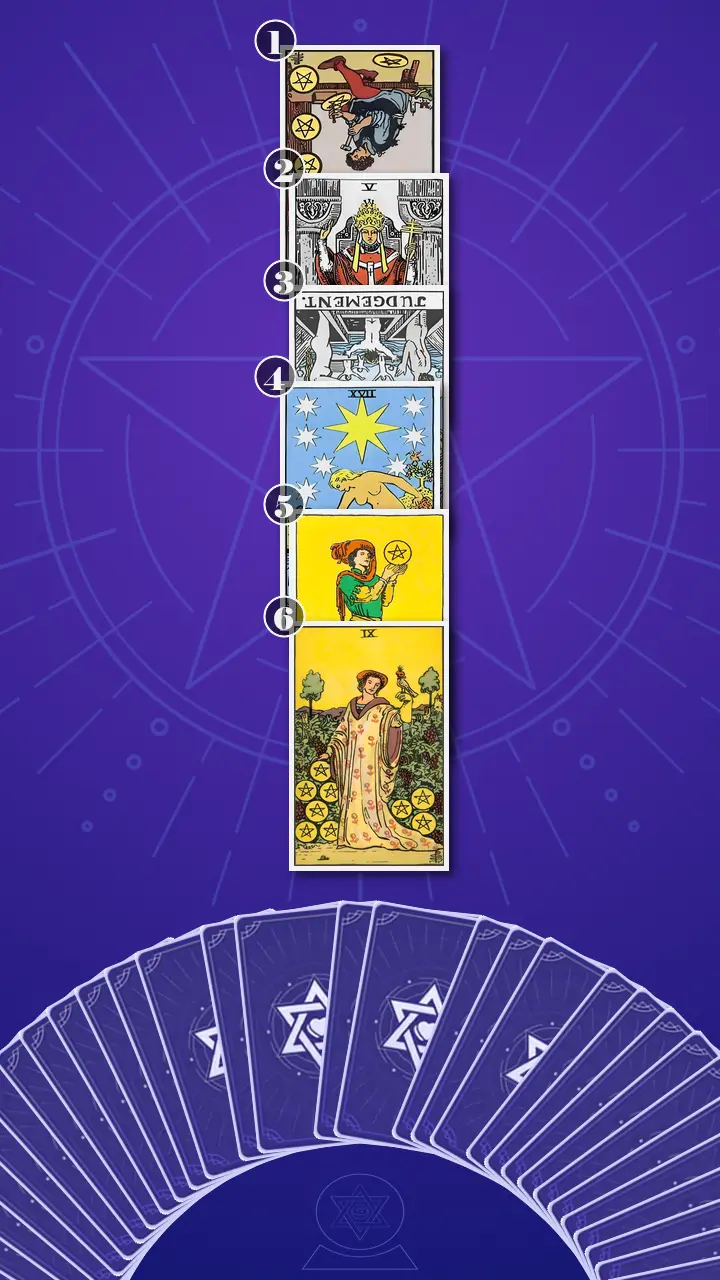
“Today I’m using a spread I designed for this exact kind of career crossroads,” I said. “It’s called the Four-Layer Insight Ladder · Context Edition—a six-card, linear tarot spread for career pressure and self-worth.”
For readers: I like this spread when someone isn’t missing information—they’re caught in an internal success script. A broader spread can scatter into external outcomes. This ladder stays tight: surface pattern → inherited rulebook → internalized judgment → key shift → one-week experiment → integration. It mirrors the real issue here: a public proof (the acceptance letter) becoming an internal courtroom… and then, if we’re lucky, becoming a private compass.
“The first card shows the exact habit you can observe this week,” I told Taylor. “The middle cards point to where the pressure learned its language. The turning-point card gives the reframe that restores breath. And the last two make it practical: what to do in the next seven days, and what ‘enough’ looks like when you own it.”
Reading the Map: When ‘Work’ Turns Into Proof
Position 1 — Surface pattern: what’s happening on your screen at 10:30 p.m.
“Now we’re turning over the card that represents your surface pattern—the specific, observable career behavior that shows how success pressure is playing out right now.”
Eight of Pentacles, reversed.
I nodded toward the image like it was a familiar app. “This is the craftsman’s bench turned into an endless revision loop. It’s 10:30 p.m. and you’re doing your fifth ‘tiny improvement’ pass on a PRD, a resume bullet, or a stakeholder email—not because it’s broken, but because done would force the scarier question: do you even want the path this work is building?”
In energy terms, this is Earth—work, skill, effort—blocked. Not absent. Not lazy. Blocked. The motion becomes repetitive and protective. Like a Jira board where “Done” is disabled, so everything stays in “In Review,” because shipping would invite feedback.
“Polishing is not the same as choosing,” I said, keeping my voice plain on purpose.
Taylor let out a short laugh that tasted like burnt coffee. “That’s… too accurate,” she said. “Like, almost rude.” Her shoulders lifted, then dropped, as if her body had been waiting for someone to name it without calling it a flaw.
Position 2 — Conditioning source: the inherited rulebook
“Now we’re turning over the card that represents the conditioning source—the inherited rulebook that defined what success should look like.”
The Hierophant, upright.
“Before you can feel good about a career move,” I said, “you run it through an invisible approval panel: How would it sound to your mom? A mentor? A future interviewer? If it doesn’t come with an easy stamp—brand name, title bump, credential—you treat it like it doesn’t count.”
The Hierophant’s energy is structured, sometimes supportive, sometimes constricting. It’s the part of us that learned, very early, what gets rewarded and what gets frowned at. And in my family’s work—what I call Generational Pattern Reading—this card often shows a love-language passed down as a scoreboard: pride expressed through what can be displayed.
Taylor’s mouth tightened, not in disagreement—more like recognition that stung. She gave a small, uneasy nod, eyes flicking away from the card as if it had read her group chat.
“You can’t build a life you like from a rubric you didn’t write,” I added quietly. “But you can notice when you’re still trying to ace it.”
Position 3 — Core fear/shadow: the inner tribunal
“Now we’re turning over the card that represents your core fear—the internalized verdict that keeps choices feeling high-stakes.”
Judgement, reversed.
“One ambiguous comment—‘good work, keep pushing’—hits,” I said, “and suddenly your career becomes a courtroom. You replay achievements like exhibits. You interrogate every choice. You delay committing unless the outcome guarantees applause, because ‘ordinary’ feels like being found out.”
This is fire-and-air energy trying to be a moral authority, but reversed it becomes overactive self-evaluation—verdict-thinking without an end date. In the nervous system, it looks like that tight chest and clenched jaw you described: your body bracing for the next downgrade.
Taylor went very still for a beat—breath shallow, fingers hovering near her water glass—then she exhaled sharply through her nose. “Oh,” she said. “That’s exactly what I do.”
When The Star Returned the Breath
Position 4 — Key shift: the reframe that dissolves the pressure
“We’re turning over the most important rung,” I said, and I felt the room quiet in that specific way it does right before someone hears themselves clearly. “This card represents the key shift—the perspective that restores self-trust.”
The Star, upright.
Setup: Taylor was living inside a familiar moment—late on a Sunday, LinkedIn glowing—rewording the same resume bullet for the fifth time because pressing “submit” felt like inviting a verdict on her whole life. Her mind kept asking for a final, defensible answer before she was allowed to move.
Stop living like your choices need the Hierophant’s stamp and a final Judgement; start following The Star’s quiet light—one replenishing step at a time.
I let the sentence hang there. In the window, a thin slice of night sky reflected back—small, dark, open. The Star is not a headline. It’s a horizon.
Reinforcement landed in her body before it landed in her logic: 1) her breathing paused for half a second, like she’d been caught; 2) her gaze softened and unfocused, as if replaying a dozen Sunday nights at once; 3) then her jaw loosened—actually loosened—and her shoulders sank a fraction. She blinked hard, not dramatic tears, just that sudden wetness that comes when you realize you’ve been holding yourself hostage.
“But… if I stop proving it,” she said, a flash of anger under the relief, “doesn’t that mean I’ve been doing it wrong this whole time?”
“No,” I answered, steady. “It means you were surviving inside a system that rewarded proof. The Star doesn’t shame the old strategy. It updates it. It says: you don’t need more proof to be worthy—you need a definition of success that gives you your breath back, and then one real step that matches it.”
I slid my notebook toward her. “Let’s do the 10-minute ‘Star Metric’ reset I use when someone’s nervous system is stuck in ‘trial mode.’ Open Notes and write three lines: (1) ‘A choice that would feel like an exhale this week is ___.’ (2) ‘A success metric only I can feel is ___—energy after work, learning pace, fewer 11 p.m. fixes.’ (3) ‘One tiny action that fits is ___.’ If your chest tightens, pause—no forcing. You’re collecting data, not proving a point.”
Then I asked her, exactly as I always do when The Star appears: “Now, with this new lens—restore first, then step—can you remember a moment last week when you reached for polishing, but what you really needed was an exhale?”
Taylor’s eyes darted up, then she gave a tiny, incredulous smile. “After that FaceTime,” she admitted. “I didn’t even want a new job. I just needed to feel… not at risk.”
And that was the shift in real time: from tight, performance-driven pressure and verdict-thinking to the first thread of grounded self-trust—small, but unmistakable.
Position 5 — One-week experiment: turning curiosity into something real
“Now we’re turning over the card that represents your one-week experiment—a concrete action that tests self-defined success in real life rather than in your head.”
Page of Pentacles, upright.
“Instead of a grand pivot announcement,” I said, “you run a small test: two informational chats, one tailored application, one mini portfolio sample. You treat results as data, not destiny.”
The Page’s energy is steady and beginner-minded. It doesn’t demand you ‘be sure.’ It only asks you to be sincere and specific. Taylor nodded fast—relief in the practicality.
“Okay,” she said. “I can do that this week. I can do data.”
“Good,” I replied. “Your next step doesn’t need to be impressive. It needs to be real.”
Position 6 — Integration: what ‘enough’ looks like when it’s yours
“Now we’re turning over the final card, the one that represents integration—what success looks like when it’s owned internally and lived sustainably.”
Nine of Pentacles, upright.
“This is quiet competence,” I said. “A calendar with breathing room. Rent on autopay without dread. A story you can tell without leading with credentials.”
In energy terms, this is Earth in balance: work that supports a life, not work that auditions for approval. Taylor’s face softened into something warm and almost longing—like she wanted to save the feeling the way her mom saved the letter.
The One-Week Curiosity Sprint: Actionable Advice Without the Courtroom
I leaned back and spoke the full thread out loud so it could feel like a single, coherent story: the Eight of Pentacles reversed showed her “always in edit mode” habit; the Hierophant named the inherited rulebook that made prestige feel like permission; Judgement reversed revealed the inner tribunal that turned every choice into a verdict; The Star offered a new logic—private replenishment and private metrics; and the Page and Nine of Pentacles brought it back to earth: small experiments now, calmer ownership later.
Her blind spot, the one hiding in plain sight, was this: she was treating external approval as a safety need, not as a nice-to-have. That’s why her body stayed braced. The transformation direction was equally simple, and not easy: move from proving-worth decisions to values-based micro-experiments that build self-trust through real feedback, not imagined judgment.
Here are the next steps I gave Taylor—small on purpose:
- The Two-Sentence “Good-Enough Verdict”In Notes, write: “This month I’m choosing ___.” + “In 60 days I’ll reassess using ___ (energy, learning, feedback, opportunities).” Keep it private—no manifesto, no debate.If your brain says it’s “not serious enough,” set a 12-minute timer and stop mid-sentence. Small tests bypass the inner courtroom.
- The Private Metrics Dashboard (Star Metric)Pin a list of 3 private success metrics at the top of your Notes app (e.g., fewer Sunday Scaries, more curiosity, cleaner boundaries). Check them on Wednesday night, not on LinkedIn.Repeat: “Private metrics are still metrics.” Your body is allowed to count.
- A Page-of-Pentacles Micro-ExperimentThis week: message 2 people for 15-minute informational chats in a direction you’re curious about (not necessarily prestigious) and submit 1 tailored application that matches interest, purely as data.No announcements. Treat it like a product test: hypothesis → smallest test → feedback loop.
And because my work is rooted in nature as much as in cards, I offered one extra tool from my own practice—gentle, fast, and oddly effective in NYC: a 3-minute family energy check. “When you feel the ‘acceptance letter’ pressure spike,” I told her, “water a plant—or if you don’t have one, stand by your sink and run water for ten seconds. Ask: am I thirsty for approval right now, or am I thirsty for rest?” The Star always answers with replenishment first.

A Week Later: Ownership, Not Certainty
Six days later, Taylor texted me a screenshot: a sent message to a woman she admired at a smaller, less brand-name company doing work Taylor actually cared about. Under it she wrote, “I didn’t overthink it. Three sentences. I hit send before my brain could open court.”
Her follow-up message was quieter: “I still woke up thinking, ‘What if this is a mistake?’ But I didn’t spiral. I made coffee, looked at my Notes metrics, and it felt… manageable.”
That’s the Journey to Clarity I trust most: not a lightning bolt of certainty, but the first honest exhale. A career isn’t a trophy case. It’s an experiment you’re allowed to iterate—until the life you’re building starts to feel like home in your body.
When success is something other people can display, every quiet desire starts to feel suspicious—and your body stays braced, like you’re always one decision away from being downgraded.
If you didn’t have to defend your next step as “impressive,” what’s one tiny experiment you’d let yourself try this week—just to see how it feels?