Keeping It 'Neutral' Was Still a Yes: Resetting My Weekends

The Friday Push Notification That Steals a Weekend
You open your phone on Friday afternoon and see family plans already added to the shared calendar—no text, no question—just your weekend getting booked, and your shoulders doing that instant “here we go” thing (Sunday Scaries, but make it family).
When Taylor said it to me on our call, they didn’t even sound dramatic. They sounded… practiced. Like they’d told this story to themselves so many times it had become a weather report.
They were curled into the corner of a small Toronto apartment couch at 8:47 p.m., laptop half-open like it was still trying to be “productive,” the blue phone-glow lighting their hands. The fridge had that steady hum that turns quiet into a kind of pressure. Street noise sifted in through a cracked window, and every time their phone buzzed, their shoulders twitched as if someone had tapped them on the collarbone.
“It’s the shared family calendar,” they said, thumb scrolling. “It started helpful. Now it’s like… my weekends are a public resource.”
When they showed me a screenshot—Sunday brunch dropped in at 11 a.m., no question mark, no “are you free?”—their chest rose high and stayed there. Their jaw held tension like a clamped lid. That particular mix of guilt and irritation sat on them like a heavy winter coat they couldn’t take off indoors.
“I love my family,” they added quickly, as if to preempt judgment. “But I hate feeling like my weekends aren’t mine. And if I say no, I feel selfish. Like I’m… opting out of belonging.”
I let that land. “You’re not wrong to want closeness,” I told them. “And you’re not wrong to want consent. Those two can exist in the same room.” I watched their shoulders drop a millimeter, like their body understood before their mind did. “Let’s try to turn this fog into a map. Not a lecture. A map—so you can find clarity and actual next steps the next time the calendar pings.”

Choosing the Compass: The Celtic Cross · Context Edition
I asked Taylor to take one slow breath—nothing mystical, just the kind of breath that tells your nervous system, we’re not in a group chat right now. While they did, I shuffled my well-worn deck on camera, the soft rasp of the cards steadying the moment like rain against a window.
“Today,” I said, “I want to use a spread called the Celtic Cross · Context Edition.”
For a question like ‘Why does my family assume I’m free every weekend—and how do I reset my role without drama?’ the Celtic Cross works beautifully because it doesn’t treat this as just scheduling. It shows the whole chain: the visible burden, the exact moment you freeze, the deeper family script underneath it, and then the most realistic communication shift—followed by the practical system that makes it stick.
I pointed to the structure as I laid the cards. “The center shows what your weekends look like right now and what blocks you in the moment you need to respond. The lower card touches the deeper role rule—what you were taught a ‘good’ person does. Then we move toward the near future: the cleanest boundary move available. And on the right-hand column, we’ll look at how you hold steady emotionally when guilt spikes, plus the family-calendar dynamics around you, and finally the outcome—your most supportive direction of growth if you make one consistent change.”
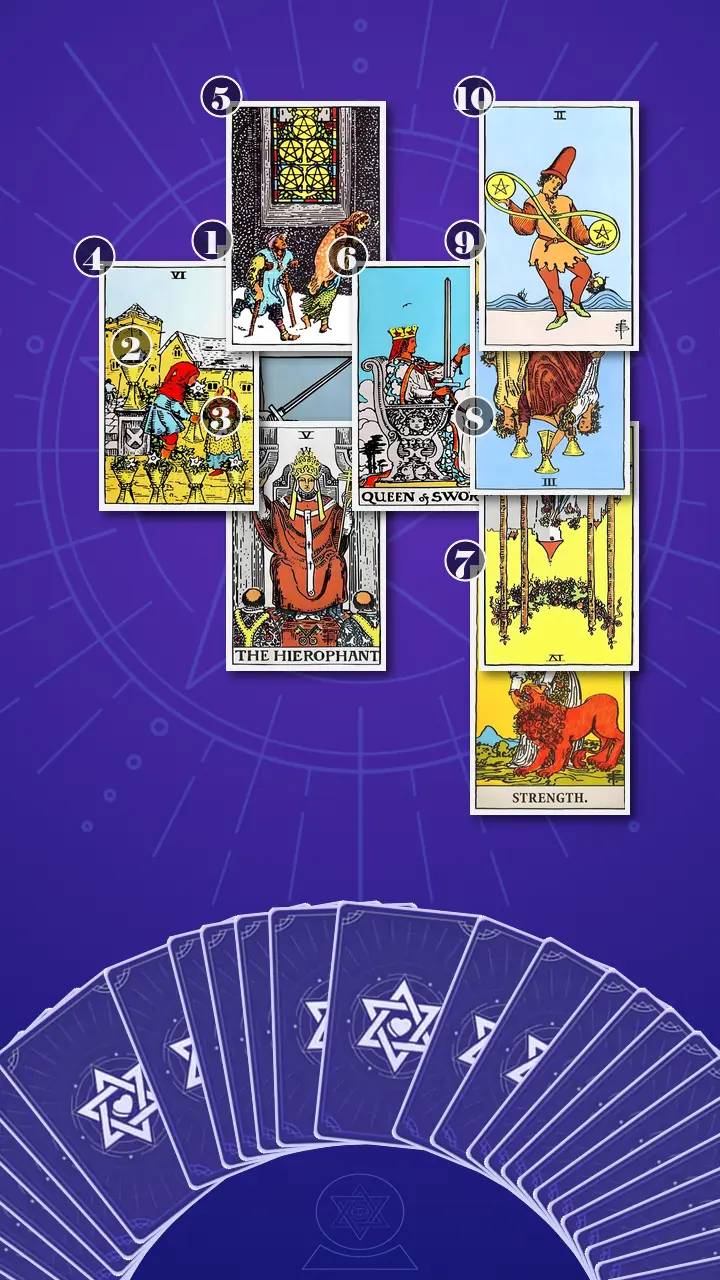
Reading the Map: From Burden to Belonging
Position 1: The Weight You’re Carrying (Ten of Wands, upright)
“Now flipping over,” I said, “is the card that represents what your weekends look like right now in observable behavior and felt load.”
Ten of Wands, upright.
In modern life, this is the Friday-afternoon moment: you close your laptop, you’re already tasting the two-day reset—and then you check the shared family calendar and realize it’s stacked. Brunch. A birthday. A quick “just stop by.” You can technically make it happen, but you’re doing it hunched over in the role of the dependable one, with zero space left to ask what you actually need.
Energy-wise, this card is Excess: too much responsibility being carried by one person, for too long, without renegotiation.
I traced the figure’s posture with my finger. “See how the wands block his vision? This isn’t just ‘busy.’ It’s that you can’t even see your own needs until after you’ve already committed. Your weekend becomes an overstuffed carry-on: you can lift it, but you can’t see where you’re going.”
Taylor gave a small, uncomfortable laugh—more air than sound. A three-step reaction moved through them like a ripple: first their breath paused (a tiny freeze), then their eyes unfocused as if replaying Thursday-night screenshots, and finally their shoulders sank with a quiet, defeated exhale.
“That’s… kind of brutal,” they said, with a grim little smile. “But yeah.”
“Brutal can be honest,” I said gently. “And honesty is how we start changing default settings.”
Position 2: The Exact Moment You Freeze (Two of Swords, upright)
“Now,” I said, “this card represents what specifically blocks you from resetting the role in the moment you need to respond.”
Two of Swords, upright.
This is the card of the blinking cursor. The half-written text. The blindfold that isn’t ignorance—it’s avoidance of the real cost. In modern life: you’re staring at the family group chat invite and you freeze, not because you don’t know what you want, but because either option has a social price tag. So you choose the third option: delay, soften, stay silent until the decision gets made for you… or you send the fastest “Sure.”
The energy here is Blockage. It’s not that you lack boundaries. It’s that you can’t access them at speed—right when the group chat needs an answer.
I described the scene I could almost feel in Taylor’s thumb: phone screen bright in a dark room, Slack finally quiet, and then that family message that reads like a plan but is actually a decision. “Two competing tabs open in your head,” I said. “One says: If I answer now, I lose my weekend. The other says: If I don’t answer now, I become A Problem. And the body hates ‘A Problem’ more than it hates being overbooked, so it reaches for the peacekeeping button.”
I used one of the phrases I’ve seen change lives precisely because it doesn’t shame: “A ‘neutral’ response is still a choice—and the system learns from it.”
Taylor’s mouth tightened, then softened. They nodded once, slow. “Yeah. I call it keeping the peace. But it’s… self-erasing.”
“Exactly,” I said. “And we’re not going to fix it with a heroic speech. We’re going to fix it with a new default.”
Position 3: The Rule You Didn’t Agree To (The Hierophant, upright)
“This next card,” I said, “represents the deeper family script or identity rule that keeps the default pattern running.”
The Hierophant, upright.
In real life, this is when the calendar stops being logistics and becomes a tradition machine. The invisible rule reads something like: A good family member shows up. A good family member doesn’t complicate plans. A good family member doesn’t make their needs the center. So you’re not just saying yes to brunch—you’re saying yes to the old definition of what earns approval.
The energy is Balance in the sense that it keeps the system stable—but it’s the kind of stability that can quietly cost one person their autonomy.
This is where my own lens—what I call Generational Pattern Reading—often matters. I’ve been the seventh-generation matriarch in my own line; I’ve watched how a family can “assign” a role the way a river assigns a path. Not with malice. With repetition.
“Taylor,” I said, “this looks like inherited choreography. Someone learned long ago that reliability keeps things warm. And then the family started moving around that reliability like it was furniture.”
Their eyes flicked up. “So… it’s not just me being weak?”
“It’s not weakness,” I said. “It’s a role that hasn’t been updated since you were smaller.”
Position 4: Where ‘Being Easy’ Once Felt Like Love (Six of Cups, upright)
“Now we’re looking at what past dynamics trained you into this role of being readily available,” I said.
Six of Cups, upright.
This card holds nostalgia with both hands. In modern terms: you can trace the “I’ll just go” reflex back to earlier versions of you—when being easy, helpful, and present kept things warm and stable. That role used to feel like love. Now, it sometimes feels like the price of admission.
The energy here is Balance tipping into Habit. The sweetness is real—but sweetness can harden into expectation when no one ever renegotiates.
Taylor swallowed. “I used to get praised for being ‘low maintenance.’ Like, ‘Taylor’s always down.’ It’s embarrassing how much that still gets me.”
“It makes sense,” I said. “Praise is a kind of weather. Your nervous system remembers where warmth came from.”
Position 5: The Fear Under the Calendar (Five of Pentacles, upright)
“This card,” I said, “represents the fear or belief you’re most aware of when you consider saying no.”
Five of Pentacles, upright.
In modern life, the calendar isn’t what scares you. What scares you is the imagined emotional winter: people bonding without you, your name not mentioned, your absence “noted.” So you pay with your time to avoid that excluded feeling.
The energy here is Deficiency: a shortage of felt belonging—specifically, belonging that can survive your boundaries.
I pointed to the warm window in the image. “This is the ‘warm circle’ you fear losing,” I said. “It’s why a simple ‘no’ doesn’t feel like a schedule choice. It feels like risking your place.”
Taylor’s throat moved like they were trying to push down a lump. “Yeah,” they said, quieter. “Like I’ll be the difficult one.”
“And yet,” I said, “if closeness is real, why does it need automatic access to your time?”
Position 6: The Policy Update (Queen of Swords, upright)
“Now we’re at the next realistic shift available through communication or a boundary move,” I said.
Queen of Swords, upright.
This is the moment you stop writing essays. You send one clean sentence: “I’m keeping Saturdays unbooked for myself going forward—please ask before adding anything.” And then you don’t stack three explanations underneath it. You let the clarity stand there, like an updated rule, not a debate invitation.
The energy is Balance: firm and fair. Not cold. Not apologetic. Just clear.
I framed it the way I know young professionals instantly understand: “This is like switching from a messy Slack thread to a one-line policy. You’re not trying to ‘win’ a conversation. You’re setting an RSVP flow.”
Taylor’s face changed—visible relief, like someone had opened a window in a stuffy room. They actually reached for their phone and started typing, not a paragraph, but a single line in Notes.
“One sentence. No debate. Repeat as needed,” I said softly.
When Strength Put a Hand on the Lion
Position 7: The Way You Hold the Line (Strength, upright — Key Card)
When I turned over the next card, the room on my end went unusually quiet—no heater click, no shuffle sound—just that thin, attentive silence that comes right before something important.
“This,” I said, “is the card that represents how you can hold your boundary emotionally, without collapsing into guilt or snapping into anger.”
Strength, upright.
And I could feel Taylor’s Thursday-night moment hovering in the space between us: you open the shared calendar, see another brunch added, and your shoulders jump like you just got assigned homework. You’re not battling the event. You’re battling the spike in your body—the guilt, the pressure, the old script that says make it easy.
Stop proving you’re ‘easy to book’ and start practicing steady, gentle firmness, like Strength’s calm hand on the lion instead of wrestling it.
I let it sit there, like a stone placed carefully on a path.
Then I watched Taylor’s reaction unfold in layers. First: their eyes widened, just slightly, as if they’d been caught in a familiar loop and someone had finally named the mechanism. Second: their hands—tight around their mug—loosened, fingers uncurling one by one. Third: a quiet exhale that sounded like surrender, but wasn’t. It sounded like relief.
“But if I’m calm,” they said, and a flash of resistance rose up, “does that mean I’m just… letting them get away with it? Like I’m the one who has to do all the work?”
I nodded. “That’s the exact fear. That being steady equals being a doormat. But Strength isn’t compliance. Strength is tone control. It’s choosing not to turn your boundary into a courtroom drama because you’re afraid they’ll reject you.”
Here’s the heart of it: in my Generational Pattern Reading, I often see one person in a family cast as the adapter. The one who makes everything smoother. The one whose flexibility becomes the family’s hidden infrastructure. Strength is how that person stops being infrastructure and starts being a person—without turning cold.
“Make guilt the lion,” I said. “It gets loud the second you set a boundary. It paces. It roars. It tells you you’re selfish. But you don’t have to fight it and you don’t have to feed it.”
I used the line I keep for moments like this because it’s practical, not poetic: “Guilt can be in the room. It doesn’t get to run the meeting.”
Taylor’s face softened, then their eyes went shiny. Not tears spilling—just that near-tear brightness when someone recognizes themselves without being blamed. “I always thought boundaries had to be… intense,” they whispered. “Like I’d have to be mad enough to do it.”
“Strength says the opposite,” I replied. “You reset the role by being consistent, not convincing. And that consistency is gentle on purpose—because it’s repeatable.”
I leaned in. “Now, with this new lens—think back to last week. Was there a moment you could have said, ‘Let me check and get back to you,’ and your body would have survived it?”
They stared up at the ceiling for a beat, eyes tracking memory. Then: “Friday. 4:42. I closed Slack and the message came in. I said ‘Sure’ in five seconds.” Their voice cracked on the last word, half laugh, half grief. “I could have bought myself time.”
“That’s the shift,” I said. “From guilt-driven compliance to calm self-trust. Not overnight. But one boundary held once is a new piece of evidence.”
Before we moved on, I gave them a small, embodied practice—because Strength isn’t an idea; it’s a nervous system skill. “A ten-minute Boundary Rehearsal,” I said. “Open Notes. Write one single-sentence boundary—no reasons, no backstory. Set a timer for two minutes and read it out loud five times in a neutral voice. Then set another timer for eight minutes and draft one follow-up line for pushback: ‘I hear you. That doesn’t work for me this weekend.’ If your chest tightens, pause. Hand on sternum. Three slow breaths. Stop. The goal isn’t to force yourself. It’s to make the words survivable in your body.”
Position 8: The ‘Celebration’ That Feels Like a Checkpoint (Four of Wands, reversed)
“Now,” I said, “we’re looking at family calendar dynamics and unspoken expectations shaping your options—context, not destiny.”
Four of Wands, reversed.
This is the garland of “family fun” hung a little too tightly over the doorway. It looks welcoming. But when it’s reversed, it can feel like an entryway you’re pushed through rather than invited into.
The energy here is Instability—not because your family is evil, but because the structure is wobbly: celebrations without consent become obligations in disguise.
Through my Home Energy Diagnosis lens, I think of thresholds. A doorway is meant to separate “outside” from “inside.” The shared calendar is your family’s doorway. Right now, it doesn’t have a door. It’s an open archway anyone can walk through with an event and drop it into your life.
“This is why a request-only rule matters,” I said. “Not to create distance. To make the doorway real.”
Position 9: The Group Chat After You Say No (Three of Cups, reversed)
“This card represents what you secretly hope will happen and what you fear will happen if you change the pattern,” I said.
Three of Cups, reversed.
In modern terms, this is the dread of watching the inside jokes keep going without you. The fear that you’ll decline once and suddenly the vibe shifts. That you’ll become the “not a team player” in the family’s emotional group chat.
The energy is Blockage again—not a lack of love, but a clog in the belonging story: Do I belong because I’m present, or because I’m real?
I brought back the warm-window metaphor: “You’re afraid that if you’re not physically there, you’ll be emotionally outside. So you keep checking the chat, rereading neutral replies like they’re coded messages.”
Taylor nodded, almost embarrassed. “After I even think about saying no, I check the chat like… twenty times.”
“That’s not pettiness,” I said. “That’s a nervous system seeking reassurance. Strength teaches you to tolerate that discomfort long enough for the system to update.”
Position 10: The Sustainable Rhythm (Two of Pentacles, upright)
“Finally,” I said, “this card shows the most supportive direction of growth if you implement one boundary and one scheduling rule consistently.”
Two of Pentacles, upright.
This is the outcome I like best for boundary work: not a fantasy where nobody ever asks anything of you, but a rhythm that can handle real life. The infinity loop around the coins is the recurring weekend. The ships in the background are the waves of changing demands. The lesson is simple and quietly radical: you treat your weekend like a budget, not an open tab.
The energy here is Balance as Practice. Not a one-time confrontation. A template you can repeat.
“This,” I told Taylor, “is you creating a simple rule: one family commitment max per weekend, with the rest decided based on energy and priorities—not guilt. Your family still has access to you, but not automatic access to your time.”
A Weekend Budget, Not a Moral Referendum
I leaned back and let the spread speak as one story instead of ten separate messages.
“Here’s what I see,” I said. “Right now you’re in Ten of Wands mode—carrying weekends like unpaid project management. Two of Swords shows the snap-freeze moment where you avoid discomfort and default to yes. The Hierophant and Six of Cups explain why: you learned an old rule that being ‘easy’ equals being loved, and it used to work. But Five of Pentacles and Three of Cups reversed reveal the hidden engine: the fear of being outside the warm circle. Queen of Swords is the turning point—one sentence, policy-level clarity. Strength is your bridge—soft voice, firm boundary. And Two of Pentacles makes it sustainable: a weekend template that stops every invite from becoming a weekly moral referendum.”
Then I named the blind spot, because clarity usually arrives with one clean truth: “Your cognitive blind spot is that you’ve been treating their expectation as more urgent than your consent. So you keep trying to feel ‘ready’ to set boundaries, when the real change is a default behavior update.”
“The key shift,” I reminded them, “is moving from automatic yes to: ‘Let me check and get back to you’—and proactively blocking one non-negotiable personal anchor on your weekend calendar first.”
I offered Taylor a small set of actions—specific enough to do, boring enough to repeat, kind enough to keep connection intact.
- Install the “Let-Me-Check” DefaultNext time a family invite lands (group chat or calendar), do not answer “Sure” on impulse. Reply: “Let me check and get back to you by tonight.” Even if you already know the answer.If guilt spikes, treat it as a cue to shorten your message, not lengthen it. Copy/paste beats courage in the moment.
- Save One “Weekend Boundary” SentenceCreate a text shortcut named “Weekend Boundary.” Use one sentence like: “I’m keeping Saturday mornings unbooked going forward—please ask before adding anything.” Send it once, then stop.One sentence. No debate. Repeat as needed. Over-explaining turns your boundary into more labor and invites negotiation.
- Protect One Anchor + Run a No-Recheck TimerBlock one non-negotiable personal anchor on your weekend calendar (e.g., Sat 10 a.m.–2 p.m. “Reset Time”). After you send a boundary text, set a 20-minute “no re-check” timer so you don’t spiral in the group chat.Use my 3-minute family energy check: before replying, glance at a houseplant. Is it reaching for light or cramped against a window? Let it remind you: growth needs space. Then do one full exhale and reply.
Taylor looked down at their calendar again, but their shoulders didn’t jump this time. “So I’m not trying to get them to agree,” they said slowly. “I’m just… updating what’s true.”
“Yes,” I said. “You don’t reset your family role by winning the argument—you reset it by calmly repeating the same boundary until it becomes boring.”

A Week Later: Ownership, Not Certainty
A week later, Taylor messaged me. Not a paragraph. Not a spiral. A screenshot: their calendar with a repeating block called Unbooked and another called Reset Time. Under it: “They added brunch. I said ‘Let me check.’ Then I said no. I didn’t die.”
Clear but still human: they told me they slept a full night… and woke up with the first thought, What if they’re annoyed? Then they caught themselves, smiled once, and made coffee anyway.
That’s what I mean by a Journey to Clarity. Not certainty. Ownership. A weekend that’s no longer a public resource—especially not by default.
And if you’re reading this with that familiar tightness in your shoulders—because your own weekend gets booked like a public resource—remember: saying no doesn’t feel like a schedule choice when it’s tangled up with belonging. It feels like risking your place in the warm circle.
So let me turn it toward you: If you didn’t have to prove you belong with constant availability, what’s one small piece of your weekend you’d protect first—just to see what it changes in you?